What is the function and physiology of aqueous humour?
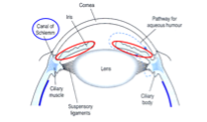
BLUE ARROW: Aqueous humour is produced by the capillaries of the ciliary body into the posterior chamber, behind the lens, and diffuses forward into the anterior chamber and then the cornea (supplying oxygen and nutrients because they have no blood supply). Aqueous humour then drains through the trabecular network which allows drainage into the canals of Schlemm back into the venous system. The hyperosmolarity in this area produces continuous water flow from the ciliary body into the anterior chamber.
What is glaucoma?
Optic neuropathy with field defect usually associated with ocular hypertension. Defined as intraocular pressure (IOP) above 21 mmHg.
What is the aetiology of glaucoma? (x3 (x3 and x4))
- PRIMARY: acute closed-angle glaucoma (ACAG), primary opened-angle glaucoma (POAG), chronic closed-angle glaucoma
- SECONDARY: trauma, uveitis, steroids, rubeosis iridis (diabetes and central retinal vein occlusion)
- CONGENITAL: buphthalmos (enlarged eye)
What are the risk factors of glaucoma? (x2)
Family history and black ethnicity.
What is the pathophysiology of glaucoma?
Decreased outflow of aqueous humour leads to ocular hypertension. Ocular hypertension compresses and stretches the retinal nerve fibres leaving the optic disc causing scotomas and visual field loss (damage to retinal ganglion cells leading to decreased visual acuity or visual loss respectively)
What is a scotoma?
A scotoma is an area of partial alteration in the field of vision consisting of a partially diminished or entirely degenerated visual acuity that is surrounded by a field of normal – or relatively well-preserved – vision. Every normal mammalian eye has a scotoma in its field of vision, usually termed its blind spot.
What is the pathophysiology of decreased outflow of aqueous humour? (x3)
- Obstruction to outflow by approximation of iris to cornea, closing iridocorneal angle and trabecular meshwork/canal of Schlemm, causing a rapid and severe rise in IOP (ACAG)
- Resistance to outflow through trabecular meshwork through unknown mechanism (POAG – note that opened-angle implies that the angle is normal)
- Blockage of trabecular meshwork by blood or inflammatory cells
What is the epidemiology of glaucoma: Age? Common? Most common type? Ethnicity?
Increasing incidence with age. Second most common cause of blindness in the world. POAG is most common. POAG is three-fold more common in black population compared to non-Hispanic white.
What are the signs and symptoms of POAG? (x2)
- Usually asymptomatic
- Peripheral visual field loss and scotoma (more peripheral and becomes tunnel vision in later stages)
- Enlarged cup-to-disc ratio
What are the signs and symptoms of ACAG? (x7)
- Painful red eye
- Peripheral visual field loss and scotoma (more peripheral and becomes tunnel vision in later stages)
- Haloes around lights is characteristic
- Hazy cornea from corneal oedema
- Fixed and dilated pupil
- Nausea and vomiting
- Enlarged cup-to-disc ratio
What are the investigations for glaucoma? (x5)
- GOLDMANN APPLANATION TONOMETRY: measure ocular pressure; POAD 22-40 mmHg, ACAG greater than 60 mmHg
- PACHYMETRY: ultrasound to measure central corneal thickness. Less than 590 mm are at higher risk of developing glaucoma
- FUNDOSCOPY: detect cupped optic disc and asymmetry, and exclude other causes of visual field loss such as retinal detachment
- GENIOSCOPY: assess iridocorneal angle
- PEIMETRY (visual field testing): for scotoma (arcuate scotoma is early sign) and tunnel vision (late sign)




