What is a force field
An area in which an object experiences a non-contact force
How are force fields represented
- Vectors
- Diagrams containing field lines, the distance between field lines represents the strength of the force exerted by the field in that region
How are force fields formed
- Gravitational fields - formed during the interaction of masses
- Electric fields - formed during the interaction of charges
What are the similarities and differences between gravitational fields and electric fields
Similarities -
- Forces both follow an inverse-square law
- Use field lines to be represented
- Both have equipotential surfaces
Differences -
- In gravitational fields, the force exerted is always attractive, while in electric fields the force can be either repulsive or attractive
- Electric force acts on charge, while gravitational force acts on mass
What is gravity
The universal attractive force which acts between all matter and is always attractive
What is Newton’s law of Gravitation (The Inverse Square Law)
Newton’s Law of Gravitation assumes that the gravitational force between two masses is:
- Always an attractive force
- Directly proportional to the product of the masses
- Inversely proportional to the sqaure of the distance between them
What is the Equation for Gravitational Force
F = G x M1 x M2 / r2
Gravitational Force = Gravitational Constant x Mass 1 x Mass 2 / Distance2
What are the two types of gravitational field
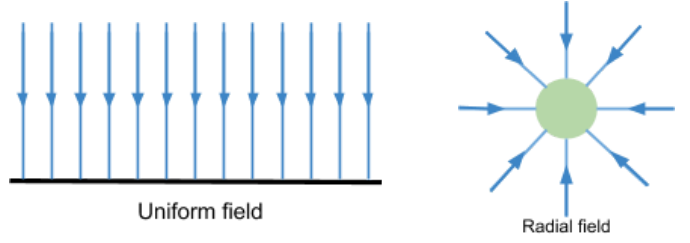
- Uniform fields - exerts the same gravitational force on a mass everywhere in the field (shown by the parallel and equally spaced field lines)
- Radial fields – the force excreted depends on the position of the object in the field ( as an object moves further away from the center, the magnitude of force would decrease because the distance between field lines decreases)
What is gravitational field strength (g)
The force per unit mass exerted by a gravitational field on an object
What are the equations for gravitational field strength
g = F / m
Gravitatioanl Field Strength = Force / Mass
or
g = GM / r2 (For radial fields only)
Gravitational Field Strength = Gravitational Constant x Mass / Distance2
What is Gravitational Potential
The work done per unit mass when moving an object from infinity to that point
Why is Gravitational Potential always negative
- Gravitational potential at infinity is zero
- As an object moves from infinity to a point, energy is released as the gravitational potential energy is reduced
- Therefore gravitational potential is always negative
What is the Equation for Gravitational Potential
V = − GM / r (For a radial field)
Gravitational Potential = - Gravitational Constant x Mass / Distance
What is the Equation for Work Done
Work done = mΔV
Work Done = Mass x Graviational Potential
What is an Equipotential Surface
- A surface where the potential is constant everywhere
- As these points all have equal potential, the gravitational potential difference is zero when moving along the surface, so no work is done when moving along an equipotential surface
Describe a graph of Gravitational Potential against Distance
Gravitational potential is inversely proportional to the distance between the centres of the two objects
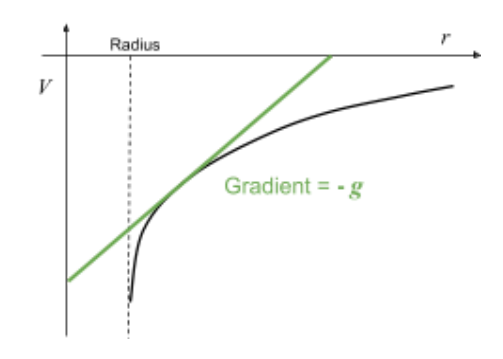
Describe the graph of Gravitational Field Strength against Distance
You can find the gravitational potential difference by finding the area under the curve.
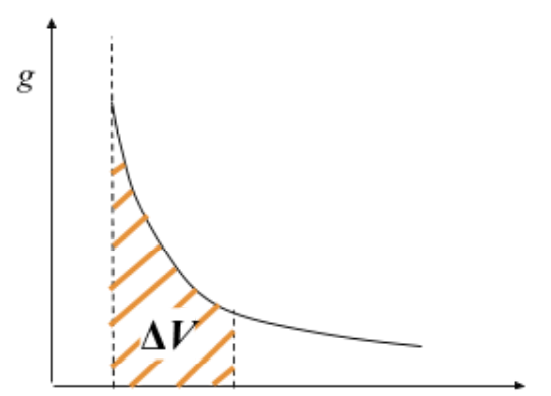
What is Kepler’s Third Law
The square of the orbital period (T)of an object is directly proportional to the cube of its radius (r)
T2 ∝ r3
What is the escape velocity of an object
- The minimum velocity it must travel at, in order to escape the gravitational field at the surface of a mass
- This is the velocity at which the object’s kinetic energy is equal to the magnitude of its gravitational potential energy
- GMm/r = 1/2mv2
State two reasons why rockets launched from the Earth’s surface do not need to achieve escape velocity to reach their orbit
Energy is continually added in flight through fuel and less energy is needed to achieve orbit than to escape from the Earth’s gravitational field
How do you calculate the total energy of an orbiting satellite
Kinetic Energy + Potential Energy
What is represented by gravitational field lines
Gravitational Field lines show the direction of force on a mass
What is a Synchronous Orbit
Where the orbital period of the satellite is equal to the rotational period of the object that it is orbiting
What is a Geostationary satellite
A satellite that has an orbital period of 24 hours so they always stay above the same point on the Earth (the equator)



