Briefly, describe the structure of haemoglobin.
- Haemoglobin is a globular haemoprotein, making up about 1/3 of the RBC. (haemoproteins are a group of specialised proteins that contain haem as a tightly bound prosthetic group).
- It consists of 2 α and 2 β chains, each holding its own haem molecule.
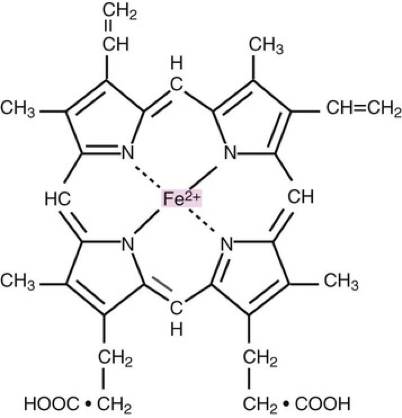
- Haem is a complex of protoporphyrin IX and ferrous iron (Fe2+).
- Iron is held in the centre of the haem molecule by bonds to the four nitrogens of the porphyrin ring.
- 65% of the haemoglobin in RBCs is synthesised at the erythroblast stage, and 35% at the reticulocyte stage.
How is haemoglobin synthesis regulated?
- It is stimulated by tissue hypoxia (when it isn’t getting an adequate supply of oxygen).
- The hypoxia causes the kidneys to increase the production of Erythropoietin (EPO), which increases RBC and Hb production.
Erythropoietin meaning - A glycoprotein hormone that regulates the production of red blood cells in the bone marrow in response to the low levels of oxygen in tissues.
Where does haem synthesis occur?
Haem synthesis occurs largely in the mitochondria.
Describe the chain of events that leads to haem production / synthesis.
- IRON DELIVERY AND SUPPLY:
- Iron is delivered to the reticulocyte by transferrin.
- SYNTHESIS OF PROTOPORPHYRINS:
- This occurs in the mitochondria of RBC precursors.
- It is mediated by EPO (erythropoietin) and Vit B6.
- This is done to create Protoporphyrin IX.
- COMBINING TO MAKE HAEM:
- Protoporphyrin IX and iron combine to make a haem molecule.
- Later, the haem can combine with globin to form haemoglobin.
Where does globin synthesis take place?
- Globin synthesis occurs in the polyribosomes.
Polyribosome meaning - a cluster of ribosomes linked together by a molecule of messenger RNA and forming the site of protein synthesis. — called also polysome.
Briefly, describe haemoglobin synthesis.
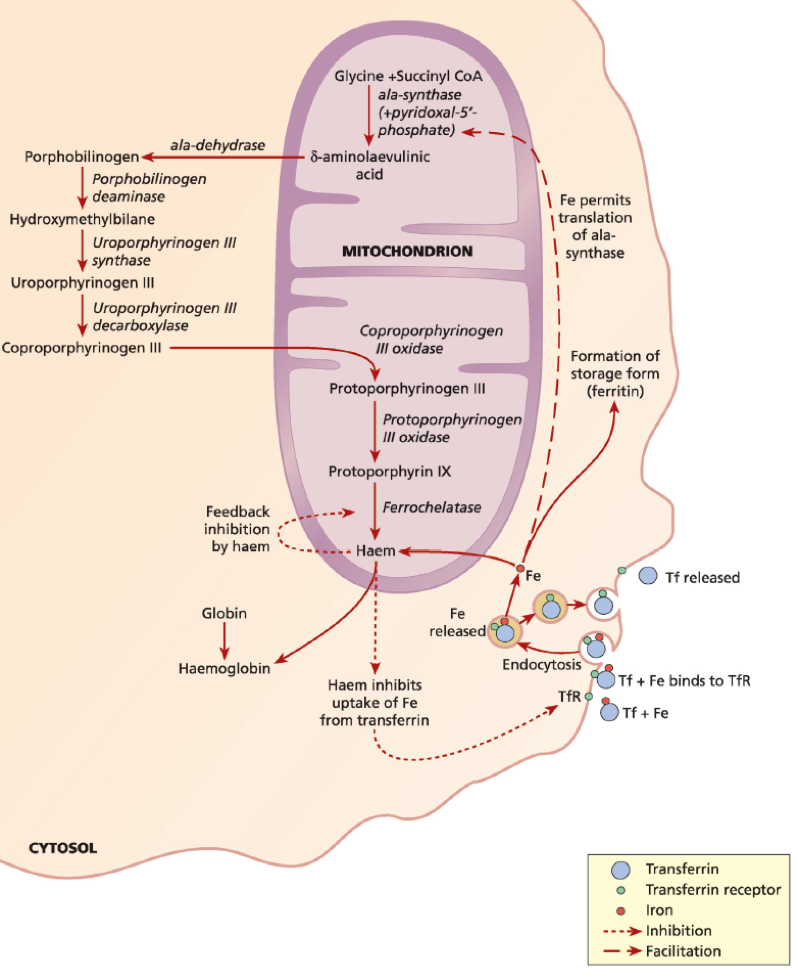
- Heme is synthesized in a complex series of steps involving enzymes in the mitochondrion and in the cytosol of the cell.
- The first step in heme synthesis takes place in the mitochondrion, with the condensation of succinyl CoA and glycine by ALA synthase to form 5-aminolevulic acid (ALA).
- This molecule is transported to the cytosol where a series of reactions produce a ring structure called coproporphyrinogen III.
- This molecule returns to the mitochondrion where an addition reaction produces protoporhyrin IX.
- The enzyme ferrochelatase inserts iron into the ring structure of protoporphyrin IX to produce heme.
Various types of globin combine with haem to form different haemoglobin. Expand (include listing the different haemoglobin during different times of human growth).
There are eight functional globin chains, arranged in two clusters:-
- B-CLUSTER (β, γ, δ and ε globin genes) on the short arm of chromosome 11
- A-CLUSTER (α and ζ globin genes) on the short arm of chromosome 16
The functional haemoglobin in humans at different times of growth are:
- EMBRYONIC: -
- Gower I (ζ2 ε2)
- Portland (ζ2 γ2)
- Grower II (α2 ε2)
- FOETAL: -
- HbF (α2 γ2)
- ADULT: -
- HbA (α2 β2)
- HbA2 (α2 δ2)
- HbF
ζ meaning - Zeta
What makes up adult haemoglobin (including their percentages)?
- It is made up of HbA, HbA2 and HbF.
- About 96-98% of the haemoglobin is HbA, with HbA2 at 1.5-3.2% and HbF at 0.5-0.8%.
What could happen to the synthesis of globin chains if mutations occur?
- Mutations or deletions may lead to: -
- Abnormal synthesis of globin chains (eg. Sickle Cell Disease)
- Reduced rate of synthesis of normal α or β-globin chains (eg. Thalassaemias)
List the functions of haemoglobin.
- To carry oxygen from the lungs to the tissues.
- To remove CO2.
- Buffering action (maintains blood pH as it changes from oxyhaemoglobin to deoxyhaemoglobin).
Describe the oxygen delivery to the tissues.
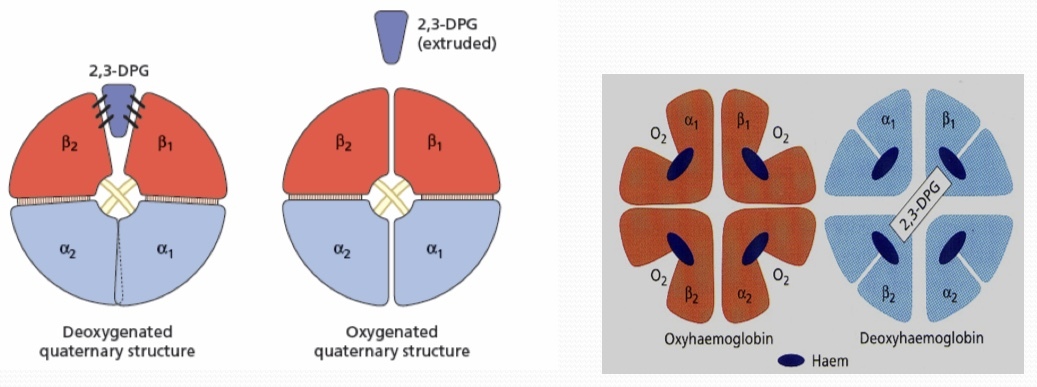
- One Hb molecule can bind to 4 O2 molecules.
- When oxygenated, 2,3-DPG (diphosphoglycerate) is pushed out; the β-chains move closer.
- β-chains are pulled apart when O2 is unloaded, permitting entry of 2,3-DPG resulting in lower affinity of O2.
2,3-DPG - is a substance made in the red blood cells. It controls the movement of oxygen from red blood cells to body tissues.
What does O2 binding to haemoglobin depends on?
The amount of O2 bound to haemoglobin and released to tissues depends on:
- PO<strong>2</strong> - partial pressure of oxygen.
- PCO2 - partial pressure of carbondioxide.
- Affinity of haemoglobin for O2 - Oxygen affinity is the ease with which haemoglobin binds and releases oxygen.
Describe oxygen affinity.
- It determines the proportion of O2 released to the tissues or loaded onto the cell at a given oxygen pressure.
- Increases in oxygen affinity mean that haemoglobin has an increased affinity for O2, so it can bind more and strongly.
- Decreases in oxygen affinity causes O2 to be released.
What is the oxygen dissociation curve?
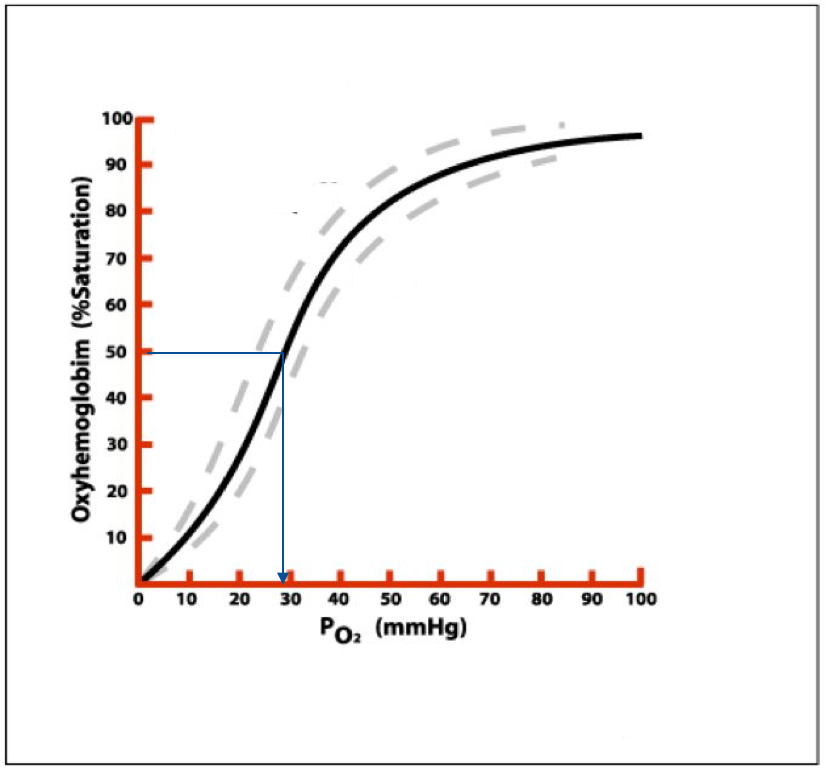
- The oxyhaemoglobin dissociation curve relates oxygen saturation (SO2) and partial pressure of oxygen in the blood (PO2), and is determined by what is called “haemoglobin affinity for oxygen”; that is, how readily haemoglobin acquires and releases oxygen molecules into the fluid that surrounds it.
- The P50 is the oxygen tension at which haemoglobin is 50% saturated.
What is the Bohr effect?
- It states that haemoglobin’s oxygen binding affinity is inversely related both to acidity and to the concentration of carbon dioxide.
- This means that, in acidic pH, the curve shifts to the right; this results in an enhanced capacity to release O2 where it is needed.
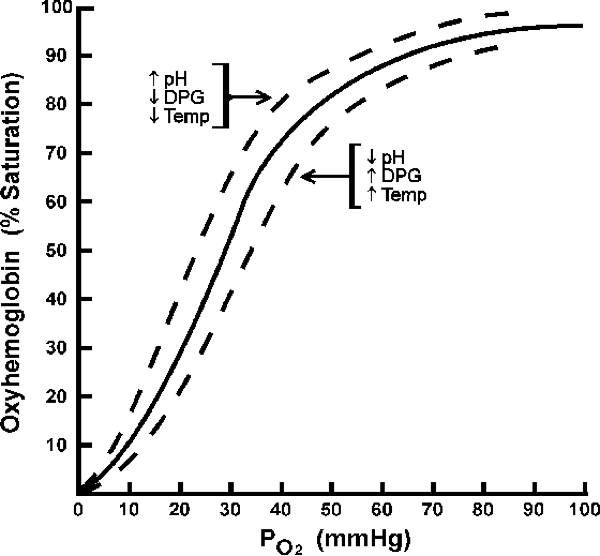
Describe what happens during the right shift of an oxygen dissociation curve.
- Increased P50
- Decreased affinity to O2
- Hb more willing to release O2 to tissue
- Examples of situations where this happens would be acidosis and anaemia (even though we may have a lowered number of RBCs, they act more efficiently to deliver O2 to the target).
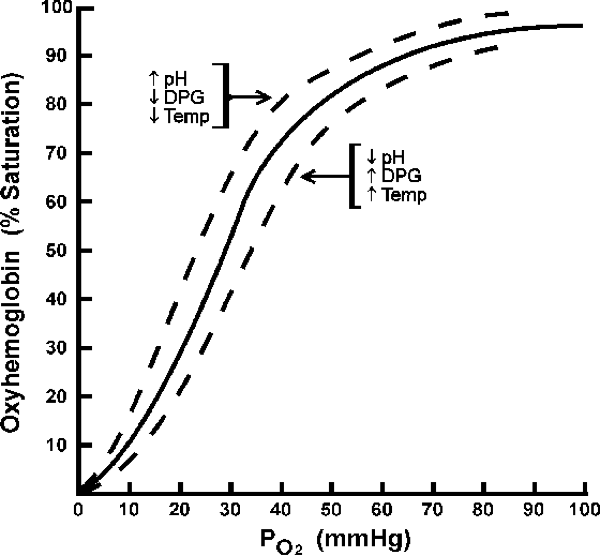
Describe what happens during the left shift of an oxygen dissociation curve.
- Decreased P50
- Increased affinity to O2
- Hb less willing to release O2 to tissue
- Examples of situations where this happens would be alkalosis and the presence of abnormal haemoglobins.
What does the normal position of the curve depend on?
- The concentration of 2,3-DPG
- H+ ion concentration (pH)
- CO2 in RBCs
- The structure of haemoglobin
The standard conditions are: -
- TEMP: 37ºC
- pH: 7.4
- BASE EXCESS (BE): 0
(Base excess and base deficit refer to an excess or deficit, respectively, in the amount of base present in the blood.)
What are the three mechanisms for carbon dioxide transport?
- Dissolution in plasma
- Formation of carbonic acid
- Binding to carbaminohemoglobin
Carbaminohemoglobin meaning - a compound made up of hemoglobin and carbon dioxide; one of the forms in which carbon dioxide exists in the blood.

-
Introduction to the structure and function of blood56
-
introduction to cellular pathology25
-
Origins of blood cells32
-
Introduction to the immune system24
-
Innate immunity17
-
Phagocytosis18
-
Introduction to the lymphatic system15
-
Adaptive immune system - T cells19
-
Adaptive immune system - B cells18
-
Infectious agents14
-
Essentials of virology I18
-
The Red Blood Cell Structure and Function22
-
Haemoglobin Structure and Function19



