Q: Describe the transfer of forces in the hip.
From sacrum to pelvis to femur
Diagram: Articular Structures of the Hip (2)
Labrum, and synovial fluid act like shock absorber
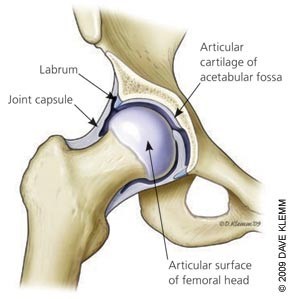
Diagram: Ligament Structures of the Hip
Iliofemoral ligament = one of strongest in the body (with the help of the labrum)
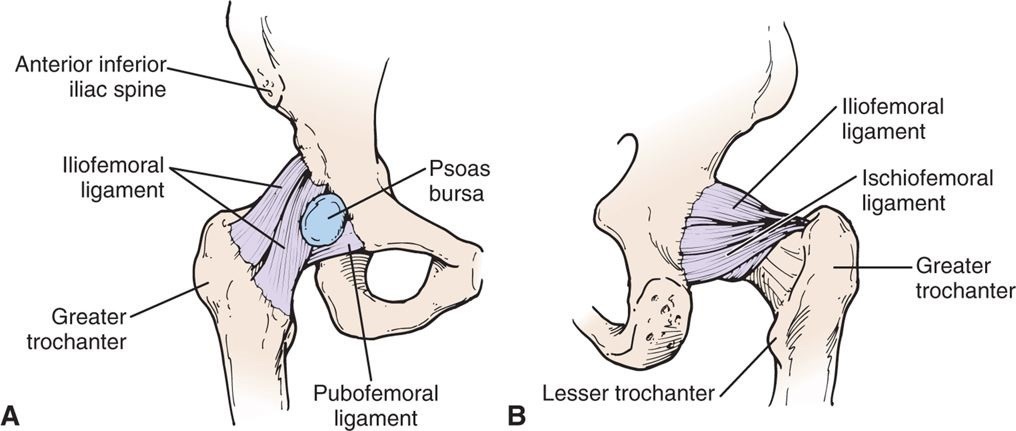
Diagram: Posterior Musculature of the Hip (6)
Large muscles used for movement (walking)
Deep muscles:
- mimic RC
- hold you in extension to keep femoral head in socket
- Can cause a posterior tilt
- ER that act as extensors when contract together
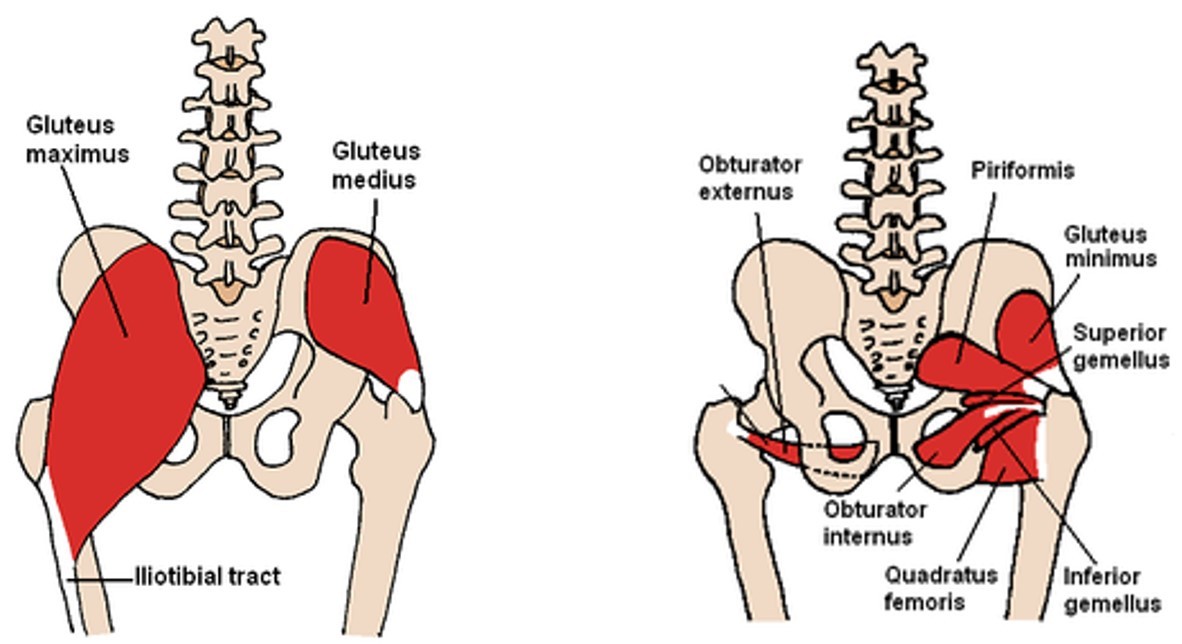
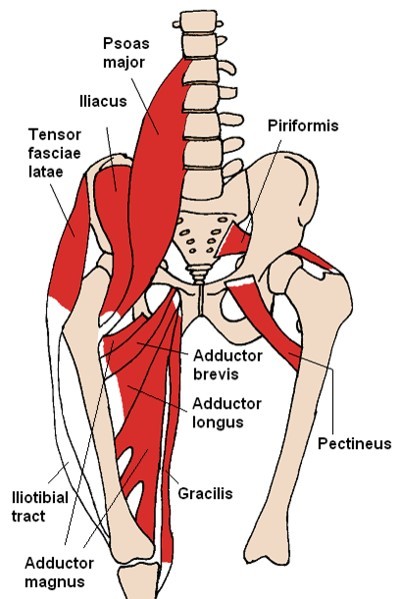
Diagram: Anterior Musculature of the Hip (2)
All the adductors (which also do IR)
Constantly contracted, can effect posture - anterior tilt
Q: Which set of muscule balance the hip?
ER and IR
Content: External Rotators (6)
- Piriformis (< 60 degrees)
- Superior/inferior gemellus
- Obturator internus/externus
- Quadratus femoris
- Gluteus maximus
- Gluteus medius/minimus (flexed)
Q: Which ER might become tight and then weak and cause posterior tilt? (5)
- Superior gemellus
- Obturator internus
- Inferior gemellus
- Obturator externus
- Quadratus femoris
Content: Internal Rotators (8)
- Piriformis (at 90)
- Semitendinosus
- Semimembranosus
- Adductors
- Pectineus
- Tensor fasica latae
- Gluteus medius (extended)
- Gluteus minimus (extended)
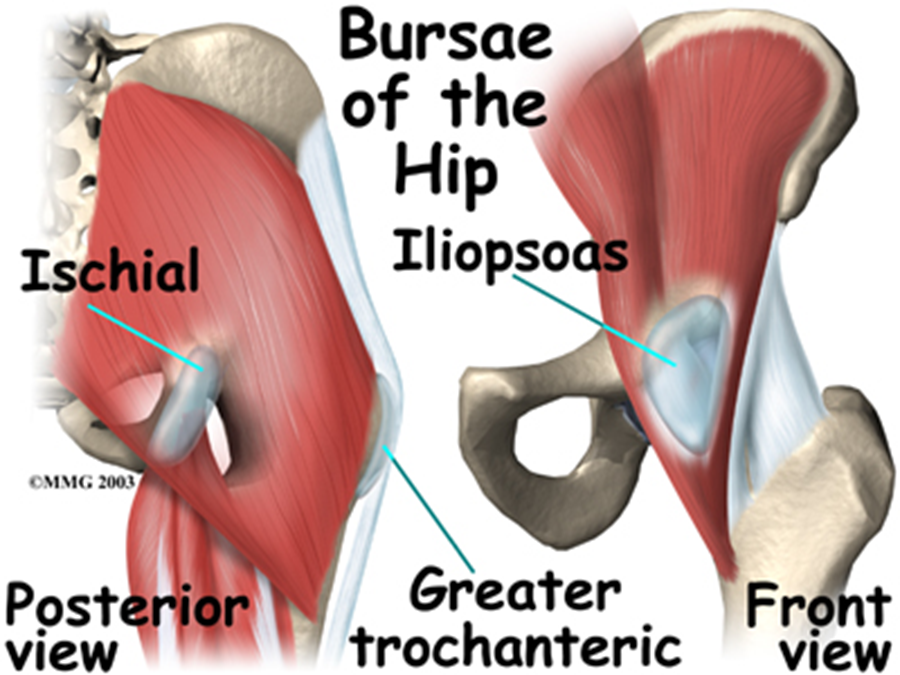
Diagram: Bursae of the Hip (2)
Ischial and Iliopsoas
Ischial = can be inflammed with prolonged sitting/trauma
Q: How much flexion can be appreciated at the hip?
110-120 degrees
Q: How much extension can be appreciated at the hip?
10-15 degrees
Q: How much abduction can be appreciated at the hip?
30-50 degrees
Q: How much adduction can be appreciated at the hip?
30
Q: How much external rotation can be appreciated at the hip?
40-60 degrees
Q: How much internal rotation can be appreciated at the hip?
30-40 degrees
Q: Describe the roll and glide with hip flexion.
R = anterior
G = posterior
Q: Describe the roll and glide with hip extension.
R = posterior
G = anterior
Q: Describe the roll and glide with hip abduction
R = lateral (superior)
G = inferior
Q: Describe the roll and glide with hip adduction
R = medial (inferior)
G = superior
Q: Describe the roll and glide with hip IR.
R = medial (anterior)
G = posterior
Q: Describe the roll and glide with hip ER.
R = lateral (posterior)
G = anterior
Q: Which hip motions have an end feel of tissue approximation (or stretch)? (2)
- Flexion
- Adduction
Q: Which hip motions have an end feel of tissue stretch? (4)
- Extension
- Abduction
- IR
- ER






