What is HPCE (High Performance Capillary Electrophoresis)? Discuss why it is used and for what.
Separative analytical techniques utilised to separate analytes in an electrolyte solution by the application of a narrow silica capillary and an electric field (high voltage)
- Very powerful and highly efficient separative technique
- Relatively new technique which can afford rapid, low-cost analysis that both complements and rivals HPLC analysis
- Used to examine a wide variety of small and large analytes
- Especially useful for very polar, ionisable and chiral compounds
What does separation rely on
SEPARATION RELIES ON THE DIFFERENT CAPILLARY MIGRATION OF ANALYTES WITHIN AN AQUEOUS BUFFER SOLUTION EXPOSED TO AN ELECTRIC FIELD
- Analytes move differently and with variable velocities giving rise to analyte separation
For electrophoretic mobility (μe);
A) What is it
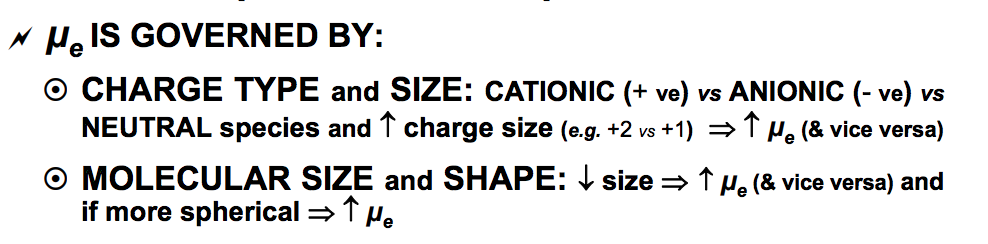
B) what is it governed by
C) Outline movement of cations and anions
D) What is the migration of all species governed by
A)
- Movement and velocity of a molecule is dependent on its ELECTROPHORETIC MOBILITY μe
B)
See attached image +
- ANALYTE μe GREATLY INFLUENCED BY ITS pKa
C)
Cations move towards cathode (-ve)
Anions move towards anode (+ve)
> Migate towards opposite terminals of the applied electric field
D)
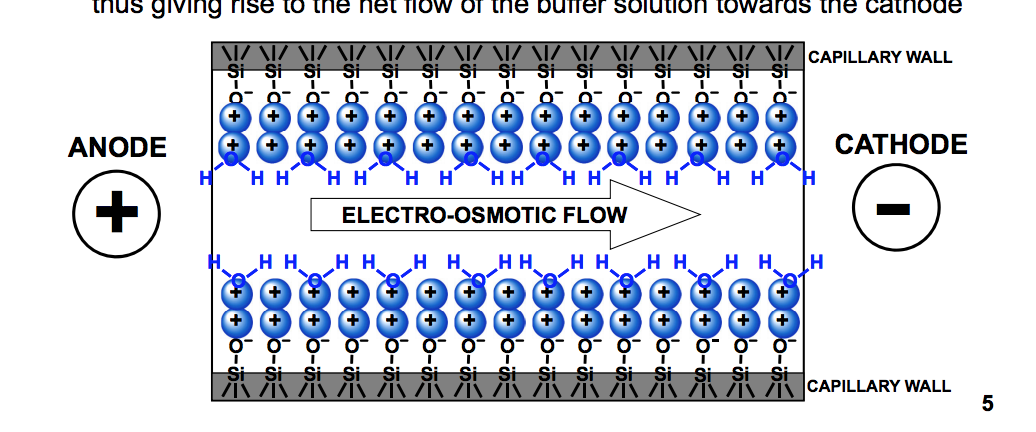
- Governed by Electro-osmotic flow (EOF) of the aqueous buffer solution
For Electro-osmotic flow (EOF);
A) How does it occur
B) Describe where species migrates
C) List the rate at which compound move is determined by
D) How is it altered
A)
Consequence of the charged interior surface of the silica capillary wall and applied electric field
- Behaviour of capillary ‘negatively ionised’ silanol groups (silanoate, -SiO-) which attract a ‘double layer’ of buffer cations that in turn attract the buffer ‘dipolar’ H2O molecules
- Movement of the outer ‘mobile’ (diffuse) cation layer and also the bulk buffer cations towards the -ve cathode followed by the dragging of H2O - thus giving rise to the net flow of the buffer solution towards the cathode
B)
- Due to EOF ALL species will migrate towards the cathode where the order of migration is cations, neutrals then anions
C)
- EOF PLUS μe FOR CATION (FASTEST)
- EOF MINUS μe FOR ANION (SLOWEST)
- EOF for neutral
D)
- Buffer pH and ionic strength
- Addition of modifiers
- Electric field (voltage)
- Surfactants
- Temperature
- Capillary wall coating
Alteration to the above and variable nature of compound μe permits a high level of separation to be achieved
For assays and instrumentation of HPCE;
A) Why are HPCE assays beneficial
B) Quantitative or qualitative
C) Difference beween HPCE and HLC
D) What is the HPCE output (data assessment same as HPLC chromatogram)
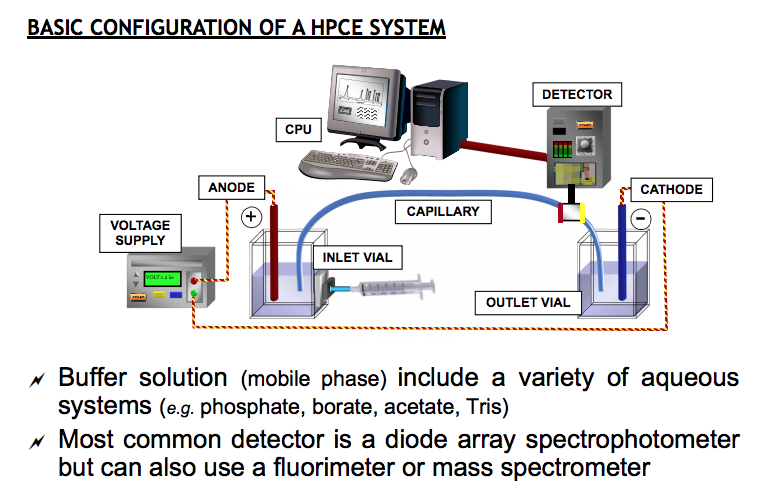
E) What is the instrumental system for HPCE
A)
- HPCE Assays display high versatility and generally permit a very high level of separation to be achieved
B)
- Both
C)
- Relatively similar to HPLC but usally need more optimisation due to increased number of assay parameters
D)
HPCE output = ELECTROPHEROGRAM (cf. chromatogram) = Plot of ‘analyte migration time (in min)’ vs ‘analyte amount’
E)
- Fairly basic configueration –> includes fused silica capillary, buffer vials/reservoirs, electrode assembly/voltsge supply an detector
What are some pharmaceutical applications of HPCE
- employed to separate complex drug mixtures and measure drug concentrations in a wide variety of media
- Also used to assess drug impurities and drug metabolites
- Drug formulation analysis
- Drug enantiomeric analysis
- Drug impurity profiling and QA analysis
- Drug bioanalysis
- Emerging technique in clinical/biomedical analysis
- HPCE offers greater separation potential but currently less robust and sensitive than HPLC pharmaceutical analysis




