What are the 9 areas of the abdomen
Common laparotomy incisions (13)
Common laparoscopic incisions (3)
anatomy of the inguinal canal
- which direction does it travel
- it is superior and parallel to ewhich structure
- serves as a pathway between where?
- clinical significance?
- contents of the inguinal canal (4)
- travels inferomedially
- it is superior and parallel to the inguinal ligament
- pathway between abdominal cavity and the external genitalia
- site of potential weakness in the abdo wall, 75% of anterior abdo wall hernias
- spermatic cord (males only), round ligament (females only), iliolinguinal nerve,genital branch of genitofemoral nerve
inguinal hernias can be split into (2)
how do you differentiate between them?
- Indirect – where the peritoneal sac (and potentially loops of bowel) enters the inguinal canal through the deep inguinal ring. More common. Congenital weakness.
- direct- where the peritoneal sac enters the inguinal canal though the posterior wall of the inguinal canal (termed Hesselbach’s triangle). They occur more commonly in older patients, often secondary to abdominal wall laxity or a significant increase in intra-abdominal pressure
Both types of inguinal hernia can present as lumps in the scrotum or labia majora.
Differentiation
differentiated at the time of surgery by identifying the inferior epigastric vessels – indirect hernias will be lateral to the vessels whilst direct hernias will be medial to the vessels.
To differentiate between types of inguinal hernias the examiner must reduce the hernia and then place pressure over the deep inguinal ring (located mid point of the ligament) before asking the patient to cough.
If the hernia protrudes despite occlusion of the deep inguinal ring, this indicates a direct hernia
Whereas if the hernia doesn’t protrude then this indicates an indirect hernia. This assessment is often unrealiable.
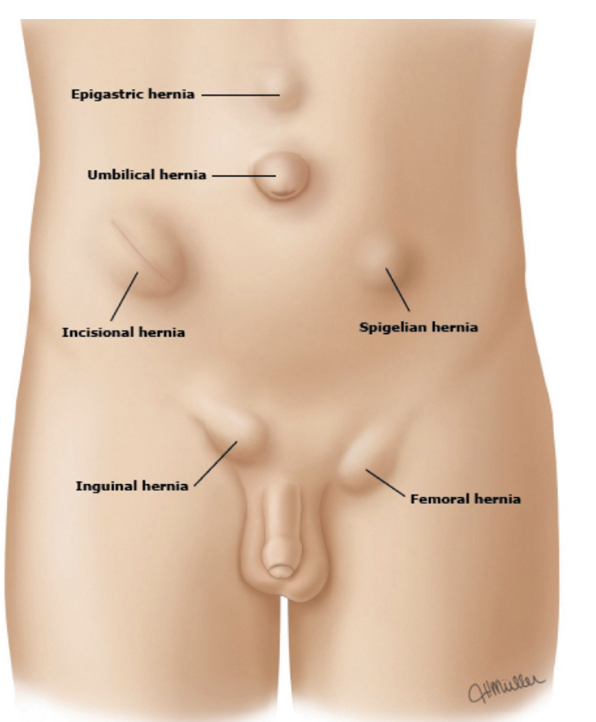
6 locations for hernia
Things that increase the risk of incidence in general anaesthesia (13)
- smoking
- diabetes
- COPD
- CKD
- frailty
- cognitive dysfunction
- obesity
- age
- aneamia
- recent cold
- recent heart attack
- recent stroke
- allergies
what test is done to assess fitness for general anaesthesia?
cardiopulmonary fitness test
cycle on bike
For consent to be valid (3)
what is capacity. what are the 4 factors of it
young people are assumed to have capacity to give consent at what age
- patient must UNDERSTAND what the procedure entails
- consent must be given VOLUNTARILY
- the patient must be COMPETENT- i.e. they have capacity
Capacity- the ability to use and understand information to make a decision, and communicate any decision made.
- UNDERSTAND the decision
- RETAIN information relevent to their decision long enough to give consent
- WEIGH UP relevent info
- COMMUNICATE their decision
capacity at 16+, if younger look on a case by case basis
what are some things you should include when gaining consent for surgery
- The patient’s diagnosis and prognosis
- Options for treatment, including non-operative care and no treatment
- The purpose and expected benefit of the treatment
- The likelihood of success
- The clinicians involved in their treatment
- The risks inherent in the procedure, however small the possibility of their occurrence,side effects and complications. The consequences of non-operative alternatives should also be explained.
- Potential follow up treatment
Complications of surgery and anaesthesia (12)
How would you identify them?
- Shock- qSOFA score.
- Haemorrhage- tachycardia, dizziness, agitation, decreased urine output
- Nausea and vomiting
- Pain- - objectively tachycardia, tachypnoea, hypertension, sweating
- Pyrexia- raised body temp above 37.5*
- Wound infection- fever, clammy, sweaty, discolouration
- DVT- pain, swelling, tenderness, redness
- PE- Rapid or irregular heartbeat, Lightheadedness or dizziness, Excessive sweating, Fever, Leg pain or swelling, or both, usually in the calf caused by a deep vein thrombosis, Clammy or discolored skin (cyanosis)
- Urinary retention-
- Reaction to anaesthesia-
- Delirium- disturbed consciousness and altered cogitive function
- Decreased sodium
Complications of abdo surgery (15)
- haematoma amnd seroma (serouds fluid)
- Surgical site infection
- Fascial dehiscence
- nerve injury
- intra-abdominal bleeding
- herniation
- mechanical bowel obstruction
- sepsis
- peritonitis
- c. diff infection
- pneumonia
- urinary retention
- uti
- DVT
- failure of surgery
possible complications of vascular surgery (4)
- Haemorrhage
- Early thrombosis of a graft or vessel nerve injury
- Graft infection
- Renal failure
staging system for colorectal cancer
what are the 2 systems
explain the different stages of them
Duke’s staging system
Stage (A-D), descrption of containment and 5 year survival rate
- A- confined to bowel wall only (75-90)
- B- Through bowel wall (55-70)
- C- Any with +ve lymph node involvement (30-60)
- D- Any with metastases (5-10)
TNM
based on 3 components:
- Extent (size) of the tumour- How far has the tumour grown into the wall of the colon or rectum? T1-4 stages of invasion of bowel wall
- N- spread to nearby lymph nodes- N0/1/2, no/up to 4/more than 4 lymph nodes involved
- M- spread to distant sites- such as lungs or liver
Additional TNM codes
TX- Main tumour cannot be assessed due to lack of information
T0- No evidence of a primary tumour
NX- regional lymph nodes cannot be assessed due to lack of information
Explain the principles of surgical treatments for colorectal cancer
list 6 procedures for general surgery
Curative treatmements are suitable for technically resectable tumours with no evidence of metastases (or metastases potentially curable by liver or lung resection)
Surgery is the mainstay of curative management for localised bowel cancer. The general plan in most surgical management plans is suitable regional colectomy, to ensure the removal of the primary tumour with adequate margins and lymphatic drainage, followed either by primary anastomosis or formation of a stoma
- Right hemicolectomy or extended right hemicolectomy
- Left hemicolectomy
- Sigmoidcolectomy
- Anterior resection
- Abdominoperineal resection
- Hartmann’s procedure
explanation of these procedures:
Right hemicolectomy or extended right hemicolectomy
-Used for caecal tumours or ascending colon tumours, extended version used on transverse colon tumours. During the procedure the ileocolic, right colic and right branch of the middle colic vessels (branches of SMA) are divided and removed w their mesenteries.
Left hemicolectomy
-Used for descending colon tumours. Left branch of the middle colic vessels (branch of SMA/SMV), the inferior mesenteric vein and the left colic vessels (branches of the IMA/IMV) are divided and removed of their mesenteries
Sigmoidcolectomy
-Sigmoid colon tumours. IMA fully dissected out to ensure adequate margins are obtained
Anterior resection
-Used for low rectal tumours, typically <5cm from the anus
Excision of the distal colon, rectum and anal sphincters resulting in permanent colostomy
Abdominoperineal resection
- Used for low rectal tumours, typically <5cm from the anus. Excision of the distal colon, rectum and anal sphincters, resulting in permanent colostomy
Hartmann’s procedure
-Procedure used in emergency bowel surgery (e.g., bowel obstruction or perforation). Complete resection of the recto-sigmoid colon with the formation of an end colostomy and the closure of the rectal stump.
Explain the principles of adjuvant (1) or neoadjuvant treatment (1) of colorectal cancer
Aims to eradicate micro-metastatic cancer cells
Neoadjuvant therapy- given as a first step to shrink a tumour before the main treatment, which is usually surgery. Examples include Chemotherapy, Radiation therapy, Hormone therapy. It is a type of induction therapy. Also lets the MDT see if they respond to that kind of chemotherapy.
Adjuvant therapy: Additional cancer treatment given after the primary treatment to lower the risk that the cancer will come back. Adjuvant therapy may include chemotherapy, radiation therapy, hormone therapy, targeted therapy, or biological therapy.
What is a stoma
Identify the different types of stomas (3)
A stoma is a surgical joining of a lumen onto the anterior abdominal wall., They are red in colour as they are mucous membranes. They don’t have any sensation so shouldn’t be painful to the touch.
- what is a colostomy?
- where are they usually placed?
- what is the output, what is it like?
- what are the 2 types of colostomy?
- A colostomy is created from a part of the colon
- Usually placed on the left-hand side of the navel (descending colon)
- The output is faeces that are usually firm and formed. Stools in this part of the intestine are solid and will need to be collected using a stoma pouch.
1) End colostomy- If parts of your colon or rectum have been removed the remaining colon is brought to the surface of the abdomen to form a stoma. An end colostomy can be temporary or permanent
2) Loop colostomy- Typically, temporary used in acute situations.
- What is an ileostomy?
- usually where is it?
- stool content?
- 2 main kinds?
- In an ileostomy operation, a part of your small bowel called the ileum is brought to the surface of your abdomen to form the stoma. Typically, when the end part of the small bowel is diseased
- Right hand side of the abdomen
- Stools are generally liquid
1) End ileostomy- Often done when part of your large bowel (colon) is removed (or simply needs to rest) and the end of your small bowel is brought to the surface of the abdomen to form a stoma. An end ileostomy can be temporary or permanent.
2) Loop ileostomy
Urostomy aka ____?
when might a urostomy be done?
how is it carried out?
- AKA ileal conduit or a Bricker bladder
- If a problem occurs within the bladder, the bladder may be removed from the body and a new system for urine to be passed from the body must be made
- Surgeon takes 6-8 inches of the small bowel (ileum) and makes it into a conduit (pipeline) for urine. Remainder of the small bowel is reconnected so your bowel will function as it did before surgery. Ureters then connect into the ileum
10 factors of cancer development
- genome instability
- resisting cell death
- sustaining proliferative signalling
- evading growth suppressors
- enabling replicative immortality
- inducing angiogenesis
- activating invasion and metastasis
- reprogramming energy metabolism
- tumour-promoting inflammation
- evading immune destruction
genome instability and how it helps
- occasionally mutations are advantagous
- allows overgrowth and dominance
- instability leads to further istability so rates of mutation increase
6 steps of apoptosis
- produces nuclear fragmentation
- chromosomal condensation
- shrinking of the cell membrane
- cellular fragmentation
- formation of apoptopic bodies
- phagocytosed by neighbouring cells



