1
Q
Define Interpolation? 2
A
- Mathematical technique to estimate the value of a function from known values on either side of the function
- Used in the reconstruction process of helical data
2
Q
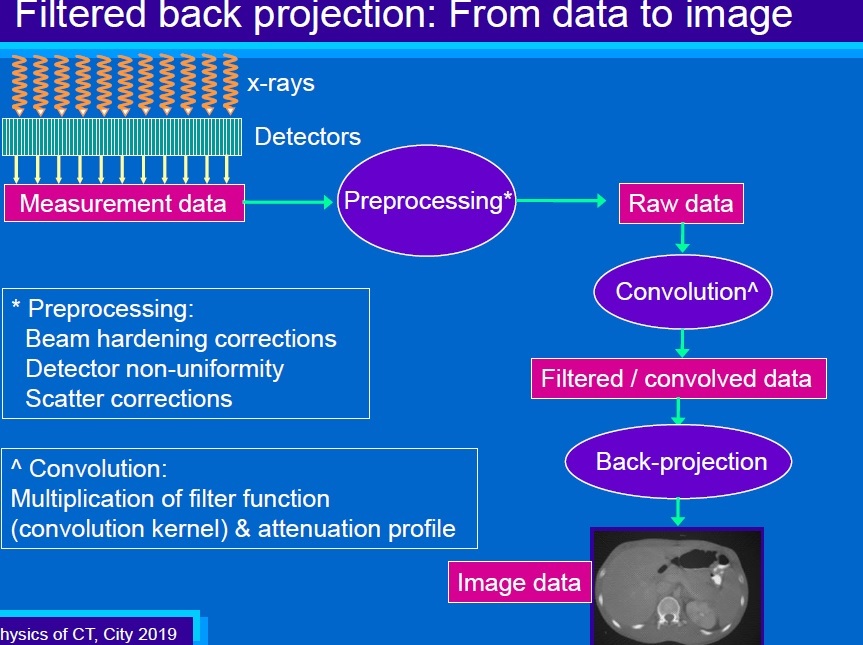
Explain how filtered back projection can be used to render images? 5
A
- Simple back projection produces blurred transaxial images.
- Projections need to be modified before being back projected by using filters also known as kernals. i.e. smoother for SOFT tissue and sharper for high resolution imaging such as bone
- Fourier transforms converts spatial image into the frequency domain, which is then applied to a high pass filter to supress the low frequencies. Hence, accentuating the high frequencies (detail and sharp edges) and reducing the blurring rendered by simple back projection.
- The spectrum is inverse fourier transformed then back projected to render a shaper image.
3
Q
fill in the blanks 11
A
4
Q
FILL IN THE GAPS
A
5
Q
Describe how iterative reconstruction works highlighting the pros and cons 12
A
Advantages
- able to handle the physics of projection/ back projection process
- better handling of beam hardening and proton starvation
- better handling of noise
- can be used to lower the patient dose as a result of less noise.
Disadvantages
- requires high computational power
- images can appear waxy/ cartoon like hence reporting staff hesitent to change practice considering influence on diagnostic accuracy.
- Slow reconstruction times but changing
- Too many iterations can amplify noise
how it works
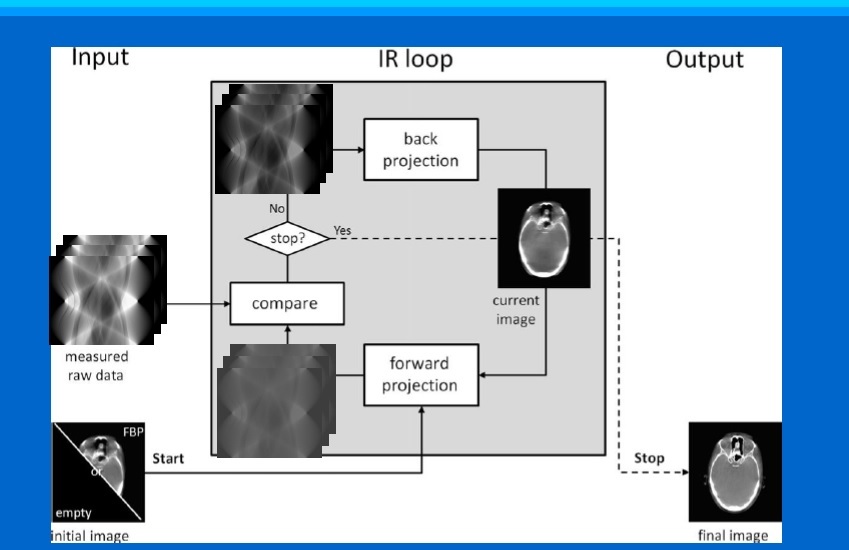
- start with an assumed imaged and compute projections. Done by modelling the image system, true object and noise).
- Sometimes the iterative process starts off the FBP data
- This is compared with measured projection.
- Review the assumption and repeat as part of a cycle until assumed and measured values are within acceptable limits.




