Key milestones in immunology?
Edward Jenner - Late 18th Century:
Cowpox conferred protection against smallpox.
Robert Koch - 19th Century:
Infectious disease caused by microorganisms. Hypersensitivity reaction.
Louis Pasteur - 19th Century:
Fowl cholera vaccine and rabies vaccine.
What does an immune system do?
Recognise and respond to problems, including infection, invasion or altered self.
Broad outline of what happens in infection?
- Prevent invasion or colonisation
- Limit early proliferation and dissemination
- Restrict growth post spread
- Kill or control pathogen
- Clearance
- Offer enhanced resistance to rechallenge
Evidence for anti-microbial mechanisms in bacteria and protozoa?
- Bacteria
- Restriction enzymes
Target specific non self nucleic acid sequences. Can be induced and may confer resistance to bacteriophages. - CRISPR-Cas systems
Clustered regularly interspersed short palindromic repeat. Uses RNA guides to target foreign sequences
- Restriction enzymes
- Protozoa
- Induction of intracellular antiviral/bacterial mechanisms
- The ability to kill vacuolar organisms by production of reactive oxygen species
Conserved basic requirements of immunity in multi-cellular animals?
- Allows survival of an individual in the face of loss of cells
- Used to develop specialised cellular functions
- Development of new sites for pathogen exploitation
- As complexity increases, new problems emerge of protection of surfaces and body fluids.
Basic process of immune engagement?
- Detection
Pattern recognition (self and microbial)
Initiates and directs response - Response
Innate
Adaptive - Outcome of response
Pathogen removal/killing
Control without removal (persistence)
Pathology (most is self induced)
Which organisms have innate immunity or adaptive immunity?
Innate immunity features in all organisms.
Adaptive immunity emerged in the vertebrates.
Key features of adaptive immunity?
Adaptive immunity responses are faster the second time around.
Key features of the innate immune system?
- Barriers
Mechanical (epithelial cell layers)
Chemical barriers (mucus, enzymes, pH, oils, antimicrobial peptides)
Microbiological (enteric microflora)
*consider induced (part of immune response) vs constitutive (both resistance)* - Tissue fluid systems
Complement cascades
Coagulation cascades
Iron binding molecules - Cellular systems
Phagocytic cells (macrophages and neutrophils)
Lytic cells (natural killer cells)
What is the complement cascade?
A plasma based enzyme cascade.
- Formation of deposits on microbial surface
- Lytic membrane attacks complex
- Marking surface to assist interaction with immune cells
- Elements have chemotactic activity
- Used as an effector for both innate and adaptive pathways
What is the coagulation cascade?
- Traps microbes
- Stops blood loss and initiates wound repair to re-establish a barrier
What are iron binding molecules used for in innate immunity?
Compete with bacteria for iron, slowing bacterial growth
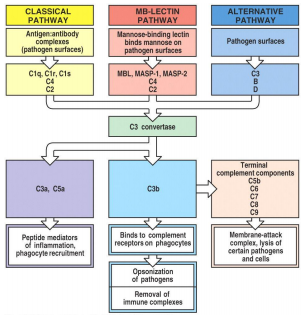
What are the different complement cascades/pathways?
Classical (adaptive), Lectin (innate) and Alternative (innate).
Same results: microbial lysis and enhanced phagocytosis.
What are the receptors used by the innate immune system?
Lectins, Toll like receptors and NOD like receptors.
Genomically encoded in their effective configuration. Most animals have 100-200 different receptors. Each expressed at high freq.
Soluble, trans membrane and cytoplasmic location.
What are the receptors used by the adaptive immune response?
Antibodies, B and T cell receptors.
They are formed by rearrangement of genomic segments, meaning there is a huge repertoire available (>108 different specificities per person). Each receptor is clonally expressed on very few cells until stimulated.
Soluble or cell surface receptors.
What are the pattern recognition receptors (PRRs)?
Respond to Pathogen Associated Molecular Patterns (PAMPs).
Diverse family of PRRs:
- Mannose binding lectin in tissue fluid
- Toll like receptors which are transmembrane
- NOD1 and NOD2 which are cytoplasmic
- Cell associated PRR strong inducers of NFkB translocation to the nucleus
Example of a toll like receptor?
TLR-5 homodimer agonist is Flagellin (protein in flagellum), which helps the cell to recognise gram negative bacteria.
The activation of this receptor mobilizes the nuclear factor NF-κB (controls DNA transcription) and stimulates tumor necrosis factor-alpha (inflammatory cytokine produced by macrophages/monocytes during acute inflammation and is responsible for a diverse range of signalling events within cells, leading to necrosis or apoptosis) production.
TLR-3 homodimer agonist is dsDNA which helps the cell to recognise viral RNAs/
Describe a macrophage?
Innate immune system.
Functions:
- Phagocytosis and intracellular killing
- Release of proinflammatory cytokines
- Antigen presentation
- Tissue repair
Describe a dendritic cell?
Part of innate immune system.
Antigen uptake in peripheral sites, and presents in lymph nodes.
Describe a neutrophil?
Part of innate immunity.
Functions:
- Phagocytosis
- Intracellular killing
- Inflammation and tissue damage
Describe an eosinophil?
Part of innate immune system.
Functions:
- Killing of antibody coated parasites
- Tissue damage
Describe a natural killer cell?
Part of adaptive immune system.
Releases lytic granules that kill some virus infected cells.
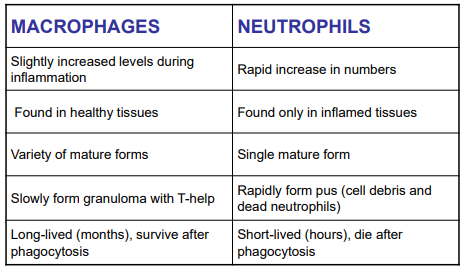
Comparison of phagocytes?
Example of some microbicidal agents produced/released by phagocytes?
Competitiors for Iron - Lactoferrin binds Fe
Toxic nitrogen oxides - Nitric oxide



-
DNA15
-
Transcription & Translation36
-
Water26
-
DNA replication9
-
Immunity69
-
Genome organisation20
-
Linkage and Recombination19
-
Gene mapping9
-
Domestication25
-
Epigenetics24
-
Regeneration7
-
Characterising and cloning genes40
-
Fertilisation9
-
Metal ions6
-
Gene expression37
-
Nucleic Acids & Carbohydrates24
-
Mendelian genetics25
-
Extracellular matrices22
-
Enzymes26
-
Development in plants28
-
Embryogenesis3
-
Animal development5
-
Exam questions13
-
Extra chromosomal genetics14
-
Membranes22



