ANTIGEN
A molecule that is recognised as non self (foreign) by immune system, this triggers an immune response by lymphocytes. Found on the surface of cells. Usually proteins . Triggers production of antibody.
ANTIBODY
A protein produced by lymphocytes in response to the presence of the appropriate antigen.
PATHOGEN
Any micro-organism that causes disease.
How is the immune system initially activated?
When a pathogen invades the body, the antigens on its cell surface are identified as foreign, which activates the cells in the immune system.
Explain Non- specific defence mechanisms.
Do not distinguish between one type of pathogen and another, but respond to all of them in the same way. Act immediately and take two forms: a) a barrier to the entry of pathogens b) Phagocytosis
Explain Specific defence mechanisms
Distinguish between different pathogens. Responses are less rapid but provide long lasting immunity. The responses involve a type of white blood cell called a lymphocyte and again take two forms: a) cell-mediated responses involving T lyphocytes b) humoral response involving B- lymphocytes
PHAGOCYTOSIS
Mechanism by which cells engulf particles to form a vesicle or vacuole.
LYMPHOCYTES
Types of white blood cell responsible for the immune response. They become activated in the presence of antigens. There are two types: B lymphocytes and T lymphocytes. NOT PRODUCED IN RESPONSE TO AN INFECTION< BUT THEY ALREADY EXIST.
How do lymphocytes work?
So many lymphocytes that high chance that, when pathogen enters body, one of these lymphocytes will have a protein on its surface that is complementary to one of the proteins of the pathogen. RECOGNISES PATHOGEN. Few of each type of lymphocytes. When an infection occurs, the one type already present that has the complementary proteins to those of the pathogen is stimulated to build up its numbers to a level where it can be effective in destroying it. TIME LAG BETWEEN EXPOSURE TO THE PATHOGEN AND BODY’S DEFENCES BRINGING IT UNDER CONTROL.
Barriers to entry (3)
-PROTECTIVE COVERING- Skin, physical barrier that most pathogens find hard to penetrate. -EPITHELIA COVERED IN MUCUS- Pathogens stick to mucus, which is then transported away by cilia, up trachea, to be swallowed. -HYDROCHLORIC ACID IN THE STOMACH- Enzymes of pathogens denatured, organisms killed.
What happens during phagocytosis?
Large particles, such as bacteria, are far too big to cross cell- surface membranes by diffusion or active transport. PHAGOCYTES engulf them.
- Chemical products of the pathogen act as attractants, causing phagocytes to move towards the pathogen.
- Phagocytes attach themselves to the surface of the pathogen.
- They engulf the pathogen to form a vesicle, known as a phagosome.
- Lysosomes move towards vesicle and fuse with it.
- Enzymes within the lysosmes break down the pathogen.
- Soluble products from breakdown of pathogen are absorbed into cytoplasm of phagocyte.
How does phagocytosis cause inflamation
Phagocytosis causes inflammstion at the site of infection. Swollen area contains dead pathogens and phagocytes, which are known as pus. Inflammation is result of release of histamine, causes dilation of blood vessels. This, in turn speeds up delivery of phagocytes to site of infection.
B lymphocytes (B cells)
associated with humoral immunity i.e. immunity involving antibodies that are present in body fluids, or ‘humour’. Formed from stem cells found in bone marrow. MATURE IN BONE MARROW.
T lymphocytes (T cells)
associated with cell-mediated immunity i.e. immunity involving body cells. Formed from stem cells found in bone marrow. MATURE IN THYMUS GLAND
What do T-lymphocytes respond to?
T- lymphocytes respond to an organism’s own cells that have been invaded by non-self material. e.g. virus or cancer cell. Also respond to transplanted material, which is genetically different.
What three types of cells do T lymphocytes respond to?
- Phagocytes that have engulfed and broken down a pathogen present some of the pathogens antigens on their own cell-surface membrane.
- Body cells invaded by a virus present some of the viral antigens on their own cell surface membrane, as a sign of distress.
- Cancer cells likewise present antigens on their cell-surface membrane. ANTIGEN PRESENTING CELLS
Why is it called a cell mediated response?
T lymphocytes only respond to antigens that are attached to a body cell.
Stages of response of a T lymphocyte.
- Pathogens invade body cells or are taken in by phagocytes.
- The phagocyte places antigens from the pathogen on its cell surface membrane.
- Receptors on certain T helper cells fit exactly onto these antigens.
- This activates other T cells to divide rapidly by mitosis and form a clone.
- The cloned T cells:
a. develop into memory cells that enable a rapid response to future infections by same pathogen.
b. stimulate phagocytes to engulf pathogens by phagocytosis.
c. stimulate B cells to divide.
d. kill infected cells.
How do T cells kill infected cells?
They DO NOT kill by phagocytosis but by producing a protein that makes holes in the cell- surface membrane. These holes mean the cell becomes freely permeable to all substances and dies as a result.
Process of Humoral immunity
- Surface antigens of invading pathogen are taken up by B cells
- B cells process the antigens and present them on their surfaces.
- T helper cells attach to the processed antigens on the B cells thereby activating them.
- The B cells are now activated to divide by mitosis to give a clone of plasma cells.
- The cloned plasma cells produce antibodies that exactly fit the antigens on the on pathogens surface.
- The antibodies attach to antigens on the pathogen and destroy them. PRIMARY IMMUNE RESPONSE.
- Some B cells develop into memory cells. These can respond to future infections by same pathogen by dividing rapidly and developing into plasma cells to produce antibodies. SECONDARY IMMUNE RESPONSE.
Plasma cells
Secrete antibodies directly. Cells survive for a few days, but each make around 2000 antibodies a second. These antibodies destroy the pathogen and any toxins it produces. The plasma cells are therefore responsible for the immediate defence of the body against infection. PRIMARY IMMUNE RESPONSE.
Memory cells
Live considerably longer than plasma cells. Do not produce antibodies directly, but circulate in the blood and tissue fluid. When they encounter the same antigen later, they divide rapidly and develop into plasma cells and more memory cells. Plasma cells produce antibodies needed to destroy pathogen, while new memory cells circulate in readiness for any future infection. MEMORY CELLS PROVIDE LONG TERM IMMUNITY AGAINST THE ORIGINAL INFECTION. SECONDARY IMMUNE RESPONSE. More rapid and of greater intensity than 1st..
ANTIGENIC VARIABILITY
Some pathogens, e.g influenza viruses have over 100 different strains. The antigens that these viruses are made of, and those they produce, are constantly changing. Subsequent infections therefore likely to be caused by different varieties of the pathogen. . Only means of overcoming is primary response.
Structure of antibodies
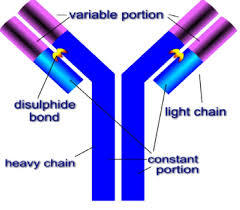
Made up of 4 polypeptide chains.
Chains of one pair are long and are called heavy chains, while other pair are shorter and called light chains.
To help antibody fit around antigen, they can change shape by moving as if they had a hinge at the fork of the y-shape.
Binding site fits v. precisely onto the antigen to form what is known as an antigen-antibody complex.
The binding site is different on different antibodies and is therefore called the variable region.
Each site consists of a sequence of amino acids that form a specific 3D shape that binds directly to a single type of antigen.
Rest of antibody is same in all antibodies.
KNOWN AS CONSTANT REGION.
This binds to receptors on cells such as B cells.

-
Causes of Disease (UNIT 1)14
-
Enzymes And The Digestive System (UNIT 1)53
-
Cells And Movement In And Out Of Them (UNIT 1)82
-
Lungs and Lung Disease (UNIT 1)35
-
The Heart and Heart Disease (UNIT 1)28
-
Immunity (UNIT 1)35
-
The Variety of Life (UNIT 2)55
-
EMPA29
-
DNA and Meiosis33
-
Classification (UNIT 2)11
-
Evidence for relationships between organisms. (UNIT 2)22
-
Variation (UNIT 2)16
-
Gas Exchange in Organisms, Insects and Fish (Exchange and Transport) (UNIT 2)16
-
Gas Exchange in Plants (Exchange and Transport) (UNIT 2)41
-
Circulatory System of a Mammal (Exchange and Transport) (UNIT2)37
-
Genetic Diversity (UNIT 2)12
-
The Cell Cycle (UNIT 2)25
-
Cellular Organisation (UNIT 2)10
-
Adaptation and Selection (UNIT 2)31
-
Biodiversity (UNIT 2)14



