1
Q
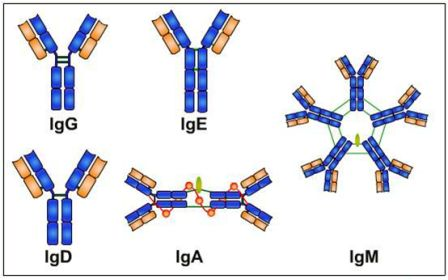
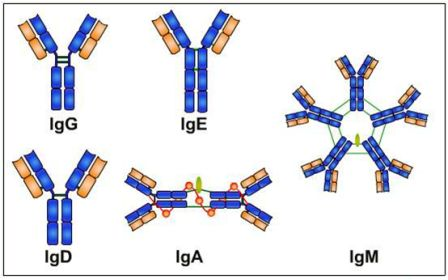
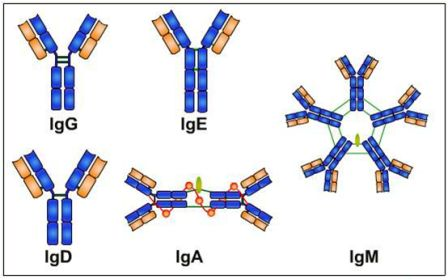
Different types of immunoglobulins
A
- IgG: (2º response)
- IgA: Secretory
- IgM: Macro Ig AKA natural antibody (1º response)
- IgD: ?
- IgE: anaphylactic hypersensitivity, allergic reactions.
2
Q
IgG
A
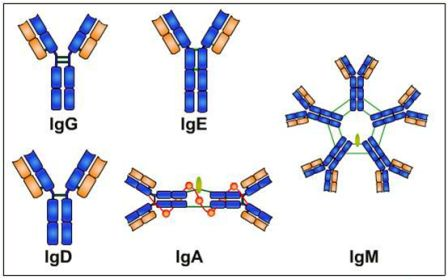
- Human IgG is expressed on the surface of mature B cells.
- IgG are the smallest but most common antibody (75% to 80%) of all the antibodies in the body.
- IgG is the predominate antibody in secondary immune response.
- IgG is the only human immunoglobulin to pass from mother to fetus to transfer immunity.
- IgG can activate complement (along with IgM)
- Binds fragment crystallization (Fc) receptors.
3
Q
IgM
A
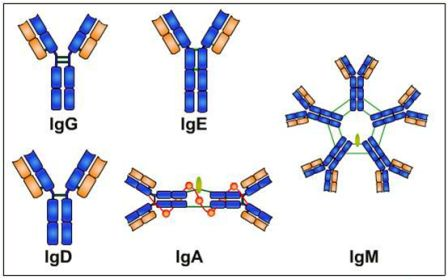
- Human IgM is expressed on the surface of immature and mature B cells as monomers.
- IgM are the largest antibody.
- IgM are the first type of antibody made in response to an infection.
- IgM is the first human immunoglobulin to be made by a fetus and virgin B cells which are challenged with antigen.
- IgM can activate complement (along with IgG)
- Pentameric structure binds fragment crystallization (Fc) receptors.
4
Q
IgA
A
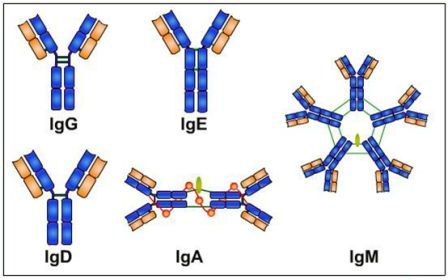
- IgA is the most prevalent lg _in secretion_s (e.g. tears, saliva and mucous).
- IgA antibodies protect body surfaces that are exposed to outside foreign substances like the nose, breathing passages, digestive tract, ears, eyes, and vagina.
- IgA is secreted in milk so can give passive immunity to infants.
- IgA does not fix complement
- Binds fragment crystallization (Fc) receptors.
5
Q
IgD
A
- Human IgD is expressed on the surface of mature B cells.
- IgD works with IgM in B cell development.
- IgD antibodies are found in small amounts in the tissues that line the belly or chest
- IgD is found in very low levels in serum
- IgD does not fix complement
6
Q
IgE
A
- Human IgE is expressed on the surface of mature B cells.
- IgE antibodies are found in the lungs, skin, and mucous membranes.
- IgE mediates anaphylactic hypersensitivity or allergic reactions.
- IgE is the least abundant Ig in the serum
- IgE does not cross placenta or fix complement.
- Fragment crystallization (Fc) receptors for IgE** are found on eosinophils. IgE binds Fc receptors on mast cells and basophils even before interacting with antigen. → involved in allergic reactions*.
* (Allergen is bound to IgE on cells which releases various pharmacological mediators which cause allergies.)

z template for editing
flashcards
Decks in class (37)
# Cards
-
Gram (+) cocci34
-
Gram (-) cocci13
-
Gram (+) bacilli30
-
Gram (-) bacilli (Enteric tract)55
-
Gram (-) bacilli (Respiratory)14
-
Gram (-) bacilli (Zoonotics)21
-
Gram (+) branching filamentous bacilli7
-
Gram indeterminate23
-
Mycobacteria16
-
Spirochetes23
-
Fungi - Systemic Mycoses16
-
Fungi - Cutaneous Mycoses13
-
Fungi - Opportunistic Fungi28
-
Protozoa of the Intestinal Tract12
-
Protozoa of the CNS16
-
Protozoa of the Blood24
-
Protozoa of Other Tissue3
-
Helminths - Nematodes (roundworms)21
-
Helminths - Cestodes (tapeworms) and Trematodes (flukes)15
-
Viruses - RNA (+) sense53
-
Viruses - RNA (-) sense50
-
Viruses - DNA - Herpes Family45
-
Immunoglobulins6
-
Viruses - DNA - NOT from Herpes Family42
-
Cardio Exam 1 (not finished dont download yet)0
-
Cardio Exam 2 (not finished dont download yet)0
-
Cardio Exam 3 (not finished dont download yet)0
-
Resp Exam 183
-
Resp Exam 2: No new micro on exam 20
-
Resp Exam 3119
-
Renal Exam 1: No new renal on exam 11
-
Renal Exam 245
-
Endo/Repro Exam 1: No new endo on exam 10
-
Endo/Repro Exam 2208
-
Endo/Repro Exam 3 (not finished dont download yet)0
-
GI Exam 1 (not finished dont download yet)0
-
GI Exam 2 (not finished dont download yet)59



