- The most striking neurologic complication of von Economo’s encephalitis(encephalitis lethargica), a type of encephalitis that occurred in epidemicproportions along with viral influenza between 1917 and 1928, was
a. Blindness
b. Hearing loss
c. Paraplegia
d. Parkinsonism
e. Incontinence
- The answer is d. (Victor, p 813.) At the onset of encephalitis lethargica,patients often develop transient fevers, lethargy, and headache. Disturbedeye movements are the most common sign of neurologic diseaseduring the acute illness. A variety of movement disorders, including chorea,athetosis, dystonia, and myoclonus, develop with the disease. About one infour affected persons dies. The most common sequela of the disease is severe,unremitting parkinsonism with signs and symptoms similar to those exhibitedwith idiopathic parkinsonism (paralysis agitans). One rather unique featureis the occurrence of oculogyric crises, or episodes in which the eyesdeviate to one side or upward, associated with other forms of dystonia andautonomic symptoms, sometimes occurring with great regularity.
- A 37-year-old woman is noted to have lymphadenopathy on routine physical exam. Following an extensive evaluation, she is diagnosed with sarcoid. She has been entirely normal neurologically.
- The cranial nerve most likely to be injured in this patient is
a. II
b. III
c. V
d. VII
e. VIII
- The answer is d. ( Rowland, p 621.) Facial paresis is the neurologicinjury most likely to develop with sarcoidosis. Almost half of patients withsarcoidosis and neurologic disease have a neurologic sign or symptom asthe first obvious complication of the sarcoidosis. These patients report progressive weakness of one side of the face with no substantial loss of sensationover the paretic side. They may feel that there is decreased sensitivity to touch on the weak side, but this is more commonly from a loss of tone in the facial muscles than from an injury to the trigeminal nerve. Other cranial nerves especially susceptible to injury in persons with sarcoidosisinclude II, III, IV, VI, and VIII.
- A 17-year-old female presents initially with fever and progressive weakness. An extensive neurological evaluation including EMG/NCS suggests a motor neuron disease. The motor neuron disease most certainly traced to a virus is
a. Poliomyelitis
b. Subacute sclerosing panencephalitis (SSPE)
c. Progressive multifocal leukoencephalopathy (PML)
d. Subacute HIV encephalomyelitis
e. Kuru
- The answer is a. ( Rowland, pp 136–137.) SSPE, PML, kuru, and HIVencephalomyelitis are all viral diseases affecting the CNS, but poliomyelitisis the only one that causes a purely motor neuron disease. Poliomyelitisvirus attacks the anterior horn cells in the spinal cord. It is most likely to beconfused with Guillain-Barré syndrome if the typical CSF picture of a viralmeningoencephalitis is not found with the progressive motor neuronimpairment. With poliomyelitis, the CSF will usually exhibit an elevatedprotein and white cell count. During the initial stages of the infection, thepatient will usually have fever.
- A 35-year-old woman who has received a liver transplant develops meningeal signs and fever. Cerebrospinal fluid testing reveals a fungal infection.The most common cause of fungal meningitis is
a. Aspergillus
b. Candida
c. Mucor
d. Cryptococcus
e. Rhizopus
- The answer is d. ( Bradley, pp 1377–1378.) Cryptococcosis is usuallyacquired through the lungs and spreads to the CNS through the bloodstream.In the CNS, it may produce either a meningitis or a meningoencephalitis.The organism has a characteristic capsule, which simplifies itsidentification. Fungal infections most often occur in the CNS in persons withdefects in their immune systems. These defects may be secondary to a viralinfection, as with AIDS, or they may be a consequence of immunosuppressivedrug exposure. Patients on immunosuppressive treatment after organtransplants and those with lymphoproliferative disorders, such as lymphocytic leukemia, were the most common victims of CNS fungal infectionsbefore the start of the AIDS epidemic. Aspergillus, Candida, Mucor, and Rhizopuscan also cause CNS fungal infections, but rarely meningitis. Aspergillus tends to cause abscesses in immunocompromised individuals, and Mucor affects mostly diabetics.
- A 28-year-old man who has recently immigrated from Brazil presents with 3 months of fluctuating but slowly progressive bilateral lower extremityweakness, a little worse on the left than the right. After a complete evaluation,Schistosoma mansoni is diagnosed as the etiology. S. mansoni ova usually damage the nervous system at the level of the
a. Cerebrum
b. Cerebellum
c. Basal ganglia
d. Spinal cord
e. Peripheral nerves
- The answer is d. (Bradley, pp 1402–1403.) S. mansoni is endemic inPuerto Rico and may produce a subacutely evolving paraparesis. The flukeitself does not invade the spinal cord, but it deposits eggs in the valvelessveins of Batson, which drain the intestines and communicate with the drainage from the lumbosacral spinal cord. The patient develops granulomas around the ova that lodge in the spinal cord, and these granulomatous lesions crush the cord.
- A 12-year-old boy has left body weakness. An MRI scan reveals a polycystic lesion. The parasitic brain lesion most likely to have a large cyst containing numerous daughter cysts is that associated with
a. Taenia solium
b. Schistosoma haematobium
c. Taenia echinococcus
d. Diphyllobothrium latum
e. Schistosoma japonicum
- The answer is c. (Bradley, pp 1396–1397.) Echinococcosis is usuallyacquired by eating tissue from infected sheep. Children are more likely todevelop cerebral lesions than adults, but people at any age may develop thisencephalic hydatidosis, which entails the development of a major cyst withmultiple compartments in which smaller cysts are evident. This hydatid cystof the brain behaves like a tumor and may become massive enough to causefocal deficits.
An 82-year-old previously healthy woman with a recent upper respiratory infection presents with generalized weakness, headache, and blurry vision. For the past 2 weeks she has had upper respiratory symptoms that started with a sore throat, nasal congestion, and excessive coughing. She went to her primary care doctor 4 days ago and was diagnosed with sinusitis. She was given a prescription for an antibiotic and took it for 2 days, then stopped. She thereafter had chills, lightheadedness, vomiting, blurry vision, general achiness, and a headache that started abruptly and has not gotten better since. Other than blurry vision, she has not had any other visual symptoms. Theblurry vision remains when she closes either eye. She also has eye tendernesswith movement and mild photosensitivity. She has no drug allergies. Examfindings include temperature of 102.5°F, nuchal rigidity, and sleepiness.127. The next most appropriate action in this case is which of the following?
a. Get a brain MRI, then perform a lumbar puncture
b. Give the patient a prescription for oral azithromycin and let her go home
c. Immediately give intravenous ceftriaxone plus ampicillin
d. Immediately start intravenous acyclovir
e. Obtain cerebrospinal fluid and blood cultures and observe the patient until the results come back
- The answer is c. ( Bradley, pp 1319–1323.) The immediate concern isthat the patient has bacterial meningitis, and she should be treated. A lumbarpuncture and blood draw to obtain cultures should be done; however, it cantake a few days for the results to come back, and it may be too late for thepatient by then. Oral azithromycin is not the proper treatment for bacterialmeningitis. Intravenous acyclovir would be used to treat herpes encephalitis.
An 82-year-old previously healthy woman with a recent upper respiratory infection presents with generalized weakness, headache, and blurry vision. For the past 2 weeks she has had upper respiratory symptoms that started with a sore throat, nasal congestion, and excessive coughing. She went to her primary care doctor 4 days ago and was diagnosed with sinusitis. She was given a prescription for an antibiotic and took it for 2 days, then stopped. She thereafter had chills, lightheadedness, vomiting, blurry vision, general achiness, and a headache that started abruptly and has not gotten better since. Other than blurry vision, she has not had any other visual symptoms. Theblurry vision remains when she closes either eye. She also has eye tendernesswith movement and mild photosensitivity. She has no drug allergies. Examfindings include temperature of 102.5°F, nuchal rigidity, and sleepiness.128. The next day the patient’s spinal fluid cultures begin growing Listeriamonocytogenes. The drug of choice in this case now is
a. Penicillin G
b. Ampicillin plus gentamicin
c. Tetracycline
d. Ceftriaxone
e. Rifampin
- The answer is b. ( Bradley, pp 1323–1324.) L. monocytogenes meningitisdevelops in renal transplant recipients, patients with chronic renal disease,immunosuppressed persons, and occasionally in otherwise unimpaired persons. It may also affect neonates. This type of meningitis is not usually seen in older children. It may on occasion lead to intracerebral abscess formation.Third-generation cephalosporins are inactive against Listeria, and ampicillinand gentamicin are recommended therapy. Neither ampicillin nor penicillinalone is bactericidal.
- A 17-year-old right-handed boy has had infectious meningitis 8 times over the past 3 years. He has otherwise been generally healthy and developed normally. Recurrent meningitis often develops in persons with
a. Otitis media
b. Epilepsy
c. Multiple sclerosis
d. Whipple’s disease
e. Cerebrospinal fluid (CSF) leaks
- The answer is e. (Victor, pp 788–790.) A CSF leak indicates a communication between the subarachnoid space and the surface of the body. This leak most often occurs through the nose as rhinorrhea or through the ear as otorrhea. The CSF may be distinguished from other fluid discharged from the nose or ear by its relatively obvious glucose content. The most common basis for a CSF leak is head trauma.
- An 82-year-old man with a history of pulmonary tuberculosis in 1947 presents with left body weakness and neglect. Imaging and subsequent biopsy reveal that recurrent tuberculosis was the cause. Mass lesions in the brain of the patient with tuberculosis may develop as a reaction to the tubercle bacillus and consist of
a. Dysplastic central nervous system (CNS) tissue
b. Caseating granulomas
c. Heterotopias
d. Colobomas
e. Mesial sclerosis
- The answer is b. (Victor, p 759.) Rupture of a large caseating granulomainto the ventricles or the subarachnoid space may produce an abrupt and often lethal deterioration. If the mass becomes large enough before it ruptures, it may in all respects imitate a brain tumor. Such lesions may respond to antituberculous medications even when they are quite large, and the patient may be spared surgical intervention.
A 31-year-old homosexual man has had headache, sleepiness, and poor balance that have worsened over the past week. The patient is known to be HIV-seropositive, but has done well in the past and has not seen a doctor inover 1 year. On examination, his responses are slow and he has some difficulty sustaining attention. He has a right hemiparesis with increased reflexeson the right. Routine cell counts and chemistries are normal.131. Of the following, which is the most appropriate thing to do next?
a. Get a head CT with contrast
b. Get a noncontrast head CT
c. Perform a lumbar puncture
d. Start antiretroviral therapy
e. Start intravenous heparin
- The answer is a. (Victor, pp 12–19.) The differential diagnosis is rather broad at this point. You should look for an infectious or malignant mass with a contrast-enhanced CT or MRI. A noncontrast head CT is less sensitive for abscess or tumor. A lumbar puncture should only be done after you are sure that there is not significant mass effect. This patient has an acute problem, which should be addressed now. Antiretroviral therapy will help him in the long term, but does not need to be initiated in the emergency room. Intravenous heparin is a treatment for embolic stroke.Embolic stroke is unlikely in this case, and further evaluation is needed before treatment with intravenous heparin is considered.
A 31-year-old homosexual man has had headache, sleepiness, and poor balance that have worsened over the past week. The patient is known to be HIV-seropositive, but has done well in the past and has not seen a doctor inover 1 year. On examination, his responses are slow and he has some difficulty sustaining attention. He has a right hemiparesis with increased reflexeson the right. Routine cell counts and chemistries are normal.132. A CT scan reveals several rim-enhancing lesions with minimal masseffect. An appropriate investigation at this point would be to
a. Get a cerebral angiogram
b. Order a ventricular cerebrospinal fluid (CSF) aspiration
c. Perform a lumbar puncture and include cerebrospinal fluid for Epstein-Barr virus (EBV) PCR in tests ordered
d. Stop all antiretroviral therapy
e. Treat with intravenous acyclovir
- The answer is choice c. ( Rowland, p 172.) The most common etiologiesof rim-enhancing brain lesions in AIDS patients are primary CNS lymphoma (PCNSL) and Toxoplasma gondii infection. Other etiologies such as bacterial or fungal abscess are also possible. CSF EBV PCR test is highly sensitive and specific for PCNSL. Since there is no mass effect, it is safe to do a lumbar puncture, so a ventricular cerebrospinal fluid (CSF) aspiration is not necessary. A cerebral angiogram should be done if you suspect an aneurysm or vascular malformation. These are unlikely in this case. Thereis no reason to stop all antiretroviral therapy. Intravenous acyclovir is usedto treat herpes encephalitis, which is unlikely in this case.
- The patient turns out to have CNS Toxoplasma gondii. Which of thefollowing is the best treatment?
a. Intravenous acyclovir
b. Neurosurgical removal of the lesions
c. Oral fluconazole
d. Sulfadiazine and pyrimethamine
e. Thiabendazole
- The answer is d. ( Rowland, p 198.) Sulfadiazine and pyrimethamine is proper treatment for T. gondii infection. Neurosurgical removal of the lesions is not indicated. Oral fluconazole is a treatment for fungal infections.Intravenous acyclovir is used to treat herpes encephalitis. Thiabendazoleis used to treat helminth infections.
- A 35-year-old female has progressive numbness of the right arm and difficulty seeing objects in the left visual field. She is known to be HIVpositive, but has not consistently taken medications in the past. On examination, she appears healthy, but has a right homonymous hemianopsia and decreased sensory perception in her left upper extremity and face. Her CD4 count is 75 cells per ìL, and her MRI is consistent with a demylinatinglesion of the left parietooccipital area. CSF PCR for JC virus is positive. Which of the following is the most appropriate treatment in this case?
a. Amphotericin B
b. Cranial radiation
c. Highly active antiretroviral therapy (HAART)
d. Intravenous acyclovir
e. Intravenous ceftriaxone
- The answer is c. (Rowland, p 156.) The patient has progressivemultifocal leukoencephalopathy. It is caused by the JC virus, which is adouble-stranded DNA virus. The prognosis is poor, but HAART has beenknown to be effective in improving survival. JC virus is ubiquitous andmay be transmitted through respiratory secretions. Cranial radiation isused to treat malignancies. Amphotericin B is used to treat fungal infections.Intravenous acyclovir is not effective against JC virus, but is usedto treat herpes simplex virus encephalitis. Intravenous ceftriaxone is usedto treat bacterial meningitis.
A 72-year-old right-handed woman has 2 days of headache and fever, followed by worsening confusion. She is taken to the hospital after having a generalized seizure. A head CT is consistent with left temporal hemorrhage and swelling.135. Localization of an encephalitis to the medial temporal or orbitalfrontal regions of the brain is most consistent with
a. Treponema pallidum
b. Varicella zoster virus
c. Herpes simplex virus
d. Cryptococcus neoformans
e. Toxoplasma gondii
- The answer is c. (Victor, pp 793–795.) Herpes simplex type 1 is thestrain usually responsible for a herpetic encephalitis. Type 2 may occur innewborns who have been exposed during passage through the birth canal ofa woman with genital herpes. Persons with AIDS are also at risk for either type1 or type 2. Temporal lobe involvement in the immunocompetent patientmay produce unilateral swelling and hemorrhage into the temporal lobe.
- Neuroimaging of the brain before attempting a lumbar puncture is advisable in cases of acute encephalitis because
a. The diagnosis may be evident on the basis of magnetic resonance imaging (MRI)alone
b. Massive edema in the temporal lobe may make herniation imminent
c. The computed tomography (CT) picture may determine whether a brain biopsyshould be obtained
d. Shunting of the ventricles is usually indicated, and the imaging studies areneeded to direct the placement of the shunt
e. It may establish what pathology is responsible
- The answer is b. (Victor, pp 793–795.) Although there is some controversy regarding whether lumbar puncture can precipitate herniation witha herpes encephalitis, most authorities believe it is best to assess the risk ofherniation before doing a lumbar puncture. Cerebrospinal fluid examination is vital in establishing the diagnosis. A variety of infections may mimic herpesin both course and anatomic distribution. The CSF cultures and analysisof CSF constituents help to establish the probable cause of the encephalitisand to direct therapy.
- CSF testing establishes this case as being the commonest form of acute encephalitis. The CSF changes late in the course of this disease typically include
a. An increased number of lymphocytes
b. A glucose content of less than two-thirds the serum level
c. A protein content of less than 45 mg/dL
d. A normal opening pressure
e. A predominance of polymorphonuclear white blood cells
- The answer is a. (Victor, pp 793–795.) The increased number oflymphocytes in the CSF of the patient with herpes encephalitis ranges frommore than 12 to several hundred cells per cubic millimeter of fluid. Redblood cells may be apparent in the CSF late in the course of the disease, buttheir absence does not eliminate the possibility of herpes encephalitis.Cerebrospinal fluid pressure is usually increased, and the glucose contentis usually normal or only slightly depressed.
- With this disease, EEG may exhibit
a. á activity over the frontal regions
b. â activity over the temporal regions
c. Three-per-second spike-and-wave discharges
d. Bilateral, periodic epileptiform discharges
e. Unilateral ä activity over the frontal region
- The answer is d. (Victor, pp 793–795.) The periodic discharges seenwith herpes encephalitis typically occur over the temporal regions. Slowwaves, rather than sharp waves, may be evident over the temporal lobes inmany persons with severe disease. Seizures commonly occur early in thecourse of herpes encephalitis, and so the EEG may be severely disturbedgenerally.
- The pathologic specimen above shows the only intracranial lesion found in this patient. This patient would be expected to have exhibited which of the following symptoms?
a. Seizures
b. Gait ataxia
c. Hemiparesis
d. Visual loss
e. Hallucinations
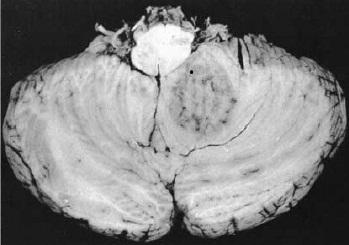
- The answer is b. (Bradley, pp 1932–1933.) This specimen is a transversesection through the brainstem and cerebellum. There is a large area ofdiscoloration and disturbed anatomy in the left cerebellar hemisphere thatis producing little mass effect. Because this is the only lesion postulated forthis patient, there is no reason to suspect seizure activity, because that phenomenonwould be unlikely in the absence of a cerebrocortical (or at leastcerebral) lesion. The other findings listed would similarly not be expectedin a patient with cerebellar damage.
- If this patient had coincidental findings of oral moniliasis, diffuse lymphadenopathy, recent weight loss, and lymphopenia, the most probable cause of the lesion would be
a. Ependymoma
b. Medulloblastoma
c. Granuloma
d. Hemorrhage
e. Infarction
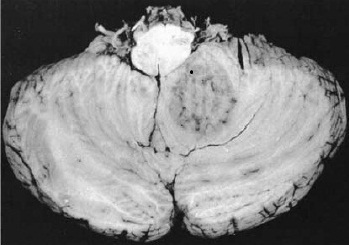
- The answer is c. (Bradley, p 1410.) The clinical picture presented suggests immunosuppression and in the current environment must be considered HIV-related disease (AIDS) until proved otherwise. The most likely cause of intracranial granuloma in an AIDS patient in the United States is Toxoplasma gondii. That this is a granuloma is supported by the limited mass effect that is evident. Tumors, such as ependymoma or medulloblastoma, might extend from the midline into a cerebellar hemisphere but would not be expected to produce so little distortion of surrounding tissues. Toxoplasma granulomas and abscesses are the most common causes of focal brain lesions in patients with AIDS.
- A 13-year-old boy is brought into the emergency room lethargic with a stiff neck and fever. Despite aggressive therapy, the child dies. Postmortem evaluation reveals that the child had primary amebic meningoencephalitis.This condition is usually acquired through
a. Freshwater swimming
b. Eating contaminated meat
c. Eating calves’ brains
d. Anal intercourse
e. Animal bites
- The answer is a. ( Bradley, pp 1389–1390.) Primary amebic meningoencephalitis is usually caused by organisms from the genera Hartmanella or Acanthamoeba. The parasites enter the nervous system through the cribriformplate at the perforations for the olfactory nerves. An especially lethal form of this meningoencephalitis may develop with Naegleria spp. Other parasites, such as S. mansoni, may be acquired through swimming in contaminated freshwater, but it is unlikely that other parasites reach the nervous system through direct invasion across the cribriform plate. Schistosomiasis is acquired when the cercarial phase of the organism penetrates the swimmer’s skin and finds its way into the blood.
- Both HIV and cytomegalovirus infections in the brain characteristically produce
a. Senile plaques
b. Intraneuronal amyloid
c. Intranuclear inclusions
d. Intracytoplasmic inclusions
e. Microglial nodules
- The answer is e. (Bradley, pp 1360–1361, 1415.) The microglial nodulesoccurring with HIV are associated with syncytial cells in the brain andspinal cord, a cell type not typically seen with cytomegalovirus (CMV)encephalitis. Cytomegalovirus is a common CNS opportunistic agent inpatients with AIDS. With HIV infection, the microglial nodules are distributedaround blood vessels throughout the brain. With CMV, the nodulesare more characteristically subpial and subependymal.
Following several days of low-grade fever and mild neck and head pain, a 10-year-old boy develops bilateral face drooping and difficulty fully closing his eyes. Serum is positive for Borrelia burgdorferi IgM. CSF PCR is also positive for this organism’s DNA.143. After B. burgdorferi is introduced by the tick that carries it, the skinaround the bite develops
a. An exfoliative dermatitis
b. Purpura
c. Localized edema
d. Erythema chronicum migrans
e. Vesicular lesions
- The answer is d. (Victor, pp 768–770.) B. burgdorferi is the agentresponsible for Lyme disease. It is a spirochete usually transmitted to humansthrough tick bites. Multiple organ systems are attacked by the spirochete; thenervous system is especially susceptible. Erythema chronicum migrans is anexpanding reddish discoloration of the skin that spreads away from the site of the bite as an expanding ring of erythema. It usually evolves over 3 to 4 weeks. This ring of erythema clears spontaneously within about 1 month and is usually associated with some headache and neck stiffness. Some patients with Lyme disease fail to exhibit the rash.
- The cranial neuropathy most commonly found with Lyme disease isthat associated with damage to cranial nerve
a. III
b. V
c. VII
d. IX
e. XII
- The answer is c. (Victor, pp 768–770.) Facial weakness may be theonly neurologic sign of Lyme disease. The neurologic deficits usually appearweeks after the initial rash. Untreated neurologic disease may persist formonths. The facial palsy or optic neuritis that develops with CNS disease ischaracteristically associated with meningitis.

-
headache and fascial pain17
-
epilepsy and seizures22
-
neoplasm26
-
eye disease40
-
Infections45
-
Disorder of Myelination20
-
CerebroVascularDisease27
-
The Neurological Examination and Diagnostic Test45
-
traumatic and occupational injuries15
-
NEUROMUSCULAR DISORDERS20
-
Spinal Cord and Root Disease26
-
Nutritional and Metabolic Disorders30
-
Dementia and Cognitive Disorders20
-
Movement Disorders25
-
Disturbance of hearing balance and test20
-
Developmental and hereditary disorders40
-
Toxic Injury15



