Black Box Model of Information Processing
Input Signals –> Processing –> Output (motor response)
3 Stages of Information Processing
- Stimulus identification (perception)
- Response selection (decision)
- Response Programming (action)
Stimulus Identifiation Stage
- The ability to sense that a stimulus is present (light, sound, touch, etc.)
- IDing a stimulus can be tricky (clarity and intensity)
- Depends on the stimulus modality
Clarity
If the vision is focused or blurry
Intensity
Brightness or loudness vs dim or quiet
How does modality affect stimulus identification?
Vision reaction time is slower than auditory or touch
Role of pattern recognition in stimulus identification
Patterns make it easier to select a response
Reaction Time
- The amount of tine that passes from the presentation of a stimulus until the beginning of a person’s response
- Different from response time
Factors that influence reaction time
- Number of possible stimuli
- Choice reaction time
- Practice
- Response compatibility
Where do errors occur in information processing?
- Reaction time
- The response was initiated too late
Hick’s Law
- The relationship b/t the number of stimulus-response options and choice reaction time
- As the # of S-R pairs increases, choice reaction time increases in a linear fashion
Effect of Practice on Reaction Time
- Greater practice time results in shorter reaction times
- Practice keeps reaction time from increasing, even when S-R alternatives increase
- Skills often become automatic
- If the same stimulus always leads to the same response, choice RT becomes quicker
S-R Compatibility
Certain responses make more sense to do, making them more compatible
Decision Making
Skilled vs unskilled
Skilled Decision Making
- Better anticipation
- Earlier prediction
- Use different cues
- Quicker reaction time
Types of Anticipation
- Spatial
- Temporal
Spatial Anticipation
- The ability to anticipate performance movement
- Predicting “what” will happen
Temporal Anticipation
- The ability to predict the time course of an event
- Predicting “when” an event will happen
Cost of Anticipation
- Delays the speed of responding
- Costs more if the incorrect movement is started
Signal-Detection Theory
-
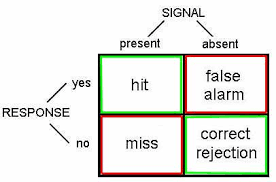
Hit
Saying yes when the signal is actually present
Miss
Saying no when the signal is actually present
False Alarm
Saying yes when the signal is not present
Correct Rejection
Saying no when the signal is not present




