Why are the outcomes for children who have out of hospital cardiac arrest poor (compared to adults)?
In adults, cardiac arrest is usually caused by cardiac arrhythmia, with normal preceding perfusion and oxygenation of tissues. In children, cardiac arrest is usually caused by hyperaemia (reduced oxygenation) or shock (reduced perfusion)< so by the time a cardiac arrest occurs, there has been significant damage to tissues and organs. Children also have small respiratory and cardiovascular reserves compared to adults.
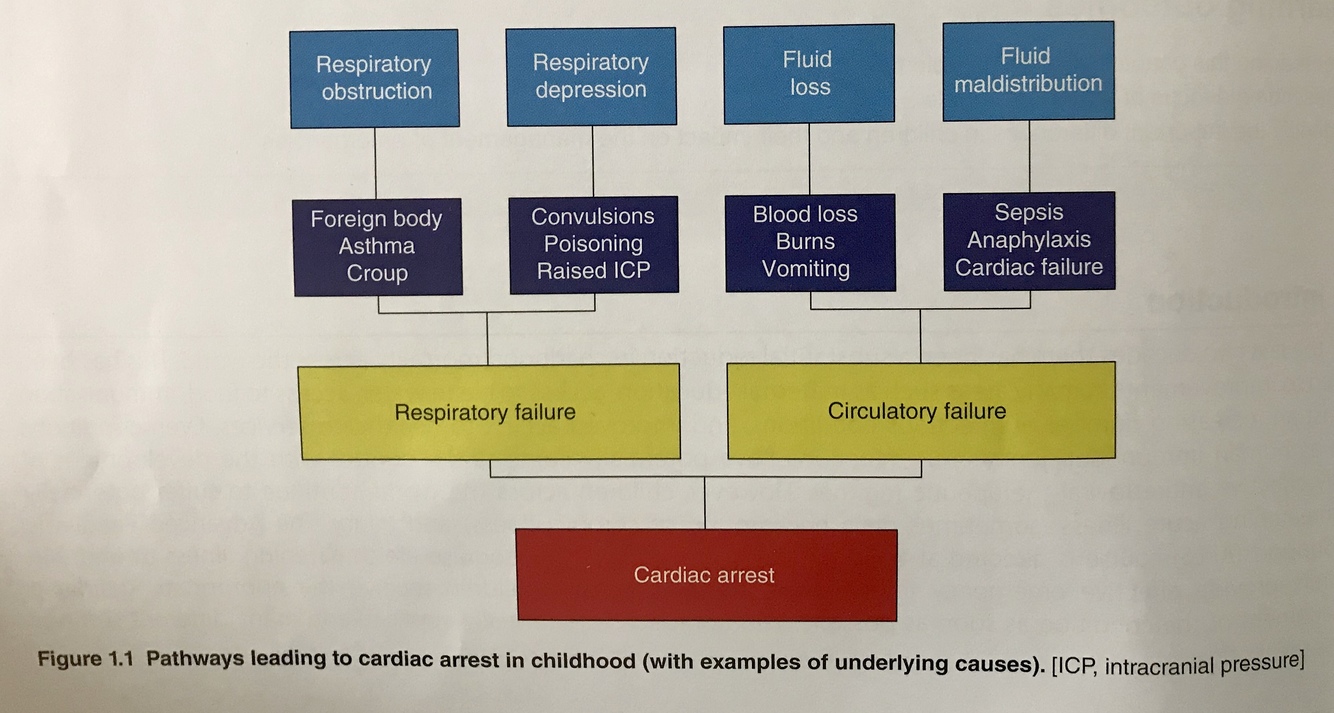
What are the pathways leading to cardiac arrest in children?
- Respiratory Failure - Obstruction e.g. upper - croup, foreign body, lower - asthma - Depression e.g. poisoning, raised ICP, convulsions
- Circulatory failure - Fluid loss e.g. vomiting, diarrhoea, bleeding, burns - Fluid maldistribution e.g. shock - septic, anaphylactic, cardiogenic (cardiac failure)
What methods are available for estimating weight in a child?
- Formulae
- Tapes - Broselow or Sandell (use length of child to estimate weight)
- What are the main anatomical differences in the upper airway of a child (compared to an adult)? 2. What problems may this cause?
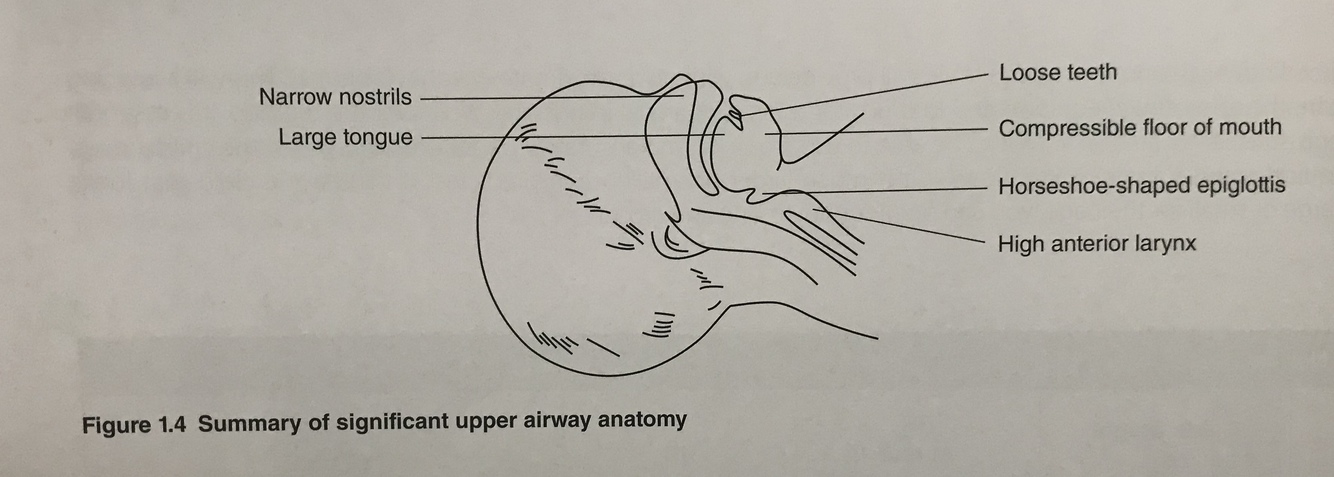
Anatomical differences in upper airway:
- Large occiput + short neck
- when the child is laid flat, this may cause neck flexion and airway narrowing - Narrow nostrils
- infants < 6 months primarily nasal breathers
=> nostrils may become blocked by mucous in URTI causing respiratory compromise
- Small face and mandible
- Floor of the mouth easily compressible
- take care when holding the jaw for airway positioning - Loose teeth
- Large tongue
- obstructs the airway in an unconscious child - may impede view at laryngoscopy - Adenotonsillar hypertrophy
- esp. b/w 3- 8 yo
- may cause obstruction
- may be hard to pass NGT/ pharyngeal/ tracheal tubes - Horseshoe-shaped epiglottis (projects 45 degrees posteriorly)
- tracheal intubation more difficult
- best to use straight blade laryngoscope - Larynx high and anterior (at the level of C2 and C3, not C5/6 as in adults)
- tracheal intubation as above - Cricoid ring is oval in shape
- round endotracheal tube causes a leak at pressure of approx. 20 cmH20
- no leak means the tube is too large
- cuffed endotracheal tubes may be advantageous (even though uncuffed normally recommended) - Trachea short and soft, carinal angles symmetrical
- overextension or flexion may cause tracheal compression
- tube displacement more likely (short trachea)
- foreign body just as likely to go into left or right main bronchus
What are the main anatomical differences in the respiratory system of a child?
- Total surface area of air-tissue interface is small
- Number of airways is small (this increases x 10 from birth to adulthood)
- Diameter of airways is small (causing increased resistance as it is inversely proportional to airway radius)
- The ribs lie more horizontally and contribute less to chest expansion
- The chest wall is more compliant - allowing serious parenchymal injuries to occur without rib fractures (NB the force must be very large for rib fractures to occur)
- They rely more on diaphragmatic breathing
- Resp. muscles have fewer Type I fibres than adults (slow twitch, highly oxidative, fatigue resistant) NB even less in preterm => more prone to fatigue and respiratory failure
What are the main anatomical differences in the circulatory system of a child?
- LV and RV of similar weight at birth, but by 2 months LV is twice as heavy NB ECG - initially shows RV dominance but becomes LV dominant by 4-6 months - p-wave and QRS complexes get bigger - PR interval and QRS duration get longer
- Circulating blood volume 70-80 ml/ kg (proportionally more than an adult but actual volume is small)
How does body surface area (BSA): weight ratio change with age? What are the consequences of this?
Small children have a high BSA: weight ratio => lose heat faster and more prone to hypothermia. As they get older this decreases.
How much BSA (body surface area) does the head account for at birth?
19%
What is surfactant?
A surface-active lipoprotein complex formed by type II alveolar cells in the lung.
What is the role of surfactant?
- Reduces alveolar surface tension, increasing compliance (ability of the alveoli to expand) and reducing the work of breathing.
- Regulates the rate of expansion of alveoli.
- Stops fluid accumulation in the alveoli (by reducing surface tension which would normally draw fluid into alveoli from capillaries).
- Contributes to innate immunity (proteins in the surfactant opsonise bacteria making them easier for uptake by phagocytes).
What are the physiological similarities in the respiratory system of a child and an adult?
- Tidal volume 5-7 ml/ kg
- Work of breathing is 1% of the metabolic rate (NB higher in pre-term infant)
What are the physiological differences in the respiratory system of a child and an adult?
- Higher metabolic rate and oxygen consumption => higher respiratory rate
- Lower lung compliance at birth - due to the presence of fluid in the lung, which is gradually removed in the first week of life - Surfactant helps to increase compliance
- Chest wall is more compliant - causes prominent sternal recession if airways obstructed or lung compliance decreases - intrathoracic pressure less negative => reduced small airway patency => lung volume at the end of expiration is similar to closing volume (the volume at which small airway closure starts to happen)
- Oxygen dissociation curve shifted to the left - P50 (PO2 at 50% O2 saturation is greatly reduced) - because 70% of Hb is HbF - HbF negligible by 6 months
- Lung more vulnerable to insult e.g. - preterm infant on prolonged resp support may develop chronic lung disease requiring oxygen dependence - children who suffer bronchiolitis may remain ‘chesty’ for a year or more
Why do infants desaturate more rapidly than adults?
- High metabolic rate and O2 consumption
- Low lung volume
- Limited respiratory reserve
What are the physiological differences in the cardiovascular system of a child?
- Small stroke volume (1.5 ml/ kg at birth)–> increases with age as the heart muscle gets bigger.
- Highest cardiac index (infant 300 ml/ kg/ min –> adolescence 100 ml/kg/min –> adulthood 70-80 ml/kg/min)
- Younger age = faster heart rate but less able to increase heart rate under stress (30% in infants , 300% in adults).
- Lower SVR (systemic vascular resistance) - increases with age from birth.
- Blunted response to volume therapy normovoaemic - until 2 years of age (CO = HR X SV, SV is small and fixed so SV cannot increase greatly to improve CO).
What is cardiac index?
A haemodynamic parameter that relates the cardiac output (CO) from left ventricle in one minute to body surface area (BSA), thus relating heart performance to the size of the individual (ml/ kg/ min).
How does cardiac index change with age?
Decreases with age. Infant has the highest (300 ml/ kg/ min) –> adolescence (100 ml/kg/min) –> adulthood 70-80 ml/kg/min).
How do you calculate cardiac output?
CO = HR X SV (stroke volume)
What are the physiological differences in immune function in children?
- Immature immune system => more susceptible to infection
- Maternal antibodies (acquired across the placenta) confer some protection but decline by 6 months, being replaced slowly by infant antibodies
- Particularly susceptible to infections in the period b/w waning of maternal antibodies and developing their own
- BF provides increased protection to resp and gastro infections

-
Introduction18
-
Structured approach to paediatric emergencies21
-
Human factors1
-
Normal ranges14
-
Structured approach to the seriously ill child25
-
The Child with breathing difficulties96
-
The Child in Shock46
-
The child with an abnormal pulse rate or rhythm17
-
The Child with a Decreased Conscious level22
-
The Convulsing Child21
-
Structured Approach To The Seriously Injured Child13
-
The Child With Chest Injury15
-
The Child With Abdominal Injury11
-
The Child With Traumatic Brain Injury17
-
The Child With Injuries To The Extremities Or The Spine28
-
The Burned or Scalded Child11
-
The Child with an Electrical Injury or Drowning14
-
Support of the Airway and Ventilation21
-
Management of Cardiac Arrest26
-
Basic Life Support (BLS)16
-
Imaging in Trauma29
-
Acid-Base Balance15
-
Fluid and Electrolyte Management52
-
General approach to Poisoning and Envenomation48
-
Resuscitation of the Baby at Birth19



