Why is there a need for conceptual frameworks in intervention planning?
Because public health interventions are often complex:
- multi component
- distal goal
Need to assess the “mini steps” required to achieve the goal
What is programme theory?
The theory of how a programme works
- explains the pathway of change
- identifies the early and immediate changes needed for the long-term goal to be achieved
- “if-then” process
Give a sample outline of a programme theory
- IF certain resources (e.g. staff, equipment) are available, THEN the programme can provide a certain set of activities or services to the participants
- IF participants receive these services, THEN they experience specific changes in their knowledge, attitudes or skills
- IF individuals change their knowlede, attitudes, or skills, THEN they will change their behaviour and usual practice
- IF enough participants change their behaviour and practice, THEN the programme may have a broader impact on the families or friends of the participants or on the community as a whole
Come up with your example of a programme theory
TIP: It can be related to food
Compare logic models (LM) vs programme theory (PT)
The terms (LM & PT) are often used interchangeably
LM is a summary/picture of a PT
PT has a more explicit explanation of the relationship between factors and resources than a LM
LMs are a practical tool which gives an overview of the whole process
What is a LM? (according to the Kellogg’s Foundation)
“…a logic model is a systematic and visual way to present and share your understanding of the relationships among the resources you have to operate your programme, the activities you plan, and the changes or results you hope to achieve.“
What are the components of a LM? Describe each one.
Input/resources : e.g. money, staff, volunteers, supplies, facilities, equipments
Processes/activities : what is done with the resources e.g. service, treatment, campaigns
Output : amount of activity provided, in quantifiable terms e.g. the no. of materials distributed, number of people screened.
Outcome : changes in participants’ characteristics e.g. knowledge, attitude, skills, behaviour. Can be long or short term
Impact : fundamental intended (or unintended) change in target population (goal).
How do you read a logic model?
IF x
THEN y
Give an example of a LM
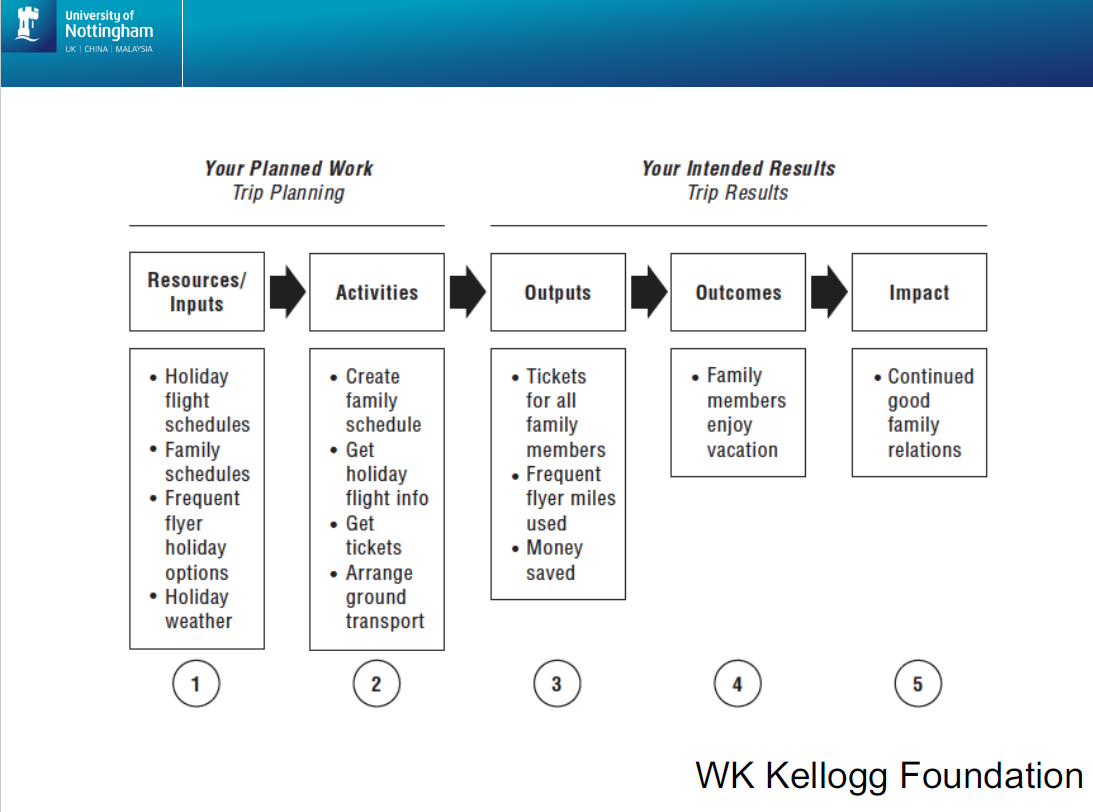
When and why should we use LMs?
In planning
- visualise how an intervention/programme will achieve its goals
- aid communication with stakeholders, especially funders
- check intervention assumptions
- review/correct interventions
In implementation
- ensure activities are consistent with intended outcome
In evaluation
- guide choice of outcomes
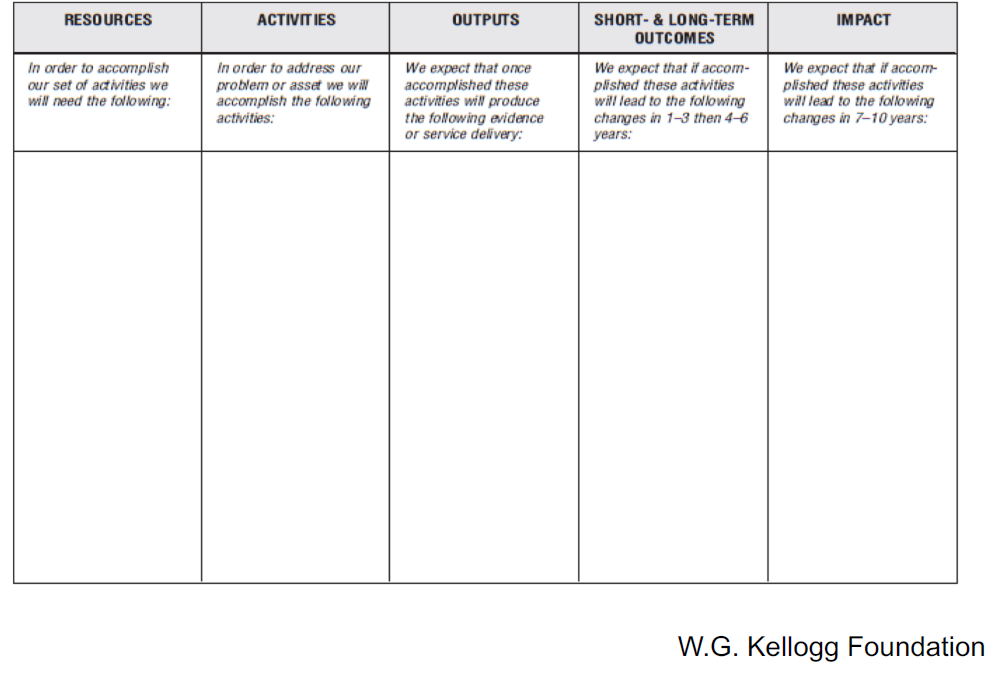
What does a logic model look like?
Can either be linear or non-linear
Avoid wordiness - needs to be succinct and easy to follow
What are the two common approaches to developing a LM?
- Forward logic* - “if…then”
- used often when there is a clear picture of what the inputs and activities will be
- Reverse logic* - “but how?”
- identify the desired outcomes and work backwards to develop activities and inputs
- useful for thinking beyond status quo
How can you facilitate a LM development?
1) Cover wall with paper. Write the long-term impact on one side
2) Identify resources, activities, outcomes. Write each of these on individual post-it notes
3) Post the post-it notes on the wall working together to position them in a logical order. Check the “if-then” relationships. Identify gaps, missing links in the causal chain. Add more post-it notes as necessary. Remove those that are duplicates or fail to fit in the oder - place these in a “parking lot” for later consideration.
4) Draw arrows connecting the post-it notes
5) Record and makes copies of all
6) Plan another meeting to review and refine the logic model




