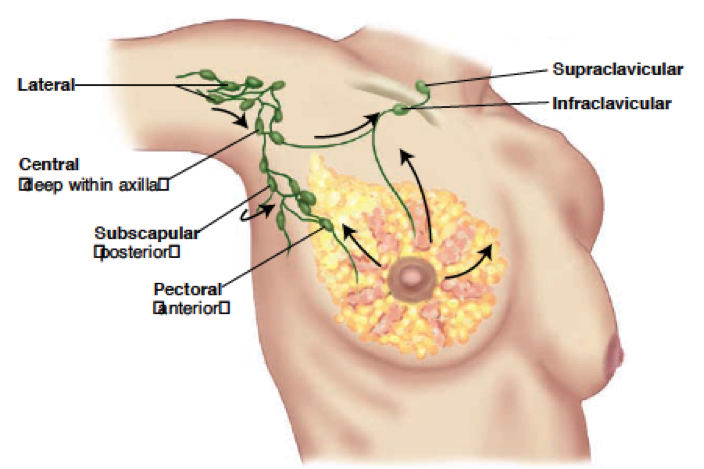
Describe where pectoral, subscapular and lateral nodes are located.
●Pectoral nodes - anterior: closest to breast tissue, nodes drain the anterior chest wall & much of the breast
●Subscapular nodes - posterior: aboce pectoral anterior, located along scapula. Drains posterior chest wall & portion of the arm
●Lateral nodes: located along upper humerus (upper arm) - drains most of arm
●inappropriate discharge of milk-containing fluid: abnormal if it occurs 6 mos or more after childbirth or cessation of breast-feeding
Galactorrhea
What is new nipple retraction an indication of?
What problems might occur w/ a person w/ long-standing nipple inversion?
How do you test for retraction?
- indicator of breast cancer or adhesions below skin surface
- long-standing nipple inversion may be normal → only problem is difficulty breastfeeding.
- new onset: possible cancer
- Testing (3 ways): arms over head, hands pressed against hips, leaning forward
What are the billion risks for breast cancer?
JK, there’s only 15.
hints:
- gender
- age
- relatives
- menarche
- menopause
- pregnancies
- breastfeeding
- which contraceptive use
- fatty fat fatty
- which drug
- lifestyles
- exposure
- ethnicity
- what disease of the nipple
●being female
●previous breast cancer
●age >50
●affected mother or sister (1st degree relative)
●EARLY menarche (<12)
●LATE menopause (>50)
●LATE (>30) or NO full-term pregnancies
●Never breastfed a child
●Oral contraceptive use
●Obesity
●use of alcohol
●high fat, high weight, low exercise
●previous radiation to chest wall
●ethnicity: White women are slightly more likely to develop breast cancer, but african american women are more likely to DIE of breast cancer. Asians, hispanics, and native-american women have a low risk of developing OR dying of breast cancer.
●paget’s disease of the nipple (scaly, eczema-like lesion that may wepe, crust, or erode)
What are the mammogram screening guidelines?
ACS vs USPSTF
- ACS:
- age 40: every year
- Postal service
- start at age 50
- every 2 years
- don’t do it after 75 b/c no one cares anymore
Self breast exam guidelines
USPSTF vs ACS
●USPSTF: no longer recommends teaching self-breast exam (BSE) to patients.
●ACS: still recommends BSE to patients 20 years and older.
Self breast exam How To
- when should you do it?
- what position should you be in?
- what size circular motions? (coin)
- how many levels?
- what are the different methods of palpation?
- Perform just after menses - 5-7 days
- Couple w/ regular clinical exam and mammography
- Can be supine or standing:
- Supine: Hand behind head, three middle fingers palpate for lumps. Use overlapping dime-sized circular motions to feel tissue. Use three different levels of pressure to feel all tissue: light, medium, and firm. Move in up and down pattern, check entire breast.
- Standing: In front of mirror with hands on hips, look for changes in size, shape, contour, dimpling, redness, scaliness. Examine underarms.
- Methods:
- Circular
- Wedge
- Lawn mower
What % of men get breast cancer?
1%
What should you palpate when palpating breasts?
- compare quadrants, areola, tail of spence
- if ON breast tissue: clock
- if NOT ON breast tissue, and closer to arm pit: tail of spence
How/where do you palpate someone w/ breast augmentation/reconstruction?
Should they get a mammogram?
- Palpate breast tissue on top and around edges of implant
- Palpate along incision lines
- Palpate axilla carefully
- Still get a mammograph!
How / where do you inspect/palpate a post-mastectomy?
What should you note?
- inspect scar/axilla
- Palpate gently over scar, upper outer quadrant, axilla
- Note lymphedema, lymph enlargement, infection, chest masses
What hormones might be imbalanced if an adolescent has gynecomastia?
estrogen & androgen imbalance
What might you see in a person with BENIGN breast disease?
●multiple tender masses
●cyclic discomfort (e.g, PMS)
●lumpiness
What are the S/S of breast cancer?
At what age are 85% of people w/ breast cancer?
●Swelling of all or part of a breast (even if no distinct lump is felt)
●fixed, solid or hard nodule, nontender, irregular or ill-defined borders
●lymphadenopathy
●85% are >40 YO, 66% >50 yo
●Skin irritation or dimpling
●Breast or nipple pain
●Nipple retraction (turning inward)
●Redness, scaliness, or thickening of the nipple or breast skin
●A nipple discharge other than breast milk
Fibroadenoma
Usual Age:
Number of masses:
Shape:
Consistency:
Delineation (border):
Mobility:
Tenderness:
Retraction:
Usual Age: 15-25, but can occur up to 55
Number of masses: single, may be multiple
Shape: round or lobular
Consistency: usually firm, may be soft
Delineation (border): well delineated
Mobility: very mobile
Tenderness: non-tender
Retraction: Absent
Cysts
Usual Age:
Number of masses:
Shape:
Consistency:
Delineation (border):
Mobility:
Tenderness:
Retraction:
Usual Age: 30-50, w/ regression after menopause except when using estrogen Tx
Number of masses: single or multiple
Shape: round
Consistency: soft or firm, usually elastic
Delineation (border): well delineated
Mobility: mobile
Tenderness: often tender
Retraction: absent
Breast Cancer
Usual Age:
Number of masses:
Shape:
Consistency:
Delineation (border):
Mobility:
Tenderness:
Retraction:
Usual Age: 30-90 - biggest range. Most common after 50
Number of masses: usually single, may co-exist w/ other nodules
Shape: IRREGULAR, STELLATE
Consistency: firm, hard
Delineation (border): not well delineated
Mobility: **fixed to skin or underlying tissue **
Tenderness: nontender
Retraction: may be present




