Calling Master in ROC
- Proceed to Bridge Imediately
- Assess Determine ROC as per Rule 7 (scanty info)
- Take Con (VDR) & Action as per Rule 8
- Avoid Immediate Danger as per R2b.
- Make sound & Light Signals
- Immanant Collision - Assess best action to save Lifes, environment and vessel - Bow Collision bulkhead is Strongest!
a) Full Ahead to full astern in one swift movement (Auto Emergency / Crash Stop) Large Ships program use Start Air
b) If searoom full turn quickest means to stop/ slow (Know Advance & Transfer caractatistics of vessel) - Collision
Raise Alarm, PA Announcement, Muster & Prepare
Follow ISM - EGM / ICS Bridge procedures guideance - CL
Remember - VDR, Record Keeping & Timeings
Report: GMDSS, Costal State, DPA, Charterers, Ovners & P&I
Make entry into Official Logbook
Bridge Organisation
- Refer to company SMS
- Assign duties as per STCW level of competency (Support, Operational, Management)
Part A: Mandatory minimum standards
Part B: Recommended guidelines
- ICS - Bridge Procedures Guide
- Check for BRM - (Bridge Resource Management)
- Assign active roles relevant to Rank
i) Operations Director - Overview all Operations - Give
guidance to Bridge Team - Monitoring Perfonmance
ii) Navigator / Administrator - Comply with COLREGS -
Responsible for conning the vessel - Warns Master
or Pilot if off track / plan - Fix & Monitor ships
position - Manage alarms ( Notify Master if urgent )
iii) Lookout - Monitor and report (Not to be distracted)
iv) Helmsman - Follow and execute helm orders
6. Bridge Manning levels
i) Green - Open sea (Minimum Bridge Mannig)
ii) Yellow - At night (Minimum OOW & Lookout)
iii) Red - Pilotage, dense traffic, overwhelmed, Fog
(Master must be on the bridge)
Not withstandig any measures above as the master is always responsible for the vessel and has overall authority
Written instructions (masters standing orders) must be followed by the bridge team.
Also whenever he leaves the bridge clear instructions should be left for all navigators in his absence in the form of night orders or notes on the chart on any operational requirements (Speed, ETA, Reporting, Calling the Master) or anything not covered by standing orders.
Masters Standing Orders
Every Ship as well as their operational requirements are different and even though the company SMS clearly stipulates each employees roles and responsibilities
The master has overall responsibility for the functioning of the vessel in every aspect. Keeping in mind Codes, Conventions, Rules and Regulations as well as special operational requirements the master puts his requirements into wrighting.
The Masters Standing Orders contain best judgement and experience combined with guidance from SMS Establishes a system of engagement with mutual intrests and understanding of what exactly is expected and therefore promote effectiveness and confidence
Consider:
i) Capabilities of Officers and ratings onboard
ii) Type of vessel and trade patterns
iii) Anything that may have caused concern in the past
iv) Guidance to insure high standards and teamwork
v) Whenever he takes rest clear instructions should
be left in his absence in the form of night orders
for any specific operational requirements
(Speed, ETA, Reporting, Calling the Master) or
anything not covered by standing orders.
Night Orders as well as standing orders is an extension of a masters personal judgement on ships specific operational requirements as well as safety and security
Every officer must sign the Standing orders as well as Night orders indicating that they have read an understood what is expected of them by the master.
Passage Planning
1) Appraisal - Sailing Directions, Pilot Books,
Nav Warnings, UKC, Nav Dangers
2) Planning - Plot best route using info from appraisal.
Make Use of Lead lights, clearing lines,
PI and WO positions. Add notes on WP,
DTG, Alterations, Call points, Riggs Traffic
concerns, Dangers to Navigation
3) Execution - Master check and aproove plan
considering owners, charterers or any
other operational requirements as well
as weather and considering ports of
refuge, Take account of Deadlines,
Speed, Fuel, Water, food, or possible
special security requirements.
4) Monitoring - Fix positions, follow Passage Plan
Emergency Preparedness
1) Conduct Regular drills to insure crew preparedness
2) Ensure all are familiar with their duties, contents of
the EGM as well as Training Manual
2) Take actions to save lifes, the environment &
property
3) Always Follow Immediate actions Guide to ensure
the correct pre-planned procedures are being
followed
4) Types of Alarm Signals
General Alarm
Rush to muster station with life jacket, immersion
suit, Act according to the vessel’s Muster Lists or as
instructed by OIC Fire alarm
Investigate immediately & Report findings to OOW If
safe to do so attempt to put out the fire with
portable extinguisher. All other crew Muster
according to the Fire Muster List.
Emergency response team to prepare without delay
in case they need to fight the Fire
Abandon Ship Signal
Rush to the muster station, Carry as much ration,
water, and warm clothing as you can carry.
Act according to the vessel’s Muster Lists.
Man Overboard signal
Throw lifebuoy and Rush to the deck and try to
locate MOB, do not lose sight.
The Williamson Turn
i) Note the position of the ship
ii) Put wheel hard over to the side of the casualty
iii) After 60º, put the wheel hard over to the other side
iv) When vessel is 20º short of the reciprocal course,
wheel on the midship, Now on reciprocal course
The Scharnow Turn
i) Rudder hard over toward MOB
ii) After 240º, rudder hard to the opposite side.
iii) When heading 20º short of the reciprocal course,
put the rudder amidships,
Now on reciprocal course
The Anderson Turn
i) Stop the engines.
ii) Put the rudder over toward the person
iii) When clear of MOB, Full ahead, full rudder.
iv) After deviating 240º (2/3 of a complete circle),
back the engines 2/3 or full.
v) Stop the engines when MOB 15º off the bow.
vi) Ease the rudder and back the engines as required.
Exceptional Circumstances
Collision, Grounding, Structural Failure, Flooding, Instability, Cargo Shift, Blackout, Steering/Engine Failure
All covered in EGM under company SMS.
EGM Part A - Onboard Guidance
Part B - Reporting & Emergency Contacts
Part C - Emergency Response Management
Manage Impact on
1) People ( Safety of Life)
2) Environment (SMPEP)
3) Asset (Damage Control, Refuge)
4) Reputation (Media and Authorities)
Marine Notice No. 55 of 2020
Reporting of oil spills and shipping casualties threatening pollution
MARINE POLLUTION (CONTROL AND LIABILITY) ACT 1981 (Act 6 of 1981)
(1) When any harmful substance has been discharged or
2) Ship sustains any damage within (E.E.Z) which causes, or creates the likelihood of, a discharge and
(3) If Damage to a ship is affecting its seaworthiness in any degree,
Anyone (preferably the Master) shall by the quickest means of communication available report the facts to the Duty Operator at SAMSA MRCC or to the nearest SAMSA Principal Officer.
Depending on severity SAMSA’s Casualty Response Unit (CRU) may also be activated, The CRU have goverment backing.
Marine Notice No. 13 of 2017
Vessels Requiring a Place of Refuge for Repairs.
Vessels transiting through South African waters but had their seaworthiness or safety compromised are not deemed to be on “innocent passage” and is therefore in contravention of the Marine Traffic Act 2 of 1981.
Any person receiving information regarding a vessel that may require assistance in any form with respect to seaworthiness or safety or a potential similar situation is to report this to the Maritime Rescue Coordination Centre, SAMSA Regional Manager or Principal Officer at the port closest to the vessels vicinity, without delay.
Contact details are found in the Annex to Marine Notice 4 of 2017.
In terms of the International Management Code for the Safe Operation of Ships and for Pollution Prevention a master in this situation is required to report these facts to the Designated Person Ashore.
Owners, Managers, P and I Club representatives and Agents on receipt of such information are requested to inform SAMSA as soon as they become aware of a potential situation.
SAMSA has authority under Marine Traffic Act
TNPA has authority under national Ports Act
SAMSA may require the following, before permission is granted to close the coast;
- SAMSA surveyor(s) may be appointed to inspect the vessel to confirm the issues reported and understand possible threats to the safety of the crew and possible pollution to the environment. Owners’ Agents are required to arrange safe transportation to the vessel, normally by helicopter;
- SAMSA may require that, where the threat of pollution may exist, all pollutants are removed from the vessel; and
- The Owners secure the services of a salvage tug, approved by SAMSA, which will be required to stand-by the vessel or escort the vessel through the Exclusive Economic Zone.
- SAMSA Levies Act (Act 6 of 1998), Charges apply for vessels breaking innocent passage.
Requirements for Refuge
- Remove All black oil including engine sump oil
- Powerfull salvage tug made fast
- Salvage contractor = member of (ISU) Int. Sal. Union
- Must have an operational plan approved by SAMSA
- Have letter of guarantee in place (IG club letter)
- Owner cannot limit liability (Wreck & Salvage Act)
- ETV on standby (Emergency Towing Vessel)
MARINE NOTICE NO 6 OF 2021
TOWING OPERATIONS IN SOUTH AFRICAN WATERS
There are generally two situations where vessels may need to be towed:
- Emergencies at sea which can be classified as an uncontrolled event e.g. vessel has a breakdown and is unable to return to port without assistance, or
- Operational reasons which can be classified as a controlled event e.g. vessel needing to move from one port to another for repairs or modifications to be carried out.
MN 6 of 2021 - A vessel that has been towed into port as casualty/emergency is considered as an operational tow if it were to depart the port again.
- Any vessel under tow making an initial departure from a South African port is required to hold a certificate of Inspection/Approval as evidence of conformance with international standards and industry best practices regarding seaworthiness, satisfactory rigging of tows and compliance with the International Regulations for Preventing Collisions at Sea 1972.
- When a tow has been inspected by an approved warranty surveyor it shall not be necessary for a SAMSA surveyor to conduct an inspection, but a certificate signed by the warranty surveyor must be provided.
- Failure to comply with the provisions above is considered a contravention in terms of the Merchant Shipping Act 57 of 1951 and may result in the vessel being unnecessarily delayed and/or the owner being prosecuted.
REPORTING OF VESSELS BEING TOWED
In order to reduce the danger and to monitor ships operating around the coast which are engaged in towing, it is requested that all vessels engaged in towage operations proceeding around the South African coast advise MRCC prior to entry into territorial waters.
The following information should be provided:
a. Name of Vessel,
b. Official number,
c. port of registry,
d. gross tonnage,
e. type and number of vessels being towed,
f. whether the vessels are pollution free or not,
g. vessels initial reporting position and final destination,
h. expected date and time of entering territorial waters,
i. the name and address of the shipowners/agents.
MN 6 of 2021 give further guidance on
- Heeling levers for towing operations
- Heeling levers for escort operations
- Additional minimum stability criteria
- Freeing ports
- Requirements for minimum freeboard set at least 0,005*Lll (Lll = load line length)
- Stability requirements are also defined in the International Code on Intact Stability, 2008 (IS Code)
LOF
Lloyds Open Form
- No time to negotiate (Urgent Assistance Needed)
- Binds Ship, Bunkers & Cargo - Owners Share Cost
- Ship & Salvage Company Negotiate on completion
- Reward is calculated on Danger and Complexity
- LOF framework ensures fairness to all
Brussels Convention
Article 14 - No Cure No Pay
- Had to prove environment, ship or cargo were in danger before compensation was paid out
- Did not apply on the high seas
Scopic Clause
Invoke Article 14
(No Cure no Pay) (Brussels Convention)
- No Proof needed
- 2 million USD security required
- Scopic Clause can be Invoked at any time.
- If Scopic Clause were Invoked 25% less if salvage is successful
What are the 4 Pillars of the IMO
- STCW
- SOLAS
- MARPOL
- MLC
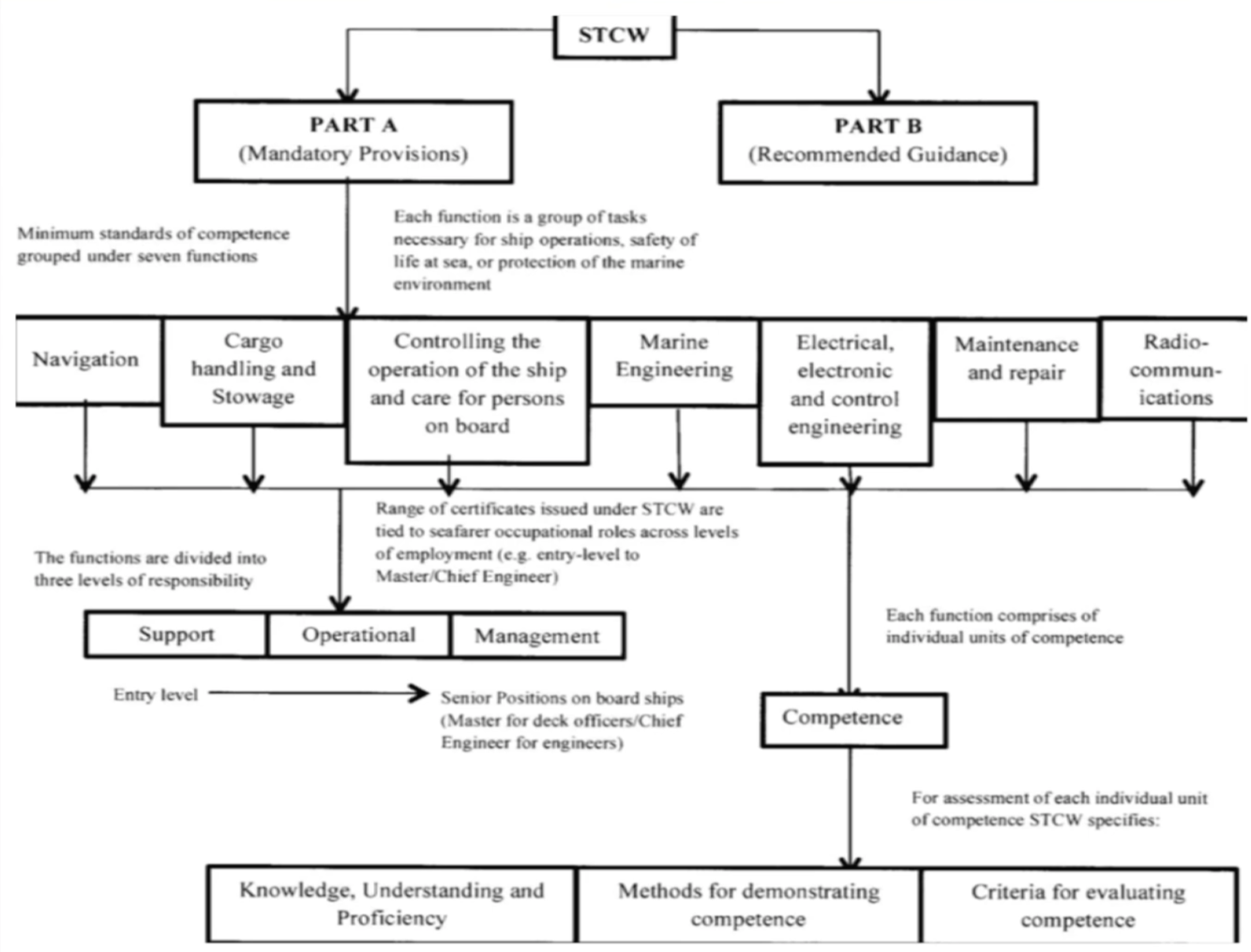
STCW
International Convention on Standards of Training, Certification and Watchkeeping for Seafarers (STCW),
Part A - Mandatory = SAMSA Code (Ratified)
Sets minimum qualification standards for masters, officers and watch personnel on seagoing ships
Part B - Recomended Guidance (ie Simulators) Not all countries have the resorces to implement
Minimum Standards of compitance is grouped into seven functions each function is nesesary to insure safety of life at sea, environmental protection as well as ensuring compatancy in all aspects of ship operations.
Seven Functions
- Navigation
- Cargo handeling & Stowing
- Ship operations and care of persons onboard
- Marine Engineering
- Electrical / Electronic Engineering
- Maintanance & Repair
- Radio Comunications
Functions devided into three levels of responsibility
- Support - Entry Level ( AB’s, MM,Cooks & Cadets )
- Operational ( OOW & Officers )
- Management ( Master, C/O, C/E & 2/E )
Compitance is measured by
- Knowlage, Understanding & Proficiency
- Methods of demonstrating Competancy
- Criteria of evaluating Competancy
The White list Countries
Full compliance with STCW-95 Convention & Code
STCW Manilla Amendments
- Rest hours incresed from 70 to 77 hours a week
- Included 10 hour rest period in 24h
- 10 hours may be devided into more than 2 periods
- One rest period must be at least 6 hours
New requirements for drug and alchol
SOLAS
International Convention for Safety of life at Sea
Compiled by IMO in responce to TITANIC disaster
Main Objectives (Minimum requirements)
- General Provissions (Port State, survey & Cert) .
- Construction
- Structure - Sub Devission, Stability & Equipment installation
- Fire - Protection, Detection, Extinguish. .
- Life Saveing Aplyances & arrangements (LSA,FFA, Resque Craft & Muster incl. drills) .
- Radio Comunications (GMDSS, SART, EPIRB, VHF) .
- Safety of Navigation (Min Manning, Passage Planning, Nav Dangers, Nav Warnings, Distress, Tide, Steering, Pilot) .
- Cargo (MSDS, Load, Unload, Stow, Grain) .
- Carage of dangerous goods (packaged / bulk)
- IBC Code - Bulk
- IGC Code - Gas in Bulk
- IMDG Code - 9 Classes of DG
- Nuclear Ships - Nuclear ship reqirements .
- Onboard Safety Management - ISM, Cert & Verif. .
- High Speed Craft - Code of safety for High speed. .
- Measures to enhance Maritime Safety - Surveys & Inspections and Ship Identification (IMO Numbers) .
- ISPS - ISPS Code, Ship security Alert System .
- IBC Code - Structural, Survey, Water ingress alarm .
- Complyance - IMO member state audits .
- Polar Reagons - Polar Code
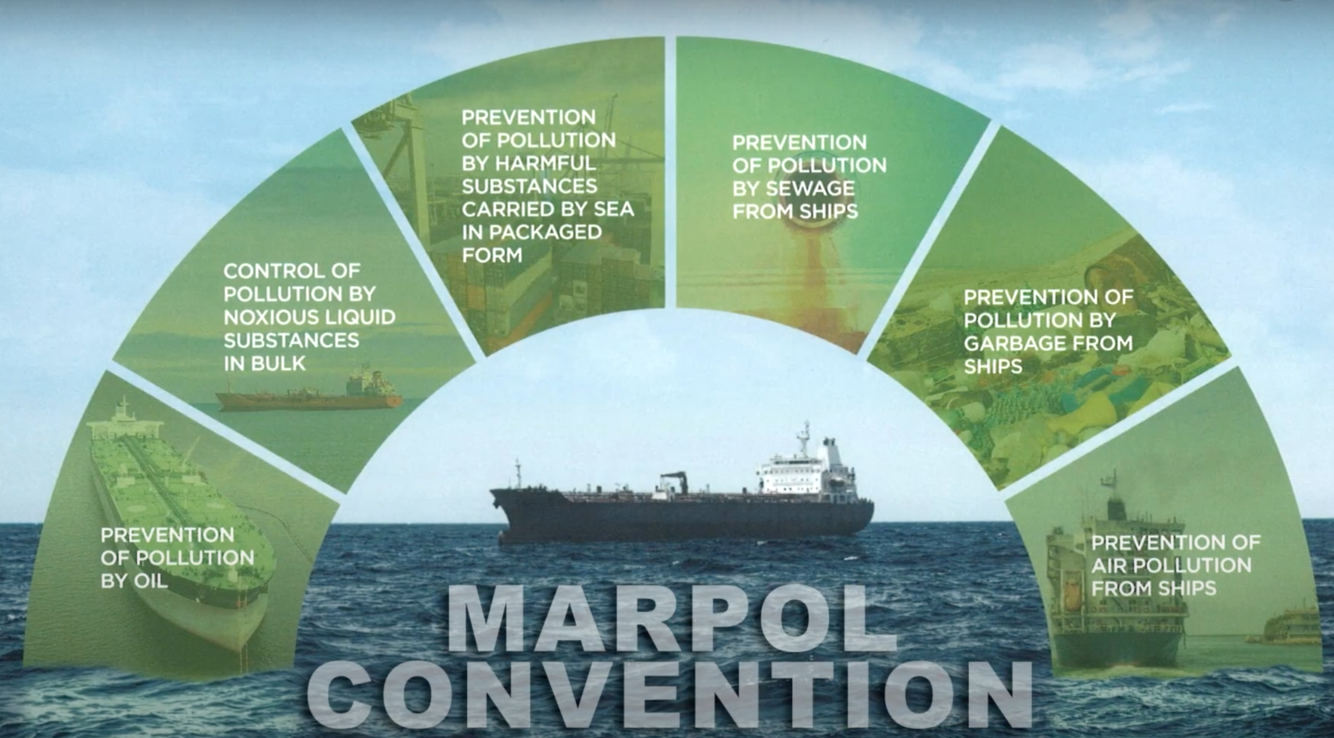
MARPOL
Seven Annexes = Pollution from:
- Oil (Double Hull)
- Ship > 400 gt
- Aprooved OWS
- Ship Enroute
- Dist > 12 nm from nearest land
- Discharge < 15ppm
- Oil < 30 liter / nm
- Monitor shut off oil > 15ppm
- No discharge in special areas .
- NLS
- Tank Washings 0.1% by weight
- Special Aria 0.05% by weight
- Concentration in ships wake 1ppm
- Dist > 12 nm from nearest land
- If cannot comply discharge to reception .
- Harm. Packag
- Detailed inst. on Packing, marking & labeling
- Certification
- Stowage
- Quantity limitation
- Exeptions & Notifications
- Clasified as marine polutants under IMDG.
- Ships must carry DG Manifest. .
- Sewage
- STP / Treated Dist > 3 nm from nearest land
- Un Treated Dist > 12 nm from nearest land .
- Garbage
- NO Plastic
- Grinded Food Waste >3M, (Special >12M)
- Food Slops >12M (Special Prohibeted)
- Cargo Residues >12M (Special see NLS)
- Air
- NOx - Nitrous Oxides
- SOx - Sulpher Oxides
- ODS - Ozone depleteing substances
- Sulphates of Marine fuel < 4.5%.
- Special arias Sulpher > 1.5%. .
- Ballast (Avoid Bio Invasion)
- Ship >400gt
- BWMP
- BW Record Book
- BWTP
- BW Mannagement certificate
- By 2024 All ships to be fitted with BWTP No exchange alowed if not treated
- Implemented on renewal of IOPPC cert .
- (Antifouling Paints)
- (Noise)
- (Vibration)
MLC
Marine Labor Convention (Seafaerers Bill of Rights)
MLC Replaces the 69 ILO conventions
Five main Areas
Part 1 - Standards ( Mandatory )
- Safe secure workplace on ship
- Age 16,
- Medically Fit,
- Trained / certified,
- Employment without charge,
- Recrutement must conform with code .
- Fair Conditions of Employment.
- Employment Agreement
- Monthly Pay in full
- Minimum wage per ISF , ITF (ship/trade)& ILO
- Regulated Rest Hours
- Paid Anual Leave
- Shore Leave
- Repatreation & Compensation (sick/sink/sold)
- Propper Manning levels
- Member countries promote employment .
- Decent working & Living conditions
- Room size, heat, a/c, WC, light & Hosp
- Well ballanced meals, water (diatry reqirem)
- Trained catering staff .
- Rights to Health Protection, Medical Care & social security protection
- Prompt & Adequate Health protection
- Financial asistance if sick, injured or death
- Onboard HSE Training (Accident, Injury)
- Social security, unimployment retirement .
- Compliance and Enforcement
- Maritime Labour Cert
- Decleration of Maritime Labour Compliance
- Certs. issued by flag state
- Inspected by Port (PSC) and Flag States
Previously countries could get away with only ratifying selected conventions.
Part 2 - Guidelines (Recomended)
- Crew Placement
- Shorebase Welfare
- Complaints handeling Procedures
Publications Available
- Guidelines for flag state inspectios (MLC 2006)
- Guidelines for port state inspections
- ILO Action Plan ITF & ISF & IMO (Int. Trade & Int. Shipping Federation)
ISM
International Safety Management Code
Direct result of the grounding of the
- “Herald of Free Enteprise” &
- “Exxon Valdez”
Both cases pointed to lack of propper management
Part A - Implementation
- General - (Definitions, Objectives, Aplication, Functional Requirements)
- Safety & Environmental Protection Policy
- Company Responsibility and authority
- DPA
- Masters Responsibility & Authority
- Resorces and Personell
- Plans for shipboard operations
- Emergency Preparedness
- Reports & Analysis (Deficiancies, Haz ID, AIR)
- Maintanance of ship and equipment
- Documentation
- Company verification
Part B - Certification & Verification (Certs & Forms)
ISM Audit
Basically everything
(Safety, Fire Fighting, Bridge, Passage Plans, PMS, ER Maint, Documented Procedures and checklists, Duties)
DOC - Issued to management company in compliance
SMC - Issued to Ship to show that it complies with ISM
SMS
SMS helps find patterns and can help to overcome safety gaps by finding and reduceing risks.
Regular reporting and continious risk assesment and management is nesesary.
3 Layer System
1) Instructions. 2) Procedures 3) Manuals (SMM)
Key Factors
- Familiarisation
- Duties & Responsibilities
- Emergency Preparedness
- Hours of work & Rest Hours
- PPE
- Company Policies (Smoke, D&A, Energy)
- Safety Meetings




