Defining the knowledge domain:
- What is the distinction between data, information and knowledge?
- Knowledge is described with two dichotomies, what are these?
Relevant data:
Data are the basic building blocks for information, i.e. Sales-, industry-, consumer-, and financial data
Relevant Information
Information is data that have been arranged into meaningful patterns. It might be given in sentences, policies, models, or tools
Relevant Knowledge
Knowledge gives the potential to act and also gives the capacity to transform data and information into ideas and decisions
Knowledge can be either explicit or tacit in nature and individual or social
In class we heard an example of an industry or a place where there has been a movement from tacit to explicit knowledge.
- Where ?
Science in the kitchen – New tendencies in culinary services innovation
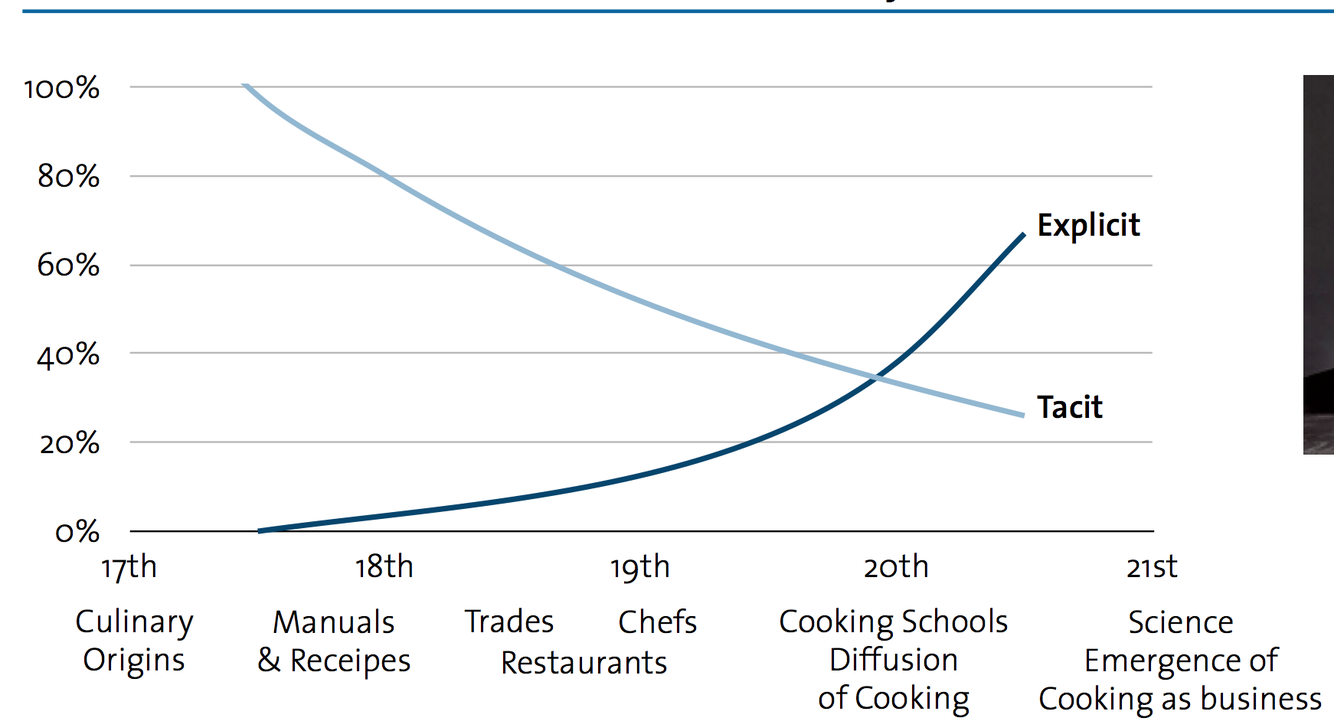
It has been argued that “You can‘t manage knowledge. Knowledge is between two ears and only between two ears”
But,
- is this true?
- Why (not)?
No,
We can enable knowledge creation by providing the right context
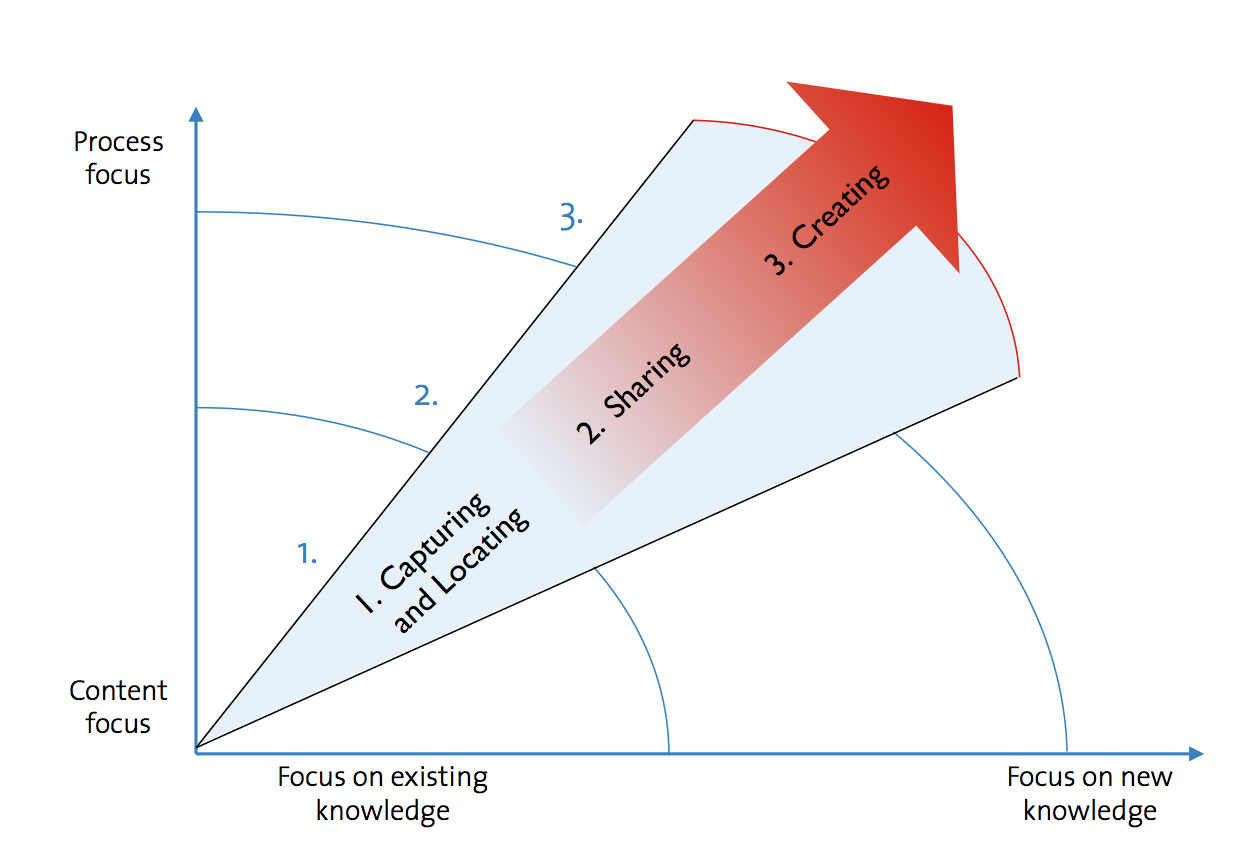
Briefly explain the model of company development:
1) What are the axes?
2) What are the phases?
1)
Y axes: Content focus - Process focus
X axes: Focus on existing knowledge - Focus on new knowledge
2)
Phase 1 - Capturing and Locating:
Locating and capturing existing knowledge
Phase 2 - Sharing and Transferring:
Transferring or exchanging explicit and tacit knowledge
Phase 3 - Creating:
Generating new explicit and tacit knowledge by individual or groups
- Two ways of Capturing & Locating existing knowledge?
1) Developing a “knowledge map”
By developing a Knowledge Map, i.e. an actual map, yellow pages, or a smartly structured database the company can create an inventory of existing knowledge
2) Making tacit knowledge accessible
Tacit knowledge can be made accessible by ensuring its identification
Two was of sharing or transferring knowledge?
1) One-Way Sharing
Transfer explicit knowledge from one person, group, department, unit, or company to an other
2) Two-Way Sharing
Exchanging explicit and tacit knowledge within a group of people through “face to face” interaction and intensive dialogue
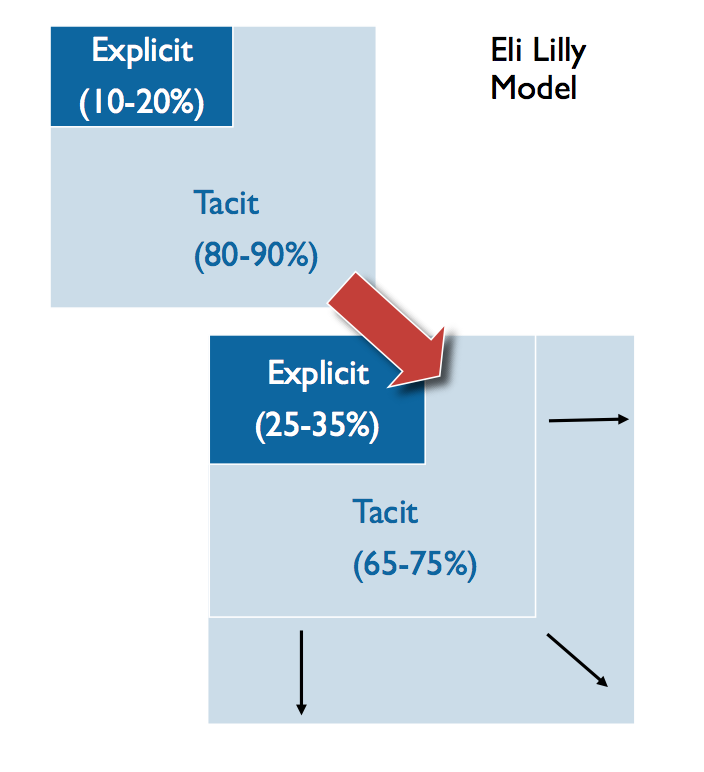
- In one line, what is the key in knowledge creation?
Moving from tacit to explicit knowledge
1) Who made the model of the “Dynamics of knowledge creation”?
2) And what is the name of the model?
1) Nonaka & Takeuchi (1995)
2) The SECI model
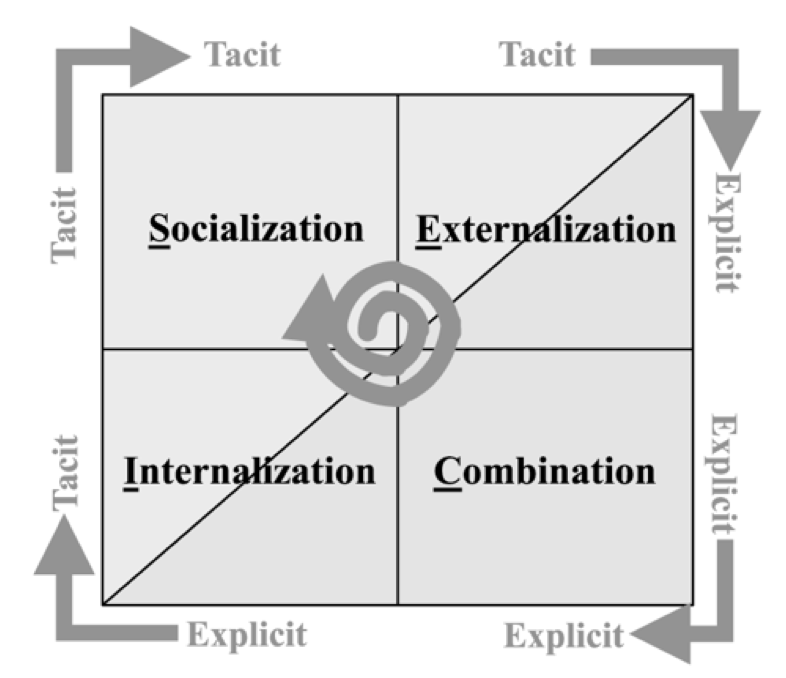
Explain the SECI model
(Try to draw it)
Nonaka and Takeuchi worked extensively with the concepts of explicit knowledge and tacit knowledge, and drew attention to the way Western firms tend to focus too much on explicit knowledge.
The authors proposed four ways that knowledge types can be combined and converted, showing how knowledge is shared and created in the organization
Socialization: Tacit to tacit. Knowledge is passed on through practice, guidance, imitation, and observation.
Externalization: Tacit to explicit. This is deemed as a particularly difficult and often particularly important conversion mechanism. Tacit knowledge is codified into documents, manuals, etc. so that it can spread more easily through the organization. Since tacit knowledge can be virtually impossible to codify, the extent of this knowledge conversion mechanism is debatable. The use of metaphor is cited as an important externalization mechanism.
Combination: Explicit to explicit. This is the simplest form. Codified knowledge sources (e.g. documents) are combined to create new knowledge.
Internalization: Explicit to tacit. As explicit sources are used and learned, the knowledge is internalized, modifying the user’s existing tacit knowledge.
Read more:http://www.knowledge-management-tools.net/knowledge-conversion.html#ixzz3XGwDZoev
What could be some critiques of the SECI model?
- It is based on a study of Japanese organizations, which heavily rely on tacit knowledge: employees are often with a company for life.
- The linearity of the concept: can the spiral jump steps? Can it go counter-clockwise?
1) How can knowledge be refered to as capabilities?
2) Describe the relationship between knowledge and the risk of replication?
1) The recurrent patterns in creating, transferring, or otherwise “managing” knowledge are referred to as capabilities
2) - Technology and knowledge is often costly to replicate, whether the replication is desired by the firm or occurs by imitation and spillover
- The codification of knowledge to make transfer less costly and more speedy, enhances the risk of imitation and spillover
From knowledge to capabilities:
- What are three types of capabilities and what are they linked to?
Combinative, Integrative and Protective
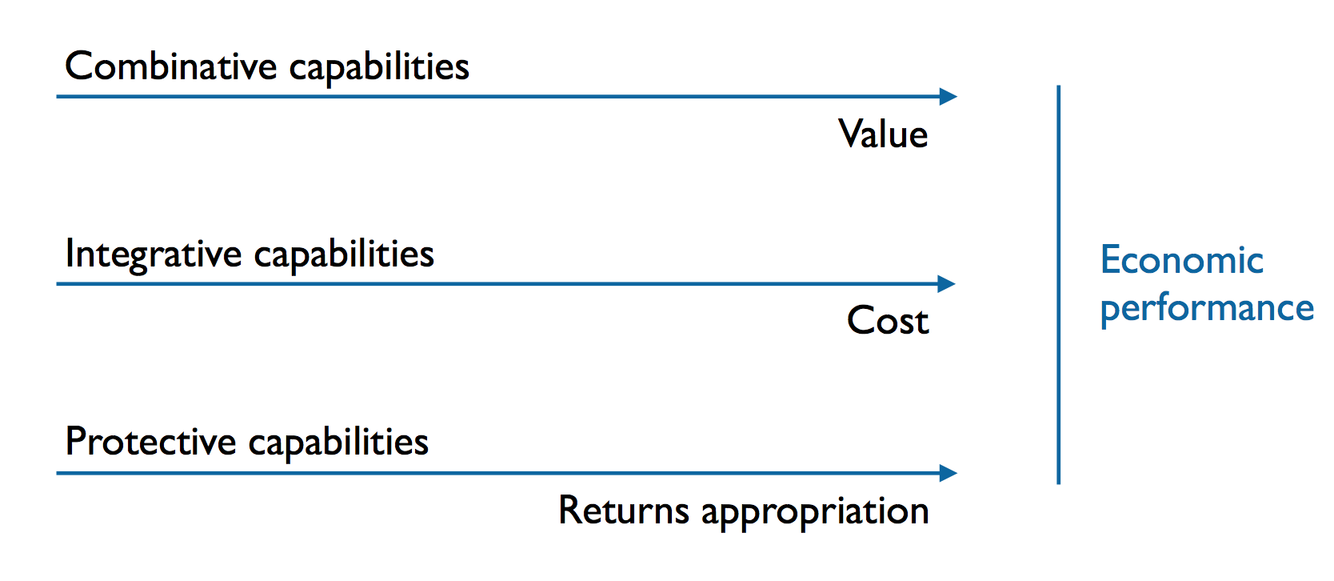
Why is Combinative Cababilities important?
- The firm needs to organize so that knowledge from external and internal sources can be used in developing products and services to meet market opportunities
- The firm’s competitive advantage, and economic performance hinges on the nature of its combinative capabilities, replication of technical knowledge, and imitation of knowledge by competitors
Combinative capabilities:
- Explain growth of knowledge of the firm (Kogut & Zander, 1992)
- The central competitive dimension of what firms know how to do is to create and transfer knowledge efficiently within an organizational context –> what firms do better than markets (why firms exist) is the sharing and transfer of the knowledge of individuals and groups within an organization
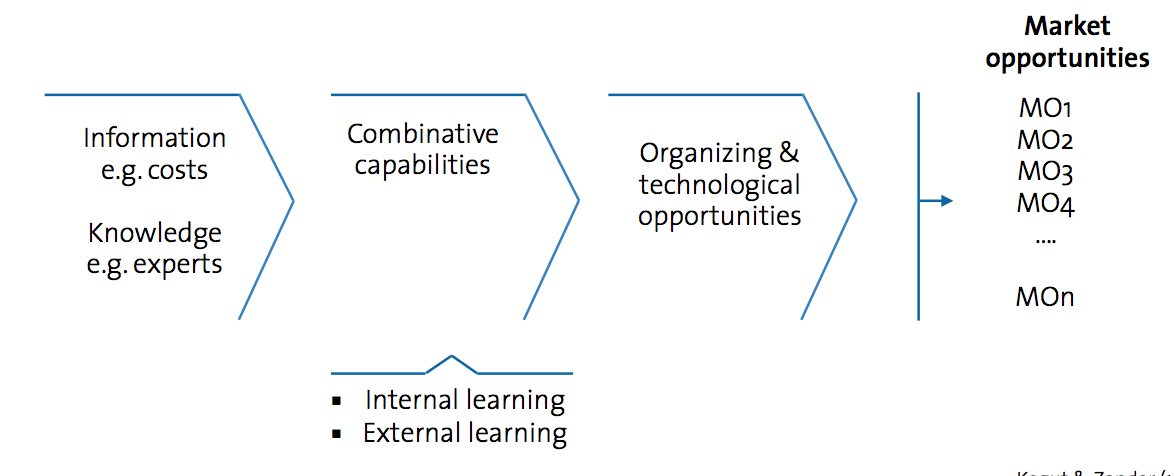
1) They begin by analyzing the knowledge of the firm by distinguishing between information (e.g prices) and know-how (e.g. divisionalize).
2) They introduce the concept of a combinative capability to synthesize and apply current and acquired knowledge
3) knowledge may be recombined through internal learning (reorganising, accidents. experiments) and external learning (acquisitions, joint ventures, new people).
4) An important limitation to the capability of developing new skills is the opportunity (or potential) in the organizing and technologies for further exploitation.
5) These investments in new ways of doing things serve as platforms on future and uncertain market opportunities.
For further explanation: http://pages.stern.nyu.edu/~padamopo/blog/ITandOrganizations/Kogut_Zander_1992.html
How/what is the relationship between resources, competitive advange and the risk of imitation?
Hint: two considerations/dimensions
Consider:
- Why might the resources be costly to imitate?
Causally ambiguous relationship:
- The resources of a firm may be costly to imitate because for the imitating firm, the relationship between resources controlled by the firm and its competitive advantage may be causally ambiguous
- If managers of firm B understand the relationship between resources and competitive advantage, it is likely that, with time, this understanding will be shared by managers of the imitating firm A
- Managers in firm B, however, may not completely understand this relationship because:
- Resources that generate competitive advantage are taken for granted
- The combinations of resources that generate competitive advantage are difficult to evaluate (thousands of smaller resources taken together generate the competitive advantage)
Social complexity:
- Resources may be costly to imitate because they are socially complex phenomena, beyond the ability of firms to systematically manage and influence
- Social complexity of resources does require causal ambiguity and vice versa
Non-valuable, socially complex resources can be a source of significant, sustainable competitive disadvantage (Leonard, 1998)
Integrative Capabilities
Name the 5 principles about ‘knowledge and the firm’ (Grant, 1996)
Explain them briefly
(Remember it by: SAART)
1) Specialization
Because humans have limited capacity to acquire, store, and process knowledge, efficient production of knowledge requires specialization
2) Aggregation
The efficiency with which knowledge can be transferred, depends on its aggregation
3) Appropriability
The ability of the owner of knowledge to receive a return equal to the value created by the knowledge
4) Requirements of production
Knowledge is the most important input-factor to production
5) Transferability
Explicit knowledge is revealed by its communication, tacit knowledge is revealed through its application. Transfer of tacit knowledge is slow, costly, and uncertain
- Is transfering knowledge an effective way to integrating knowledge?
- Why (not)?
- NO, Transferring knowledge is not an efficient approach to integrating knowledge
- If production requires the integration of specialists’ knowledge, efficiency is achieved by effective integration while minimizing knowledge transfer through cross-learning by organizational members
(Intuitively, thinking of a scenario where knowledge is to be integrated in the organisation, it is not efficient to learn all the employees all tasks within the organisation)
How is knowledge efficiently integrated?
Through:
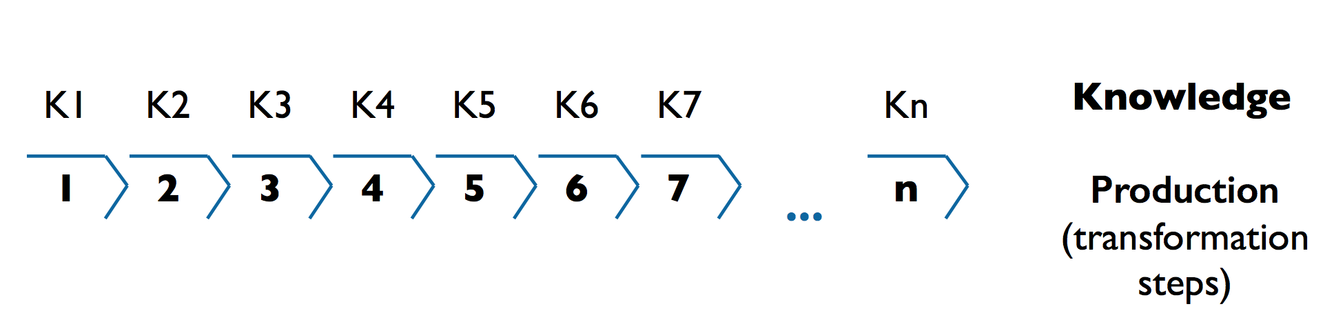
1) A generic production process
2) Efficient use of knowledge inputs requires application of specialized knowledge to each transformation step 1 to n
What are the four Mechanisms for integrating knowledge in the firm
1) Rules and directives
2) Sequencing
3) Routines
4) Group problem solving and decision making
1) What is the purpose of rules and directives in the integrative process?
2) What are exampels of rules and directives?
1)
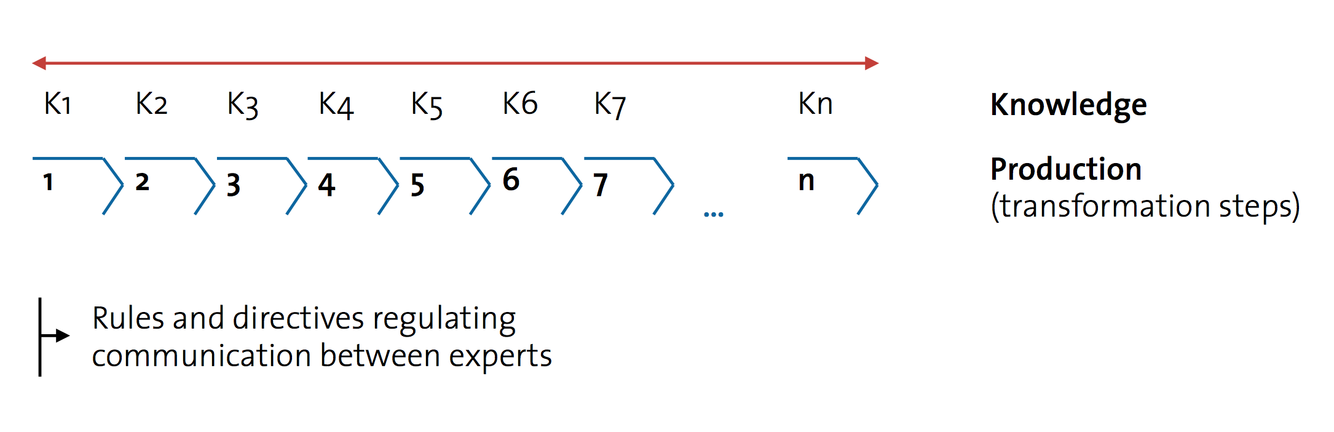
- Regulates the needed interaction between those who hold specialized knowledge (Rules and directives regulating communication between experts)
- Regulates application of knowledge on transformation steps 1 to n
2)
- Plans, schedules, forecasts, rules, policies, procedures, standardized information and communication systems
1) What is the purpose of sequencing in the integrative process? And what is it?
2) What are the different types of sequences? (The transformation steps)
1)
- The simplest means by which individuals integrate specialist knowledge while minimizing communication
- Transformation steps ordered in a time-patterned sequence such that each specialist’s input occur independently through being assigned a separate time slot
2)
- Fully sequential
- Overlapping sequential
- Concurrent
What is the name of the sequence:
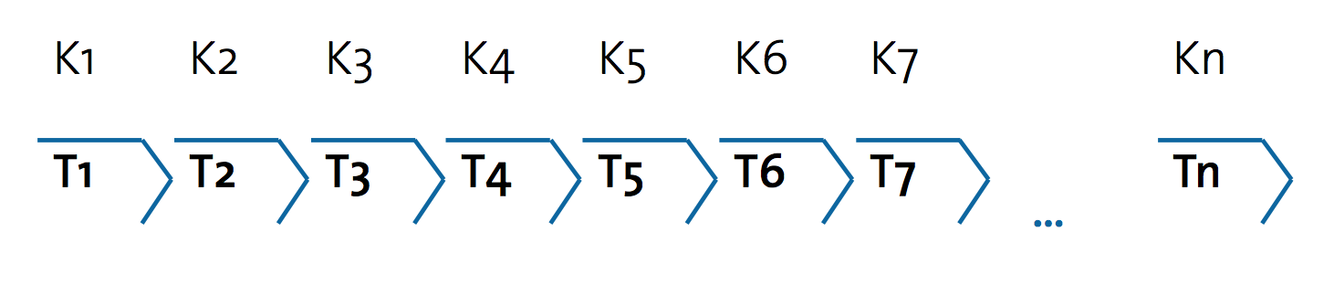
Fully Sequential
What is the name fo the sequence:
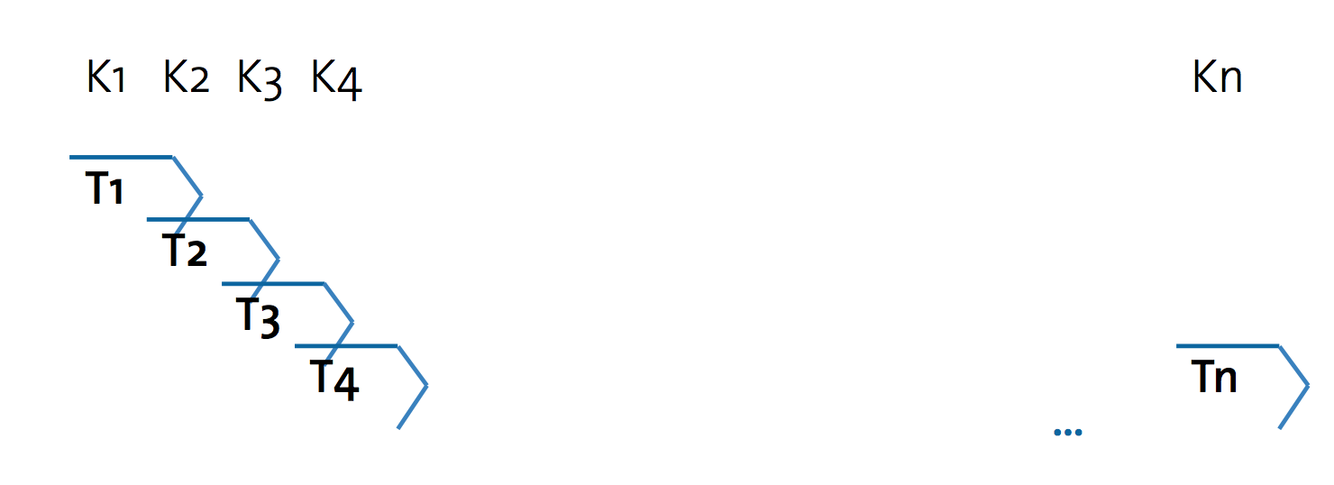
Overlapping sequential
What is the name of this sequence:
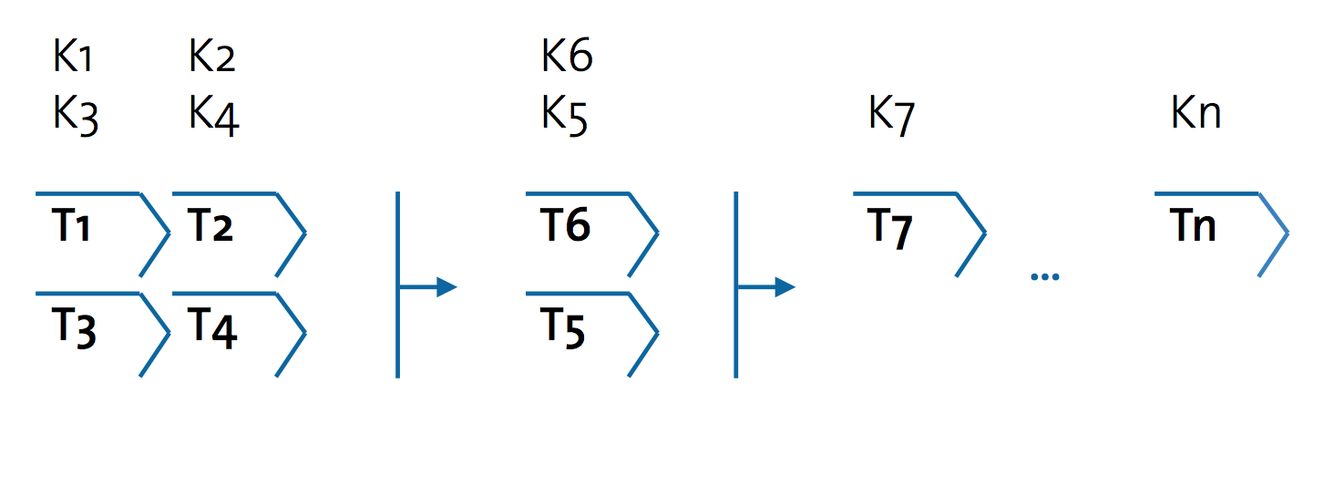
Concurrent






