What is Bite Registration?
- Bite registration is taking an impression of a patient’s upper and lower teeth in the bite position to assist in the making and fitting of crowns, dentures, mouthguards, study models etc…
- It is an occlusal representation of how the maxillary and mandibular
- Bite registration is essential when we need to articulate maxillary and mandibular study models.
Why do we need to take a bite registration?
- To allow articulation of master casts
- Allows analysis of occlusion
- Allow construction of indirect prostheses (crowns, onlays, inlays, veneers)
- Wax-ups (both fixed and removable prosthodontics)
- Construction of Splints
- Allows construction of denture components (removable prosthodontics)
- Allows us to set teeth according to chosen occlusion (removable prosthesis)
Which are the position we can record the bite?
- Maximum intercuspation (MIP)/ ICP (intercuspal position)
- Retruded Contact position (RCP)/ Centric Relation (CR)
most commonly used position: intercuspal position
Maximum intercuspation (MIP)/ ICP (intercuspal position):
- The most common position that we ask our patients to close so that we can record their bite.
- This position there is the most contact between the teeth and it’s a position that can change with time.
Retruded Contact position (RCP)/ Centric Relation (CR):
- This it the most retruded position of the mandible.
- We record in this position when we are aiming at carrying out multiple crowns or restorations, in cases that we are planning on increasing the occlusal vertical dimension, when making hard splints and for complete dentures.
- These are jaw positions rather than tooth positions
Which are the differences between MIP and RCP?
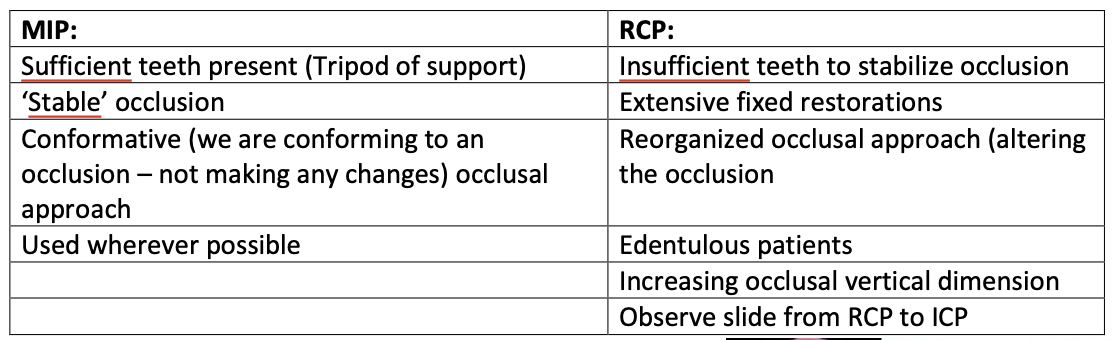
Which are the materials used for bite registration?
- Beauty wax
- Pink wax (this should not be used)
- Polyvinylsiloxane bite registration paste
- Duralay
How is wax used for bite recording?
(a) Grab a sheet of wax (ideally beauty wax).
(b) Soften it by warming in a warm water bath, not boiling (Similarly to what we did to extend our trays when taking impressions).
(c) Roll it three times to get adequate thickness and to have the width of the dental arches.
(d) Use either a hot wax knife to seal the edges of the wax so that it does not un-roll.
(e) Educate your patient about the purpose and procedure of the bite registration.
(f) It is then placed in the patient’s mouth after you have softened it in warm water.
(g) It is placed over the occlusal surfaces of either dental arch, depending on operators preference.
(h) The patient is instructed to bite normally onto the wax (It is advised not to use a lot of force).
(i) The patient’s teeth should remain embedded in the wax while the wax cools and hardens.
What is Polyvinyl siloxane bite registration paste supplied as?
Supplied both as a paste system and also as cartridges
Which are the characteristics of Polyvinyl siloxane bite registration paste?
- No odor or taste for the patient
- Fast setting
- Dimensionally stable (once set)
- Easy to use
- No resistance to biting forces
Which are the steps of Recording the bite using Polyvinyl siloxane bite registration paste?
(a) Load the cartridge in the dispensing gun and insert appropriate tip (Note: If you are using the paste system instead of a cartridge then you just mix the material with the activator.)
(b) Ask the patient to open his mouth and eject the material on the occlusal surfaces of the lower teeth.
(c) Ask patient to close and wait until the material sets.
(d) Once set remove from the mouth and assess the accuracy of the bite registration.
(e) If there is excess material, you may choose to trim the excess.

-
L1a15
-
L1b-Impression materials51
-
L2a: Planning and preparing for prosthetic dentistry12
-
L3a: Caries and Dental Plaque31
-
L3b: Impressions4
-
L4: Introduction to periodontal tissues in health and disease- Link with Prosthodontics57
-
L5: Foundation restorations in fixed prosthodontics24
-
L6: Luting cements for fixed prosthodontics40
-
L7: Bite Registration11
-
L8: Tooth morphology and Occlusion (Introduction)29
-
L9: Crown Preparation and Technology – Principles of Tooth Preparations22
-
L10: Fixed Partial Dentures Elements and construction principles34



