What are the seven faunal regions?
What species characterize these regions?
- Palearctic
- Shares species with Nearctic regions, taiga regions, some warm and wet regions
- Rodent families, artiodactyls, etc.
- Nearctic
- Tundra and taiga, desert, forest, grasslands
- Didelphids, castoridae, etc.
- Shares species with Palearctic, so grouped together as Holarctic
- Neotropical
- Tropical rainforest
- Pilosans, primates, marsupials
- Ethiopian
- Some tropical rainforest, shares many species with Neotropical
- Rodents, primates, artiodactyls, tenrecs, golden moles etc.
- Oriental
- Tropical forest
- Shares families with Palearctic and Ethiopian regions
- Colugos, tree shrews, gibbons, tarsiers
- Australian
- Mostly desert, some tropical forest in northern part
- Monotremes and marsupials are endemics
- Oceanic
- Mammals on remote islands and
Label the different parts of the skull
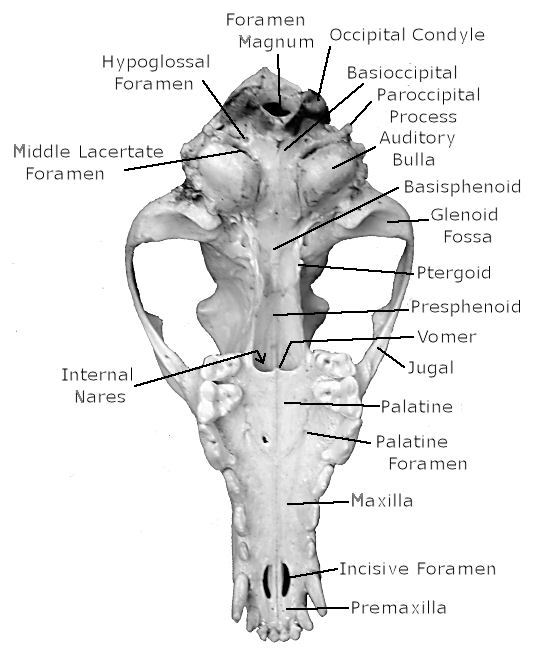
What is the foramen magnum?
- Opening that the spinal cord passes through
What is the infraorbital foramen?
Allows passage of infraorbital vein, artery, and nerve (visible clearly in elephant skull)
What are the occipital condyles?
At the posterior end of the skull. Articulate with the vertebral column and allow for greater movement of the head and neck
What are the auditory bullae?
At the anterior end of the skull. Encloses parts of middle and inner ear
What is the saggital crest?
Midline ridge of the skull. Attachment point for jaw muscles
What is the zygomatic arch? What two bones is it made up of?
Composed of the jugal (anterior) and dentary (posterior) bones. Surrounds and protects the eye and is a place of attachment for jaw muscles
What is the mandible?
Lower jaw. Consists of dentary bone and completed posteriorly by the coronoid process, mandibular condyle, and angular process
What are the three “roofing” bones?
Nasal, frontal, and parietal
What is the postorbital process?
Projection of the frontal bone that marks the upper edge of the eye socket
What are the primary and secondary palates?
- Primary palate is the vomer, palatine, and pterygoing
- Secondary palate is the premaxilla and maxilla, tooth bearing portions of the upper jaw. Allows for simultaneous breathing and eating
Function of:
Incisors
Canines
Premolars
Molars
- Incisors: Cutting and gnawing
- Canines: Piercing, tearing
- Premolars: Cheekteeth, grinding (deciduous predecessors)
- Molars: Cheekteeth, grinding (no deciduous predecessors)
In which orders are rootless teeth found?
Some rodents, horses, rabbits, walrus
What are some examples of orders that have homodont dentition?
Toothed whales (odontocetes), cingulata
What do monophyodont, diphyodont, and polyphyodont mean? Which orders display these characteristics?
- Monophyodont: One set of teeth (e.g., toothed whales, manatees, walruses)
- Diphyodont: Two sets of teeth
- Polyphyodont: Teeth are replaced multiple times
What are hypsodont teeth?
High crowned, deep rooted teeth
Advantageous for herbivores that grind their food to avoid wear on the teeth
What are brachyodont teeth?
Low crowned, shallow rooted teeth
Used for shredding and tearing
What is the primitive eutherian dental formula?
3/3, 1/1, 4/4, 3/3




