Kingdom Animalia
- Phylum Nematoda - roundworms
- Phylum Arthropoda - insects, spiders, crustaceans, etc.
Phylum Arthropoda
a) Subphylum Trilobitomorpha – trilobites (extinct)
b) Subphylum Cheliceriformes – horseshoe “crabs”, spiders, mites, scorpions, ticks, etc.
c) Subphylum Crustacea – lobsters, crabs, shrimp, barnacles, etc.
d) Subphylum Myriapoda – millipedes, centipedes
e) Subphylum Hexapoda – insects
Nematoda
- These organisms are pseudocoelomate.
- Some are free-living and others are obligate parasites.
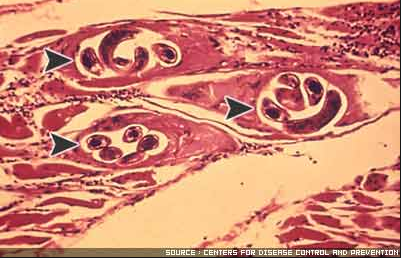
- Trichinella are nematodes that live in mammal muscle tissues. They are a health issue for humans because in some countries they can be found in pig muscle (pork – generally not in the U.S.).
Describe Free-Living Nematodes (vinegar eels)
tiny, white worms
un-segmented roundworms, usually elongate and tapered at both ends, bilaterally symmetrical, and with a complete digestive tract. Most show considerable sexual dimorphism, with the female usually larger and the tail of the male being more curled
Free living nematodes are long thin worms with transparent and typically curled bodies
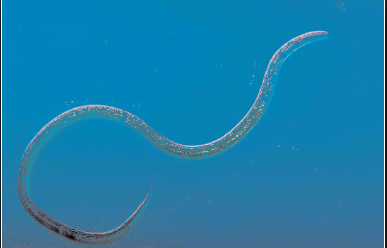
Describe Parasitic Nematodes
Free living nematodes are long thin worms with transparent and typically curled bodies, parasitic species have a variety of less streamline shapes relating to their degenerate parasitic life styles, one unifying characteristic that makes the phylum unique is the lack of cilia or flagella, even the sperm of nematodes are amoeboid.
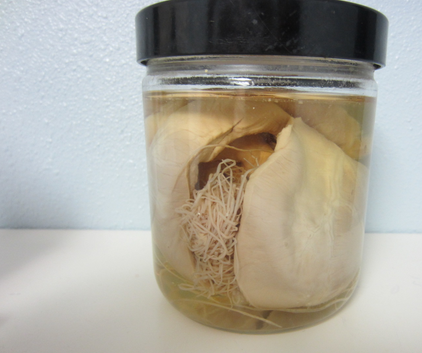
juvenile Trichinella cysts in muscle tissue
Arthropoda
- Arthropoda means jointed-foot. The presence of jointed appendages is one of the characters that unite all arthropods.
- In addition they all share an exoskeleton composed of a complex polysaccharide called chitin, and in some species that is augmented with calcium carbonate.
- High degree of segmentation. Segmentation is not unique to arthropods but the degree to which they have taken it is hypothesized to be one of the reasons for their incredible success.
- Antennae, mouthparts, specialized limbs, all evolved due to increasing segmentation. Segmentation provided the raw material for natural selection to “mold” into an enormous diversity of shapes to exploit an enormous number of lifestyles
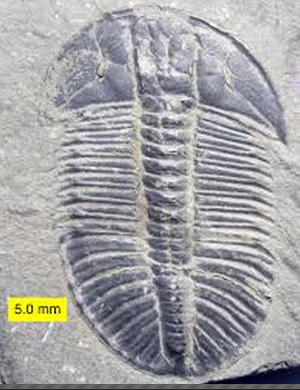
Subphylum Trilobitomorpha
Trilobites:
- Have segmented bodies
- Highly cephalized
Subphylum Chelicerata
- (arachnids, sea spiders, horseshoe crabs and extinct giant water scorpions)
- Like all arthropods, chelicerates have** segmented **bodies with jointed limbs, all covered in a cuticle made of chitin and proteins
- They exhibit cephalization
Identify the two main body segments of Cheliceriformes:
anterior cephalothorax and posterior abdomen.
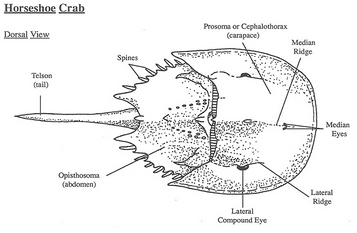
Jointed Appendages of Arthropods
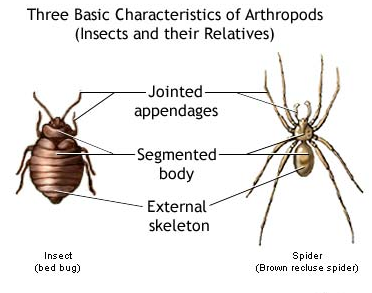
How many pairs of walking legs do arachnids (spiders, ticks, mites, scorpions) have?
All arachnids have eight legs, although the front pair of legs in some species has converted to a sensory function, while in other species, different appendages can grow large enough to take on the appearance of extra pairs of legs.
Do cheliceriforms have an endoskeleton or an exoskeleton? What is its composition?
- They have an exoskeleton made of chitin (and some calcium)
Subphylum Crustacea
Includes: crabs, lobsters, crayfish, shrimp, krill
and barnacles.
- They exhibit segmentation and cephalization (like other arthropods)
Joint Appendages in Crustaceans
a. Appendages
2 pairs of antennae: 1st homologous to antennae of insects & myriapods, 2nd homologous to chelicerae
3rd pair of head appendages are mandibles
Biramous - terminal segment with endopod and exopod
Crustacean appendages
are biramous (branched).
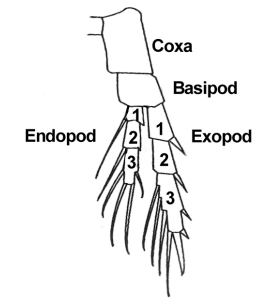
How many pairs of antennae do crustaceans have?
2 pairs
first are unirameous, 2nd are birameous
Skeleton of Crustaceans
Exoskeleton
30–50 percent chitin
Subphylum Myriapoda
Includes millipedes, centipedes, etc.
Segmentation
Their segments lack specialization
Show cephalization
Millipedes, centipedes and their relatives have seven-segmented legs, comprising coxa, trochanter, prefemur, femur, tibia, tarsus, and a tarsal claw.
Subphylum Hexapoda
the insects as well as three much smaller groups of wingless arthropods: Collembola, Protura, and Diplura
Hexapods are named for their most distinctive feature: a consolidated thorax with three pairs of legs. Most other arthropods have more than three pairs of legs.
Hexapoda
Gas exchange is important for any animal, and since we are often stuck in a vertebrate
frame of reference you might assume that terrestrial arthropods breath through their mouth like we
do. But you would be wrong. Hexapods breath through pores on the side or their abdomen called
spiracles. (Do not confuse this with the skeletal structure spicules in some sponges). Make sure
you read the lab exercise about them. What strikes me about these structures is how similar they
are to stomata in plants. Pores the organism can open and close to regulate gas exchange and
dehydration. An important ability to have if you are terrestrial. It is a nice example of convergent
evolution – very different organisms coming to a similar answer for a similar challenge
Hexapods
exhibit segmentation, cephalization
Hexapod primary body regions
head, thorax, abdomen
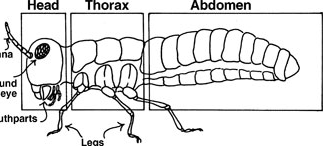
Hexapod thorax legs
3 pairs of legs aatached to the thorax






