What class are cartilaginous fish found under and which orders do this class include?
Class Chondrichthyes
Order Squaliformes
Order Rajiformes
Order Chimaeriformes (subclass Holocephali)
What characters link all Chondrichthyes together?
- Placoid scales or dermal denticles
- Claspers on male pelvic fins
- Internal fertilisation
- Spiral valve intestine
- Cartilaginous skeleton
- Replaceable teeth, usually
What is the species name of dogfish sharks? Order? Family? Characteristic traits?
Subclass Elasmobranchii Order Squaliformes Family Squalidae
Species: Squalus acanthias
Single spine in front of both dorsal fins; white spots along sides; no anal fin\
BC; SW

What are the identifiable shark external anatomy?
- Nostril, in which water flows into and enters nasal sac
- Ampullae of Lorenzini, small pits covering large areas of skin near the mouth and nose below the sharks snout, detecting weak electrical fields
- eyes
- dermal denticles: placoid scales that are structured like small teeth, which are shed and grow as the shakes does
- first dorsal fin: stabiliser
- countershading
- lateral line: sensory hair cell clusters (neuromasts) and small water-filled canals, lie immediately beneath the skin on a shark’ head and extends along sides of body
- second dorsal fin: assists in thrust and helps stabilisation, preventing rolling from side to side as it swims
- caudal fin: heterocercal in sharks
- anal fin: aid in stabilisation
- pelvic fin: in males, have rod-like extension on inner edge used for internal fertilisation
- pectoral fin: used for lift during swimming, for turning, and as stabilisers as they resist pitch caused by heterocercal tail lift
- gill slits: usually five but may have six or seven; chimeras have one
- teeth: found in rows that fall out and is replaced by new teeth that move forward in little as 24h; chimeras only have large permanent grinding tooth plates
- jaws: loosely connected by ligaments and muscle to the skull and are high mobile where snout bends up and out and jaws move forward and protrude and move back in and under snout; chimeras have cranially fused upper jaw

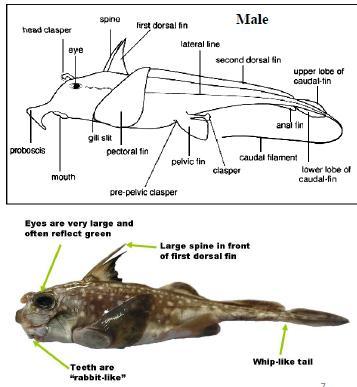
What are the traits of a male chimera required to be IDed for lab?
- Head clasper – absent in females
- Eye Spine on first dorsal fin
- Lateral line
- Elongate second dorsal fin
- Upper lobe of caudal fin
- Lower love of caudal fin
- Caudal filament
- Anal fin
- Claspers on pelvic fins
- Pre-pelvic clasper
- Pectoral fin
- Full slit
- Mouth
- Proboscis
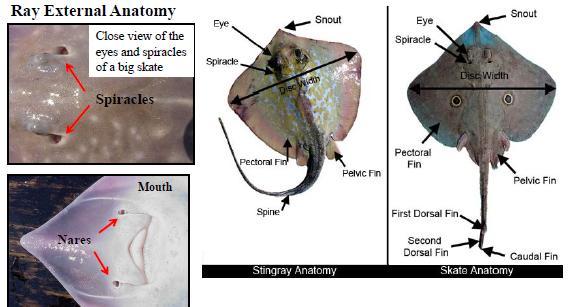
Where are spiracles and nares found on rays and skates?
Spiracles are right behind eyes on the dorsal side. When resting on the bottom, the large spiracles pull water from dorsal surface in through it’s gills and out its ventral gill slits.
Nares are anterior of ventral mouth, and pulls water in through nares into mouth.
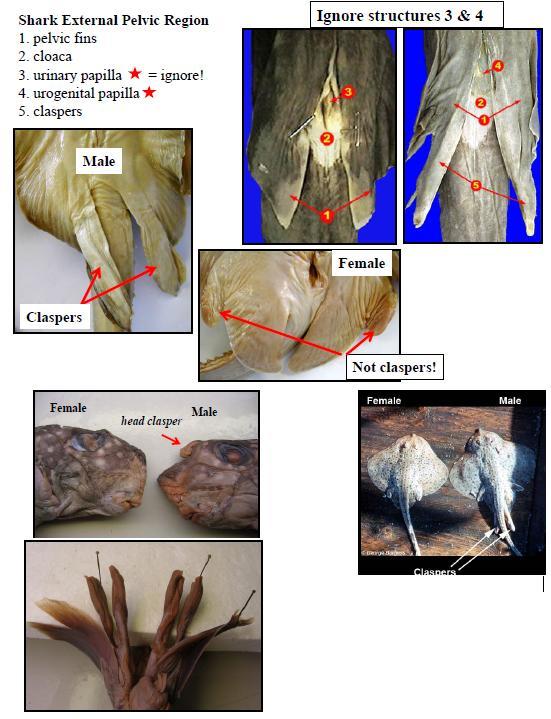
Where are claspers found and what are they used for?
Found in Chondrichthyes, inner base of pelvic fins in males of all species and groups.
Claspers are used for internal fertilisation and are evident in very young and immature individuals.
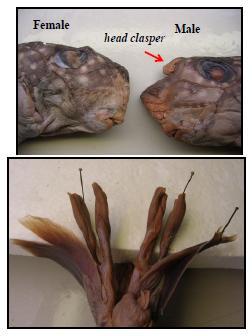
How do copulatory organs differ in Chimaeridaes than other Chondrichthyes families?
Males have head (cephalic) claspers or tentaculum and have pelvic claspers on the inner pelvic fins but are bifid or each are divided into two, producing an appearance of distally of four claspers.
What are the components of the common urogenital system found in both male and female Chondrichthyes?
- kidneys: used for osmoregulation where urea is kept inside of shark blood so that osmotic pressure equals that of sea water and therefore no gains or losses of water occurs
- rectal glands: tube-like rectum extensions controlling salt concentration within the body; excess salt is excreted into the rectum
- archinephric ducts: females = drain into cloaca through urinary papilla; males = transports urine and sperm and forms the seminal vesicle caudally
- accessory urinary ducts: generally absent in females; drains caudal kidneys and found dorsal to seminal vesicles
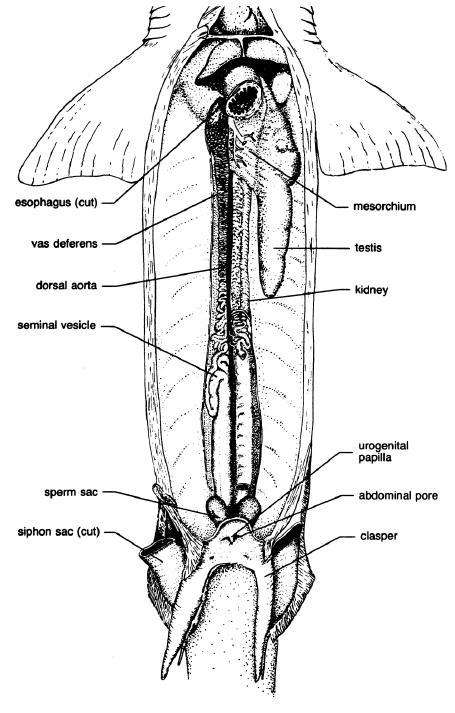
What are the components of Chondrichthyes male genital system?
- TESTES: dorsal to liver lobes in which male gametes are formed
- EFFERENT DUCTULES: small tubes carrying sperm from testes into kidneys
- EPIDIDYMIS: head kidney collects sperm \
- VAS DEFERENS: highly coiled tube that carry sperm to seminal vesicle
- SEMINAL VESICLE: enlarged section of vas deferens which adds secretions to sperm
- SPERM SAC: small invaginated sacs of the seminal vesicle that receives sperm and seminal secretions
- SIPHON: a cranially closed sac that produces secretion expelled with aid of claspers during mating
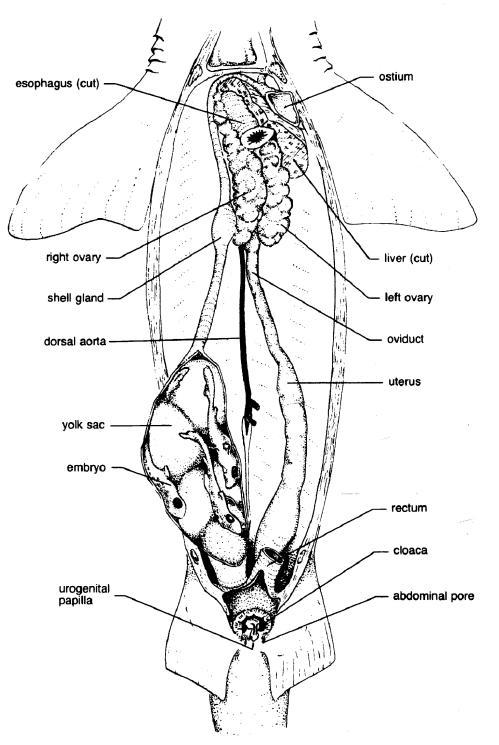
What are the female genital system components found in Chondrichthyes?
- OVARIES: two cream coloured organs dorsal to liver where eggs move into body cavity and into oviducts when ready to be fertilised
- OVIDUCTS: two dorsalaterally elongated tubes that share common opening to body cavity (OSTIUM)
- SHELL GLAND: at the cranial end of oviducts that secretes shell around group of eggs, is reservoir for sperm storage, and in which eggs are fertilised within as they pass through
- UTERUS: enlarged caudal end of the oviduct, in which fertilised eggs develop
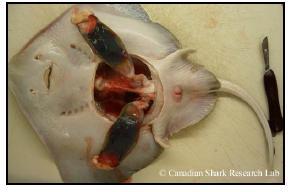
What is a characteristic of the Family Rajidae?
Lay egg cases – are OVIPAROUS – which contain one to a few young inside. Egg cases are species specific.
How is blood pumped in Chondrichthyes (and nearly all other fishes)?
Heart is situated on ventral side directly behind gills and blood is pumped FORWARD from the heart and UPWARD through the gills and circulates through the upper part of the body and ultimately back down to the heart.
By pumping blood up from the ventral part of the body, gravity as well as pressure is used to being blood back to the heart.
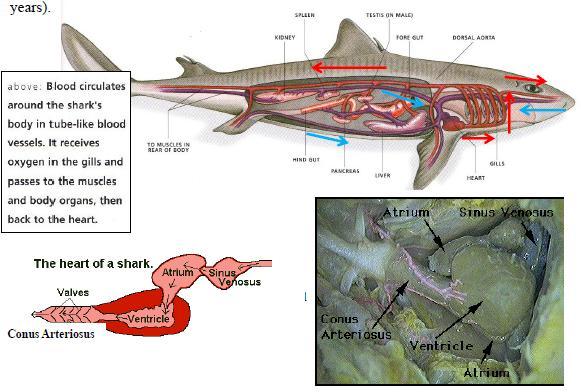
Describe the blood flow through the various parts of a Chondrichthyes heart from the body to the lungs using a diagram.
6) Body➡1) Sinus venosus➡2) Atrium➡3) Ventricle➡4) Conus Arteriosus➡5) lungs↖6) Body

Verbally describe the GENERAL flow of blood found in fish.
In virtually all fishes, the heart is a SINGLE TWO-CHAMBERED PUMP (vs a four-chambered pump in tetrapods). Deoxygenated blood is pumped forward from the SINGLE VENTRICLE to the GILLS where O2 and CO2 are exchanged. The oxygenated blood then passes to the tissues, where it loses oxygen, and eventually returns to the hear where it enter through the SINGLE ATRIUM.
What is the difference between the heart of Chondrichthyes and that of Atinoptyerigians?
Chondricthyes has a CONUS ARTERIOSUS which pumps blood from the VENTRICLE–> GILLS.
- CHONDRICHTHYES: BODY to…. 1) Sinus Venosus 2) Atrium 3) Ventricle 3) CONUS ARTERIOSUS …..to GILLS
Actinoptyerigians have a BULBUS ARTERIOSUS (vs a CONUS ARTERIOSUS).
- ACTINOPTYERIGIANS: BODY to…. 1) Sinus Venosus 2) Atrium 3) Ventricle 4) BULBUS ARTERIOSUS …..to GILLS
How many heart chambers are there in Chondrichthyes/other fish?
Conforms to a general four-chamber-in series where blood enters the SINUS VENOSUS, then to the SINGLE ATRIUM, followed by the VENTRICLE, and through the CONUS ARTERIOSUS (Chondrichthyes) or BULBUS ARTERIOSUS(other fish).
Explain the function and form of the 4 heart chambers found in Chondrichthyes and contrast it to that of an Actinoptyergian.
- SINUS VENOSUS: a THIN-WALLED TRIANGULAR sac that lies dorsal and slightly posterior to the ventricle, which collects venous blood from the body and passes it one way to the….
- ATRIUM: a THIN-WALLED, LIGHTLY MUSCLED SINGLE-CHAMBERD sac that lies anterior to the sinus venosus(1) and dorsal to the ventricle (3), which pumps blood into the ventricle (3) and has atrioventricular valves that stop backflow from ventricle to atrium when ventricle contracts.
- VENTRICLE: a THICK-WALLED (highly muscled) SINGLE CHAMBERED sac that pumps blood directly to the gills then through to the body.
- CONUS ARTERIOSUS: a THICK-WALLED TUBE extending from the ventricle to the ventral aorta, that contains numerous SEMILUNAR VALVES that prevent back-flow into ventricle, and EXPANDS during VENTRICLE CONTRACTION and CONTRACTS after VENTRICLE COMPLETES CONTRACTION, and as a result evens out blood pressur reaching the thin-walled gills.
- Actinopterygians have a BULBOUS ARTERIOSUS
Describe the branchial gill structure found in Chondrichthyes.
GILL FILAMENTS are PAIRED but are ATTACHED to each other by way of the GILL RAY or the GILL SEPTUM.
The gill ray/septum is attached internally with the GILL ARCH.
The GILL RAKER is found on the inside of the GILL ARCH.
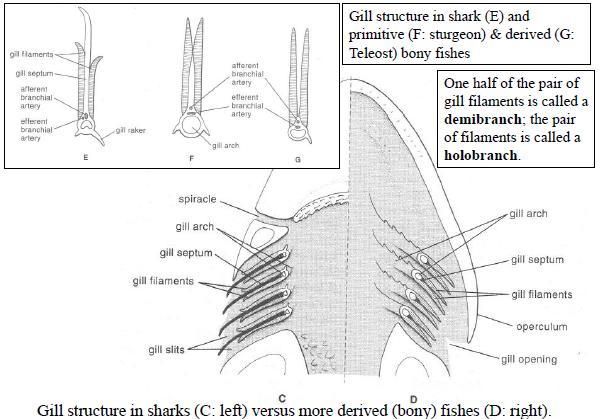
Each half of the gill filament pair of is called a DEMIBRANCH.
The pair of filaments is called a HOLOBRANCH.
The GILL ARCH/GILL SEPTUM connects directly to the skin separating the gill slits in Chondrichthyes.
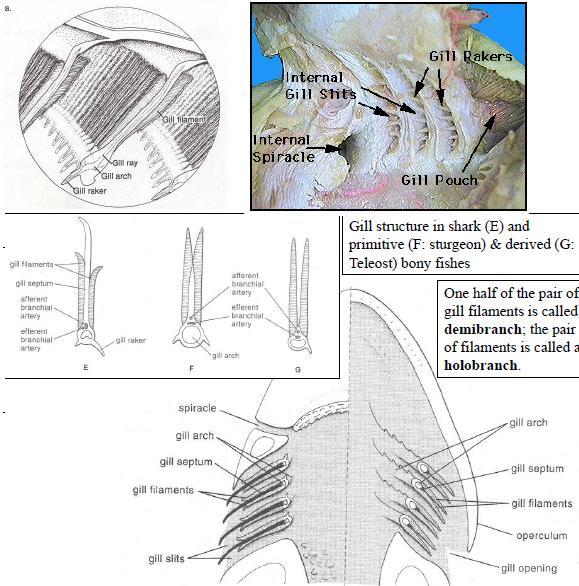
Half a pair of gill filaments is known as?
Demibranch
A single pair of gill filaments is known as what?
Holobranch
What is the difference between Chondrichthyes branchial structure versus an Actinopterygian’s
In sharks, rays and chimeras, the gill filaments are separated from each other by the GILL SEPTUM and each septum is connected to the skin that separates each gill slit. The gill septum is connected internally to the gill arch which in turn makes up the gill raker.
In Actinopterygians, the gill septum is small and the pair of gill filaments are not separated from each other by a fold of skin.
What are Placoid scales?
Found in sharks and rays (and early/extinct chimaeras) and NO OTHER FISHES.
Composed of a vascular inner core of pulp, a middle layer of DENTINE and a hard enamel-like outer layer of VITRODENTINE.
Are often referred to as DERMAL DENTICLES.
They do not increase in size as the fish grows, instead new scales are added.
Differentiate between placoid scales and dermal denticles.
Different name for the same thing: is a scale that is composed of a vascular inner core of pulp, a middle layer of dentine and a hard enamel-like outer layer of vitrodentine.






