The phenotype of the nude mouse model is:
Athymic and hairless (linked gene defect). ** No T cell function.**
- Defectivve transcription factor gene controlling thymic epithelial cell differentiation
Phenotype of SCID mouse?
Hypoplastic lymphoid tissues. No Ig or T cell responses. Sensitive to ionizing radiation because of defective DNA repair mechanisms.
- Defective DNA-dependent kinase that recombines gene segments coding for T (TcR) and B (Ig) cell receptors
T/F. Ectromelia virus is highly stable at room temperature.
TRUE
Which strains are most susceptible to mousepox (ectromelia) virus? Which are resistant?
Most susceptible: DBA/1, DBA/2, BALB/c, A, C3H
**Resistant: **C57BL/6, AKR
Mouse cytomegalovirus (MCMV) and thymic necrosis virus (MTV) are what type?
herpesviruses
MCMV is betaherpesvirus
Describe clinical signs and reservoir of MCMV. The pathogenicity of mouse cytomegalovirus (MCMV) __________ with age.
pathogenicity decreases with age
Asymptomatic in adult immunocompetent mice. Immunodeficient adult mice are susceptible to pathogenic infection. Neonates are highly susceptible to lethal infection, although maternal immunity is protective. Wild mice are reservoir. Persistently infected mice shed virus in saliva, urine, and tears for many months.
- Detection of enlarged cells with intranuclear inclusions, especially in salivary glands, are diagnostic
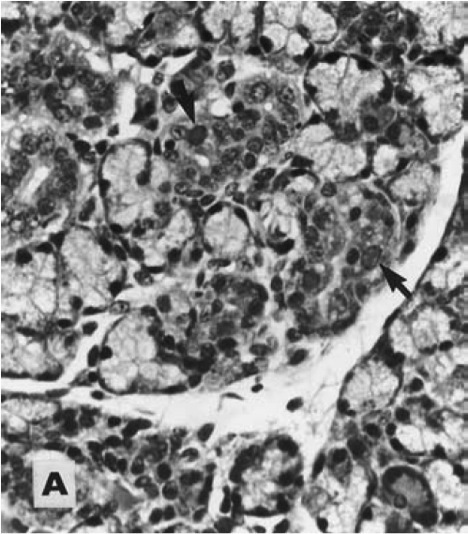
A central feature of non-lethal infection of mice with MCMV is
persistent infection (although MTV can also cause PI in salivary glands)
Persistent infection often affects the salivary glands and pancreas. Detection of enlarged cells with intranuclear inclusions, especially in salivary glands, are diagnostic, if present.
The type of immunity critical for protection against MCMV infection is
cellular
Severe, diffuse necrosis of the thymus is a clinical sign associated with
mouse thymic virus (MTV)
The hallmark histologic lesion of MTV is:
thymic necrosis associated with intranuclear herpetic inclusions in mice exposed within ~1 week after birth
MVM transmission and infection:
- Parvovirus
- transmission by oronasal exposure and viral contamination of biologicals
- excreted in feces and urine
- infects GI tract
- persistent infection not a feature, unlike MPV
Characteristics of mouse adenovirus?
- nonenveloped DNA virus
- causes intranuclear inclusions in vivo and in vitro
- MAdV-1 (FL) and MAdV-2 (K87); MAdV-2 responsible for all natural infections
- Asymptomatic in immunocompetent mice, except possible transient runting in neonates
- MAdV-1 cause multisystemic disease characterized by necrosis
- MAdV-2 causes amphphilic, intranuclear inclusions in intestinal epithelium especially in distal small intestine and cecum - pathognomonic
LAM, p 64
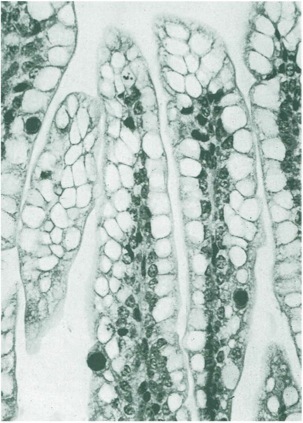
Histologic viral inclusions in mouse parvovirus are easier to detect in
infant mice than in adults
Mouse tissue. Etiology?
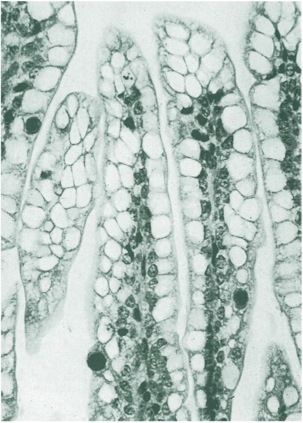
MAdV-2
The small DNA virus of mice that is highly antigenic in adults and induces multiple types of tumors in mice infected as neonates is called:
Murine polyoma virus (MPyV) - family Polyomaviridae (the other is K virus)
Natural infection is rare and asymptomatic in immunocompetent mice. Primary importance stems from use in murine models of experimental oncogenesis.
- Experimental inoculation of neonatal mice can produce viremia, and acute death. Surviving mice develop tumors 2-12 months later.
- Salivary glands are common sites for tumor development. Also, skin adnexa, upper GI, and kidneys
- Athymic mice can develop cytolytic and inflammatory lesions, followed by multisystemic tumor formation. IN inclusions may be present in cytolytic lesions.
When and where do tumors arise in neonates experimentally infected with polyoma virus?
Experimental infection of neonatal mice can produce viremia and acute death. In surviving mice, tumors appear 2-12 months post-inoculation, and the salivary glands are prevalent sites in most strains. Tumors can also appear in skin adnexa, upper GI, and kidneys.
T/F. Prevention measures for airborne transmission are required for polyoma virus
True
Describe lactate dehydrogenase elevating virus (LDV) in terms of taxonomy, transmission, and clinical signs.
togavirus specific to mice
Primary mouse-to-mouse transmission is mechanical transfer from aggressive behavior. Inoculation of mice with contaminated biologicals (cell lines, transplantable tumors, serum) is most common source of induced infection. LDV can infect, but not replicate, in tumor cells.
Asymptomatic usually. Mild leptomeningitis and myelitis in C57BL/6. Causes increased levels of several serum enzymes, most notably lactate dehydrogenase (LDH). SJL/L mice show most dramatic increases (15-20X normal), which is due to a recessive somatic gene)
Infections with LDV induces a duration of viremia that peaks at _____ and then is __________
12-24 hours after infection; persistent at a lower level lifelong
Why is LDV difficult to detect?
infection produces modest humoral response, but virus-antibody complexes interfere with serologic tests
inhibitory factors in cells and serum may cause false negative PCR
Lungs from an immunocompetent mouse that exhibited generalized signs of illness in addition to chattering. What is the most likely etiology and mouse strain?
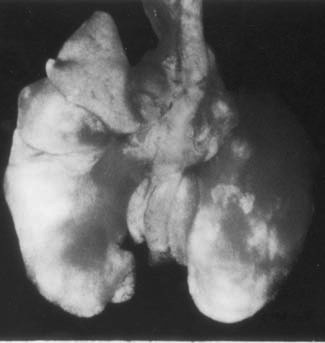
Sendai virus
DBA/2 are highly susceptible to lethal infection.
- Paramyxoviridae, genus Repirovirus, related to parainfluenza 1 of humans
- Recent studies have shown that SV and parainfluenza 1 replicate equally well in URT of African greens and chimps
- SV also infectious to laboratory rats and hamsters. Guinea pigs can be experimentallt infected
P&B, p 37
What is your presumptive diagnosis for 2-week old mice presenting with oily, matted hair, emaciation, and jaundice?
Reovirus-3
- Histologic evidence of multisystemic necrosis is also consistent with Reovirus-3
- Should be confirmed by immunohistochemistry or virus isolation
- Differential for diarrheal disease of infant mice: mouse coronavirus, EDIM, Salmonella, C. piliforme
LAM, p 73
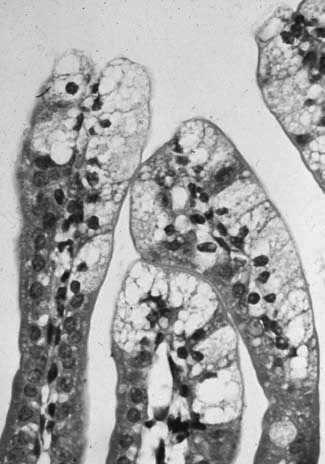
Why does EDIM cause more severe disease in mice less than 2 weeks old?
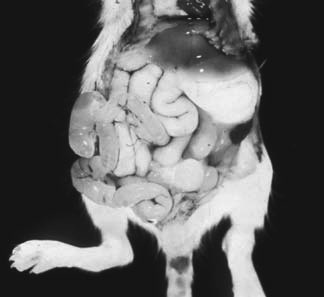
Rotavirus preferentially infects terminally differentiated enterocytes of the small and large intestine. The number of such cells decreases as the intestinal tract matures.
- Note clubbing of intestinal villi with cytoplasmic swelling and vacuolization
LAM, p 73-4
Phenotype of Rag-1 and Rag-2?
Hypoplastic lymphoid tissue. No Ig or T cell responses.
- Defective recombinase enzymes (Rag-1 or Rag-2), preventing formation of functional B alpha (Ig) and T (TcR) cell receptors



-
Mouse flashcards_SG58
-
LAM3_35-5339
-
LAM3_53_6676
-
LAM3_66-80103
-
LAM28_SG45
-
PB_MiceCh1111
-
PB_137_20062
-
PB_201_397197
-
LAM3_93-133_JS80
-
BB Ch3 80-93 KD167
-
SBG Mouse Qs_BBCh335
-
BB AALA Ch10 Rodents120
-
Behavioral Testing39
-
BB Ch27 - Genetic Monitoring24
-
Jax Handbook - Chap 4 Characteristics of Popular Strains75
-
Jax Handbook - Chap 8 Genetic QC20
-
Jax Handbook - Chap 9 Animal Husbandry61
-
Jax Handbook - Chap 13 Breeding Strategies & Techniques41
-
Jax: Rules of Nomenclature of Mouse & Rat Strains34
-
Jax Handbook - Chap 7 Animal Health: Preventing, Identifying, and Eradicating Microbial Contamination21



