When can a learning disability be diagnosed
Must include the presence of:
- A significantly reduced ability to understand new or complex information or to learn new skills
- A reduced ability to cope independently
- An impairment that started before adulthood, with a lasting effect on development
ICD-11 definition of a learning disability
Disorders of intellectual development are a group of conditions in which intellectual functioning and adaptive behaviours are significantly below average. ID isn’t necessarily a mental health disorder, but rather an impairment caused by the way society is organised (social model of disability.)
How can a learning disability be assessed
Using an intelligence quotient: An assessment of ability to think and reason which produces a normally distributed score (Average range: 70-130. Average score: 100). The Wechsler Intelligence scale is used to produce an IQ score:
- Verbal Scales: general knowledge, digit span, vocabulary, simple arithmetic, comprehension, similarities.
- Performance Scale: picture completion, arrangement, block design, digit symbol, object assembly.
What is the prevalence of the different severities of learning disability
- Mild learning disability often has no specific cause and suggests that the patient is on the lower end of the normal distribution curve. Prevalence: 2-3/100
- Severe learning disability usually has specific causes- brain damage, genetic abnormalities, hypothyroidism. Prevalence: ~3/1000 (Moderate, severe and profound)
Give some specific causes of moderate to severe ID
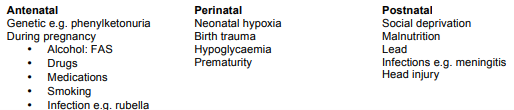
How can ID be prevented
By mitigating against risk factors: Educating parents on the risks of alcohol use during pregnancy, improving antennal/opostnatal care (e.g MMR vaccine for prospective mothers, iodine supplementation of water), genetic counselling, early detection and treatment of preventable causes.
What is the clinical presentation of an ID
ID usually presents in childhood, but may be missed if mild. Early indications include delayed developmental milestones and needing more support at school. In general the more severe the ID, the higher the likelihood of comorbid problems
- Mild Learning Disability • Language usually good, may be delayed • Problems may go undiagnosed – labelled as behavioural problems • Live and work independently with support
- Moderate Learning Disability • Less developed language and cognitive ability • Reduced self-care and limited motor ability • May need long-term accommodation with family or group home • Simple practical work achievable with support
- Severe Learning Disability • Marked impairment of motor function • Little or no speech during early childhood • Simple tasks cannot be performed without assistance • Likely to require family home or 24h staffed home
- Profound Learning Disability • Severely limited language, communication, mobility and self-care • Significant associated medical problems • Higher levels of support needed
What are the IQ thresholds for mild, moderate, severe and profound IDs
Profound (<20), Severe (20-35), Moderate (35-50), Mild (50-69)
List some early indicators of ID
- Reports of difficulty in reading and writing
- Difficulty in achieving skills (academic or daily life skills) considered acceptable for age & socio economic group
- Attendance at specialist school (thought not all attendees will have a LD) or on the LD register. Special Education Needs Statement
- Experience of having to modify communication
- Previously known to specialist children services
What physical illnesses often co-present with IDs
- More likely to have poor diet and to be obese.
- High levels of epilepsy, prevalence in institutions 32% , prevalence in community 16.1% - may be due to treatment itself
- High levels of sensory impairment: Hearing loss in 25-42% of people living in the community, Poor visual acuity in 40% of people with severe learning disability and 12% of people with mild learning disability.
- This is partly due to difficulty in assessment
What are some psychiatric co-morbidities of IDs
- All categories of mental illness occur in people with learning disability
- More common disorders:
- Schizophrenia: 3% prevalence
- Mood disorders: 4 x more likely to have depression or anxiety compared to people without learning disability
- Autism: about 75% have learning disability
Substance misuse and AN are less common in the general population
Why are patients with IDs predisposed to psychiatric co-morbidities
- Patients with LDs often have co-morbid psychiatric illness. There are several reasons for this: These patients are at significant risk of abuse and neglect, additionally they have issues accessing treatment, psychiatric illness may also precipitate the LD.
- Vulnerability factors:
- • Brain damage/epilepsy • Vision/hearing impairments • Physical illnesses/disabilities • Genetic/familial conditions (autism, behavioural phenotypes etc) • Drugs/alcohol abuse • Medication/physical treatments • Rejection/deprivation/abuse • Life events/separations/losses • Poor problem-solving/coping strategies • Social/emotional/sexual vulnerabilities • Poor self-acceptance/low self-esteem • Devaluation/disempowerment • Family issues following diagnosis • Inappropriate environments/services • Financial/legal disadvantage
How can a learning disability be diagnosed
Diagnosis is not purely based on the objective IQ scale and often encompasses the idea of ‘adaptive functioning’: This concept is very broad and relates to a person’s performance in coping on a day-to-day basis with the demands of his/her environment. It is, therefore, very much related to a person’s age and the socio-cultural expectancies associated with his/her environment at any given time. It is concerned with what a person ‘does’
As a result diagnosis of ID is clinical diagnosis which can be accompanied by assessment.
What tools exist for assessment of IDs
- Intellectual impairment assessed using the WAIS IV (Wechsler Adult Intelligence Scale): 11 subtests to derive Verbal IQ + Performance IQ = Full Scale IQ
- Adaptive/Social functioning established via clinical interview and ABAS II (Adaptive Behaviour Assessment System)
- Presence in childhood established using clinical interview and school reports
- May also use historical information: Historical information, family, personal, medical, developmental, psychiatric, personality (process requires an MDT)
- Need to rule out underlying physical causes, assess for recent life events/ traumas and exclude developmentally normal phenomena
Other investigation include a functional assessment by OT and/or social workers and a full physical examination to identify both specific causes and associated illnesses: chromosome analysis, FBC etc.
Management of IDs
- Monitor efficacy of intervention / treatment and any adverse effects
- Multidisciplinary, need to manage any underlying mental illness and physical illness. Also need to work with social networks
- Need to treat physical and psychiatric comorbidity: Patients may be particularly sensitive to medications so slow titration is often required (could use Dossett boxes). Hearing and visual impairments must be addressed. People with IDs may carry Healthcare Passports
- Educational support: Statement of Special Educational Needs allow appropriate support, in either mainstream or specialised schools
- Psychological interventions:
- Behavioural treatments – Antecedents > Behaviour > Consequences. Management involves avoiding antecedents, reinforcing positive behaviours whilst preventing negative ones and helping people understand the consequences of their actions. This generates a _behavioural management plan_.
- Cognitive Behaviour Therapy or psychodynamic psychotherapy
- Family education/therapy – Including for adults
- Creative/complimentary therapies – Art therapy, drama therapy, aromatherapy
- Social Interventions: Early detection, health and care plans (EHC) enables appropriate support in mainstream schools. Augmentative and alternative communication (AAC) plans support people with ID to speak, or provides alternatives to verbal communication.
- Community learning disability teams include: Community Learning Disability Nurses • Psychiatrists • Psychologists • Occupational Therapists • Speech and Language Therapists • Physiotherapists • Dieticians • Care Managers
Whta communication factors are important to recognise when taking a history from a patient with a learning disability
- Allow plenty of time
- Relaxed, familiar, comfortable, quiet environment
- Articulate clearly, start with open questions, check if person understands, repeat and rephrase, straightforward language and short sentences, be concrete.
- Some people may use signs. Can use a choice board- promotes choice-making and fosters sense of independence. Could also use a self-help board or schedule board
- Visually impaired: attract attention, start the sentence with name, touch hand before speaking
Hearing impaired: check if person can see your mouth and face, position yourself on the side of best hearing, check for hearing aid
What is the prognosis for patients with IDs
- Lifelong condition: Life expectancy is reduced (roughly 16 years lower) because of comorbid physical illness and unmet health needs
- Important: people with learning disabilities are very vulnerable to neglect, abuse and exploitation
- This may be compounded by communication difficulties
- Behavioural change may be their way of communicating distress

-
Practical Psychopharmacology (Antidepressants and Mood Stabilisers)41
-
Depression29
-
Bipolar Affective Disorder (BPAD)27
-
Suicide and Self-harm17
-
Psychotic Disorders54
-
Anxiety Disorders43
-
Medically Unexplained Symptoms13
-
Eating Disorders16
-
Personality Diosorders19
-
Substance Misuse Disorders41
-
Organic Psychiatry37
-
Old Age Psychiatry35
-
Learning Disabilities17
-
CAMHS29
-
Perinatal Psychiatry10



