In an average year, hazards require ____ people around the world to evacuate their homes.
20 million
Within North America, every location is at risk from ______ hazardous process.
at least one
What hazardous processes are the west coast, east coast, mid-continent, and all areas of NA at risk for?
West Coast: earthquakes, blizzards
East Coast: hurricanes
Mid-continent: tornadoes, blizzards, thunderstorms
All areas: drought
What processes can natural hazards arise from?
- Internal forces within the Earth
- driven by internal energy of the Earth
- eg. plate tectonics
- External forces on Earth’s surface
- driven by the Sun’s energy
- atmospheric effects (thunderstorm, snow storm, tornado)
- Gravitational attraction
- driven by gravity
- eg. downslope movement
What is a natural hazard?
-a natural process that poses a potential threat to people and property
What is a risk?
-the probability of an event occurring multiplied by the impact on people and property
What is a disaster?
-a brief event that causes great damage or loss of life (actual carrying out- carrying out of a hazard)
What is a catastrophe?
-a massive disaster
What are examples of 4 well-known catastrophes?
- Tsunami, Indonesia, 2004
- Hurricane (Katrina), New Orleans, 2005
- Earthquake, Haiti, 2010
- Tsunami, Japan, 2011
How do natural hazards differ in their potential to cause a catastrophe?
- natural hazards differ in their potential to cause a catastrophe based on the size of the area affected
- more likely to be catastrophic: tsunamis, earthquakes, volcanoes, hurricanes, floods
- less likely to be catastrophic: landslides, avalanches, wildfires, tornadoes
What constitues the impact of a hazard?
- the impact of a hazard is a function of both its magnitude (ie. energy released) and frequency
- it can also be affected by geology, land use (eg. rural or urban), population density, etc.
What is the magnitude-frequency concept?
- there is an inverse relationship between magnitude and frequency (if one goes up, the other goes down)
- low magnitude earthquakes are very frequent, high magnitude are not frequent
What provides insight on an area’s risk of hazards?
- history of the area
- maps, historic documents, journals, aerial photos
- weather and climate data
- craters (clue of meteorite), faults (earthquakes), valleys (glacier melting)
What is the geologic cycle?
- throughout Earth’s 4.6 billion year history, the materials on or near the surface have been created and modified by physical and chemical processes
- collectively, these processes are called the geologic cycle
- the geologic cycle encompasses the tectonic cycle, rock cycle, and hydrologic cycle
What is the tectonic cycle? Where is new land formed and destroyed?
- creation, movement, and destruction of tectonic plates (land)
- tectonic plates: large blocks of earth’s crust that form its outer shell; there are 14 plates (7 big which are continents and 7 small ones between)
- the process is driven by Earth’s internal energy
- new land is formed at mid-ocean ridges (two plates separate)
- land is destroyed at subduction zones (two plates come together and one goes under)
What is the rock cycle?
- a rock is an aggregate of one or more minerals
- the rock cycle refers to a group of interrelated processes that produce the three different rock types: igneous, sedimentary, and metamorphic
- igneous: comes from volcano erupting (hardened lava)
- in a given location, the types of rocks give clues to geological events of the past
Describe the stages of the rock cycle
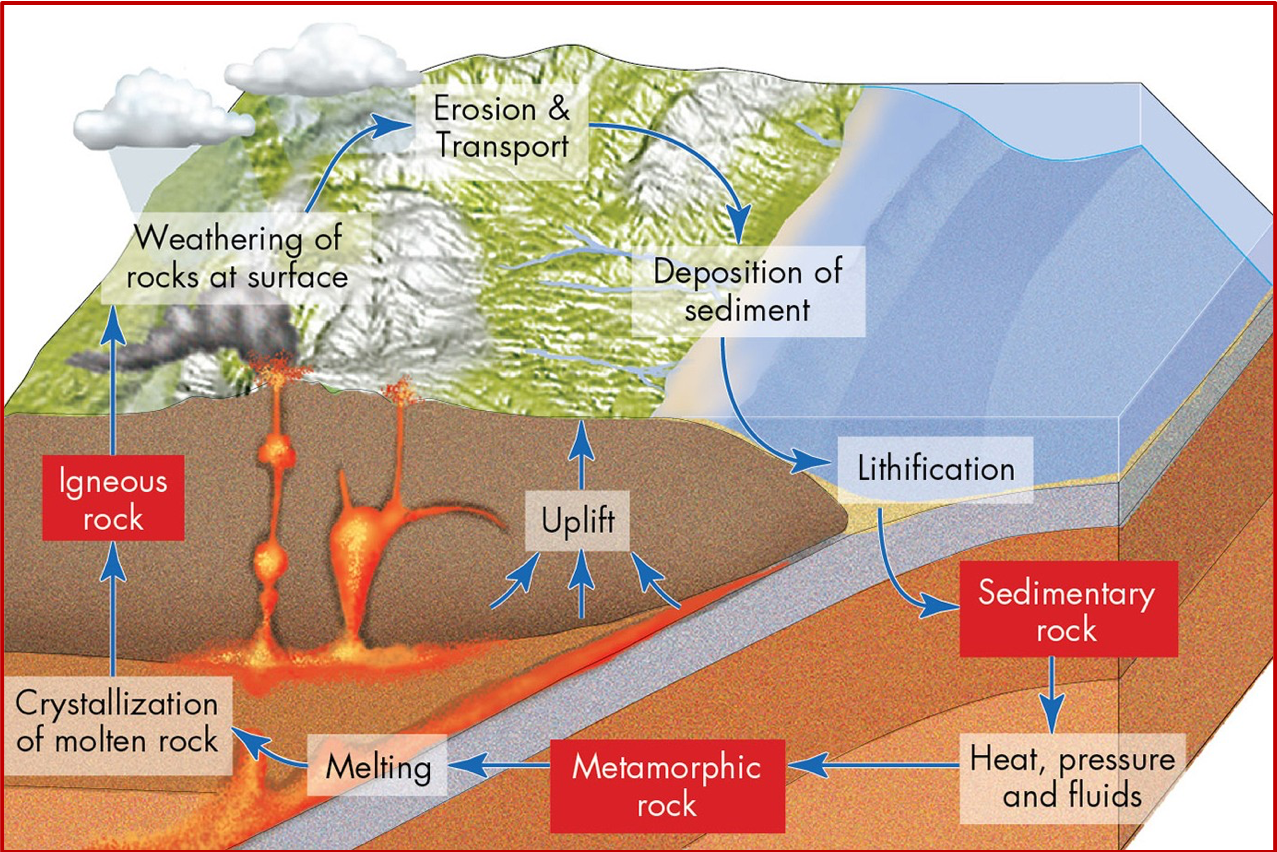
What is the hydrologic cycle?
- the movement and exchange of water among the land, atmosphere, and oceans by changes in state
- also referred to as water cycle
- solar energy drives the movement of water among the atmosphere, oceans, and continents
- residence time of a water molecule ranges from days (in the atmosphere) to thousands of years (in the ocean)
Describe the stages of the water cycle
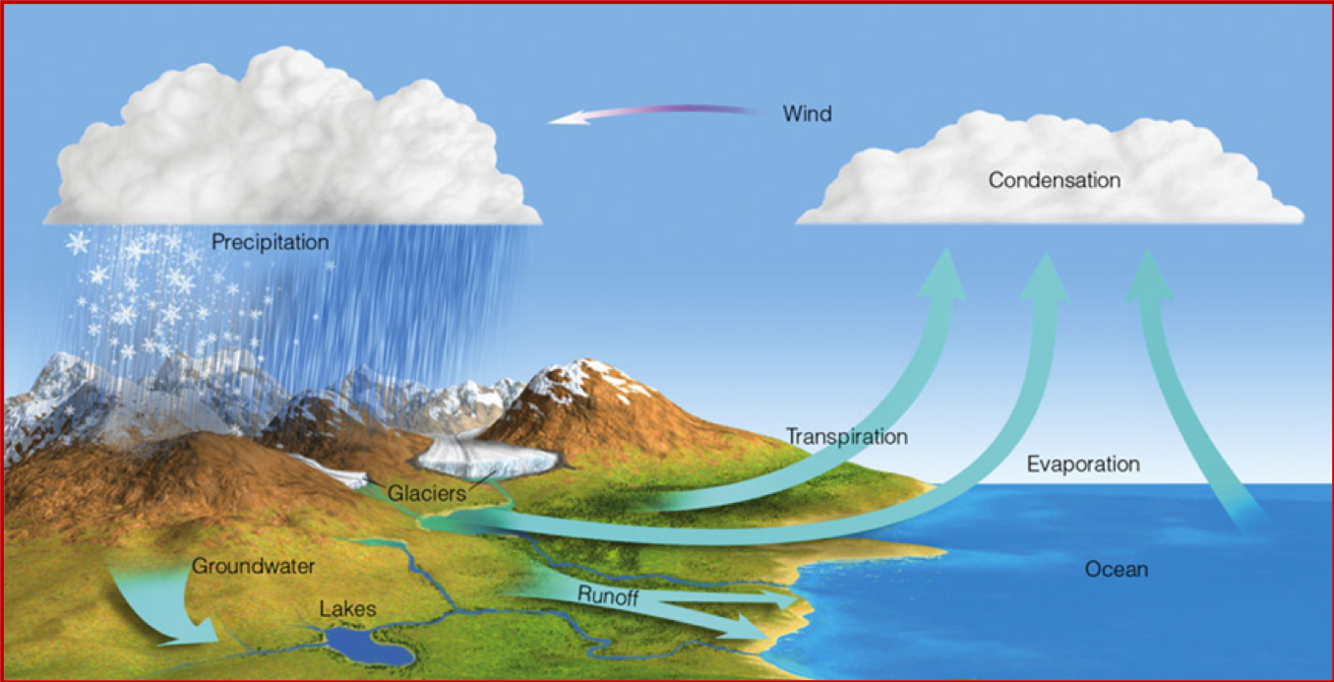
Describe the course theme: Hazards can be understood through scientific investigation and analysis.
- scientists observe a hazardous event and form a possible explanation for the cause
- from this explanation, a hypothesis is formed
- data is then collected to test the hypothesis
- knowing the cause allows for the identification of where hazards may occur
- knowledge of past events aids in predicting future events
What are 5 major course themes?
- hazards can be understood through scientific investigation and analysis
- an understanding of hazardous processes is needed to evaluate risk (risk, consequences)
- hazards are linked to each other and the environment
- population growth and socioeconomic changes are increasing the risk from natural hazards
- the consequences of hazards can be reduced
Describe how hazards are natural processes
- the events are natural forces
- they only become hazardous when they disrupt human activity or the environment
- these processes are not within our control
- we can’t prevent them, we can only respond tot hem
- the best solution to mitigate loss is preparation
What is a prediction vs forecast?
- prediction: a specific time, date, location, and magnitude of the event
- forecast: a range of probability for the event
How are predictions and forecasts invovled in mitigating loss?
- accurate predictions and forecasts are necessary to reduce loss
- some hazards can be predicted, many can be forecasted






