What is a passive response or passive potential?
-associated with molecules coming in (information from other neurons) -change in the membrane potential, but not yet the action potential (that happens when the +40mV threshold is reached= when the membrane is depolarised and an action potential is initiated)
What is the resting membrane potential?
-65mV
What is the threshold for generating an action potential?
+40mV
What is an action potential like?
-non graded, either occurs or it doesn’t - it is the patterning of APs (number and frequency) that determines what sort of information is received/sent
What is a neuron’s cell membrane like normally?
-sits in a position of equilibrium, balance of charges -it is negatively charged inside compared to outside
What set up the resting membrane potential and any subsequent changes in membrane potential?
-ion channels -balance of charges is due to charged ions
Where around the membrane is there more K+ (Potassium)?
-much higher inside than outside the cell -intracellular= 140 (mM) -extracellular= 5 (mM)
Where around the membrane is there more Na+ (Sodium)?
-much more outside than inside cell -intracellular= 5-15 (mM) -extracellular= 145 (mM)
Where around the membrane is there more Cl- (Chloride)?
-much more outside than inside the cell (smaller gradient than Na+) -intracellular= 4-30 (mM) -extracellular= 110 (mM)
Where around the membrane is there more Ca2+ (Calcium)?
-more outside than inside the cell -intracellular= 0.0001 (mM) -extracellular= 1-2 (mM) -large gradient thanks to the small concentration inside the cell
How are the gradients set up along the cell membrane?
- via ion transporters
- actively move ions against concentration gradients
- create ion concentration gradients
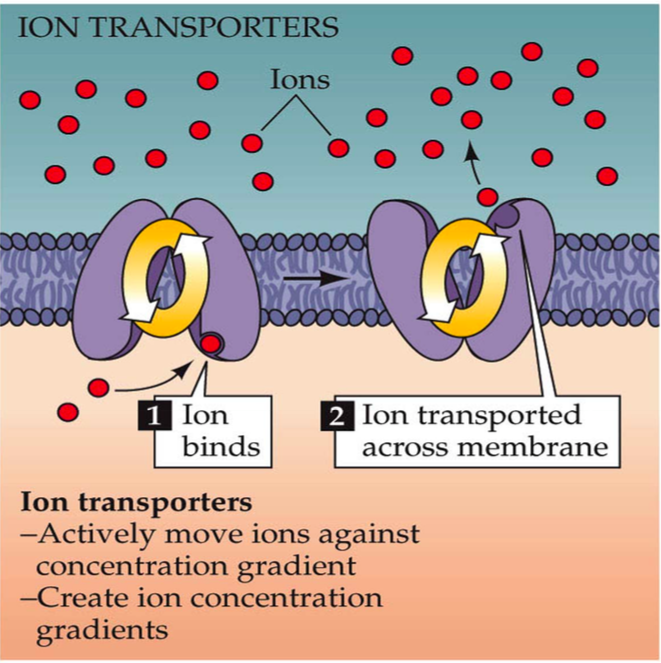
What is the Na/K ATPase?
- pumps sodium out of cells, while pumping potassium into cells. It has antiporter-like activity but is not actually an antiporter since both molecules are moving against their concentration gradient
- these are the crucial to set up the concentration imbalance across the membrane of the cell
- move ions against conc gradients
- 70% of energy use of the brain is involved in this movement of ions
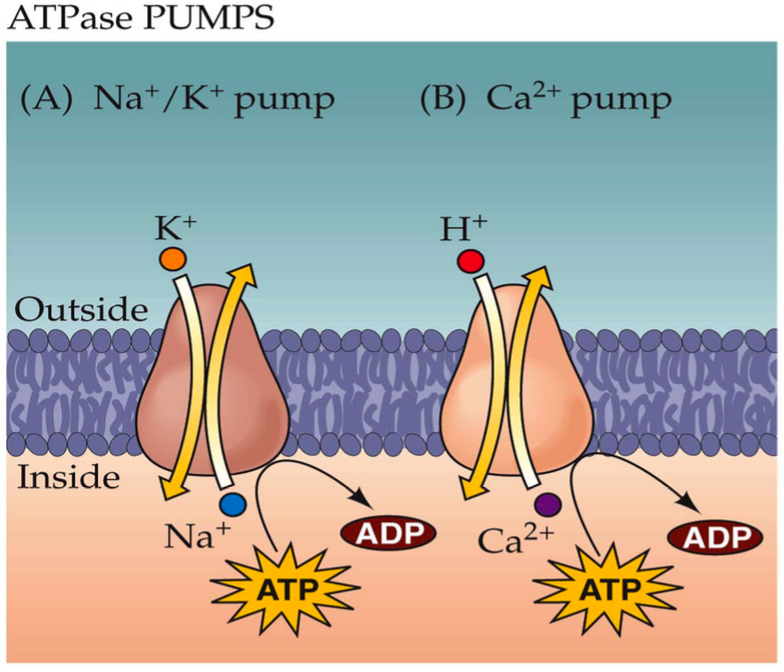
What is another ATPase in the brain?
- Ca2+ pump
- large gradient across the membrane so need the pump to remove Ca2+ from inside the cell
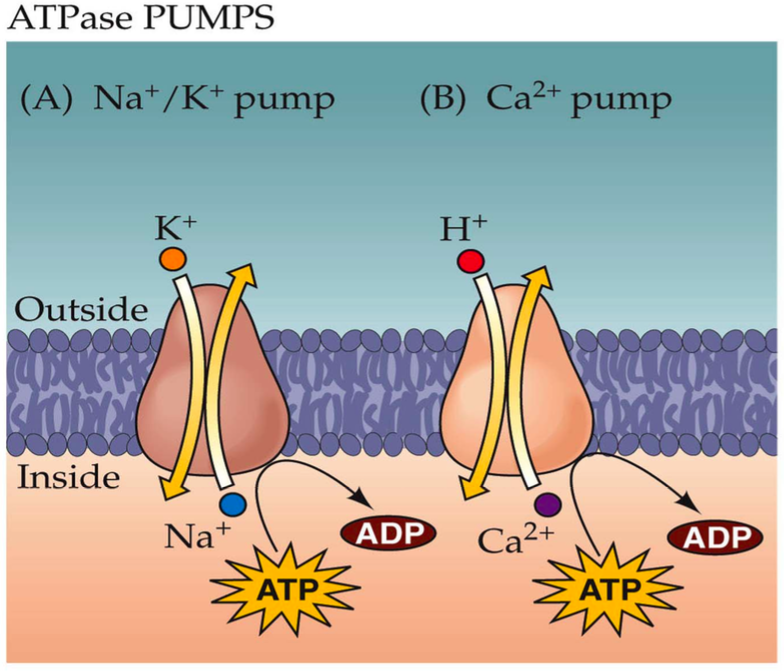
How is the Na/K pump important for resting membrane potential?
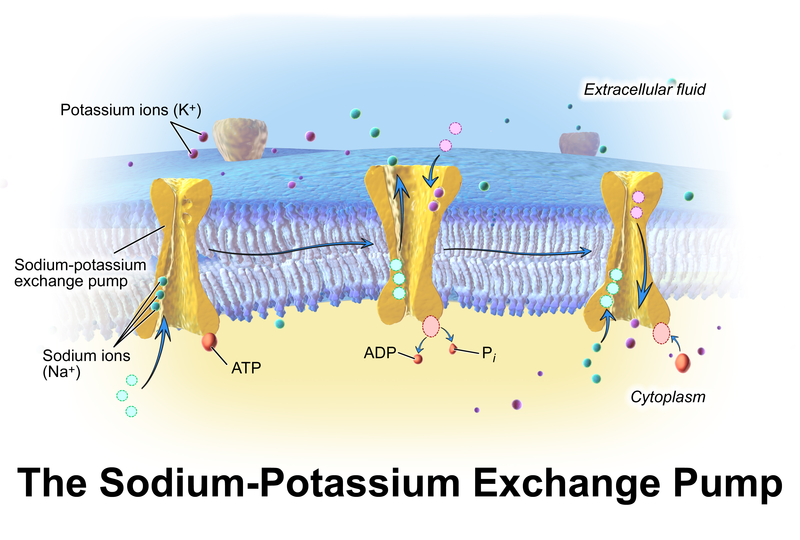
-In order to maintain the cell membrane potential, cells keep a low concentration of sodium ions and high levels of potassium ions within the cell (intracellular). -The sodium-potassium pump moves 3 sodium ions out and moves 2 potassium ions in, thus, in total, removing one positive charge carrier from the intracellular space. (for each ATP that is broken down)
What is the structure of the Na/K pump?
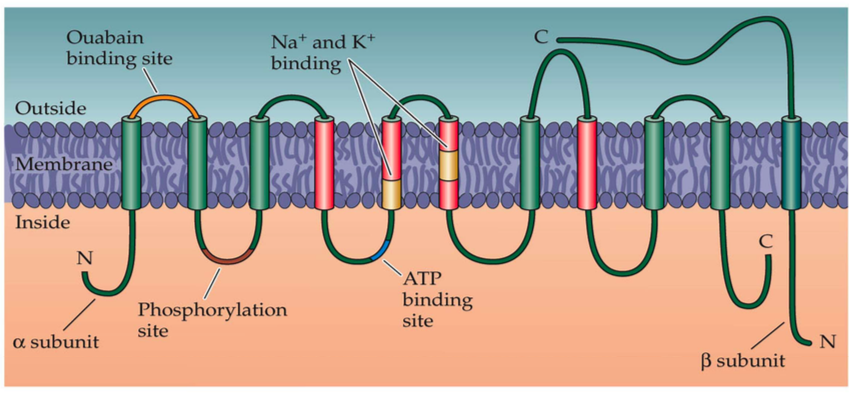
- composed primarily of one alpha subunit (approx. 1000 amino acids) and one beta subunit
- The alpha subunit is responsible for most of the enzyme’s pumping function. It contains the specialized sequences of amino acids which bind to sodium, potassium, and ATP.
- The beta subunit is involved in the routing of the alpha-beta complex to the cell membrane, and it also functions to occlude, or to make inaccessible to either side of the membrane, potassium ions during conformation change
- The alpha subunit dominates both the cytoplasmic and transmembrane regions of the enzyme, while the beta subunit is primarily on the extracellular side of the membrane. This arrangement makes sense given their specific functions.
What is the mechanism by which the Na/K ATPase operates?
- The pump, after binding ATP, binds 3 intracellular Na+ ions.
- ATP is hydrolyzed, leading to phosphorylation of the pump at a highly conserved aspartate residue and subsequent release of ADP.
- A conformational change in the pump exposes the Na+ ions to the outside. The phosphorylated form of the pump has a low affinity for Na+ ions, so they are released.
- The pump binds 2 extracellular K+ ions.
- This causes the dephosphorylation of the pump, reverting it to its previous conformational state, transporting the K+ ions into the cell.
- The unphosphorylated form of the pump has a higher affinity for Na+ ions than K+ ions, so the two bound K+ ions are released. ATP binds, and the process starts again.
What are ion exchangers?
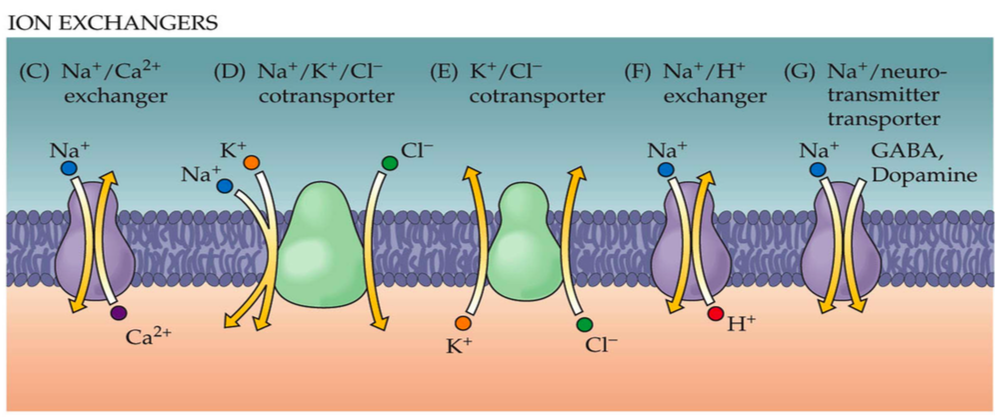
- Ion exchangers are either cation exchangers that exchange positively charged ions (cations) or anion exchangers that exchange negatively charged ions (anions). There are also amphoteric exchangers that are able to exchange both cations and anions simultaneously.
- set up and control the membrane potential as well
- these are energy independent -drive for Na to go in, down the gradient, this is used to make the conformational changes, energy from sodium drives Ca out (works same in the other types)
- this is for ion homeostasis as well as for neurotransmitters in some cases
- many types: c) Na+/Ca2+ exchanger, d) Na+/K+/Cl- cotransporter (can do more than 1:1), e) K+/Cl- cotransporter, f) Na+/H+ exchanger, g) Na+/neurotransmitter transporter (GABA, Dopamine)
What is the role of Potassium in setting up the resting membrane potential?
•The cell membrane forms a barrier to the movement of ions. •Transporters use energy to establish concentration gradients across the neuronal membrane. •At rest the neuronal membrane is selectively permeable to potassium. •Potassium is close to equilibrium with little net movement due to a balance between the concentration gradient and the electrical gradient forces. •This results in a membrane potential of approximately 65 mV with the interior of the neuron negative (i.e. -65 mV). Note this is close to the K+ equilibrium potential. -at rest membrane is selectively permeable to potassium= close to equilibrium -close to K+ equilibrium (-80mV)
Does the setting up of the resting membrane potential via K+ affect its concentration inside the cell?
-it doesn’t change K+ conc inside the cell that much -the movement of K+ out doesn’t change the actual number very much -setting up the membrane potential by the movement of K+ doesn’t have much effect on the actual number of K+ ions
How does ion selectivity work?
- channels that can differentiate between Na and K, not much difference in size of the ions
- how how do they differentiate:
- potassium channel= made up of four subunits= together they come together to form the channel
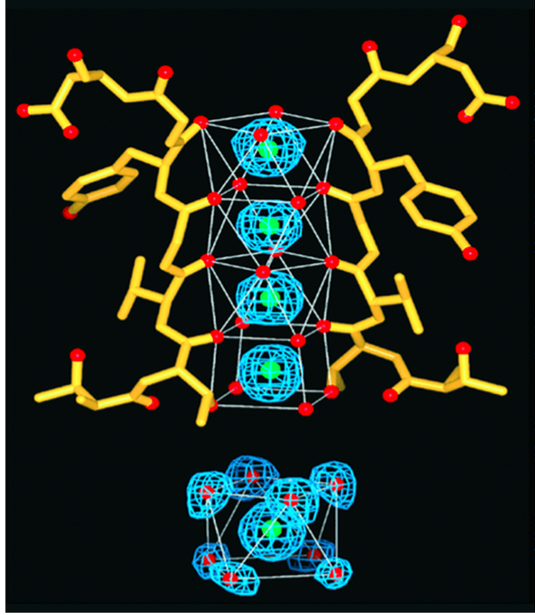
- potassium ions that exist in the hydrated form in the membrane, intra and extracellular space= go through ion selectivity filter= make the ions line up (4)
- 4 lined up -like the ball toy (metal one bumps and the next bumped)
- ion selectivity filter= what makes the difference between potassium and sodium?
- water= polar potassium ion is surrounded by water
- most energy efficient form, the position is exact for that ideal form -amino acids in the selectivity filter= have oxygen molecules that form the structure of teh channel= they mimick exactly the position of K and water position
- so the ion (K) can sit in the channel in their idealised form and when there is a concetration gradient
- sodium, cl etc don’t have the same size as ideal with water so they don’t fit
What is gating and how does it work?
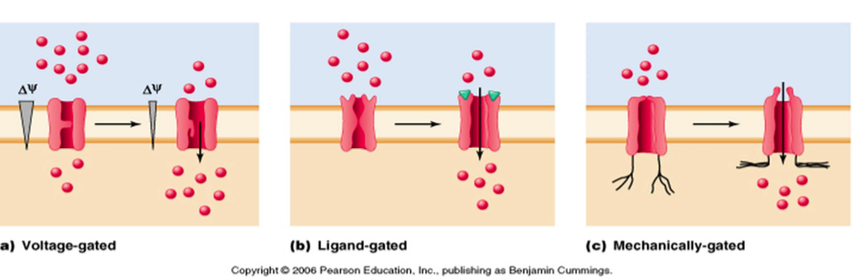
- gating refers to the opening (activation) or closing (by deactivation or inactivation) of ion channels
- 3 types: voltage gated, ligand gates and mechanically gated -some stimulus comes along, opens it and allows for the ions to go through
- name ‘gating’ derives from the idea that an ion channel protein includes a pore that is guarded by a gate or several gates, and the gate(s) must be in the open position for any ions to pass through the pore. A variety of cellular changes can trigger gating, depending on the ion channel, including changes in voltage across the cell membrane (voltage-gated ion channels), drugs or hormones interacting with the ion channel (ligand-gated ion channels), changes in temperature,[2] stretching or deformation of the cell membrane, addition of a phosphate group to the ion channel (phosphorylation), and interaction with other molecules in the cell (e.g., G proteins).
- multiple types of gate -ligand= binding of a ligand allows for conformational change that allows ions through -mechanical= on skin= allows you to feel sth as it mechanically changes the shape and allows ions through
What is the selectivity filter?
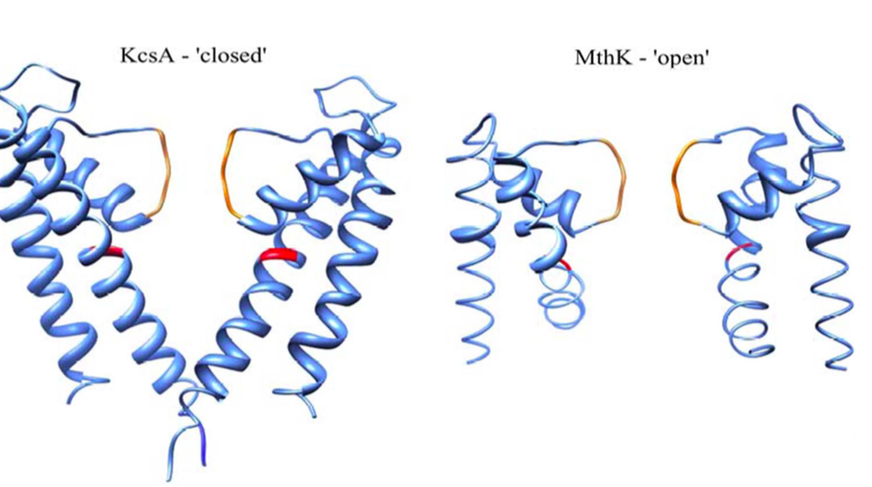
eg. in the KcsA potassium channel:
- this model describes the importance for passage of the dehydration of the potassium ion.
- The main chain carbonyl oxygen atoms that make up the selectivity filter are held at a precise position that allows them to substitute for water molecules in the hydrated shell of the potassium ion, but they are too far from a sodium ion.
- Potassium ion channels remove the hydration shell from the ion when it enters the selectivity filter.
- The selectivity filter is formed by a five residue sequence, TVGYG, termed the signature sequence, within the P loop of each subunit.
- This signature sequence is highly conserved, with the exception that an isoleucine residue in eukaryotic potassium ion channels often is substituted with a valine residue in prokaryotic channels.
- This sequence in the P-loop adopts a unique structure, having their electro-negative carbonyl oxygen atoms aligned toward the centre of the filter pore and form a square anti-prism similar to a water-solvating shell around each potassium binding site.
- The distance between the carbonyl oxygens and potassium ions in the binding sites of the selectivity filter is the same as between water oxygens in the first hydration shell and a potassium ion in water solution, providing an energetically favorable route for de-solvation of the ions.
- The selectivity filter opens towards the extracellular solution, exposing four carbonyl oxygens in a glycine residue (Gly79 in KcsA).
- The next residue toward the extracellular side of the protein is the negatively charged Asp80 (KcsA). This residue together with the five filter residues form the pore that connects the water-filled cavity in the centre of the protein with the extracellular solution
How does the selectivity in K+ channel work?
-The mechanism of potassium channel selectivity remains under continued debate. The carbonyl oxygens are strongly electro-negative and cation-attractive. The filter can accommodate potassium ions at 4 sites usually labelled S1 to S4 starting at the extracellular side. In addition, one ion can bind in the cavity at a site called SC or one or more ions at the extracellular side at more or less well-defined sites called S0 or Sext. Several different occupancies of these sites are possible. Since the X-ray structures are averages over many molecules, it is, however, not possible to deduce the actual occupancies directly from such a structure. In general, there is some disadvantage due to electrostatic repulsion to have two neighboring sites occupied by ions. Proposals for the mechanism of selectivity have been made based on molecular dynamics simulations,[29] toy models of ion binding,[30] thermodynamic calculations,[31] topological considerations,[32][33] and structural differences[34] between selective and non-selective channels.
How many types of channels are there in the brain?
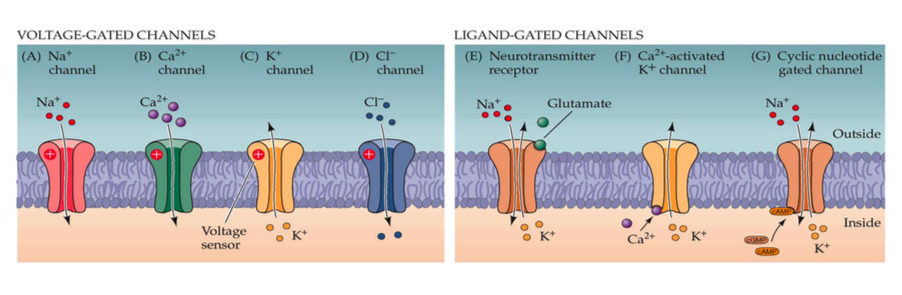
- vast array
- eg.: voltage gated: Na+ channel, Ca2+ channel, K+ channel, Cl- channel
- ligand-gated channels: Neurotransmitter receptor, Ca2+ activated K+ channel, Cyclic nucleotide gated channel
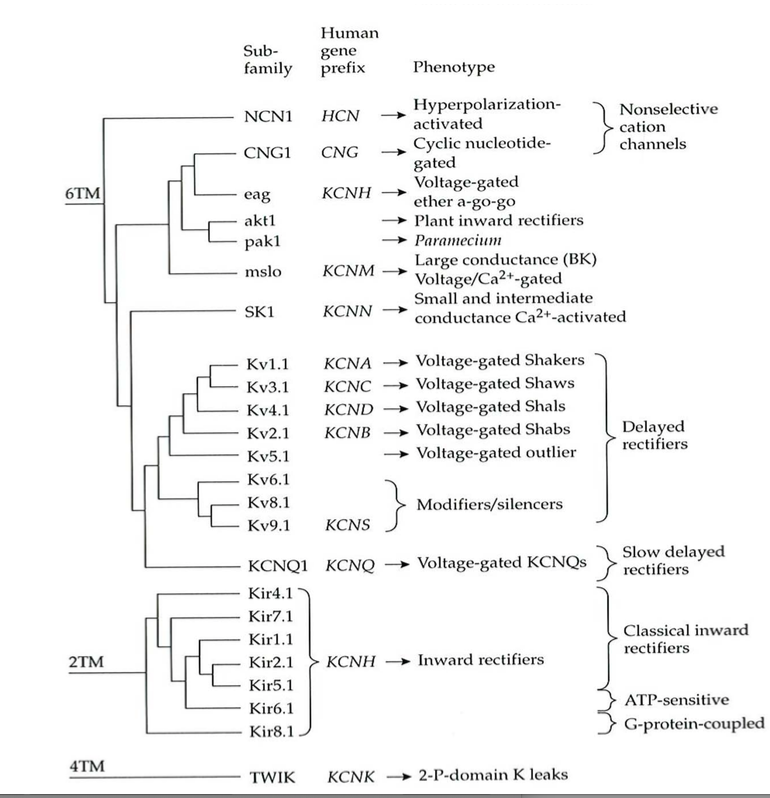
- there are 100s of K+ channels, multiple different types - do different things -this gives us the different responses that neurons give
- Kv1.1= the main subunit but can also join in with other types and then give different types of channels, different rates of hyperpolarisation etc.
- it gives us subtle differences in their ability to respond



-
Lecture 1- Introduction34
-
Lecture 2- Neurons and glia42
-
Lecture 3- Ionotropic receptors I: Excitation29
-
Lecture 4- Ionotropic receptors II: Inhibition18
-
Lecture 5- AP and AIS28
-
Lecture 6- Mechanosensory Transduction20
-
Lecture 7- Special sensory transduction mechanism15
-
Lecture 8- Measuring neural activity I28
-
Lecture 9- Measuring neural activity II25
-
Lecture 10- Introduction to metabotropic receptors50
-
Lecture 11- Modulation of neuronal functions by metabotropic receptors30
-
Lecture 12- Dopamine27
-
Lecture 14- Stem Cell Therapies for Parkinson's disease32
-
Lecture 15- Synaptic release and presynaptic proteins42
-
Lecture 16- Axonal transport24
-
Lecture 17- Neurotrophins24
-
Lecture 18- Postsynaptic density7
-
Lecture 19- Autonomic nervous system I40
-
Lecture 20- Autonomic nervous system II17
-
Lecture 21- Autonomic nervous system III17
-
Lecture 22- Autonomic nervous system IV14
-
Lecture 23- Spinal injury26
-
Lecture 25- Enteric nervous system I22
-
Lecture 26- Enteric nervous system II12
-
Lecture 27- Modelling of neurons16
-
Lecture 28- Neuropsychiatry and gut14
-
Lecture 29- Gut microbiome16
-
Lecture 30- Injury to the nervous system I27
-
Lecture 31- Injury to the nervous system II23
-
Lecture 32- Repairing the nervous system22
-
Lecture 33- Neuroplasticity I12
-
Lecture 34- Neuronal plasticity II21
-
Lecture 35- Neuronal plasticity III13



