Give brief descriptions of primary, secondary, tertiary and quaternary structures
- Primary = each aa’ linked by peptide bonds 2. Secondary = Hydrogen bonded arrangement of the backbone 3. Tertiary = 3D structure (know where every atom is in space) 4. Quaternary = Multiple chains interact with each other (not all proteins have multiple chains)
What is the phi angle? What is the psi angle? What is the omega angle?
Phi = Ca-N
Psi (trident) = C-Ca
Omega = C-N (peptide bond)
What collision does Phi lead to? What collision does Psi lead to?
Phi = O-O Psi = NH-NH
Which amino acid can adopt many phi and psi angles?
Glycine because it doesn’t have proper side chains
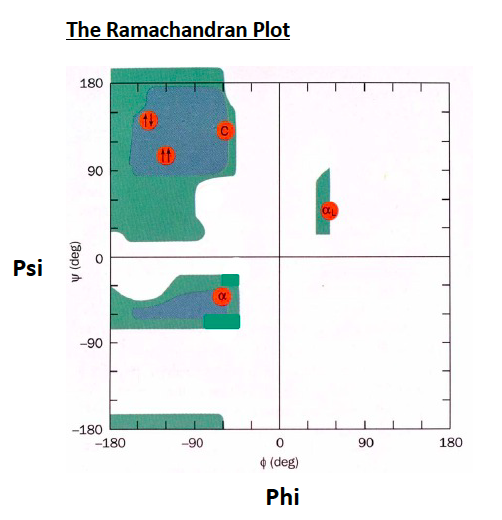
Describe the Ramachandran plot in your head
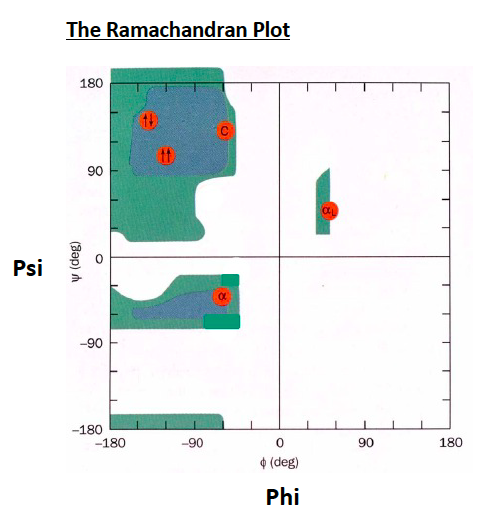
Omega is the angle of the peptide bonds - what is the angle of trans and cis? About 10% of the peptide bonds that precede _____ may be cis
Trans = 180 degrees
Cis = 0 degrees
Proline
Chi - usually staggered or not? Why? Where do the values cluster?
Staggered (out og phase - H have more freedom so most proteins adopt staggered positions)
Values cluster near sterically free regions
To do with the angles - is 180 and -180 the same?
When viewed from what terminus axis does the rotation clockwise increase the angle of rotation?
Yes
N
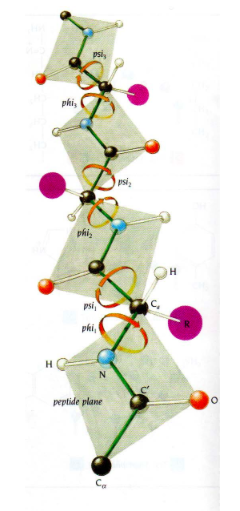
The combination of all the angles for a protein leads to a description of its…..
Overall 3D structure
Protein secondary structure is dominated by two _____ structures
Caconical (general)
Alpha helix and beta strand
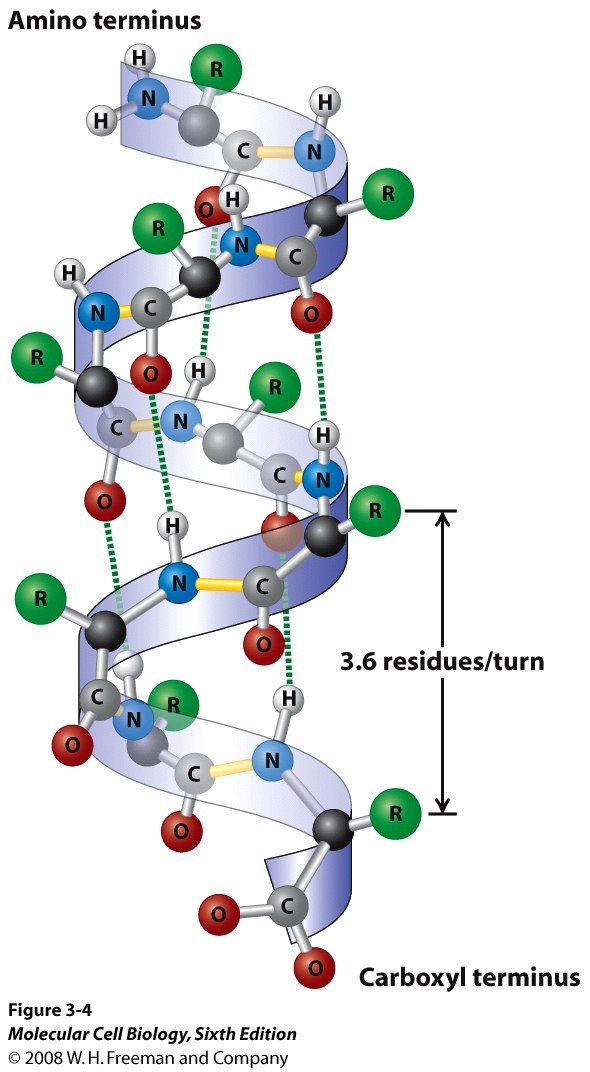
Alpha helix:
- What adopts a spiral?
- How to find the direction of the helix?
- What two atoms and hydrogen bond and where are they found?
- What is the distance between O and N? Why measure that?
- How many residues per turn and how long vertically is a turn?
- What are the phi and psi angles in a alpha helix?
- Side chains point where?
- Each time you move up a residue, how many Å have you moved up?
- What residues are common helix breakers?
- What are the dipoles they talk about?
Yeah
Other than alpha, what other helix exists?
What is it?
Which two forms exist?
Which kind of peptide bond may occur?
How many residues per turn?
Variant is found where in humans?
Tell me about the glycines
-
Beta structure
- Hydrogen bonding between what?
- B-sheet is how many strands at least?
- Typically how many strands?
- Each strand has up to how many aa’?
- Average strand length is what?
- What are the two types?
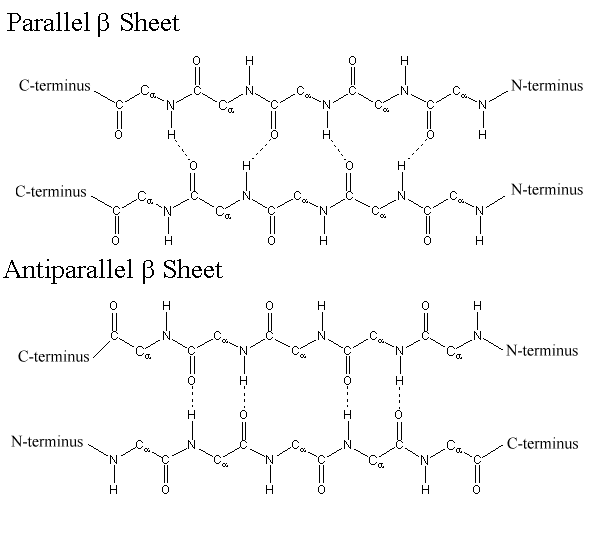
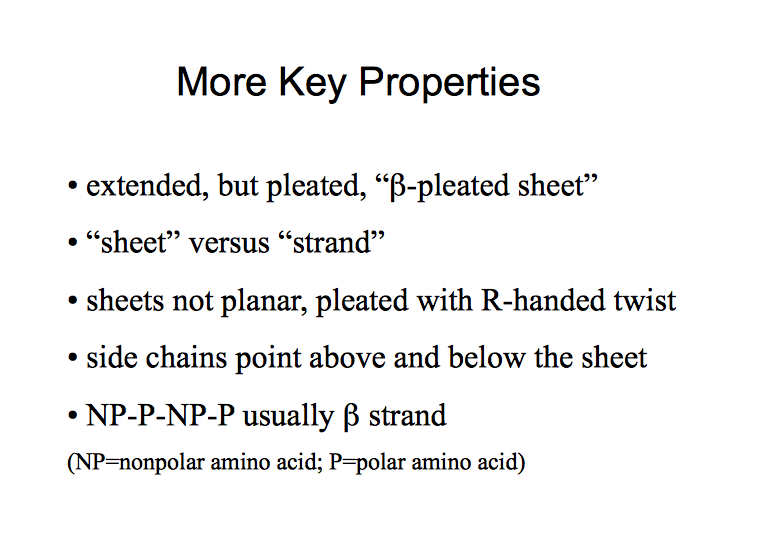
More key properties about B-sheets:
- What is an extended but pleated thing called?
- Sheets - are they planar?
- What’s the usal arrangment of a B strand?
-
What resembles a polyproline helix?
Give the phi and psi angles for alpha helix (right handed), parallel beta sheet and antiparallel beta sheet. Also collagen.
Collagen
On plot, C - location of polyproline helix
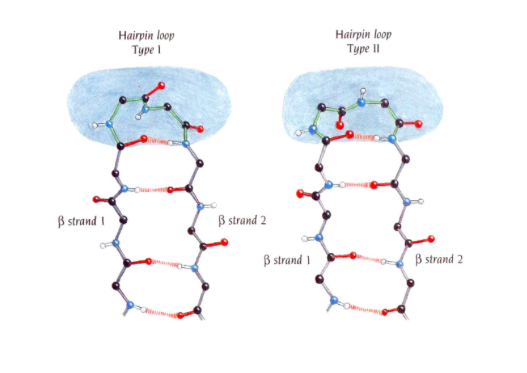
Turns:
- Involve how many residues?
- High content of what two aa’? Why?
- What percentage of residues involved?
- Hydrogen bond - common or not?
- How many types of turns?
- What are the most common?
-

-
Lecture #1 - Introduction to proteins, aa', peptides and peptide bonds14
-
Lecture #2 - Secondary structures16
-
Lecture #3 - Protein folding18
-
Lecture #4 and #5 - Haemoglobin as a model protein14
-
Lecture #6 - Haemoglobin variants12
-
Lecture #7 - Post-translational modifications13
-
Lecture 8 & 9 - Enzymes (intro)22
-
Lecture #10-12 = Enzyme kinetics, inhibition and regulation8
-
Lecture #18 - Membrane Lipids and Proteins12
-
Lecture #19 - Membrane channels and transporters6
-
Lecture #13 - Biotech 117
-
Lecture #14 - Biotech 212
-
Lecture #15 - Ligand-gated ion channels13
-
Lecture #16 - G protein-coupled receptors13
-
Lecture #17 - Nuclear receptors8
-
Lecture #20 - Energy and metabolism 118
-
Lecture #21 - Carbs19
-
Lecture #22 - Proteins19
-
Lecture #23 - Lipid stuff14
-
Lecture #26 - Energy/ATP stuff11
-
Lecture #27 - Glycolysis11
-
Lecture #28 - B oxidation9
-
Lecture #29 - CAC11
-
Lecture #30 - Oxidation of aa'2
-
Lecture #24 - Vitamins10
-
Lecture #25 - Minerals4
-
Lecture #37 - Exercise14
-
Lecture #38 - Diabetes10
-
Lecture #39 - Obesity15



