what are the two main components to the chest wall?
- bone and muscle and fibrous tissue
- the lungs
ribcage and lungs
what are the natural tendencies of both the rib cage and the lungs?
- the ribcage recoils outwards
- the lungs recoil inwards
what is the volume and pressure of the pleural cavity?
- fixed volume
- and contains protein-rich negative fluid
- there is negative pressure
what is the functional residual capacity?
- when we are at the end of tidal expiration
- at the end we are at FRC when both the lungs and the ribcage are in equilibrium
what is the importance of the pleural cavity?
- it is the link between the lungs and the chest wall
- if we do a full inspiration we are expanding the chest wall as well as pulling the diaphragm down
- so the chest wall needs to pull the lung with it
- the negative pressure of the pleural cavity allows the chest wall to pull the lungs with it
what happens to the pleural cavity with a punctured lung?
- if you have a puncture in the chest wall
- the fixed volume pleural cavity is compromised
- air will fill the pleural cavity the elastic recoil will take over and the lung will collapse
what is the difference with a haemothorax?
- this occurs much slower
what is hyperventilation?
excessive ventilation of the lungs atop of metabolic demand
what is hypoventilation?
Deficient ventilation of the lungs; unable to meet metabolic demand
*show a diagram of a labelled lung volume and capacity graph :
*
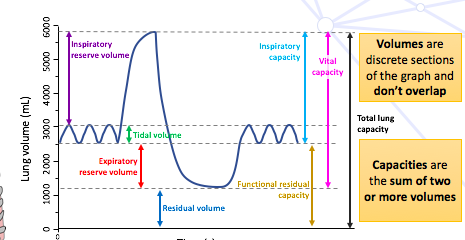
what is the tidal volume?
normal breathing volume - it can increase during exercise
what is inspiratory reserve volume?
how much extra air you can draw in after a breath in
what is expiratory Reserve volume?
how much extra air you can breathe out after a normal breath in
residual volume?
the volume left in the lungs after normal expiration
what factors affect the lung volume and capacity?
- body size - sex (men are bigger) - fitness - disease - age
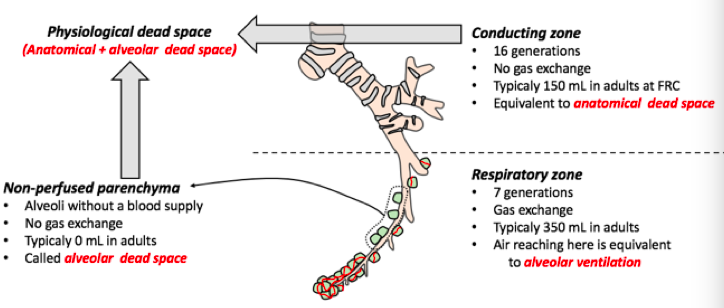
what is dead space?
these are areas on the airway that do not participate in gas exhange
what are the two types of dead space?
anatomical dead space -
alveolar dead space -
non perfused parenchyma (alveoli without a blood supply)
the conducting zone is dead space
what are the two distinct parts of the lungs?
- conducting zone - anatomical dead space - respiratory zone - split into 7 generations
*show a diagram of dead space:
*
how to increase dead space ?
- use a ventilator
how to decrease the dead space?
- tracheostomy
what is
transmural pressure
transpulmonary pressure
transrespiratory pressure
transmural = across several tissues
transpulmonary = difference between alveolar and intrapleural pressure
transrespiratory pressure = tells us if there is airflow into or out of the lung
what is the snorkel analogy saying?
a longer snorkel means more dead space which means the lungs may not be able to shift - poiseuilles law: a decrease in diameter by a half increases resistance by x16
how does the alveolar volume and pressure in alveolar change ?
- at the start there is no transpulmonary pressure - there is no pressure change - the chest wall expands and creates the negative pressure - the pressure gradient is established - the pressure gradient equalises


-
lecture 1 : introductory29
-
lecture 2: ventilation43
-
lecture 3: respiratory31
-
lecture 4: structure and function of the airways23
-
lecture 5 : lung cell biology24
-
lecture 6: lung pathology16
-
lecture 7: pathology of lung cancer39
-
lecture 8: breathlessness and control of breathing48
-
lecture 9: acid and base25
-
sensory aspects of resp disease38
-
lung infection12
-
lung mechanics20
-
lung immunology16
-
hypoxia28
-
lung development21
-
pulmonary circulation33
-
control of breathing when asleep21



