List 6 indications for pulmonary function testing (PFT)
- Evaluate sx’s and signs of lung disease (i.e., cough, dyspnea, wheezing, hyperinflation, etc.
- Assess progression of lung disease
- Monitor effectiveness of therapy
- Evaluate preoperative patients in selected situation
- Screen people at risk for pulmonary disease such as smokers or people with occupational exposure
- Monitor for potentially toxic effects of certain drugs/chemicals
Pulmonary function tests are not indicated in which patients; may be confusing when what is present?
- Not indicated in pt’s without sx’s
- May be confusing when non-pulmonary diseases that effect the pulmonary system are active (i.e., CHF); pt may appear to have pulmonary disease
What are the 3 most important values measured during pulmonary function testing?
- FVC
- FEV1
- FEV1/FVC ratio
What is the FEV1/FVC ratio used to determine?
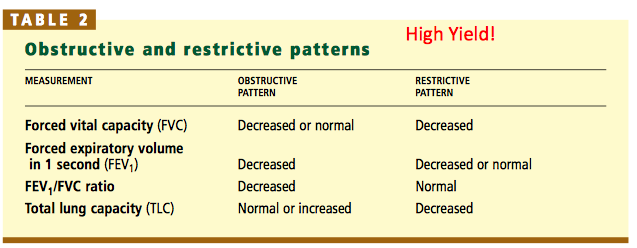
If pattern is obstructive, restrictive, or normal
Which gas is used to assess the diffusion capacity of the lungs?
Carbon monoxide
For obstructive disease, measurement of the RV and TLC can be used to demonstrate what?
- Air trapping
- Hyperinflation
What value is needed to confirm true restriction and to better quantitate the degree of restriction in a restrictive lung disease?
TLC
If the FEV1/FVC ratio is either normal or increased this may indicate restrictive disease or normal study, how can the FVC value be used for further interpretation?
- If the FVC is NOT less than the lower limit of normal = normal study
- If FVC is less than the lower limit of normal = restrictive pattern
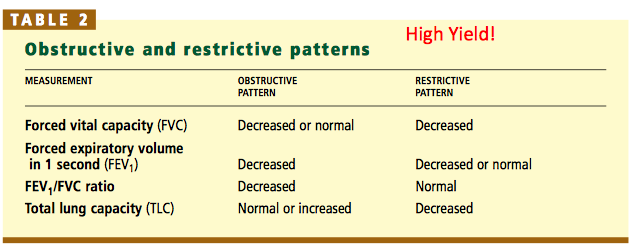
What is the FVC like in an obstructive vs. restrictive pattern of disease?
- Obstructive = decreased or normal
- Restrictive = decreased
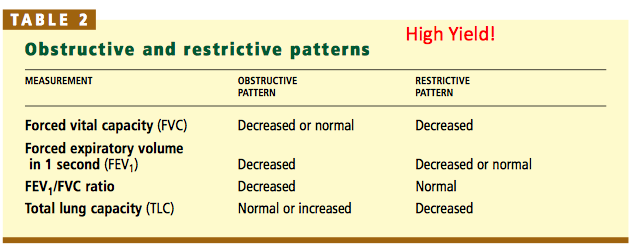
What is the FEV1 like in an obstructive vs. restricitve pattern of disease?
- Obstructive = decreased
- Restrictive = decreased or normal
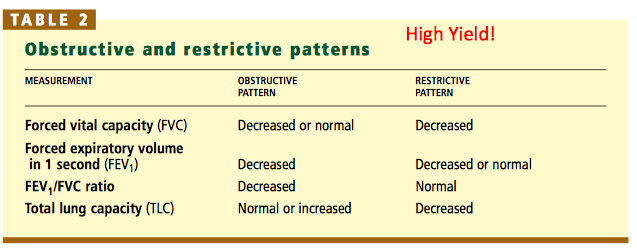
What is the TLC like in an obstructive vs. restricitve pattern of disease?
- Obstructive = normal or increased
- Restrictive = decreased
Using the FEV1 as % of predicted value for classifying the severity of an obstruction which value indicates mild, moderate, moderately severe, severe, and very severe?
- Mild = >70%
- Moderate = 60-69%
- Moderately severe = 50-59%
- Severe = 35-49%
- Very severe = <35%
If the FVC is less than normal, how can using the TLC and RV determine if there is a mixed pattern of obstructive/restrictive or if there is obstruction with air trapping?
- If there is mixed pattern, the TLC will be decreased
- If air trapping is occurring then the TLC will be normal or elevated and the RV will be significantly increased
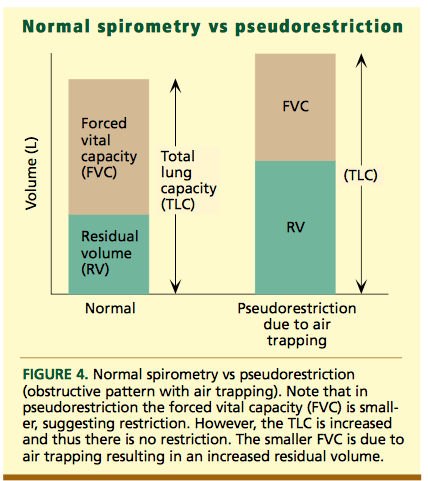
Air trapping will lead to an increase in which value of lung volume?
RV
What are 4 extra-parenchymal causes of restrictive lung disease?
- Obesity
- Neuromuscular disease
- Chest wall deformities
- Large pleural effusions
Which value can be used to distinguish between parenchymal vs. extraparenchymal causes of restrictive lung diseases?
- Diffusing capacity of the lung
- If below lower limit of normal after correcting for lung volumes = parenchymal disease likely
What will FVC be in restrictive lung disease?
What will the FEV1/FVC ratio be in restrictive lung disease?
Will TLC and RV be increased or decreased?
Will DLCO be high, normal or low?
<80% predicted
normal to >.70
Decreased
Could be normal or low
What will FEV1/FVC ratio be in obstructive lung disease?
What will the graph look like?
Is TLC and RV high or low?
Will DLCO be high, normal or low?
<.70
Concave, scooped, “Chair”
TLC and RV are high from air trapping
DLCO can be normal or low
In patients with obstruction, you need to determine if there is any improvement in FEV1 or FVC after bronchodilator therapy
If there is >12% increase in FEV1 or FVC AND an absolute volume increase of >200ml then ?
if not?
the patient has asthma
if not then the patient has COPD or another obstructive lung disease

-
Chapter 15: The Lung - Pleura40
-
Chapter 15: Pneumonia in Immunosuppressed; Lung Transplants; Tumors79
-
Chapter 15: Pulmonary Infections123
-
Chapter 15: The Lung - Restrictive through Diseases of Vascular Origin142
-
Chapter 15: The Lung - Congenital through Obstructive127
-
Chapter 16: Upper Airways, Ear and Neck96
-
Lecture 3: Pulmonary Function Testing19
-
Asthma and COPD24
-
Pneumonia, Influenza, Covid-19, ARDS38
-
Lecture 3: Pulmonary HTN and Sleep Apnea29
-
Lecture 5: Interstitial Lung Disease22
-
pHTN, PE, OSA, ILD40
-
PTX, Sarcoidosis, TB22
-
Drugs for Pulmonary HTN32
-
Lecture 6: Drugs for Thromboembolic Disorders87
-
Drugs for PNA41
-
Lecture 2: Pharm of Pulmonary Infections - Fungal49
-
Lecture 2: Pharm of Anti-influenza20
-
Lecture 4: Asthma and COPD Drugs68
-
Lecture 2: Pharm of TB43
-
Lecture 6: Respiratory Distress in Children30
-
Drugs for ILD21
-
Respiratory Radiology28



