Planck’s Equation
e=hc/λ h is Planck’s constant, (6.63 x 10⁻³⁴ J/s and λ is the wavelength of the photon (nm, 10-9m). Radiant energy is transported by photons which behave both as particles and waves and travels at the speed of light (c = 3 x 10¹⁰ m/s in vacuum). The photon energy of the radiation (e) in inversely related to the wavelength of the radiation, as described by Planck’s equation.
Variation in Light Intensity, Duration, and Directionality (Slide)
Units - Light is transported in discrete bundles called PHOTONS -Mole of Photons (6.02x10²³) = 1 Einstein (E) -Einsteins are only used for PAR (400-740 nm) -The intensity of PAR is determined by the photon flux density, which is about 1500μE m-2 sec-1 near midday on a clear day
Lambert’s Cosine Law
Light intensity (LI) at the ground is influenced by its angle of incidence, which depends on the relative height of the sun above the horizon
Lambert’s Cosine Law
Light intensity (LI) at the ground is influenced by its angle of incidence, which depends on the relative height of the sun above the horizon
Lambert’s Cosine Law Equation
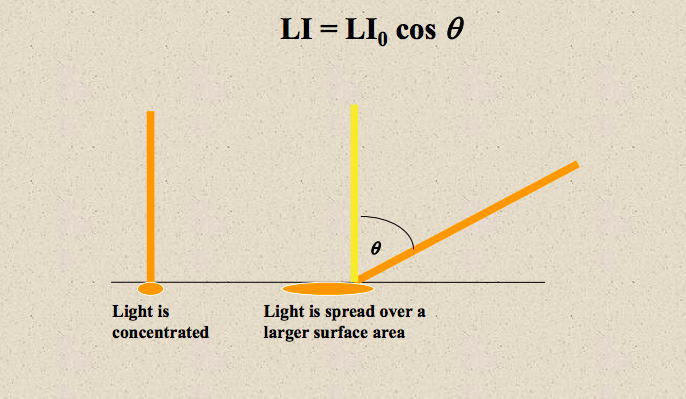
Lambert’s Cosine Law Diagram
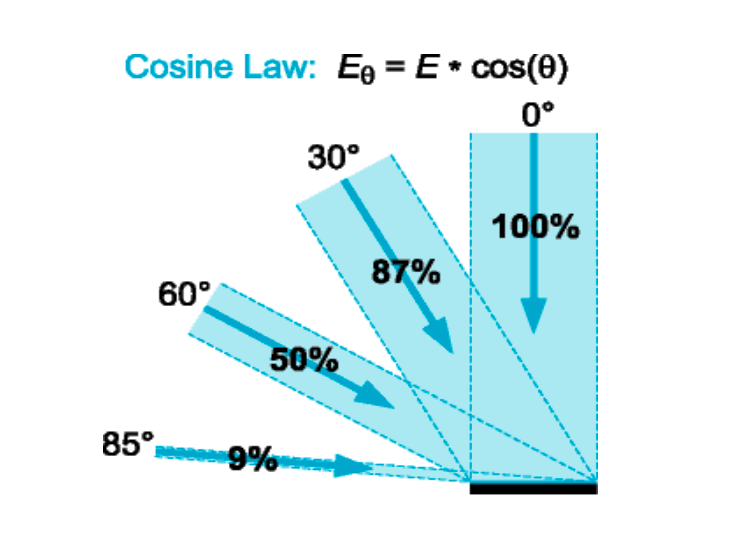
Light Intensity Varies With…
Latitude
Season
Time of Day
Aspect
Slope
Albedo
Percent of incident solar radiation that is reflected from a surface
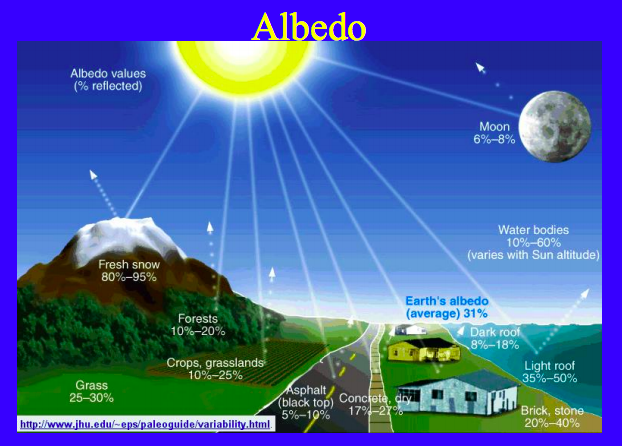
Leaf Area Index
Total leaf area per unit of ground area
Leaf Area Index (LAI) Equation
LAI= Total Lead Area/ projected ground area
Beer’s Law
Describes the relationship between leaf area index (L) and available light
Beer’s Law Equation
I=I0e-kLi
I= Available light at any height
e= base of natural logarithm (2.718)
Li= cumulative LAI above height i
k= Light extinction coefficient (measure of degree to which leaves absorb and reflect light)
Higher LAI and higher k → less available light
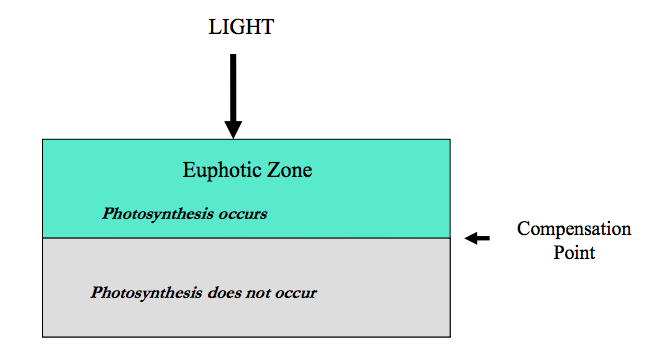
Euphotic Zone
Water depth where light intensity is above the compensation point (high enough to support photosynthetic organisms).
Compensation point is at the bottom of the Euphotic Zone
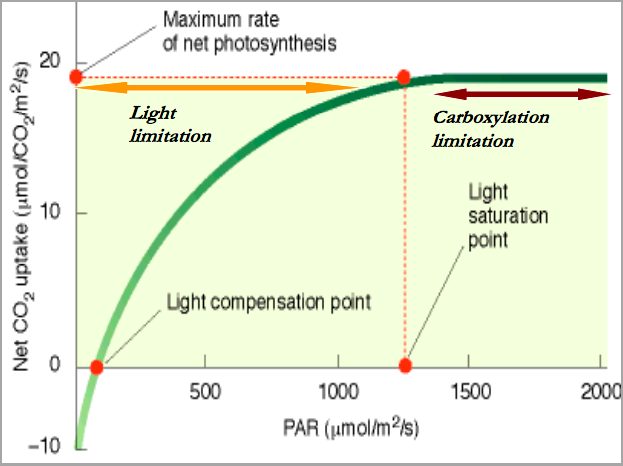
Light Response Curve
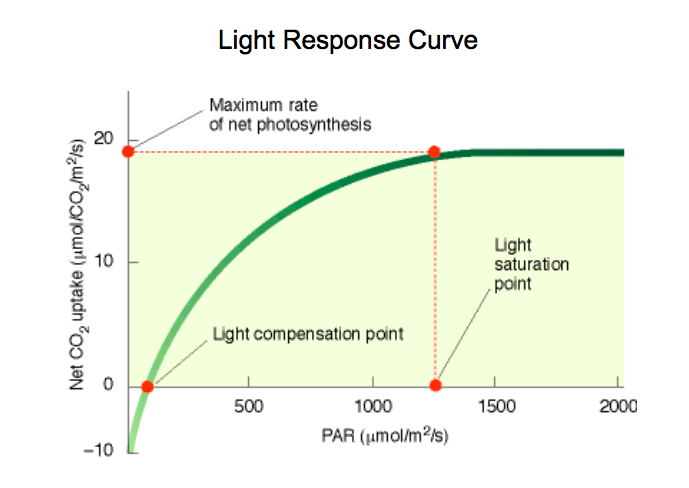
Compensation Point
- Light intensity at which gross carbon fixation via photosynthesis is balanced by CO2 -C losses via respiration
- Explains why it is more difficult for leaves and plants to survive and grow in the subcanopy
- At the compensation point, a plant is neither losing or gaining carbon (net)
Saturation Point
- Saturation point = light intensity beyond which there is no increase in net C fixation
- At some point, plants are “saturated” with respect to light intensity
- Because of inherent limitations of biochemistry
- CO2 may become limiting (diffusion of CO2 through stomates can’t keep up with photosynthesis
- Stomates may close if water stress accompanies high light intensity
Another Light Response Curve