Describe the change in filtrate composition as it passes through the nephron:
- Renal corpuscle = No absorption, pH 7.4, 100% Glucose, Na, Cl, K, Water
- PT = Bulk absoprtion, Remaining: 0% Glucose, 33% Na, Cl and water, 30% K. pH Dropped to 6.7
- Loop, DCT, CD = Everything continues to drop / absorbed. BUT K increases slightly in the CD. pH has dropped to 4.5
What are starlings forces?
The the balance of hydrostatic and colloid oncotic forces between the plasma and interstitial fluid.
- Govern movement of water and solutes b/w plasma and intersitial fluid (WITHIN ECF)
i. e Hydrostatic pressure forces water and solutes out of blood, but plasma proteins that arent filtered exert oncotic pressure inwards.
With starlings forces what happens in normal capillaries?
Normal capillaries: Small outward fluid shift (collected by lymphatics)
Describe the filtration forces of the glomerulus:
~10mmHg net filtration pressure = (Glomeurular hydrostatic pressure - (Oncotic prressure (back in) + Capsular hydrostatic pressure)
What is the glomerular filtration rate and how much of the total plasma volume in the glomerular capillaries is filtered?
125ml/min for both kidneys
~20% of total plasma volume in glomerular caps is filtered.
Why is GFR (glomerular filtration rate) so important?
For the kidney to tightly regulate ECF osmolality and pH it needs to ensure constant GFR.
Primary regulation of GFR is via changes in glomeular hydrostatic pressure
How does systemic blood pressure influence GFR?
Changes in systemic blood pressure dont change GFR because of renal autoregulation
(Renal autoregulation can only occur over a set range of MABP, beyond these limits (pathological blood pressures) GFR changes.
What does renal autoregulation involve?
Feedback mechanisms that cause ither dilation or constriction of the afferent arteriole or constriction of the efferent arteriole.
Macula densa cells of the DCT sense NaCl and release ATP to change the aff or eff art diameter.
What are some extrinsic mechanisms of renal autoregulation?
Renin-ANG2 = Constriction of efferent art. (inc. GFR)
ANP and BNP = Dilatation of afferent art. (inc. GFR)
SNS = Constriction of afferent art (Dec. GFR)
What are the intrinsic mechanisms of GFR?
Myogenic : Increased art. pressure strethces the afferent arteriole inducing it to constrict = Offsets pressure increase and keeps CFR stable
Tubuloglomerular feedback: Macula dense cells monitor NaCl levels in distal tubule, if high they signal to the afferent arteriole to constrict = Decrease GFR (returning CFR to stable point)
Describe the RAAS regulation of GFR in a flow chart
Dec. GFR -> Sensed by macula dense which release paracrine factors -> JG cells release renin -> ANG2 = Afferent art. constriciton (inc. GFR) and aldosterone release -> Increases Na reuptake from distal tube and increased BV = inc. GFR
Describe the response of lowered BP to GFR
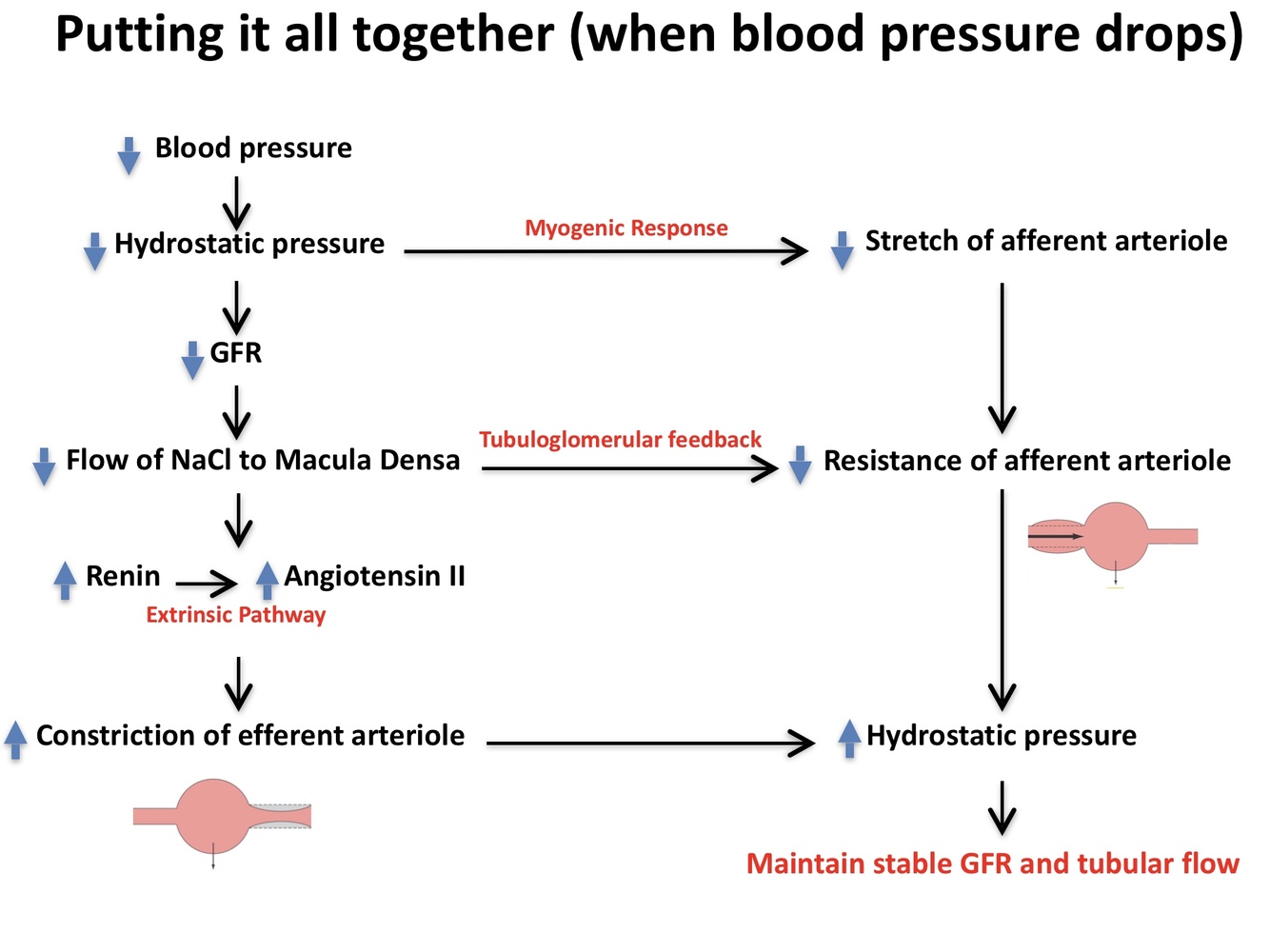
Describe the SNS relation to maintaining GFR
Low Na or lower perfusion of brain triggers increased SNS to kidney which results in:
- Inc. Renin from JG cells
- Inc. PT Na and water reabsoprtion
- Decreased renal blood flow; afferent art. constriction, Dec GFR.
Acts to retain Na and water in body (maintain BP) (WHEN SEVERE SHOCK HAS OCCURRED)
Whats absorbed in the PT?
- ~66% water and inorganic ions
- ~100% glucose and AA
- 90% Bicarb
What are the transport mechanisms in the PT?
Transcellular
- Primary active transport
- Secondary active transport, drive by another gradient
- Co transport or symport
- Countertransport or antiport
Paracellular - b/w cells (passive)
What are the predominant transporters in the PT?
Na couples transporters are predominant therefore Na/K ATPase function is critical (90% ATP is consumed here)
Describe some transporters in the PT:
Na/K ATPase drives:
- Na/glucose symporters and antiporters. i.e Na down its gradient pulls glucose with it against its gradient
Water follows Na by paracellular osmosis via leaky junctions, some solutes i.e K follow this via solvent drag
Because water follows NaCl osmolality in the lumen remains constant.
How is Bicarbonate re-absorbed in the PT?
- HCO3 is a key pH buffer thus needs to be reabsorbed from filtrate but cannot cross membrane. Thus brush border contains carbonic anhydrase that forms H2O and CO2 that freely diffuse across the membrane
This is why the pH drops to 6.7 in the PT
What happens to CO2 when it enters the cell?
It is hydrated to form HCO3 and H+.
Bicarb transported across the basolateral membrane by transporters
THUS PT dysfunction causes PT acidosis due to loss of HCO3 in urine.
How does PT generate new bicarb?
- PT cells metabolise glutamine to ammonium ion and bicarbonate
- Ammonium is secreted into the lumen by Na/NH4 exchanger.
- HCO3 is transported into the blood
- An increased in ECF [H+] increases renal glutamine metabolism (Increases HCO3 production)
- New HCO3 is a key function, as most PT H+ secretion that could (in theory) be used to regulate pH is instead used to reabsorb filtered HCO3
What is fanconi syndrome?
Either heriditary of acquired, results from an impaired ability of the PT to reabsorb HCO3, Pi, AA, glucose and low-MW proteins, resulting in increased urinary excretion of these solutes.
Describe Cl reabsoprtion in the late proximal tubule
- Cl becomes concentrated in the late proximal tubule due to the prior reabsorption of water and solutes in the early tubule
- [Cl] in lumen > [Cl] in ECF
- Cl moves down its concentration gradient via leaky tight junctions (paracellular)
- Lumen becomes electropositive -> Inducing paracellular Na+ reabsorption
Whats secreted in the proximal tubule?
Organic anions and organic cations are secreted in the PT
- Clearance of xenobiotic agents ingested from the diet, or environment
Just understand that drugs are excreted
What is the function of the loop of henle:
- Functions to produce urine that is more concentrated or more dilute than plasma
- Not clear how it works: Countercurrent and passive hypothesis theories
- Concentration and volume of urine can very dramatically

-
Lecture 5: Nephron function 133
-
Lecture 6: Nephron function 222
-
Lecture 2: Renal Histology31
-
Lecture 14: Water and salt balance Part 121
-
Lecture 15: Renal disease34
-
Lecture 18: Clinical problem solving: Hyponatraemia36
-
Lecture 21: Clinical problem solving - Renal failure23
-
Lecture 25: Water and salt balance 215
-
Lecture 1: CV function10
-
Lecture 2: Cardiac electrophysiology and arrhythmia25
-
Lecture 3: Pathophysiology of resp. failure28
-
Lecture 4: Treatment of cardiac rhythm disturbances32
-
Lecture 5: Pathophysiology of resp. failure part 215
-
Lecture 6: Anticoagulant drugs33
-
Lecture 7: Regulation of cardiac function21
-
Lecture 8: ACE inhibitors29
-
Lecture 9: Alpha blockers and Ca channel blockers22
-
Lecture 10: Vascular function 129
-
Lecture 11: Beta blockers22
-
Lecture 12: Antihypertensives26
-
Lecture 13: Vascular function part 211
-
Lecture 14: Aspirin21
-
Lecture 15: Clinical endocrinology0
-
Lecture 16: CV Control 115
-
Lecture 17: Statins20
-
Lecture 18: CV control 221
-
Lecture 19: Clinical renal failure50
-
Lecture 20: Salt and water45
-
Lecture 21: Mg and K33
-
Lecture 22-24: Acid:Base Part One39
-
Lecture 22-24: Acid:Base Part Two44
-
Drug essentials1
-
GI Problems One: Luminal pathology30
-
GI Problems Two: Jaundice38
-
GI problems Three: The liver39
-
GI Problems Four: Viral hepatitis13
-
Cardiac rhythm problems38
-
Ischeamic heart disease problems30
-
Cardiac function problems16



