Why we care about Intellectual Property Rights
- IPRs can increase incentives to innovate
- IPRs can help to appropriate profits from innovation
- The IPRs of others (competitors, suppliers, customers, …) can make a firm’s life and innovative activity difficult
- The IPRs of others contains valuable information
Whate are the most important formal protection mechanisms?
- Patents
- new
- inventive - sufficiently different
- usually 20 years in pharma 25 years
- needs to be ensured by patent holder
- Registered designs (“Geschmacksmuster”) - Design right
- New and individual character; only apply to products - not technical just shape
- Just five years, but a lot cheaper than patents
- Difficult to enforce, except for direct copies
- Registered trademarks
- like coca cola
- Copyright
- Automatic, lasts for 70-years after author’s death
- Mainly for artistic works, but also software
Overview: Formal IPRs and how they are applied
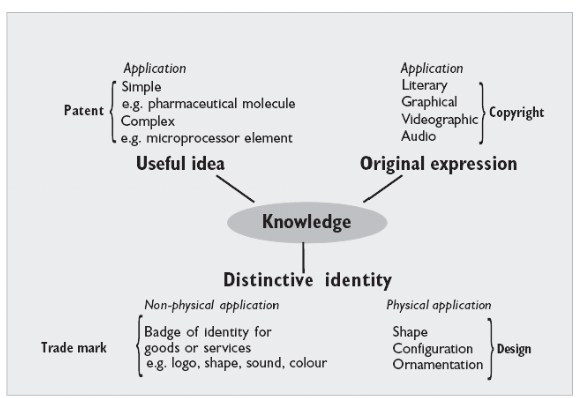
Why is a patent not a monopoly?
- patent must not be a monoly (new headache drug e.g.)
- not every patent make it through a product
- validity of the patent
What is a patent?
- A patent is a right of ownership over an invention, granted to an inventor by a government for a specified period of time
- The owner may sell or license a patent.
- Patents are territorial rights; so a German patent relates only to Germany
- Patents have limited lifetime. After the end of the patent term, or if the patent should lapse, the invention becomes freely available.
What is patentable?
– Be new – prior public disclosure can invalidate an application
– Contain an ‘inventive step’ - i.e., compared with what is already know, it should contain something that would not be obvious to someone with a good knowledge and experience of the subject.
– Be capable of industrial application – i.e., be capable of being made or used in “industry” (broadly defined). i.e., that the invention must take the practical form of an apparatus or device, a product such as some new material or substance or an industrial process or method of operation.
Patent examiners judge whether these conditions are met
– Undertake searches to see whether patent breaches “prior art”
– Assess inventive step, industrial applicability
What cannot be a patent?
- A ‘scientific’ discovery – without an industrial application
- A scientific method or mathematical method
- An aesthetic creation (e.g., literature, art, music, etc.)
- A device contrary to the accepted physical laws
(e. g., a perpetual motion machines, or a time machine) - [In Germany & Europe]
– Computer program (except if technically novel)
– A business method (except if technically novel)
– Invention of a new animal or plant variety
– A method of treatment of the human or animal body by surgery or therapy; or a method of diagnosis
How to obtain a patent?
- To obtain a patent, one submits a patent application to the patent office
- The application
- describes the technical invention
- defines the desired area of protection
- The application is examined and approved (or rejected) by the patent office
- In any case, the application is made public after 18 months
- Avg. time from application to decision at EPO: about 4 ys!
- Granted patents can be renewed for up to 20 ys
- exceptions for pharmaceutical industry, 25 ys
Benefits of patents?
- Profits from
- use in own production without risk that a competitor receives the patent
- Licensing against cash
- Licensing in exchange for other patents (cross-licensing)
- Creates costs for rivals (for invent-around) and potentially entry barriers
- Image, signaling (esp. for young firms seeking venture capital)
Costs for patents?
- Process cost (incomplete): – attorney
- research
- patent office application fee – renewal fees
- translation cost
- Opportunity cost to secrecy (application is made public!)
- Detection of infringement
- Assertion of patent in case of infringement
The big debate: Societal benefits and cost of patents
Patents provide (under suitable conditions) incentives for developing new technology → dynamic efficiency
- Economic reasoning: A limited period of protection and increased market power (potentially even monopoly) shall create incentives to invest in innovation
- Lawyers‘ reasoning: The inventor has a right to his/her intellectual property which is embodied in the invention.
But, on the other hand, granted patents provide exclusion rights, and typically an inefficiently low use of the existing technology
- → static inefficiency




