Precursors of Platelets?
Come from Megakaryoblasts that are: Large, small cytoplasm, immature with nucleoli
Megakaryocytes are the next step. The have small granules and are found next to the sinusoidal endothelial cells. About 4000 platelets are formed from the breaking up of a single megakaryocyte.
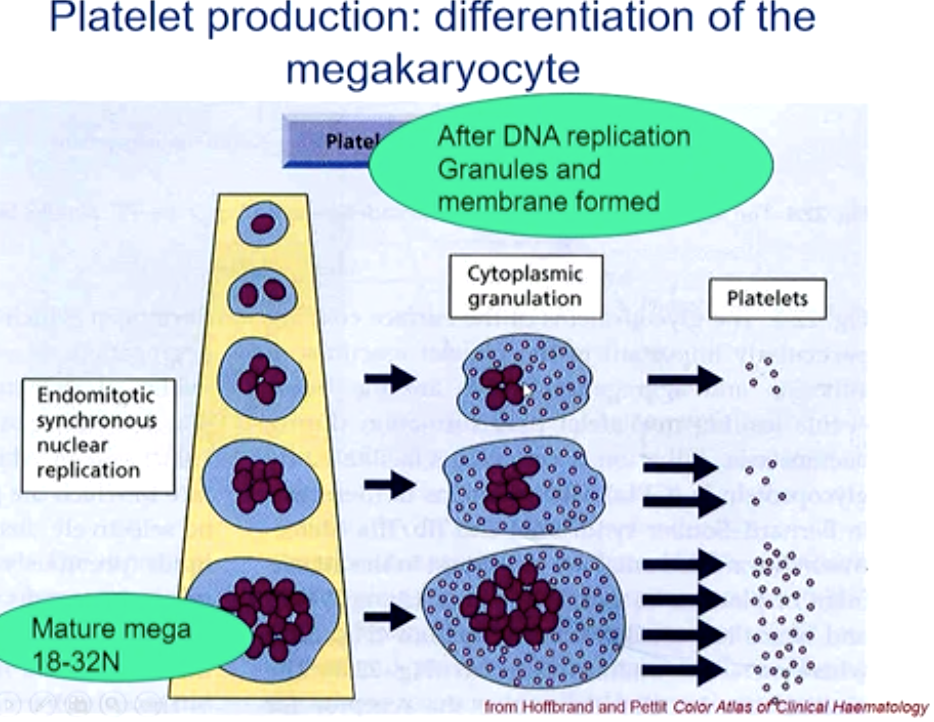
Hormones involved in thrombocytopoiesis? Homeostasis?
- Steel (stem cell) Factor - (early on)
- LIF (leukaemia inhibitory factor)
- Interleukin 6 and 11
- Thrombopoietin (TPO) - MAJOR
Number maintains at a constant level and so we require about 10%- 40000 new platelets/uL/day. (clinically important as Aspirin irreversibly blocks COX enz so after 5 days off it you have 50% of normal platelets at least)
They last about 7-10 days and are consumed by utelisation or senscence.
Platelet ultrastructure?
These are discoid in shape and contain an intricate system of channels continuous with the phospholipid plasma membrane. No Nucleus but does have mitochondria. A and B granules contain various things that are to be released.
Primary Haemostasis? Supression normally?
Primary Haemostasis is the process of forming a platelet plug at the site of vessel injury (trauma or just the general wear and tear)
- phase one is vascular constriction
- phase two is the formation of an unstable platelet plug by aggregation of platelets.
Normally this is stopped by NO and PGI2 being released from intact endothelium.
Platelet interactions?
Von Willebrand factor binds to exposed collagen in the endothelial matrix then binding to resting platelets via Glycoprotein (GP) 1B-V-IX
In a rolling motion the platelet is pulled in releasing granules (eg. thromboxane A2 )that expose Integrin and bring in more platelets and also exposes Integrin AIIbB<strong>3</strong> which is a target for stopping clotting
Fibrinogen then binds between this integrin and the integrin on another activated platelet.
What are the main influences on blood platelet levels?
Decreased Production
- Viral infections, Drugs, Bone marrow failure (rare)- aplastic anaemia, leukaemia, carcinoma
Increased Destruction
- Immune thrombocytopenia (ITP), DIC
Increased Production
- Myeloproliferative neoplasms (essential thrombocythemia)
Names for different types of bruising?
Petechiae - small spots
purpura - larger spots/small bruises
ecchymoses - large bruising

-
Lecture 1: Blood and Marrow10
-
Lecture 2: RBCs and Hb11
-
Lecture 3: Fever and cough (URTI)8
-
Lecture 4: Skin and Soft tissue infection12
-
Lecture 5: Pneumonia8
-
Lecture 6: Anaemia10
-
Lecture 7: WBCs16
-
Lecture 8: Platelets7
-
Lecture 9: Innate immunity + antigen presentation8
-
Lecture 10: Physiological coagulation11
-
Lecture 11: Malignant Blood disorders9
-
Lecture 12: coagulation in the lab + bleeding disorders14
-
Lecture 13: Thrombotic disorders11
-
Lecture 14: Osteomyelitis15
-
Lecture 15: Septic Arthritis and Rheumatic Fever10
-
Lecture 16: Immune activation, Helper cells and regulation11
-
Lecture 17: Blood group serology12
-
Lecture 18: Blood Products8
-
Lecture 19: B cells and Antibodies13
-
Lecture 20: Transfusions5
-
Lecture 21: Cell-mediated immunity11
-
Lecture 22: Fever and a new Murmur5
-
Lecture 23: Diarrhoea and Gastro illness11
-
Lecture 24: Boy with Fever ILA0
-
Lecture 25: Peritonitis and intra-abdominal infection7
-
Lecture 26: Infection and Immunity12
-
Lecture 27: Immunisation8
-
Lecture 28: Fever and headache12
-
Lecture 29: Dysuria- Dysuria-urethritis, cervicitis and testicular pain14
-
Lecture 30: Dysuria-UTI6
-
Lecture 31: Fever and Lymphadenopathy6
-
Lecture 32: Autoimmunity and hypersensitivity14
-
Lecture 33: Skin6
-
Lecture 34: AIDS and headache8
-
Lecture 35: Genital Ulcers and lesions12
-
Lecture 36: Molecular medicine-febrile neutropenia4
-
Lecture 37: Febrile returned traveller8
-
Lecture 39: Factors influencing immune responses8
-
Lecture 40: POC- healthcare associated infections14
-
Lecture 41: Patient with Jaundice- viral hepatitis10
-
Lecture 38: Fever and Rash1



