Define facies.
The term facies describes an interval of sediment or rock that has unique definable characteristics that distinguishes it from adjacent rocks.
Facies are products of unique processes and conditions in the host environment.
I.e. environment + process = facies.
Define texture.
Texture = physical properties of grains and aggregates of grains.
Textural features of sediments:
Grain size.
Grain shape.
Sorting.
Rounding/roundness.
Fabric.
Porosity.
Permeability.
What is grain size in rock controlled by?
Grain size in rock is controlled by:
Source rock (inherent grain sizes).
Composition (inherent hardness of sediment particles).
Energy levels during transportation and deposition.
Time sediment spent in transportation cycle.
–> The degree to which source materials are abraded and broken down during transport.
Preserved grain size by itself cannot be used to identify specific depositional environments.
What nomenclature is used to describe grain size?
Grain size nomenclature:
Standard scheme developed by Udden and Wentworth.
Geometric progression with base factor of 2 (i.e. 2^n).
–> Sediment categorises (e.g. sandstone, siltstone etc) defined by grain size.
A useful modification of Udden-Wentworth scale:
–> Logarithmic phi (Φ) scale (Krumbein).
–> A method oc convenience which allows grain sizes to be expressed in units of equal value and easy for graph plotting and statistical calculations.
–> This scale is based on the following relationship:
Φ = -log2 (Grain size diameter in mm).
OR
Φ = -log10 (diameter) / log10 (2).
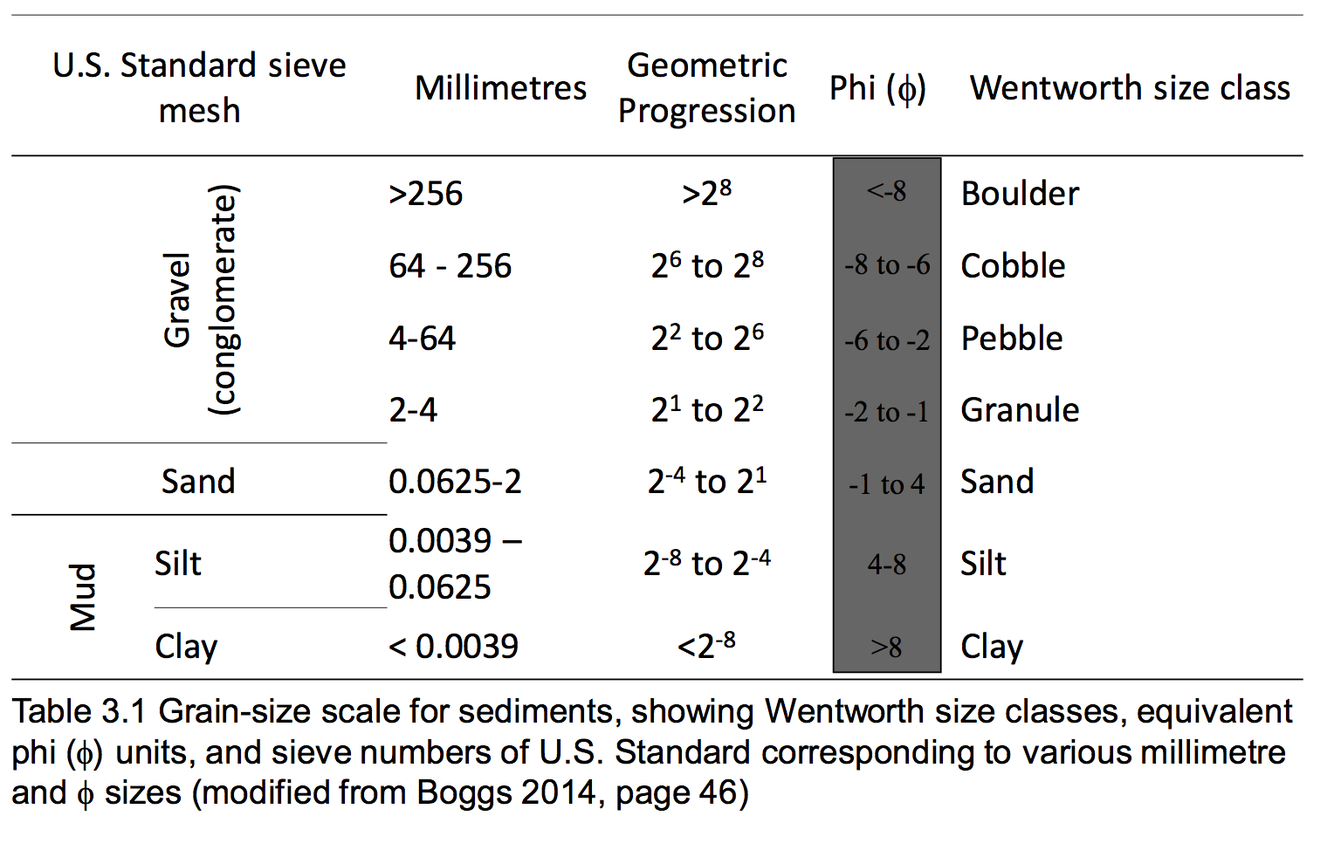
What are the different sizes of different sediments?
Primary sediment/sed rock grain-sizes:
Clay/ claystone : <0.0039 mm
Silt/ siltstone : 0.0039 – 0.0625 mm
Sand/ sandstone : 0.0625 – 2 mm
Granule/ granule conglomerate*/breccia* : 2 – 4 mm
Pebble/ pebble conglomerate*/breccia* : 4 – 64mm
Cobble/ cobble conglomerate/breccia : 64 – 256mm
Boulder/ boulder conglomerate/breccia : >256mm
* Breccia = lithified gravel with angular fragments.
* Conglomerate = lithified gravel with round fragments.
How are the sizes of unconsolidated grains measured?
Boulders, cobbles and pebbles:
Manual measurement of individual clasts.
Granules, sand and silt:
Sieving, settling-tube analysis and image analysis.
Silt and clay:
Pipette analysis, sedimentation balences, photohydrometer. Sedigraph, lazer diffractometer and electro-resistance (e.g. coulter counter).
What are applications of grain size studies?
Reflect energy levels in environments.
Record changes in environment.
- Fair weather to storm.
- Reef to lagoon.
- River to flood plain.
Grain size trends may identify environment.
Grain size trends for sequences across multiple beds, not just one.
Key features:
–> Coursing/fining upwards.
–> Cyclicity.
–> Abrupt/gradual changes.
What is sorting?
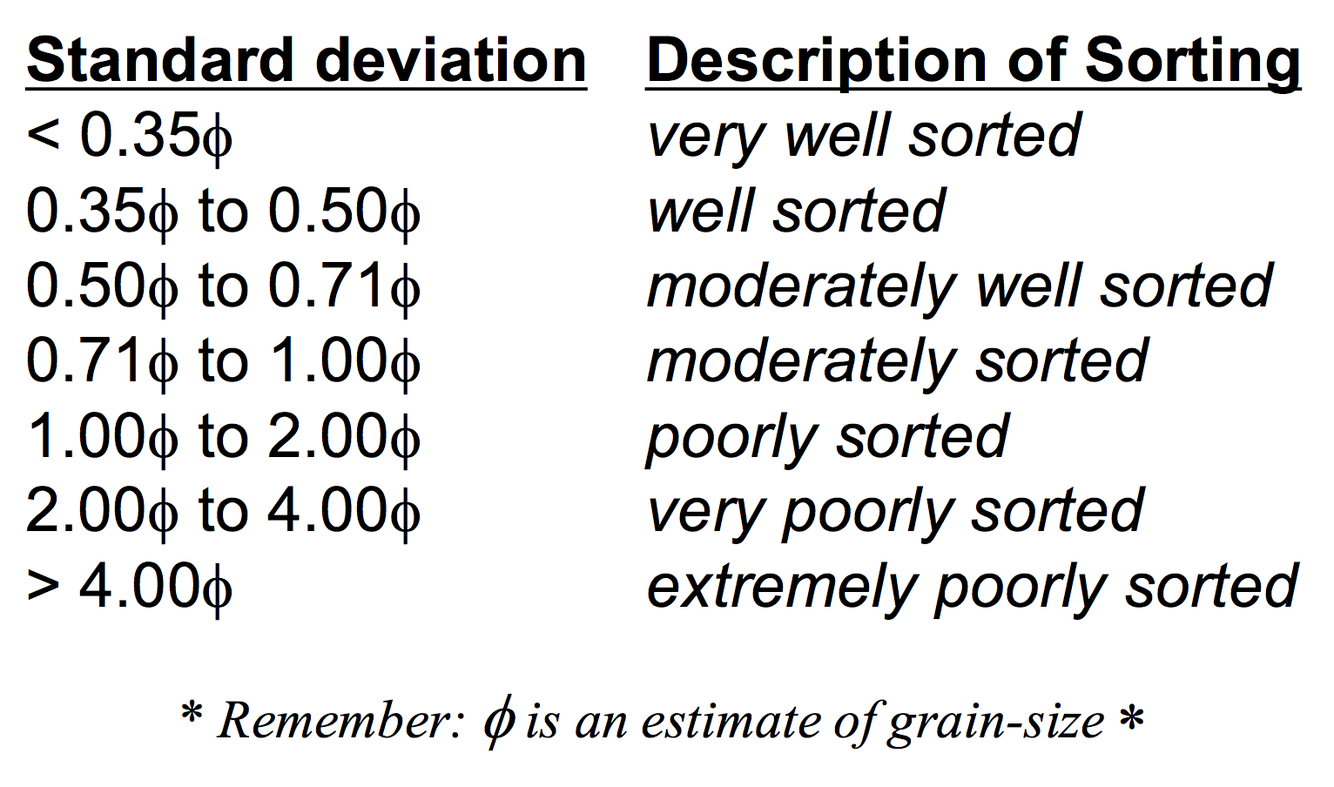
Sorting = The degree to which a sediment has a uniform grain size.
- Valiid where grain sensities and shapes are similar.
Assessed statistically after sieving or visually.
Sorting of sediments increases as the duration of sediment transport increases and if the energy/current velocity is constant.
E.g. in a river, the coarsest and most poorly sorted sediments are near the source region.
What is hydraulic sorting?
Hydraulic sorting = The degree to which particles respond uniformly when acted on by a current.
Relevent where:
1) Grain densities are variable.
E.g. Pyroclastic sediment with low density pumice fragments and dense lithic and crystal fragments.
2) Grain shapes vary significantly.
E.g. Beach sand with equant dense mineral grains and platey shell fragments.
Vs sorting - shape and density of all grains must be ~ equivilent.
Assessed by settling veloity studies.
- Particles of different density and shape settle at different velocities through a collumn of water.
A sediment with particles of different densities and shapes may by hydraulically well sorted but poorly size sorted.
What is grain shape?
Grain shape of sediment grains or fragments is largely inherited from the source characteristics of the sediment.
Mineral grains will largely preserve their original crystal form although that may become abraded.
Rock fragments will often have a shape that reflects some original fabric in the source rock.
- Preserved bedding or tectonic cleavage/foliations.
Shell fragments will retain a curvi-planar, platey shape (because are less dense and will therefore float, and not be hit as much by the other sediments being transported).
- Reflects original skeleton morphology of the shell even if reqorked and abraded.
What is roundness/rounding?
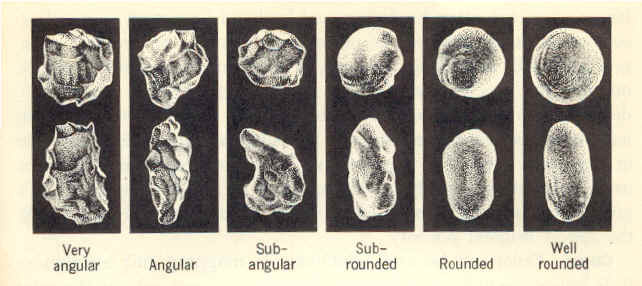
Dgree to which sharp corners and edges of a grain have been abreaded and smoothed.
Visual estimation on ‘Powers Scale.’
Significance of roundness vs angularity:
- Rounding indicates tractional transport and abrasion.
- High rounding with large time or distance of tractional transport.
- Well rounded sands only form in beaches, wind blow environments.
- Well rounded gravels/pebbles only form in beaches, high energy rivers.
Mass flow porcesses are too short lived to produce any significant rounding of rock clasts and sand grains.
BUT mass flow processes can re-deposit sediments rounded in tractional environment in to deep water.
What is fabric (in relations to sedimentary rocks)?
Organisation of grains and binding medium.
Fabric elements:
- Framework grains (FWGs) = large grains in a sediment.
+
- Matrix = fine grains between FWGs.
and/or
Cement = chemically procipitated mineral in voids/pore spaces between FWGs.
Framework types:
- Grain supported = FWGs support each other.
–>In matric and or cement (and or voids) in interstitial spaces.
- Matrix supported = FWGs supported by matric.
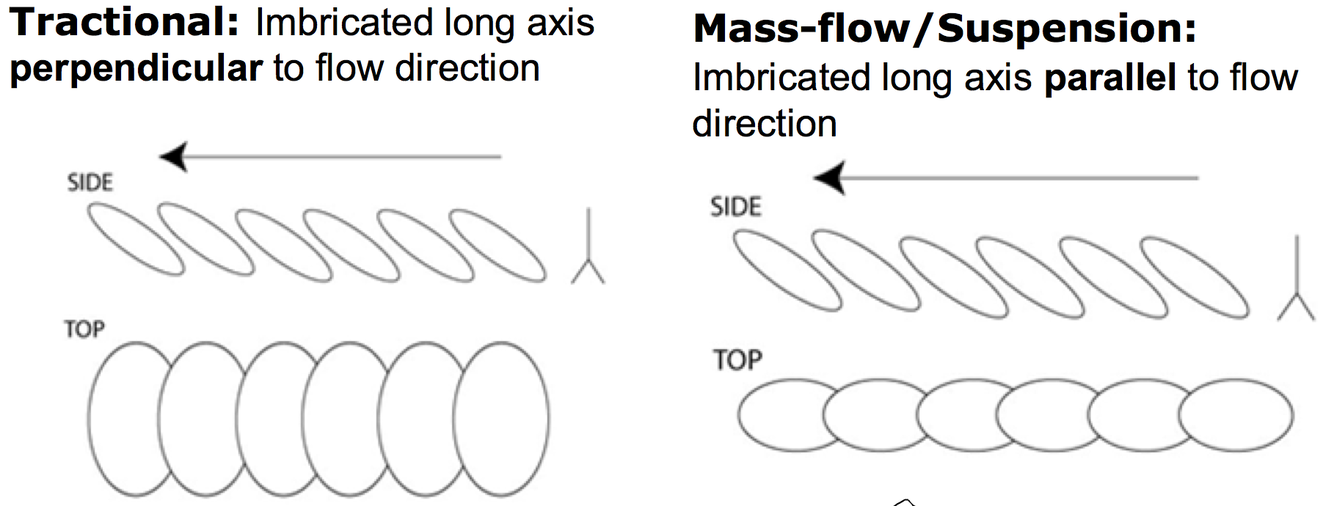
Grain orientation fabrics (gravel and sand sizes):
- Grains oriented parallel to bedding.
- Elongated grain orientation dependant on depositional setting.
–> Tractional = imbricated long axis transverse to current direction.
–> Mass-flow/suspension = imbricated long axis aligns parallel to current direction.
Imbricated = en echelon stacking of tabular (slabby) clasts oblique to bedding.
What are the different kinds of fabric grain sizes?
Grain size grading barics:
Normal grain size grading:
- Grain size decreases upwards in a single bed.
E.g. turibidity current deposit -> turbidite.
Reverse grain size grading:
- grain size increases upwards in a single bed.
E.g. grain flow deposits.
‘Course tail’ grain size grading:
- Only the dispersed course grain size population decreases in size and the matrix grain size remains the same throughout.
E.g. mudflow, debris flow, pyroclastic flow deposits.
What is porosity?
Percentage of open pore space in a sediment/rock.
Effective porosity = % of interconnected pore spaces.
Factors controlling porosity:
- Grain size, shape, sorting, vesicularity.
–> Increase any of the above and porosity increases.
- Fabric (matric or cement).
–> Increase either of above and porosity decreases.
- Compaction.
- Dissolution, joining/fracturing; AKA decondary porosity.
Utility:
- OIl, gas, water exploration.
What is permiability?
Rate of flow of fluid through effective porosity.
Function of:
- Effective porosity.
- Pore sizes.
- Viscosity of fluid.
- Presure (due to depth).
Utility:
Allows calculation of possible extraction and charge rates of oil, gas or ground water from subsurface rock resivoir or aquifer.
Using Darcy’s Law –> Flow rate of fluid though a porous medium (e.g. sediment/rock).

-
Lecture One - Plate Tectonics and Surface Processes6
-
Lecture Two - Divergent boundaries or spreading centres (rifting and drifting)8
-
Prac Two - Folds, cross sections and measuring rocks9
-
Lecture Three - Convergent boundaries (subduction zones and continental collisions)12
-
Lecture Four - Fold morphology15
-
Lecture Five - Fabrics and folds9
-
Lecture Six - Faults and shear zones17
-
Lecture Seven - Extension tectonics6
-
Lecture Eight - Strike slip tectonics5
-
Lecture Nine - Stress and strain10
-
Review Lecture One - Plate tectonics and structural geology27
-
Lecture Twelve - Igneous and metamorphic geology12
-
Lecture Thirteen - Igneous and metamorphic geology II11
-
Lecture Fourteen - Igneous and metamorphic geology III14
-
Lecture Fifteen - Igneous and metamorphic geology IV15
-
Lecture Sixteen - Introduction to metamorphism14
-
Lecture Seventeen - Metamorphic processes and occurrences I (how to classify metamorphic rocks)7
-
Lecture Eighteen - Metamorphic processes and occurrences II10
-
Lecture Nineteen - Metamorphic processes and occurrences III12
-
Lecture Twenty - Rocks and minerals in geochemical reactions4
-
Lecture Twenty One - Weathering: fluid rock reaction and making sedimentary rocks from igneous and metamorphic rocks4
-
Lecture Twenty Four - Review lecture1
-
Lecture Twenty Five - Sedimentary geology (basins)8
-
Lecture Twenty Six - Particle transport and erosion of stationary particles11
-
Lecture Twenty Seven - Surface processes and sedimentary transport11
-
Lecture Twenty Eight - Surface processes and sedimentary textures15
-
Lecture Twenty Nine - Sedimentary facies analysis11
-
Lecture Thirty - River (fluvial) environments, dynamics and successions8
-
Lecture Thirty One - Shelf environments and carbonate rocks14
-
Lecture Thirty Two - Deep ocean sedimentary settings16
-
Lecture Thirty Three - Lithostratigraphy10
-
Lecture Thirty Four - Biostratigraphy and chronostratigraphy6
-
Lecture Thirty Five - Tectonic basins as sedimentary resting places10



