Cell layout
Layout where transforming resources with a common purpose (such as, processing the same types of product, serving similar types of customer, etc.) are located together in close proximity (a cell).
Product (line) layout (examples)
high volume, low variety, mass production
- car manufacturing
- cafeteria with line-layout
- continuous service (electricity, internet, etc.)
Manage demand
A strategy to influence the demand in order to match it to the capacity.
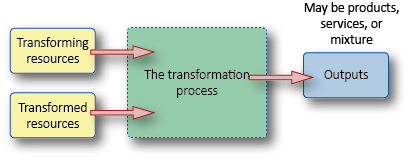
Input-output model (transformation process)
Transformational resources (those people, skills, information, plant, equipment and technology) that do the transforming, and the transformed resources (raw materials, components, information and customers) that are transformed. These enter a process, operation or system (which exists in its specific context) and transforms (by combining the transformational and transformed resources) into a number of outputs(outputs may be products, services or a mixture of the two). Outputs should have greater value than the individual inputs - hence you have a process, operation or supply network that delivers value.
Production operations (4 characteristics!)
Production operations =
(1) identified by their output (products)
(2) tangible / can be moved
(3) production occurs before consumption (non-perishable=„has some shelf life”)
(4) quality measured objectively (size, colour,…)
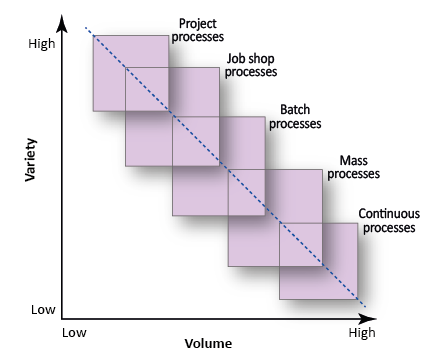
Production operation types (5)
- Project process
- Job shop process
- Batch process
- Mass process
- Continuous process
Principles of TQM
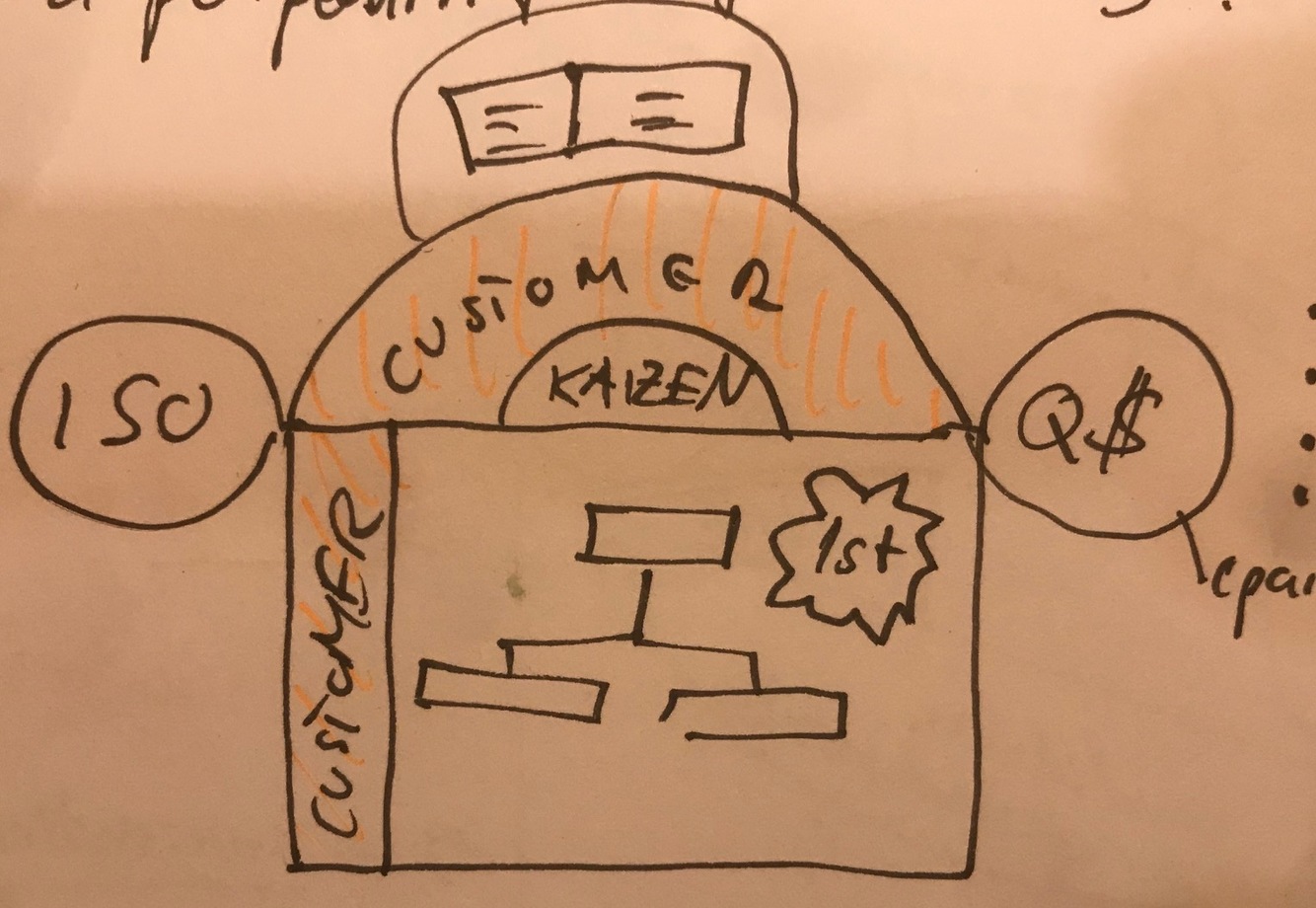
1) Stress on TOTALITY
2) Include every person in the organisation “quality at he source”
3) Focus on “zero-defects” and “do it right first time”
4) Kaizen (small incremental improvements)
5) Concept of internal and external customers
6) Use scientific methods (SPC, fishbone, cost analysis)
7) Implement Systems that improve Quality (ISO 9000)
8) Examine all costs related to quality (external failure costs, prevention costs,appraisal costs,internal failure costs)
Service operations type (3)
- Professional services
- Service shops
- Mass Services
Job shops (examples)
- bakery
- tailor (not bespoke) like …..
-10 bridges all the same –> customization only at the end
-
Which costs to consider in Invetory Mgmt?
cost of holding vs cost of ordering
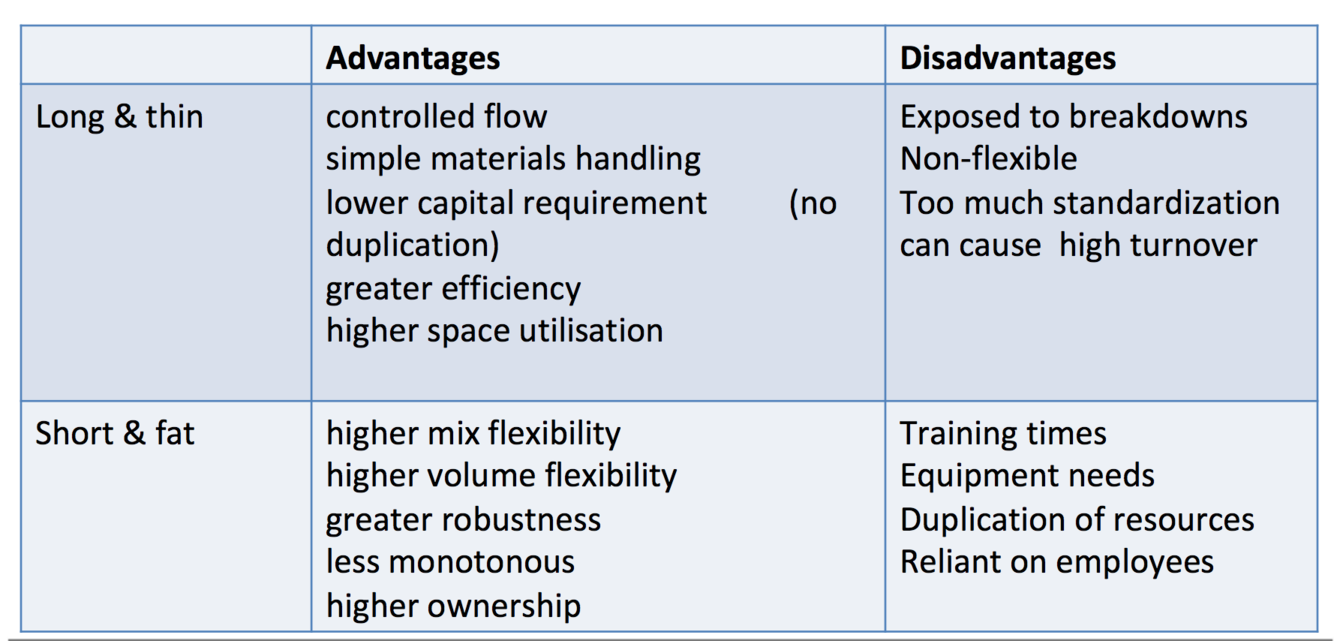
LONG-THIN VS. SHORT FAT (+/-)
Projects (project processes) (characteristics)
- single outcome or deliverable
- single and highly bespoke creation “a one-off”
- performance managed through 3 criteria
- on time: long periods
- on cost: expesive
- on quality
Functional (Process) Layout (examples)
“the flow of products or customers can take different routes through different functional areas.”
Laut my.WBS:
- hospitals
- libraries
- supermarkets
- bakery (batch process)
- carpenter shop (job shop)
- radiology unit
How can LCP/MD be enhanced?
- price incentives (increase price to reduce demand, discount to increase demand)
- complimentary services (e.g. free shipping)
- use reservation systems (better forecasting)
- create customer awareness of the company’s capacity (navigate towards “quiet periods)
Functional layout (+/-)
+:
- High variety & mix flexibility
- Rela*vely robust in case of disrup*ons
- Easy to supervise
-:
- Low utlisation
- Can have very high WIP
- Complex flow
When would you use LCP?
In capital intensive businesses (production ops) where the priority is on facility utilisation.
Managed Demand (+/-)
Benefits of an MD strategy:
- It reduces the cost of creating capacity flexibility
- It improves utilisation of assets.
- It can reduce service failure (waiting and queuing).
Limitations of an MD strategy:
- high levels of planning and forecasting - this can be costly.
- A detailed understanding of price sensitivity of customers is required.
- Discounting may have unintended consequences, outside of the discount period (it may devalue products and services). “bullwhip effect”
- You may create permanent loss of business.
Performance Measure
MANTRA: QSFDC
QUALITY = importance of high quality defined as :
-QUALITY of CONFORMANCE = high quality conformance infers low deviation/variation from the specification is accepted - low quality conformance infers high variation from the specification is accepted
-QUALITY of SPECIFICATION = it reflects high skills, valuable/expensive/precision raw materials. eg. specs of a laptop, specs of a car, etc.
SPEED = importance of fast delivery times ( (as defined from a customer perspective)
FLEXIBILITY = importance of flexible operation (as defined from a customer perspective)
DEPENDABILITY= importance of delivery ON TIME (as defined from a customer perspective)
COST = importance of LOW cost (as defined from a customer perspective)
DMAIC
D-Define
- Define the problem, set goals
M-Measure
- Gather Data
A - Analyze
- Analyze Data, identify “root causes”, establish problem hypothesis and validate
I - Improve
- test ideas, measure results
C - Control
- Standardize and implement
Service operations (4 characteristics)
Service operations =
(1) identified by their output (services)
(2) non-tangible
(3) production and consumption is simultaneously (cannot be stored, perish immediately)
(4) quality measured subjectively
Chase demand
A strategy that creates flexibility in an operation’s capacity to match increases and decreases in demand. This may take the form of a lag approach or a lead approach.
Chase Demand (+/-)
Benefits of an CD strategy:
- The operation is flexible to changes in customer demand.
- There is a reduced under- or over-production in the operation.
- Less waste in terms of resources.
Limitations of a CD strategy:
- Increased costs to provide flexibility of resources.
- It can reduce the levels of quality control.
- Increasing staff can be less costly than laying off staff - this can encourage practice such as ‘zero hours contracts’, which has negative connotations.
Service shops (examples)
- school teachers
- restaurant
- hotel reception





