How are local anesthetics classified?
amino-esters
amino-amides
How are local anesthetics metabolized?
- Esters undergo hydrolysis by pseudocholinesterases found mostly in plasma, with Chloroprocaine being the fastest.
- Amides undergo enzymatic biotransformation primarily in the liver. The lungs may extract a small amount of lidocaine & bupivacaine from the circulation.
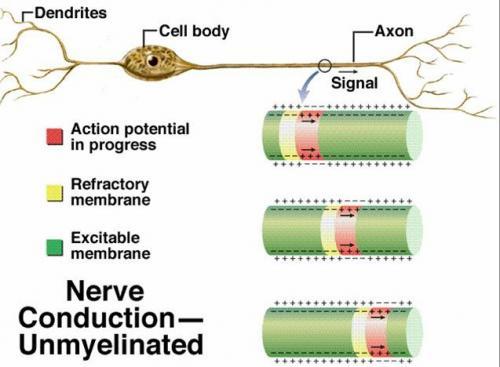
How are impulses conducted in nerve cells?
by an action potential “wave of depolarization” that is propagated along the axon by continuous coupling between excited and non-excited regions of the membrane.
(the upperclassmen SG had a 3 paragraph answer. this is the condensed version)
What is the mechanism of action of local anesthetics?
- diffusion of the base form across the nerve sheath and nerve membrane
- re-equilibration between the base and cationic forms in the axoplasm
- penetration of the cation into and attachment to a receptor site within the sodium channel
- blockade of the sodium channel
- inhibition of sodium conduction
- decrease in the rate and degree of the depolarization phase of the action potential
- failure to achieve the threshold potential
- lack of development of a propagated action potential
- blockade of impulse conduction
A patient tells you they are allergic to dental “Novocain”, should you then avoid use of all local anesthetics?
- Novocain is an ester anesthetic. Ester anesthetics (especially novocaine—procaine) are metabolized to paraaminobenzoic acid (PABA), which is the agent responsible for most allergic reactions to ester locals.
- Cross tolerance to LAs is usually from presence of PABA, or PABA like compounds found in preservatives (even in amide local anesthetics). So, yes, one can use an amide local anesthetic, but it also has to be preservative free (or methylparaben free)
What determines local anesthetic potency?
Lipid solubility is the primary determinant of local anesthetic potency.
The more lipid soluble a local anesthetic is, the more potent it is.
What determines local anesthetic duration of action?
The duration of action of a local anesthetic is proportional to the time the drug is in contact with nerve fibers.
That’s why we add epi, do produce vasoconstriction which limits systemic absorption and maintains drug concentration in the vicinity of the nerve fibers.
What determines local anesthetic onset of action?
Alkalinazation of local anesthetics solutions shortens the onset of neural blockade.
Alkalinization increases the percentage of local anesthetic existing in the lipid-soluble form. Lipid soluble = diffuse across lipid cellular barriers.
How does the onset of anesthesia proceed in a peripheral nerve block? (kind of a long answer, but it makes sense)
- When local anesthetic solutions are deposited in the viscinity of a peripheral nerve, they diffuse from the outer surface (mantle) toward the center (core) of the nerve along a concentration gradient.
- Consequently, nerve fibers in the mantle (surface) are anesthetized first, which blocks the proximal anatomic structures. Then the core (center) nerves are blocked, which are distributed to more distal structures.
- This is why the development of anesthesia is starts proximally, with subsequent distal spread.
- Conversely, recovery of sensation occurs in the “reverse direction” from what one would expect. What happens is that mantle nerve fibers are exposed to “LA free” fluids first, thus return of proximal sensations first, with core fibers being exposed to “LA free” fluids later and then a return to sensation of the distal structures.
You perform an ankle block for amputation of a toe secondary to nonhealing diabetic ulceration and sepsis. The block technique looked good but the patient almost jumped off the OR table when the surgeon made the incision. What went wrong?
Because locals are weak bases, it is possible that the sepsis/non healing ulceration caused a change in pH of the tissue in the area of injection to be more acidic.
With the tissue being more acidic, the local anesthetic is in a more ionized state, which can decrease efficacy of the local anesthetic agent.
What is ion trapping and how is it significant in OB anesthesia?
Conditions for ion trapping exist when a membrane separates 2 compartments with different physiologic pH values – maternal pH 7.4 for example and fetal pH 7.3 (or lower, especially in prolonged labor).
As weakly basic drugs like local anesthetics cross the placenta in nonionized form, they become more ionized in the fetal circulation, blocking their ability to cross the placenta and return to maternal circulation.
As a result, the drug accumulates in the fetus. This is called ion trapping.
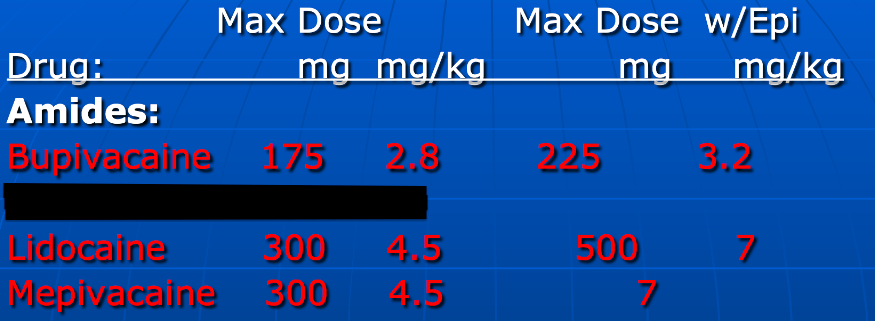
What is the maximum dose of local anesthetics a patient should receive? (specificially the ones in red from the ppt slides)
Why add epinephrine or phenylephrine to a local anesthetic and how much should be added?
- Adding a vasoconstrictor into a mixture with a local anesthetic, such as Epinephrine or less commonly Neosynephrine, decreases absorption of the local anesthetic into the blood.
- This results in prolonged duration of action and decreased bleeding
- Vasoconstrictors = Decreased Absorption = Decreased Systemic Toxicity
- Helps to identify intravascular injection when used as the marker in a “test dose.”
- Most commonly used dosage of epinephrine is 5ug/ml (1: 200 000 concentration), but doses as low 1-2 ug/ml may be sufficient.
When would adding epinephrine or phenylephrine to a local anesthetic be contraindicated?
Epinephrine containing solutions should not be injected intracutaneously or into tissues supplied by end-arteries (fingers, ears, and nose) because resulting vasoconstriction can produce ischemia and even gangrene
How does a patient become toxic from local anesthetics?
The most common causes of systemic local anesthetic toxicity are inadvertent intravascular injection and administration of an excessive dose
What are the clinical signs of toxicity?
CNS: Lightheadedness, tinnitus, circumoral and tongue numbness, visual disturbances, muscular twitching, convulsions, unconsciousness, coma, respiratory arrest, CVS depression (progression of severity)
Cardiovascular: Vasodilation (Hypotension), Increased conduction time (increased PRI and QRS), decrease chronotropic and inotropic effects
What is the order of vascular absorption from greatest to least for the various regional anesthetics blocks?
Greatest to least = Mepivacaine, Lidocaine, Prilocaine, Etidocaine

-
Vasodilators30
-
Calcium Channel Blockers28
-
Alpha and Beta Antagonists43
-
Antihypertensives and Diuretics Study Guide53
-
Peripheral Vasodilators ppt74
-
Antihypertenives and diuretics ppt20
-
CCB ppt47
-
Local Anesthetics55
-
Antidysrhythmics Study Guide55
-
Antidysrhythmics ppt66
-
Antidysrhythmic chart should probally know this well1
-
Local Anesthetics Study guide17
-
Anticoagulants and Reversal Study Guide23
-
Psych (Antidepressants/Antiepileptic/Etc) SG45
-
Local Anesthetics **Drug Cards**22
-
Psych ppt (Part 1)29
-
Psyc ppt (Part 2)40
-
Coag ppt109
-
Antiemetics ppt Micky Dees35



