1
Q
MALDI Acrynm
A
- matrix assisted laser desorption ionization
- soft ionization method useful for macromolecules of >200kDa
2
Q
What is MALDI
A
- soft ionization technique which leaves molecules intact
- can be used for liquid or solid substrates
- can be interfaced with liquid chromotography and electrophoresis
3
Q
MALDI Mechanism
A
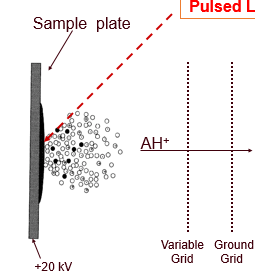
- sample is mixed with a matrix and allowed to dry which results its crystal formation
- laser flash ionizes the matrix molecules which in turn transfer protons to the analyte molecules
4
Q
MALDI Specifications
A
- pulsed laser of wavelength 193-430nm
- pulse width 0.5-10ns
- energy per pulse 1X10⁻⁷microjoules
- mean power of pulse 102W-5X10³
- diameter of pulse 10-200micrometers
- energy per laser pulse and unit area (fluence) 3X10⁻⁵ to 60X10-6 microjoules per meter squared
- laser penetration depth 50-200nm
5
Q
MALDI Matricies
A
- absorb a large amount of energy from the laser thus increasing its temperature by 100-600C
- the matrix then relays the energy to the sample in controlled amounts allowing the analyte macromolecules to desorb without decomposition
- matrix also provides a source of protons for the analyte
6
Q
MALDI Matrix Solution
A
- the mixing and the solvent must be compatable with the analyte so that uniform distribution occurs
- a plate needs to be spotted for analysis but it can be automated with a fraction collector
- 1:10,000 ratio of analyte to matrix molecules so that the analyte imolecules are completely isolated from one another
- coupling of the matrix with the laser causes rapid vibrational excitation and localized disintigration
- this causes clusters of matrix and analyte to be ejected from the surface thereby leaving the analyte in the gas phase and the matrix as violatile ions
7
Q
MALDI Analyte Ionization
A
- photoexcited matrix molecules transfer protons via a secondary ion-molecule charge-transfer reaction
- since catiions can be produced desalting is an important step
- peptides and proteins typically have higher proton affinities than standard matrix materials
8
Q
MALDI Spectrum
A
- charge one molecular ion
- high background at (m/z)<1000
- suitable for high throughput screening
9
Q
Ambient Ionization
A
*

Mass Spectrometry
flashcards
Decks in class (7)
# Cards



