Mega Deck Flashcards

(643 cards)

1
Q

State two conditions for any object to be in equilibrium

A

Resultant force zero
Resultant moment about any point zero

2
Q

State three vector quantities

A

Any 3 of the following:

Velocity
Acceleration
Force

Displacement

Weight

Momentum

3
Q

State three scalar quantities

A

Any 3 of the following:

Speed
Distance
Mass

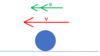
Energy

Power

Temperature

4
Q

How can force vectors be arranged to show that an object has constant velocity?

A
  1. Vectors make a closed shape when rearranged (by scale drawing)
  2. Or resolve into components and show
  • Total up forces = Total Down forces
  • Total left forces = Total right forces
5
Q

What is the difference between a vector quantity and a scalar quantity?

A

Vector has a direction
Scalar does not

6
Q

What is meant by centre of mass?

A

The point in a body where the weight of the object appears to act

Also the resultant moment about this point = 0

7
Q

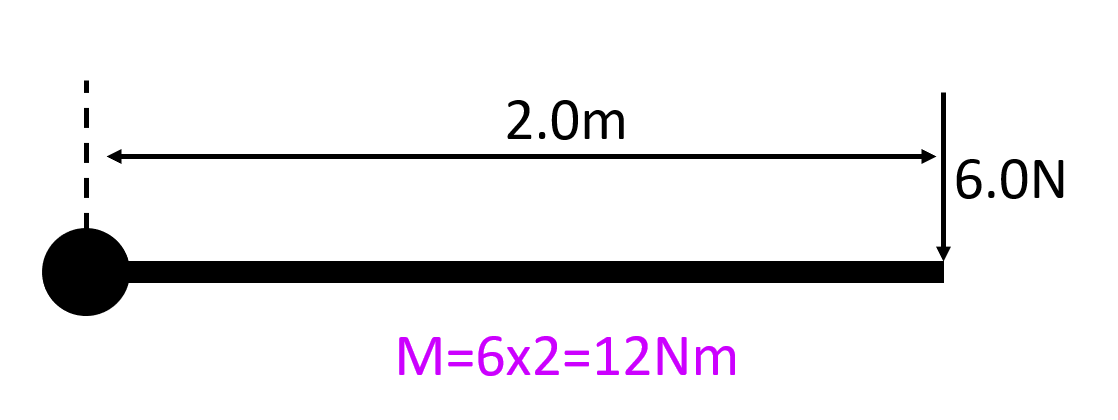
Define the moment of a force

A

Product of the force and the perpendicular distance from the line of action of the force to the point
8
Q

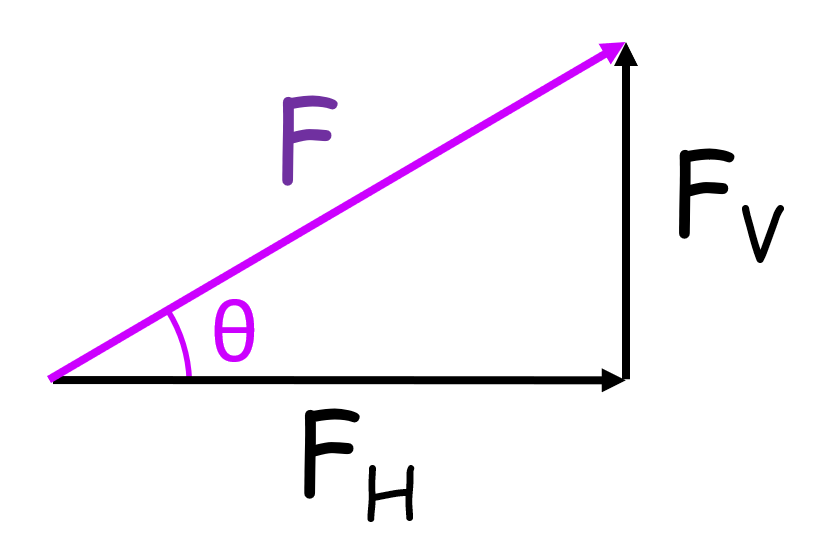
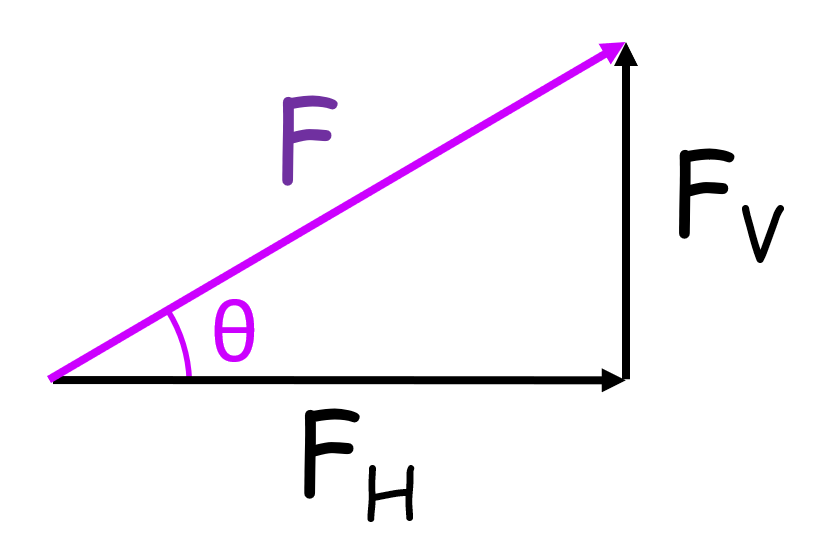
Resolve F into its vertical and horizontal components…
A

FH = FcosØ

Fv = FsinØ

9
Q

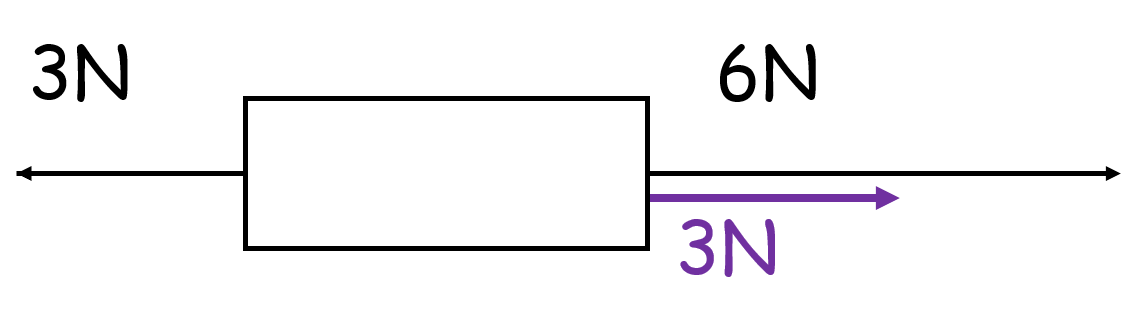
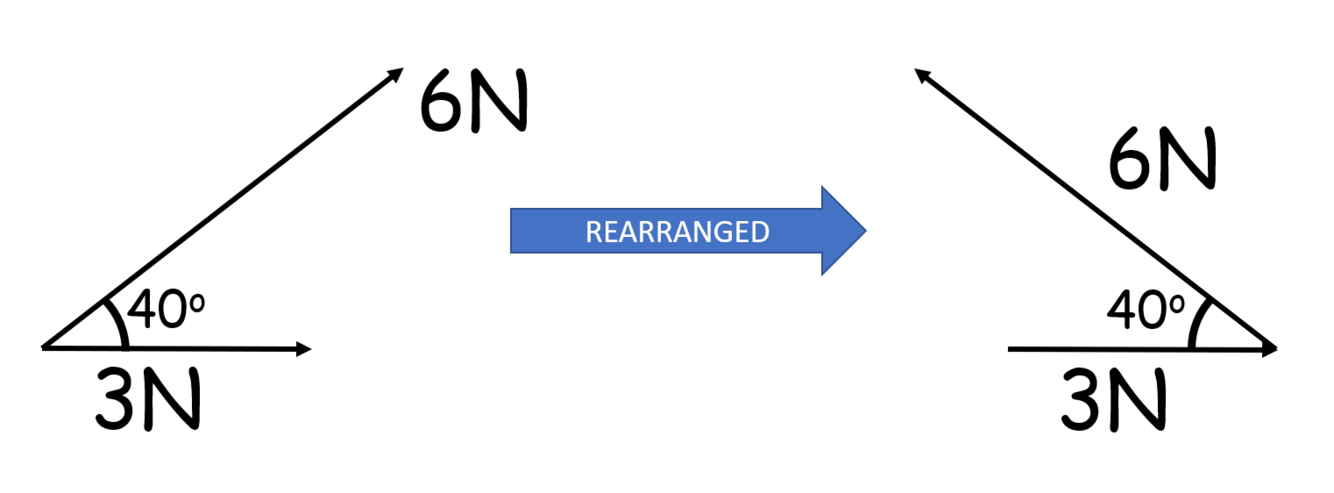
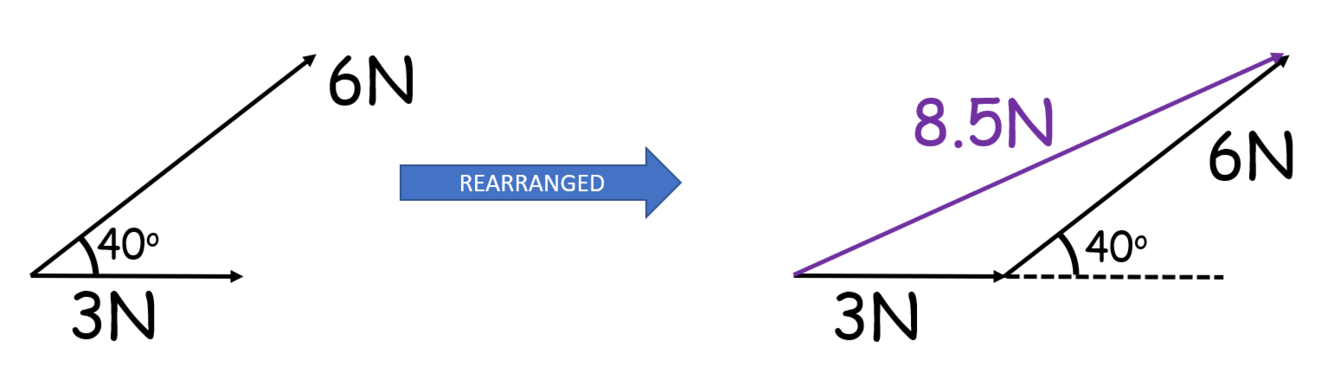
What mistake has been made in rearranging the vectors for a scale drawing?
A

6N vector has been translated (moved) but also rotated

Should be:
10
Q

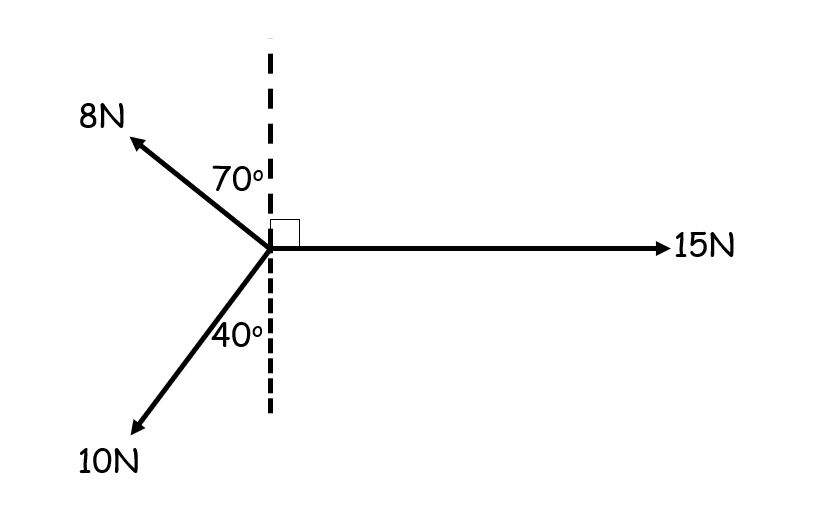
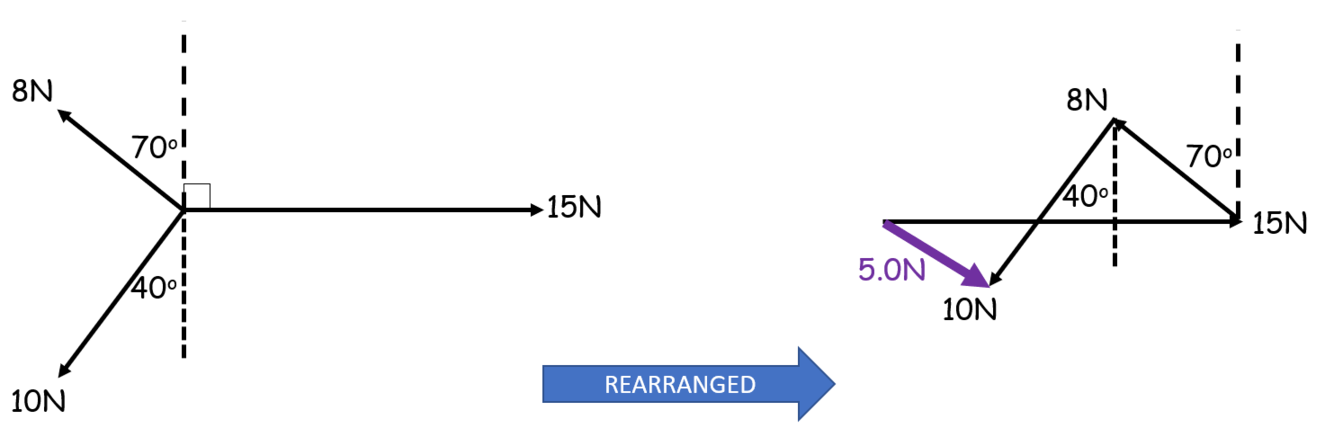
What are the steps in working out the resultant force using a tip-tail scale drawing?
A
  1. Set a scale
  2. Draw the horizontal or vertical vector first (if there is one)
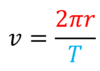
  3. Move each vector in turn to the end of the previous one (DO NOT ROTATE THE VECTORS)
  4. Resultant vector goes from the very start to the very end
11
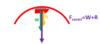
Q

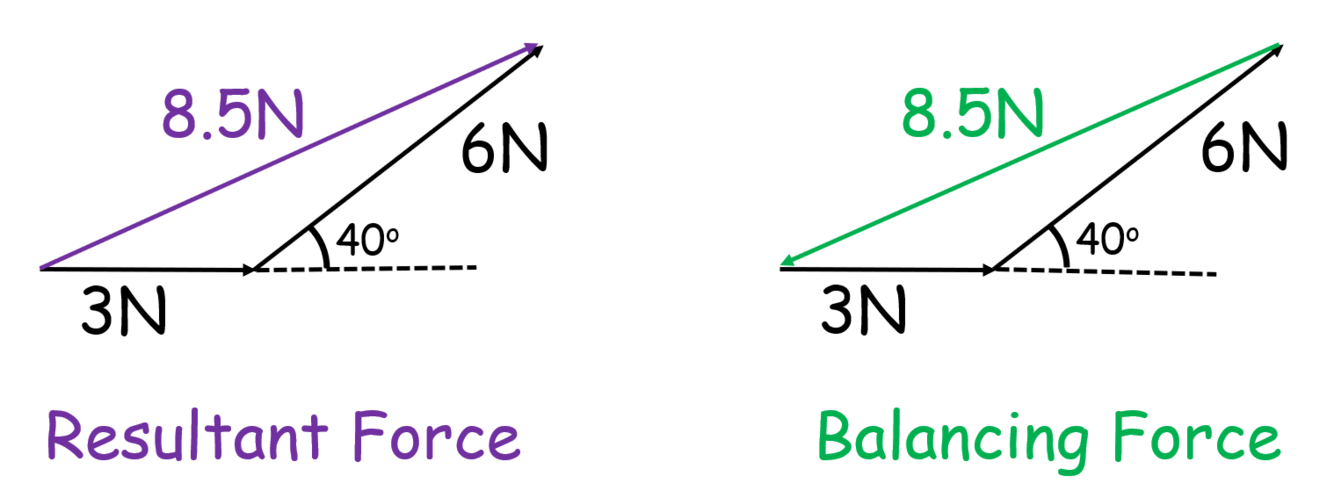
How is the balancing force different from the resultant force?

A

The balancing force brings the object into equilibrium so makes the resultant force = 0

For a scale drawing, it is the vector that closes the shape
12
Q

If vectors are parallel they can be resolved by…
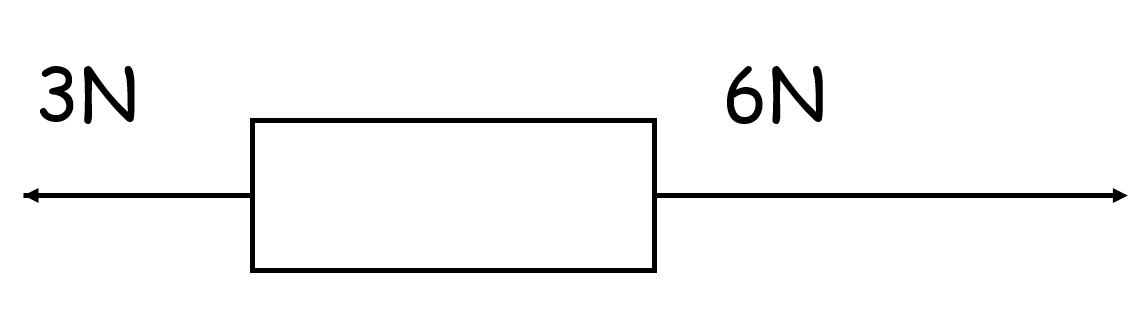
A

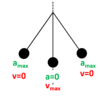
Adding or subtracting the values

13
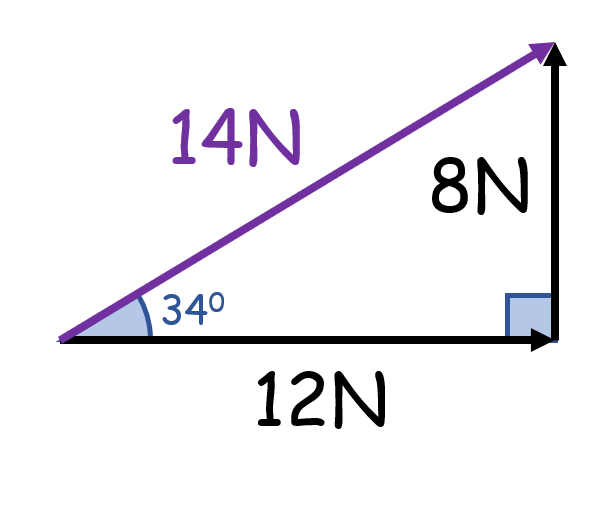
Q

If vectors are perpendicular they can be resolved by…
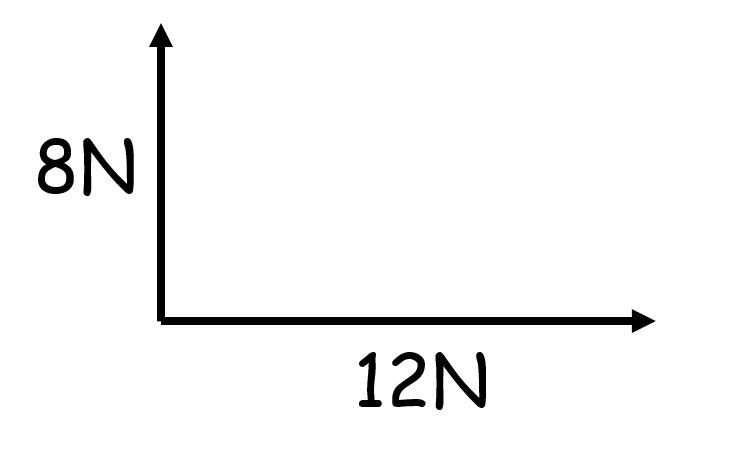
A

Making a right angled triangle and using trigonometry and pythagoras
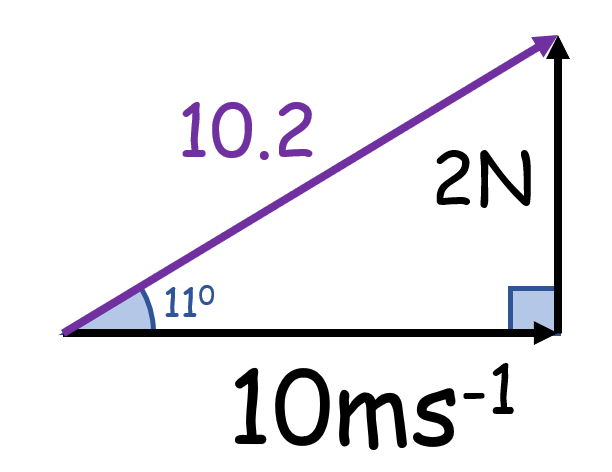
14
Q

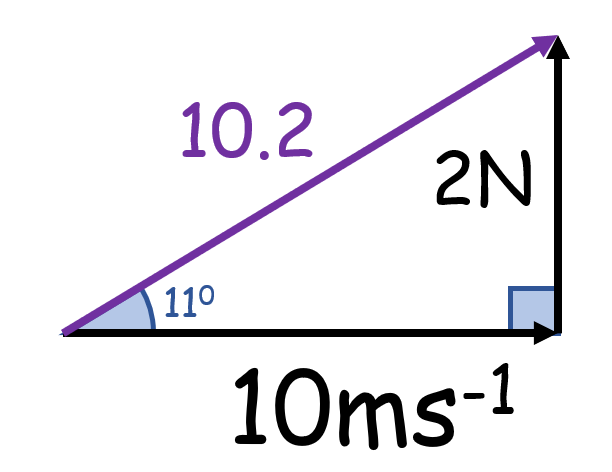
What is wrong with this?

A

Vectors of different types can’t be combined

(Here, force and velocity cannot be combined)
15
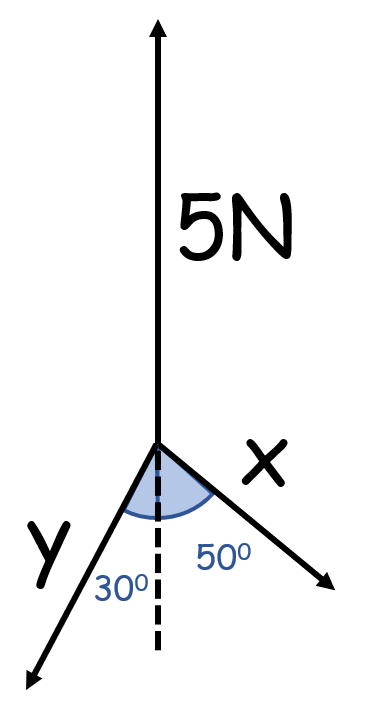
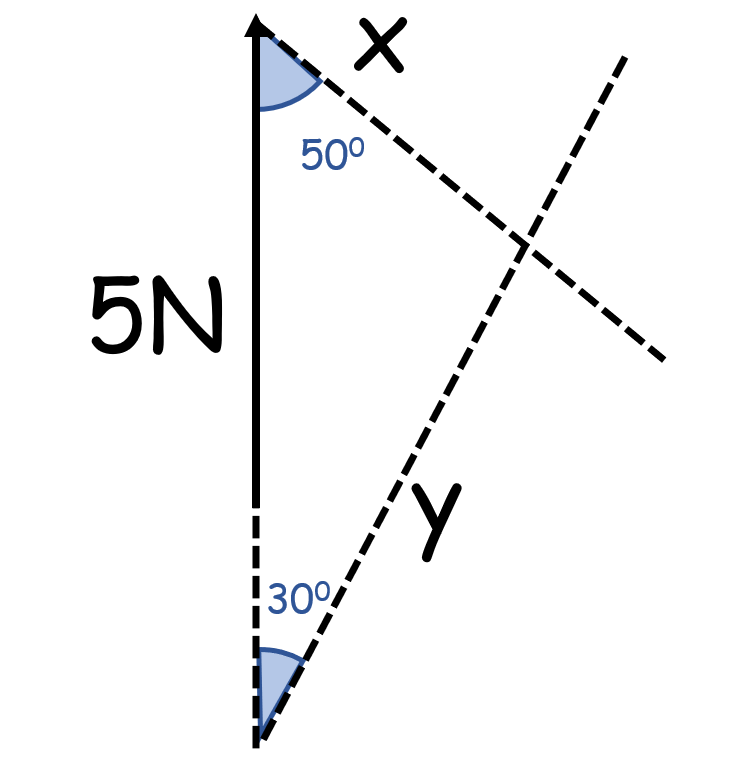
Q

How do you solve this if the object is in equilibrium?

(3 vectors with 2 unknown sizes)
A
  1. The vectors must form a closed shape
  2. Start as you would with a scale drawing
  3. But draw the third vector meeting for where it connects to the start of the first
  4. Draws vectors as dotted lines

(x=2.54N, y=3.89N)
16
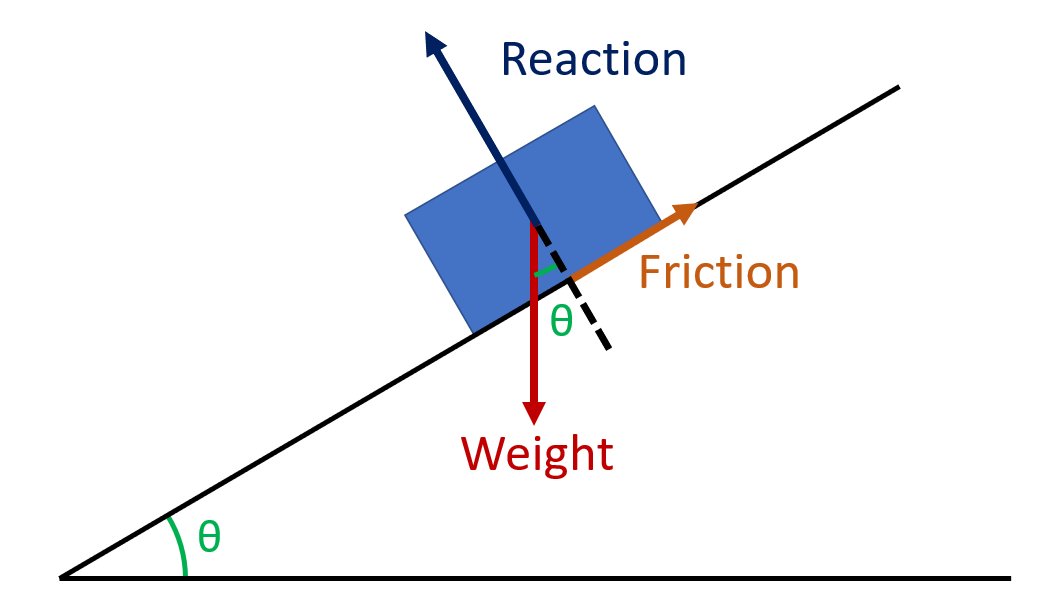
Q

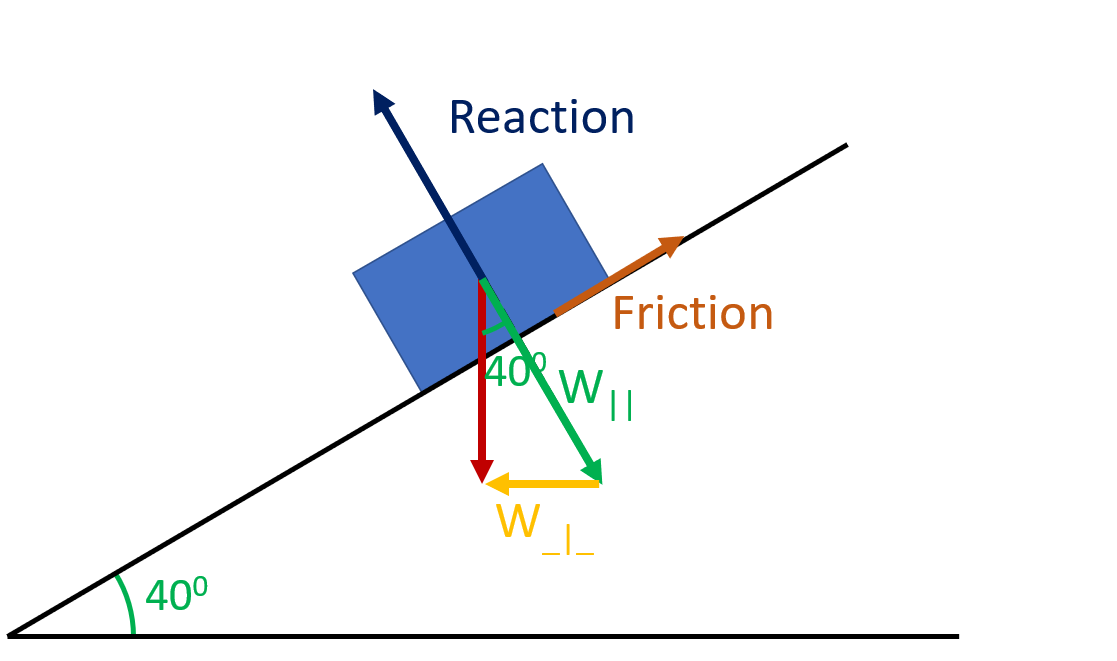
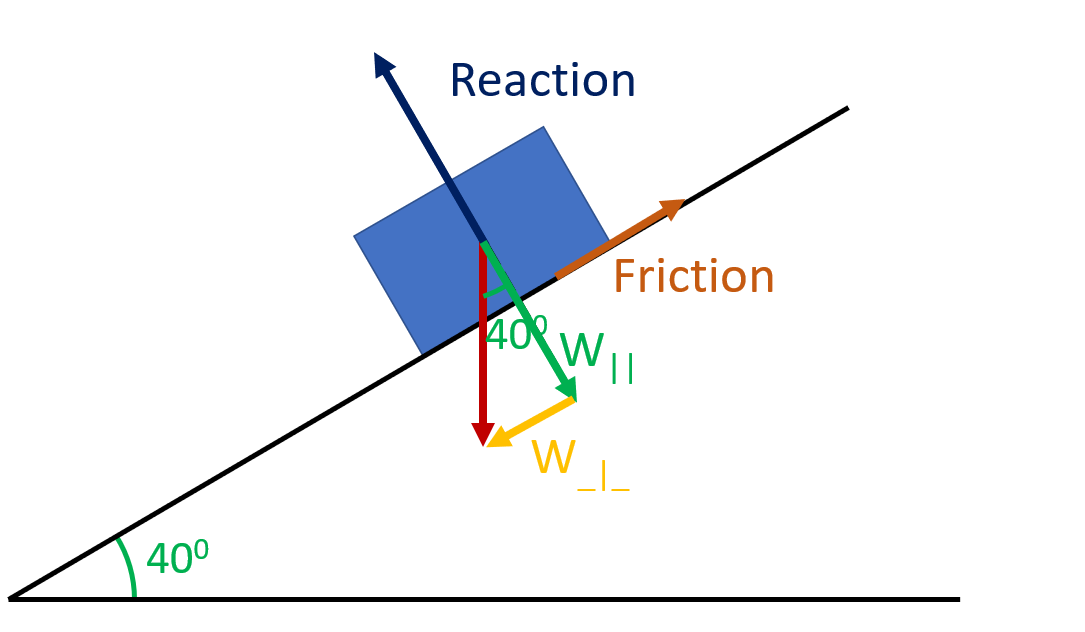
The box is in equilibrium with no external forces applied

Label the forces acting on the box
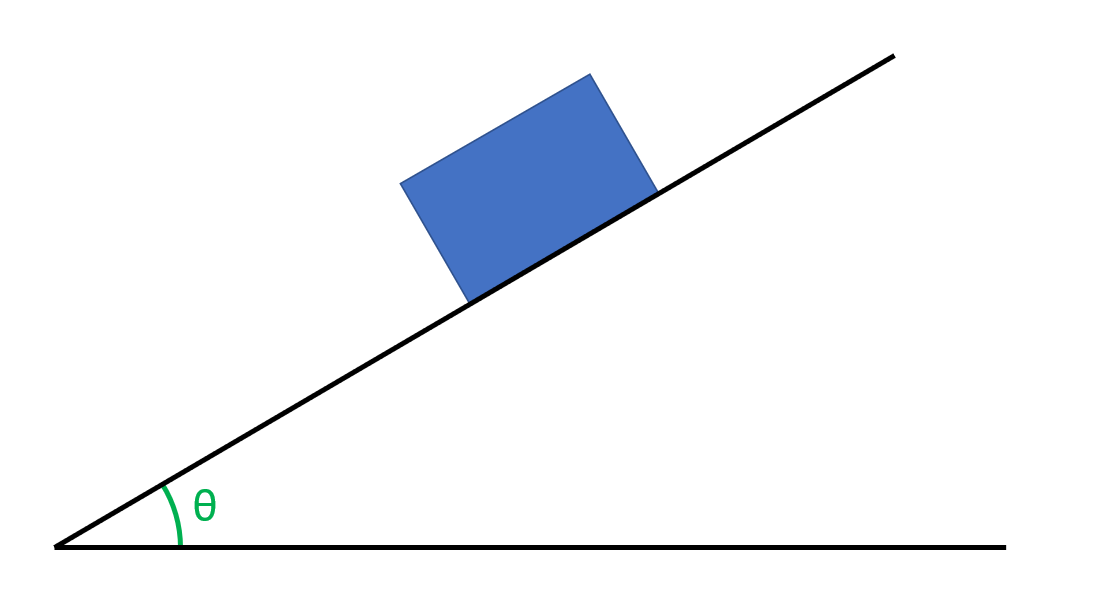
A

Notice the angle between weight and perpendicular is also Ø
17
Q

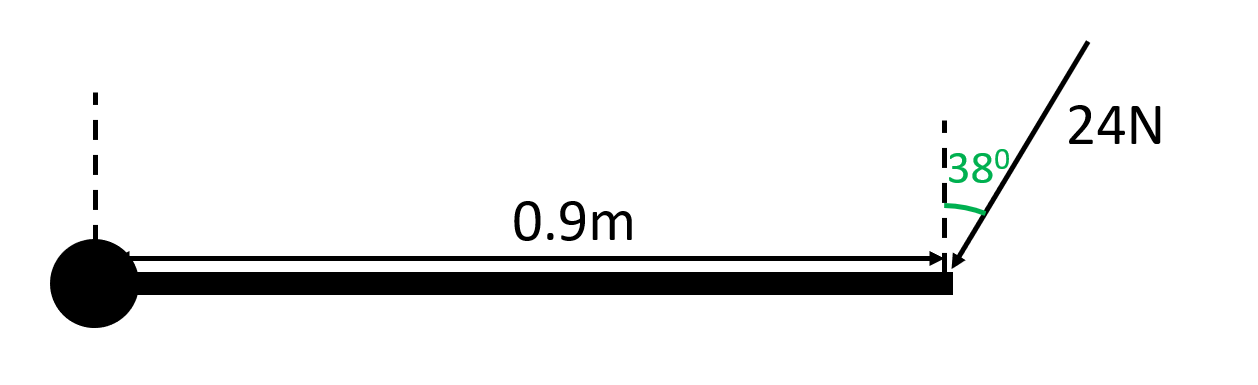
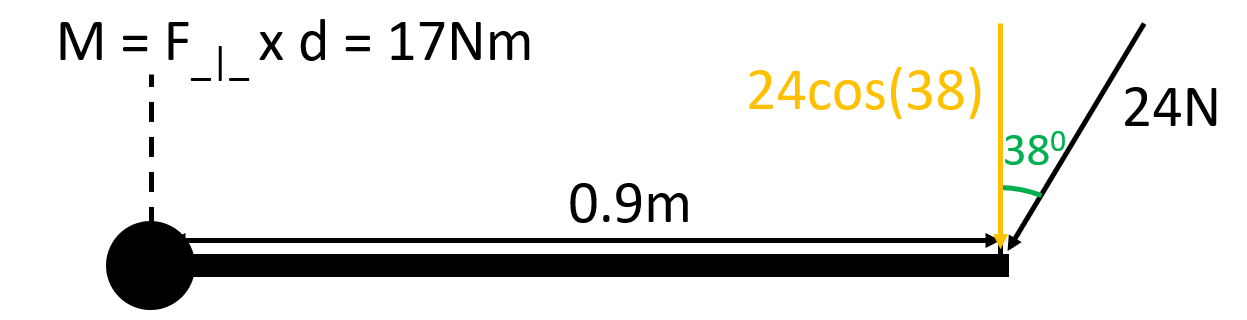
How do you calculate the resultant moment? (2 ways)
A
  1. Multiply perpendicular component of force by distance
  2. Multiply perpendicular component of distance by force

(First method is shown)
18
Q

What’s wrong with this?

A

Weight must form the hypotenuse of the triangle
19
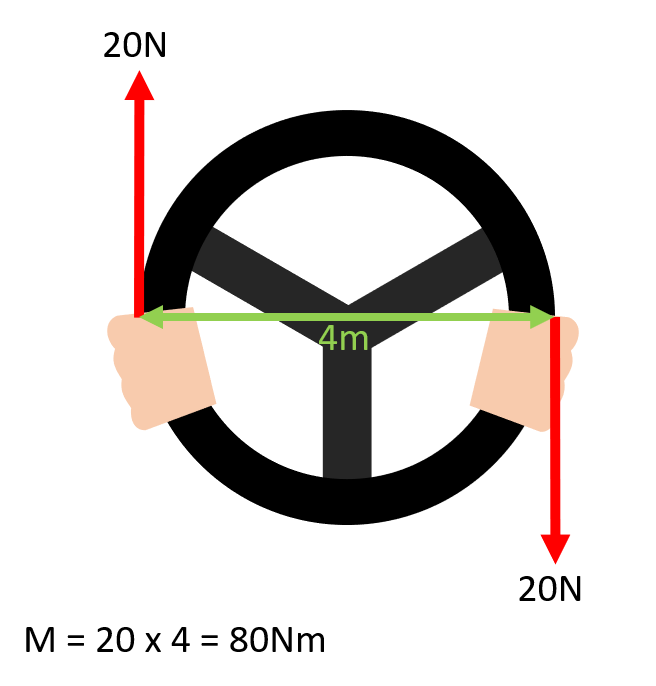
Q

What is a couple?

A

A pair of equal and opposite coplanar forces which do not act along the same line of action
20
Q

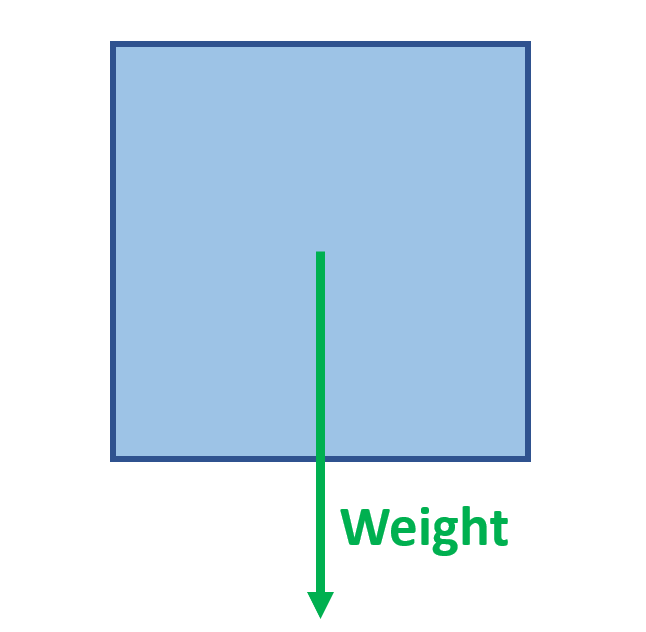
What does it mean if an object is uniform?

A

It has an constant density so its centre of mass acts from the physical centre point of the object

(Weight vector starts from middle of object)
21
Q

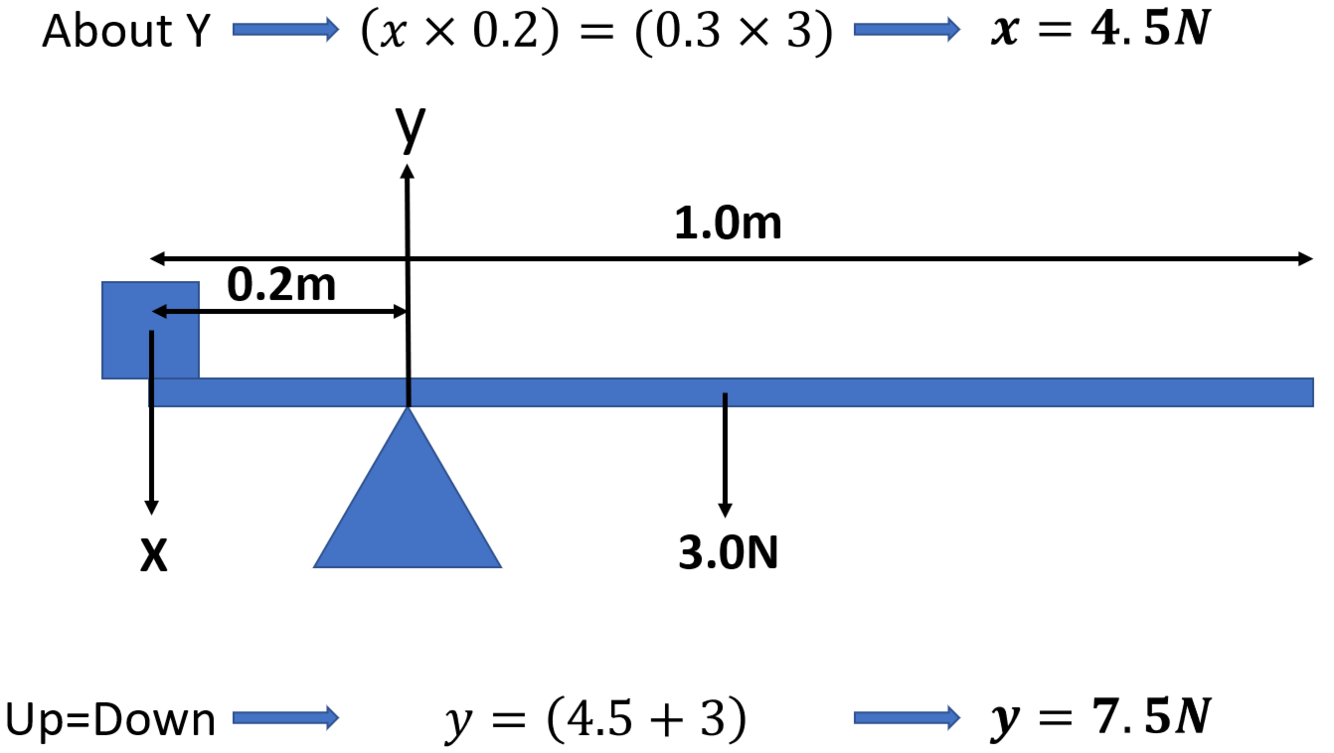
When should you use moments?

A

Any situation that has two unknown forces acting on an object

Take moments about one of the unknown forces to find the other

Then use total up force = total down force to find the other
22
Q

State the principle of moments

A

Sum of the clockwise moments about a point is equal to the sum of the anticlockwise moments for a system in equilibrium

23
Q

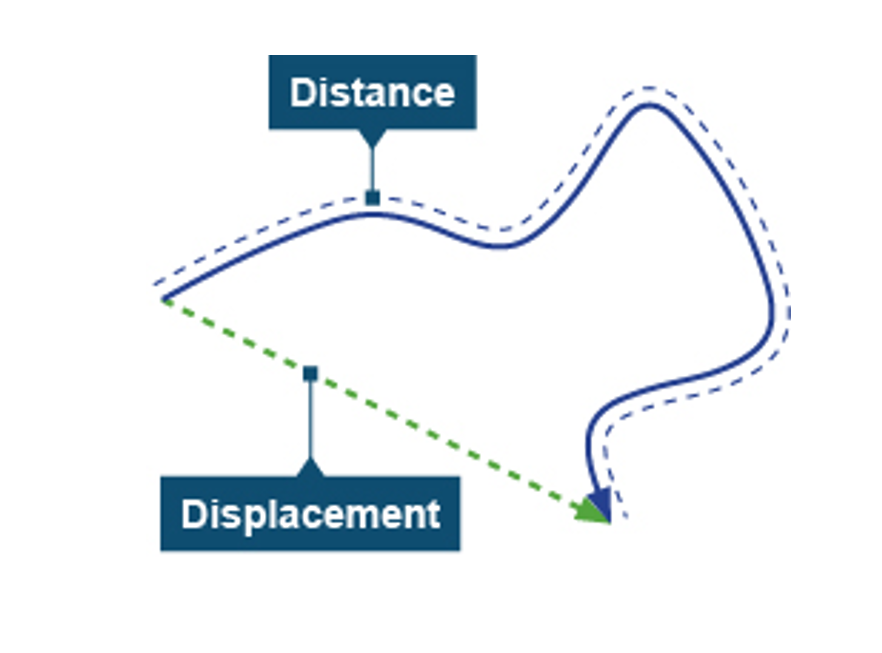
What is displacement and how is it different to distance?

A

Displacement is a measure of the line connecting the starting point to the finishing point.

Distance is a measure of the total length of the path travelled.

Also distance is a scalar and displacement is a vector.
24
Q

What does a straight line on a distance-time graph represent?

A

A constant speed.

25
How is acceleration defined?
Acceleration is the rate of change of velocity.
26
How is speed different to velocity?
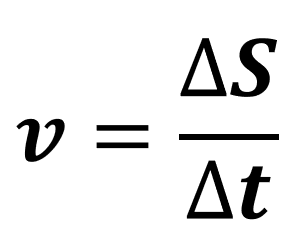
Speed is the rate of change of distance. Velocity is the rate of change of displacement.
27
Describe the motion of this ball
Ball is moving to the right and speeding up.
28
Decribe the motion of this ball.
Ball is moving to the left and speeding up.
29
Describe the motion of this ball.
Ball is moving to the right and slowing down.
30
Describe the motion of this ball.
Ball is moving to the left but slowing down.
31
Is the ball moving to the right?
Only if the velocity vector is also acting to the right.
32
What does a straight line on a displacement-time graph represent?
A constant velocity.
33
What does a curve with an increasing gradient represent on a displacement-time graph?
An increasing velocity (acceleration)
34
What does a curve with a decreasing gradient represent on a displacement-time graph?
A decreasing velocity (decceleration)
35
What does a negative gradient on a displacement-time graph represent?
A negative velocity (travelling back to where it started)
36
What does a straight line on a velocity-time graph represent?
A constant acceleration.
37
What does a curve with an increasing gradient represent on a velocity-time graph?
An increasing acceleration.
38
What does a curve with a decreasing gradient represent on a velocity-time graph?
A decreasing acceleration.
39
What does a negative gradient on a velocity-time graph represent?
A negative acceleration.
40
What does this graph show?
A ball bouncing off a surface (Dotted lines represent the bounce) (Red lines represent the ball accelerating towards the ground)
41
What does the acceleration time graph of a ball in freefall look like?
Constant acceleration of 9.81ms-2
42
What's wrong with this?
Displacement takes direction into account. It should be...
43
Why can't you use SUVAT's when working with this graph?
Because the **acceleration (gradient) is changing**
44
What does it mean if an object is in freefall?
Only **weight is acting on the object** It has a constant **acceleration of 9.81ms-2** acting downawards (on Earth)
45
If one ball is dropped as another is projected horizontally which hits the ground first?
They both hit the ground at the same time... Both in freefall so accelerate at 9.81ms-2 **Vertical motion independent of horizontal motion**
46
What's wrong with this labelling?
Initial velocity and final velocity are not 0
47
In projectile motion when is the vertical component of the velocity 0?
At the peak of a parabola ## Footnote **Not at the start or end**
48
How do you start a question involving **angled projectile motion?**
Resolve the velocity into vertical and horizontal components and fill out the corresponding SUVATs
49
What is wrong here?
The acceleration is only 9.81ms-2 if the object is in freefall
50
What does the area of a speed-time graph represent? How about a velocity-time graph?
51
When can you use this equation?
When the **acceleration = 0 (constant velocity)** Or to work out an **average speed**
52
When can you use SUVATs?
When **acceleration is constant** Or if object has stages of constant acceleration
53
What is the term given to an object rotating at a steady rate?
Uniform circular motion
54
If an ball on a string is travelling in a circle in the vertical plane, where are the points of minimum and maximum tension?
Minimum tension at the top Maximum tension at the bottom
55
Why do planes turn when at an angle?
The lift force is comprised of a horizontal and vertical component. The horizontal component provides the centripetal force causing it to turn.
56
Define centripetal force
The resultant force that makes the object move in a circle
57
What kind of motion will a pendulum perform?
Simple harmonic motion
58
What is the period of oscillation?
The time for one complete cycle of oscillation.
59
If the graph of displacement is sin(x), what will the respective graphs of velocity and acceleration look like?
Velocity as cos(x) Acceleration as -sin(x)
60
Describe a freely oscillating object
It oscillates with a constant amplitude because there is no friction acting on it. (Its energy is constant)
61
What is natural frequency?
The frequency of free oscillations of an oscillating system.
62
What are forced vibrations?
Making an object oscillate at a frequency that is not it’s natural frequency
63
When does resonance occur?
When the **frequency of driving force** or oscillation **matches** the **natural frequency** of the system.
64
What is the outcome of resonance?
An increase in amplitude of the system’s oscillation.
65
What is damping?
The term used to describe the removal of energy from an oscillating system.
66
Describe heavy damping (over damping)
System not allowed to oscillate. Slowly returns to equilibrium.
67
Describe critical damping
The oscillating system returns to the zero position of the oscillation after one quarter of a time period.
68
How do you convert degrees -\> radians
69
How do you convert radians -\> degrees
70
Define angular displacement
The angle through which an object in circular motion travels in a given time
71
What are the three levels of damping?
Light Heavy Critical
72
Describe light damping of a system
The system oscillates over a long time frame before coming to rest. The amplitude of the oscillations exponentially decay.
73
What is the equation for linear velocity?
74
In circular motion which direction do the acceleration and centripetal force vectors act?
**Always towards the centre**
75
What is the condition for circular motion to happen?
A **velocity** needs to be acting **perpendicular** to a **resultant force**
76
What is Fcentri for an object at the top of the vertical circle?
77
What is Fcentri for an object on top of a vertical circle?
78
What is Fcentri for an object at the bottom of a vertical circle?
79
How do you find out the minimum velocity for an object travelling in a vertical circle?
Set R=0 (or tension if ball on string) And rearrange for v
80
How do you find out the maximum velocity for an object travelling over a vertical circle? (eg car over a hill)
Set reaction R=0 Then rearrange for v
81
When solving angled circular motion problems what are the 3 usual steps?
1. Set vertical component of force = weight 2. Work out horizontal component using trig 3. Fcentri = horizontal component
82
Why can't a ball be swung around in a circle **with the string horizontal?**
There must be a vertical component of the tension to match the weight Otherwise ball is not in vertical equilibrium
83
What are the **two conditions for SHM?**
1. Acceleration must be proportional to displacement 2. Acceleration must be opposite to displacement
84
How does the time period differ for the two pendulums?
**Time period is independent of amplitude**
85
Label up the maximum and minimum velocities and accelerations on the simple pendulum...
86
Label up the maximum and minimum velocities and accelerations on the mass spring system...
87
Label up the maximum and minimum potential and kinetic energies on the simple pendulum...
88
What are the kinetic energy, potential energy and total energy lines for one cycle of SHM?
89
How do you calculate KEmax or PEmax or ET in SHM?
90
What two factors affect the time period of a mass spring system in SHM?
1. Mass on the end of the spring 2. Spring constant (stiffness) of spring
91
What two factors affect the time period of a simple pendulum in SHM?
1. Length between top of string and centre of bob 2. Gravitational field strength
92
What does the graph of energy against displacement look like in SHM?
93
How do you deal with rpm? (revolutions per minute)
**÷60 to convert to rps** (revolutions per second) Then set **rps = frequency**
94
When an SHM system is **lightly damped** what happens to its **amplitude and time period?**
Amplitude decreases (as it loses energy) But time period remains constant
95
How is natural frequency determined for a mass spring system?
96
How is natural frequency determined for a simple pendulum?
97
Define frequency
The number of complete oscillations per second
98
Why is an object in circular motion accelerating?
Its linear **velocity does not change in magnitude** But is **constantly changing in direction**
99
The graph below shows driven oscillations with varying frequencies. Add two lines if the system is: 1. Undamped (free oscillations) 2. Over damped
100
For Barton's pendulum which two balls oscillate?
P and Y because they have the **same length** So **natural frequency of y matches** frequency of driving force from **P**
101
What happens if... Fcentri \> Fmax
Circular motion does not happen (Eg car skids off the road or moves to a higher radius)
102
What happens if... Fcentri max ≤ Fmax
Circular motion happens (eg friction is large enough to keep car on track)
103
Define amplitude.
The **maximum displacement** of an obejct/particle/point **from equilibrium position**
104
When do you use? x=Acos(wt) When do you use? x=Asin(wt)
x=Acos(wt) -\> displacement in SHM when x=A when t=0 x=Asin(wt) -\> displacement in SHM when x=0 when t=0
105
Does circular motion count as SHM?
When projected onto a flat surface, yes it does
106
What happens if the frequency of driving force is less than the natural frequency of a system? f0
Low amplitude oscillations With 0 phase difference.
107
What happens if the frequency of driving force matches the natural frequency of a system? f=f0
**Resonance occurs** Large amplitude oscillations π/2 radians out of phase
108
What happens if the frequency of driving force is more than the natural frequency of a system? f\>f0
Low amplitude oscillations With phase difference of π
109
What is Newton's 1st Law of Motion?
If no resultant force acts on a body, then it will either remain at rest, or continue moving with constant velocity (no acceleration)
110
What is Newton's 2nd Law of Motion?
The rate of change of momentum (acceleration) of a body is directly proportional to the resultant force acting on it ## Footnote **Fres ∝ a**
111
What is Newton's 3rd Law of Motion?
When two objects interact, they exert an equal and opposite force on each other and the forces are of the same type
112
If the **forces** acting on an object **are balanced** what can you say about its motion?
There is **no resultant force** so it will continue moving at a constant velocity. It won't accelerate.
113
What's wrong with this?
In F=ma, **F must be the resultant force!!!**
114
How does an object reach terminal velocity?
As it speeds up, air resistance increases, decreasing the resultant force. Eventually air resistance = driving force, Fres=0 so a=0.
115
What two things are the case for tension?
1. Tension always acts away from the contact points 2. Tension is constant throughout the rope/wire/ cable
116
Why are objects never truly in freefall?
There will always be **air resistance** opposing the weight (Apart from when v=0)
117
What is the condition for terminal velocity?
The drag force = driving force (or weight) so **Fres=0** and so **a=0**
118
What factors the drag force on an object?
* Fluid density * Shape of object * Cross sectional area of object * Velocity of object
119
Why does air resistance increase with velocity?
The object is colliding with more air molecules **per second**
120
What does the velocity time graph of an object reaching terminal velocity look like?
121
What's wrong with this?
The **acceleration is not constant** so you **cannot use SUVATs** Instead use area under graph
122
How is momentum calculated?
123
What's wrong with this?
Direction must be taken into account (as momentum is a vector)
124
What two things is impulse equal to?
1. Rate of change of momentum 2. Impact force x impact time
125
What are the units of impulse and momentum?
126
What does the area under a force-time graph represent?
The **change of momentum** or **impulse**
127
What is the conservation of momentum?
For a system of interacting objects, **the total momentum remains constant...** **…**provided **no external resultant force acts**
128
In any interaction, what is conserved?
Total momentum is always conserved Total energy is always conserved **Kinetic energy is only conserved if collision is elastic**
129
What is an elastic collision?
A collision where kinetic energy is conserved (as well as momentum)
130
What is wrong here?
You have to c**alculate kinetic energies separately** for each object
131
In physics terms what is an explosion?
The total momentum = 0
132
How do you answer flow rate questions? (momentum of a flowing liquid)
Consider the cylinder made by a liquid's flow after 1 second Where the **length of the cylinder = velocity of the fluid** And use density equation to get volume of cylinder
133
How do you work out the area of a curved graph?
1. Split into boxes 2. Count the boxes (pairing up incomplete boxes) 3. Multiply number of boxes by area of each box
134
What is the principle of conservation of energy?
Energy cannot be created or destroyed, only transferred from one type to another.
135
How does an object gain energy from a force?
When the **force does work on the object (same direction as movement)**
136
How does an object lose energy?
By **doing work against a force** (usually frictional)
137
What's wrong here?
In W=Fs you **multiply the parallel components**
138
When using **W=Fs** what must be the case?
The **components must be parallel**
139
What is the **work done by the weight** of this block?
0 because the weight is **perpendicular to the movement** So there is **no parallel component to displacement**
140
If two objects are **dropped from the same height** and air resistance is negligible, which hits the ground first?
Both hit at the same time because they both accelerate at 9.81ms-2
141
How do you calculate the velocity the object hits the ground using GPE and KE (assuming no air resistance)
Energy equivalency (only works when air resistance = 0)
142
What is power?
The rate of transfer of energy or The rate at which work is done (Measured in **Watts [W]**)
143
What is wrong here?
For P=Fv, **F is not the resultant force**
144
How do you calculate efficiency?
145
If the system **is not 100% efficient** would this be correct?
**No,** because some GPE is converted to thermal and kinetic energy of the snow (working against friction)
146
What is 1 mole?
A collection of 6.02×10²³ molecules (Avogadro's constant)
147
What is the molar mass of a substance?
The mass of each mole (every 6.02×10²³ molecules) Eg for He each mole has a mass of 4g
148
How do you calculate the molar mass of a compound eg NO2
**Add up the nucleon numbers** (14+16+16=46gmol-1)
149
How do you calculate the number of molecules in a substance?
**N = n × NA ** (Number of molecules = moles × Avogadro's constant)
150
What is the molecular mass and how is it calculated?
The mass of each molecule of the substance **m = M/N** (molecular mass = total mass / number of molecules)
151
How is the total mass of a substance calculated?
**M = n × mr** (Total mass = moles × molar mass)
152
How do you convert a temperature from °C to K?
**T(K) = T(°C) + 273**
153
Define absolute zero
The point at which an ideal gas exerts no pressure (0K, -273°C, molecules have no kinetic energy)
154
What is Boyle's Law?
The pressure in a gas is inversely proportional to the volume it occupies **at a fixed temperature** **and a fixed mass of gas** (P ∝ 1/V)
155
What does the P-V graph look like for an ideal gas?
156
How do you prove Boyle's law graphically?
Plot a graph of P against 1/V Should be a straight line **passing through the origin**
157
What is Charles' Law?
Volume a gas occupies is directly proportional to the temperature of the gas **at a fixed pressure** **and a fixed mass of gas** (V ∝ T)
158
How do you prove Charles' law by graph?
Plot a graph of V against T Should be a straight line **passing through the origin**
159
For an ideal gas, what does a graph of V against T(°C) look like?
Note: x-intercept represents absolute zero
160
What is the Pressure law?
The pressure of a gas is directly proportional to the temperature of the gas ## Footnote **at a fixed volume** **and a fixed mass of gas**
161
How do you prove the pressure law graphically?
Plot a graph of P against T Should be a straight line **passing through the origin**
162
For an ideal gas, what does a graph of P against T(°C) look like?
Note: x-intercept is absolute zero
163
What is the ideal gas relationship?
164
When can you use the ideal gas relationship?
If the **mass of the gas is constant**
165
How do you calculate the work done compressing or expanding a gas?
Calculate the **area under the curve**
166
What is the general equation for pressure?
P = F / A (Pressure = Force / Area)
167
How does a gas exert a pressure on a container?
* The gas molecules collide with the container walls changing their momentum. * This creates a force on the molecule and the wall * Exerting a pressure
168
What are the 5 conditions for an ideal gas?
1. **Volume of the molecules** must be much **smaller** than the **volume of the gas** itself 2. The **intermolecular forces** are **negligible** 3. The **collision time** of molecules with each other and the walls is much **less than** the **time between** them 4. The collisions are **elastic** (no loss in KE) 5. The molecules' motion is **random**
169
How does **Brownian motion** explain the random motion of smoke?
* Air molecules are moving randomly * They collide with the smoke changing momentum and exerting a force on the smoke particles * If at one moment there are more collisions on one side than the other * The smoke particle has a resultant force so accelerates in that direction
170
Explain Boyle's Law using the molecular Kinetic Theory
* When volume of container is decreased * More collisions **per second** * So total momentum change bigger (▲p) * So force exerted bigger * So pressure bigger (From P = F/A)
171
Explain Charles' Law using the molecular kinetic theory
* When temperature is increased * Volume increases to increase the distance travelled between collisions * Molecules have greater kinetic energy but travel further so frequency stays same * Change in momentum (▲p) stays constant * So pressure is constant (P = F/A)
172
Explain the Pressure law using the molecular kinetic theory
* As temperature increases * The average kinetic energy of the molecules increases * Increasing the number of collisions **per second** with container walls * So greater change in momentum * Greater force and pressure exerted (P = F/A)
173
How would you use this equation to work out the density of a gas?
174
How do you calculate crms from a list of speeds?
1. Square the speeds and add up 2. Take a mean of the squares 3. Square root the value
175
How is cms calculated?
cms = (crms)2
176
What are the units of cms?
[m2s-2]
177
What does the **maxwell-boltzmann distribution** tell us about gases?
Molecules have a **range of kinetic energies**. So temperature of the gas is a measure of the **average kinetic energy.**
178
For these equations how do you **calculate the internal energy** of the gas?
Multiply each by the **number of molecules of the gas**.
179
How do two objects brought into contact reach thermal equilibrium?
* There is a **net flow** of thermal energy from the hotter object to the colder object * **Until** both objects are at the **same temperature** * And there is now **no net flow of thermal energy**
180
Define specific heat capacity
The energy required to increase 1kg of a substance by 1K [Jkg-1K-1]
181
When would you use this equation?
To calculate the **mass flowing per kg** of a fluid
182
Why does the temperature of a substance changing state not increase?
The thermal energy is used to **break some of the intermolecular bonds** (solid → liquid) or the **rest of the intermolecular bonds** (liquid → gas)
183
Define specific latent heat of fusion
The energy required to change the state of 1kg of a solid to a liquid **at its melting point.**
184
Define specific latent heat of vaporization
The energy required to change the state of 1kg of a liquid to a gas **at its boiling point.**
185
What is wrong with this?
Haven't considered the change of states. Need to break it into 3 equations:
186
How is density defined?
The mass per unit volume. [kgm-3]
187
How do you convert 2,3,4 etc… units to SI units? (eg 5cm3 to m3)
Whatever you do to the unit, you **do the same to the prefix** (eg 5cm3 = 5x(10-2)3m3 = 5x10⁻⁶m3)
188
How do you measure the density of an irregular solid?
1. Read off the volume from the **beaker or measuring cylinder** without and with the object submerged in water 2. The difference in volumes is the volume of the solid 3. Measure the mass **using a balance** Calculate density using ρ=M/V
189
How do you calculate the average density of an alloy? (Eg 200cm3 5kg rod of 60% copper (8960kgm-3) and 40% aluminum (2700kgm-3) by volume?)
1. Work out the mass of each and the volume of each 2. Add together to get the total mass and volume 3. Then do the density calculation
190
Define Hooke's Law
When a material is stretched, its extension is proportional to the force applied, up **until the limit of proportionality** F=kx
191
Define the limit of proportionality
The point at which the material stops obeying Hooke's law. The graph is no longer a straight line.
192
Define the elastic limit
The point at which when stretched further the material no longer returns to its original length (there is a permanent extension)
193
What do the gradient and area of a force extension graph tell you for a spring.
**Gradient** → The **spring constant** (must be taken before limit of proportionality) **Area under line →** The strain energy stored loading the spring or energy released unloading the spring
194
What equation **calculates** **energy stored** when a material is **stretched**?
E=½Fx
195
What is the difference between the **elastic limit** and the **limit of proportionality**?
Limit of proportionality is the point at which a stretched spring (or wire) stops obeying Hooke's law. The elastic limit is the point at which it doesn't return to its original length when unloaded.
196
Will this spring return to its original length if it has been stretched to 35mm?
Yes, because it has **not passed the elastic limit**
197
What is a **ductile** material?
A material with a **large plastic region**.
198
What is a **brittle** material?
A material with a small plastic region.
199
What is the **fracture point** of a material?
The point at which a material breaks
200
How do you know the rubber hasn't stretched passed its elastic limit?
It still returns to its original length when unloaded.
201
What is the formula for **Young's Modulus** that you need to remember?
202
What does the **gradient** and **area** under a **stress-strain** graph give?
**Gradient** → **Young's modulus** (before the limit of proportionality) **Area** → strain **energy per unit volume**
203
If this box is in **equilibrium** how would you go about calculating the frictional force and the reaction force?
204
Define current (I)
The **rate of flow of charge**
205
How do you work out the number of electrons carrying a charge (eg 10C)?
Divide charge by the charge of each electron (6.25x10¹⁹)
206
What is the difference between **conventional current** and **electron flow**?
**Conventional current** flows from the +ve terminal to the -ve terminal **Electron flow** shows the direction the electrons flow, from -ve to +ve
207
How is the current in a circuit related to potential difference and resistance?
Increasing potential difference increases the current Increasing resistance decreases the current
208
What is Ohm's law?
The current flowing through a metallic conductor is proportional to the potential difference applied across it **at constant temperature**
209
When does Ohm's law apply?
When the **component has a fixed resistance** (eg a fixed resistor at a constant temperature, or a filament at a low current)
210
Define **potential difference**
The **work done** (energy transferred) **by** **each coulomb of charge** moving between two points (Eg a 12V battery adds 12J of energy to each coulomb of charge passing through)
211
How does a circuit ‘short circuit’?
If there is an available path with **0 resistance** **Current → ∞** And the circuit **heats up**
212
What is the I-V graph for a fixed resistor?
213
What is the I-V graph for a filament bulb?
214
What is the graph for a semiconductor diode?
215
What's wrong with this?
Resistance is **not calculated using the gradient (**of a tangent**) of an I-V graph!!!** Instead just **use the voltage and current at that point**
216
Explain the shape of the I-V graph for a filament
As current increases, temperature of filament increases This **increases lattice ion vibrations**. Which increases the number of **collisions per second with electrons.** So **resistance increases.**
217
How does the I-V graph for a fixed resistor prove it is ohmic?
The **straight line passing through the origin** ## Footnote **proves that current ∝ voltage**
218
Explain the shape of the semiconductor diode (in positive bias)
* As the potential difference increases **weakly bound electrons** in the conductor gain energy * After the threshold pd, some **electrons become free** to carry a current * The **lattice vibrations** still increase but this is **less significant**
219
What happens if a semiconductor diode is connected in reverse bias?
No current flows until the breakdown voltage is reached (**~**50V) The diode breaks and all current flows through
220
What is the difference between a **series** and a **parallel** circuit?
**Parallel circuits have junctions** (3 or more wires connect)
221
Why doesn't adding voltmeters in parallel affect the circuit? (it is still series)
Voltmeters have ~ **∞ R so no current flows through**
222
What are the p.d and current rules for a series circuit?
**P.D is shared** across the components (by resistance) **Current is constant** throughout
223
What are the p.d and current rules for a series circuit?
**P.D is shared** across the components (by resistance) **Current is constant** throughout
224
What are the p.d and current rules for a **parallel** circuit?
**P.D is same for parallel branches** **Current separates at junctions** (according to branch resistance)
225
What is Kirchoff's 1st Law?
At any junction in a circuit the **sum of the current flowing into the junction** is **equal** to the **sum of the current flowing away from it.**
226
What is Kirchoff's 2nd Law?
In any complete “loop” of a circuit the sum of p.d’s equals the source p.d.
227
How do you combine **series resistors in the same branch?** (no junction between them)
Add up their resistances
228
How do you combine resistors in parallel branches? (one junction between them)
Use the following equation…
229
What is the advantage of placing resistors in parallel arrangements?
The **total resistance is always less** than the smallest resistance
230
Will the current split equally?
No, because the **resistance of each branch is different**
231
Will each component receive the same voltage?
No, because the **resistance of the components are different**
232
Why would you place **batteries in parallel**?
* The power delivered is the same * But they take longer to run flatter
233
What is a potential divider circuit?
A circuit with **2 or more resistors connected in series** with a power supply. (usually one is a thermistor or LDR)
234
How does resistance change for an **NTC Thermistor?**
As **temperature increases, resistance decreases**
235
How does resistance change for a **Light Dependent Resistor (LDR)?**
As **light intensity increases, resistance decreases**
236
What is the advantage of setting up a **rheostat** as a **variable resistor?**
* Simpler circuit * Current constant throughout * But cannot get 0V across bulb
237
What is the advantage of setting up a **rheostat** as a **potential divider?**
* Bulb can receive full range of voltage 0V → Vsource * Current through bulb can be reduced to 0A * But maximum current is lower
238
How does changing the **dimensions** of a piece of metal **affect its resistance?**
* Increased length → increased resistance * Increases cross sectional area → decreased resistance * Increased resistivity (using different material) → increased resistance
239
How do you calculate the **cross sectional area of a wire?**
Assume it to be a cylinder (unless told otherwise) ## Footnote **A=∏r2**
240
Why do metals with a greater cross sectional area have a lower resistance?
There are **more paths for the electrons to propagate**
241
How do you calculate the potential difference across branches?
* Work out the P.D of each component * Make a loop connecting the branches * Subtract the PDs of one branch from the other
242
What is a superconductor?
A material with **0 resistance at and below the critical temperature**
243
Why does a material become **superconducting at and below its critical temperature?**
* The **lattice ion vibrations reduce to 0** * So **electrons can pass** through **without collision**
244
What is the advantage of superconductors and name a use?
* Transmit large currents with 0 resistance * So negligible thermal energy losses * Used to create high power magnets → MRI machines * High processing power circuits → Supercomputers
245
Define **emf** of a power source
The **potential difference across the terminals** when **no current** is flowing through
246
Define **terminal potential difference** of a circuit
The **potential difference** across the terminals **when a current** is flowing through
247
What is the **lost voltage** in a circuit?
The potential difference used up pushing a current through the battery (**vlost = emf - TPD**)
248
How should you work with a circuit **involving internal resistance?**
Treat the internal resistance as another resistor in series with the components Then solve as a regular circuit (using ohm's law, kirchoff's laws, P=IV etc)
249
What is the **photoelectric effect?**
Light incident on a **metal surface** causes **electrons to be emitted from the surface**
250
Why are electrons emitted from this surface by shining green and blue light on it? (not red)
Blue and green light are **above the threshold frequency of this metal** So the **photons of light have an energy \> work function (****φ****)**
251
Why are no electrons emitted when red light shines on this metal?
The red light **photons are below the threshold frequency** So the **energy of each photon \< work function (****φ****)**
252
Why does making the **red light brighter not cause electrons to be emitted? (Photoelectric effect)**
**Electrons** in the metal interact with photons in a **1-1 interaction** They only absorb photons which have an **energy \> work function (****φ****)**
253
1. Why do both light source cause electrons to be emitted? (from the surface) 2. What is different about the electrons emitted due to the blue light?
1. Both light sources have **frequency above the threshold frequency (f0)** of the metal 2. The electrons emitted due to the blue light have a **greater maximum kinetic energy** (because blue photons have a greater energy from E=hf)
254
What does **threshold frequency (f0)** of a metal mean?
The **minimum frequency of the incident light** needed to cause electrons to be emitted from the surface
255
1. What can you say about the green light incident on this metal? 2. What difference does the brighter lamp make?
1. The green light is above the threshold frequency so the photelectric effect happens 2. The brighter lamp causes **more photons of light to collide with electrons** so **more photons are emitted per second** (But the electrons have the same maximum kinetic energy)
256
You are shining a light (above f0) on a metal. How do you: 1. **Increase** the maximum **kinetic energy** of the emitted electrons? 2. **Increase** the **number** of **emitted** electrons per second?
1. **Increase the frequency** of the light source 2. **Increase the brightness** of the light source
257
This is a graph for the photelectric effect. What information do the 3 features of the graph provide? 1. Y-intercept 2. X-intercept 3. Gradient
1. Y-intercept = - work function 2. X-intercept = threshold frequency 3. Plancks' Constant
258
This is the photoelectric effect graph for a metal Plot a line on this graph for a metal with a higher threshold frequency
1. Y-intercept (φ) decreases 2. X-intercept (f0) increases 3. **But the gradient (h) is constant**
259
If you shine a really bright light on a metal but the **light is below the threshold frequency** why will electrons never be emitted?
Electrons interact with the photons in a **1-1 interaction** But only if the photon has an energy \> work function **No red light photons have an energy \> work function** So electron **emission will never occur**
260
What is the definition of the work function (φ) of a metal?
The **minimum energy** required to **liberate an electron from the surface of a metal**
261
How is the **work function (φ) related to the threshold frequency (f0)** of a metal?
262
When light (above f0) is incident on a metal surface how is the maximum kinetic energy of emitted electrons calculated?
Difference between the energy of each photon and the work function (φ)
263
For the gold leaf experiment (to show the photoelectric effect): 1. How do you make the gold leaf rise? 2. Why does the gold leaf fall?
1. A charged rod transfers additional electrons to the plate causing repulsion between the stem and gold leaf 2. Electrons are liberated from the metal surface (by light above f0) so the stem and leaf become neutrally charged again
264
Define the **electron volt**
The **kinetic energy gained by 1 electron passing through a potential difference of 1 volt**
265
How do you **convert between electron volts and Joules?**
**eV → J : multiply by 1.6x10⁻¹⁹J** **J → divide by 1.6x10⁻¹⁹J**
266
**How is the maximum kinetic energy of photoelectrons** (emitted during the photoelectric effect) **measured?**
1. Connect the system to a circuit 2. Place a battery opposing the current produced by the emitted electrons 3. Measure the **stopping potential** when the total current = 0 4. **Ekmax = eVs**
267
During the Photoelectric effect **why are electrons with a range of kinetic energies emitted?**
**Electrons deeper down require more energy to rise to the surface** before being liberated (Electrons at the very top of the surface are emitted with maximum kinetic energy)
268
What are the 3 types of line spectra and how are they produced?
1. Continuous - Produced by **blackbody** 2. Emission - Produced by **an excited gas** 3. Absorption - Produced by a **continuous spectrum passing through a cold gas**
269
What are the key ideas of the **Bohr model of the atom?**
* Electrons can only travel in **allowed orbitals (energy levels)** * Electrons can emit or absorb energies to **instantaneously transition between orbitals** * Electrons **cannot exist between orbitals**
270
How could an electron excite from the n=2 → n=4 energy level?
It must **absorb an energy = the difference between levels** (By photon or electron collision)
271
How could an electron de-excite from n=3 → n=1 energy level?
It must **emit an photon of energy = the difference between levels**
272
How is the energy of a photon calculated?
273
Why do different gases (made of **different elements) have different emission spectra?**
1. Each element has a different set of orbitals (with different energy levels) 2. So each element has a different set of electron de-excitation energies 3. The different de-excitation energies produce photons with different frequencies (E=hf)
274
How would you show the 488nm hydrogen emission line corresponds to a de-excitation from n=4 → n=2?
1. Calculate then energy difference between the energy levels 2. Convert energy difference to Joules 3. Convert to f or λ (E=hf or E=hc/λ)
275
What is the ionisation energy of an atom?
The energy required for an electron to to become liberated from an atom ## Footnote **Equal to the energy of the ground state**
276
What is wrong with this?
**Never use work function when talking about energy levels**. Ionisation and work function are different.
277
How is excitation by photon different from excitation by an electron?
* Photon energy = Difference between energy levels * Electron energy ≥ Difference between energy levels
278
How many photons (of different wavelengths) can be emitted from this hydrogen atom?
6 possible transition so 6 different photons
279
Why is this mercury vapor in the fluorescent tubes kept at low pressure?
So a large enough current (of incident electrons) can be sustained
280
How does fluorescence work in a tube light?
1. Mercury atoms excite by absorbing electrons from the current 2. When the Mercury atoms de-excite they emit UV photons 3. UV photons are absorbed by and excite the phosphor coating 4. When the phosphor coating de-excites it emits visible light
281
When do particles exhibit properties of waves? (refraction, diffraction and polarisation)
When their **Debroglie Wavelength is similar to the size of the gap** they are passing through
282
What does this experiment show?
Wave-Particle duality Electron diffraction through graphite to form maximas (bright rings) and minimas (dark rings)
283
How is the Debroglie wavelength λdb of a particle calculated?
284
Which part of the atom has the **largest specific charge** and why?
**The electron** (It has the same magnitude of charge as the proton but a much smaller mass)
285
Why do the proton, neutron and electron deflect differently in a magnetic field?
Neutron → 0 specific charge so zero deflection Electron → Greatest specific charge so greatest deflection Proton → Smaller deflection in opposite direction as specific charge smaller and opposite
286
How do you calculate the **specific charge of a nucleus?**
Divide the total charge of the protons by the total mass of nucleus (Protons + Neutrons)
287
How do you calculate the **specific charge of an ion?**
Charge of the ion (Protons - Electrons) divided by total mass of ion
288
What is an isotope?
An atom with the 1. **same number of protons** 2. **Different number of neutrons**
289
When will an isotope undergo radioactive decay?
If the nucleus has: 1. too many or too few protons 2. Too many nucleons 3. Too much vibrational energy
290
What happens in **alpha (****α****) decay?**
A nucleus ejects a helium nucleus (2 protons and 2 neutrons) Decreasing its nucleon number by 4 And its proton number by 2
291
What happens in **Beta Minus (****β-****) Decay?**
A **neutron turns into a proton** **Ejecting a fast moving electron (****β-****) and an anti-electron neutrino**
292
What happens in **Beta Plus (****β+****) Decay?**
A **proton turns into a neutron** **Ejecting a fast moving positron (****β+****) and an electron neutrino**
293
What is wrong about this Beta Decay equation?
The **nucleon number must not change**
294
Why do the α, β-, β+ and γ deflect differently in a magnetic field?
α and β+ → Deflect in same direction but β+ larger (greater specific charge) β- → Equal and opposite deflection to β+ (Equal and opposite specific charge) γ → No deflection (no specific charge)
295
What is an antiparticle?
A particle with the: 1. **Same mass** 2. **But equal and opposite charge**
296
What happens during Annihilation?
A **particle collides** and annihilates with its correspond **antiparticle** And their **mass energy (E=mc2) is converted to radiation energy** **Producing at least 2 gamma photons**
297
Why do **at least 2 photons need to be created during annihilation?**
To conserve momentum Before annihilation ptotal = 0 AFter annihilation **ptotal = 0 (can't be achieved with one photon)**
298
What happens during **pair production?**
A gamma photon (with energy ≥ 2 **×** mass energy) spontaneously creates a particle, anti-particle pair
299
What condition must pair production meet?
The energy of the gamma photon ≥ Mass energy of the particle anti-particle pair (Any excess energy is used a kinetic energy for the particles produced)
300
How was the anti-electron neutrino discovered?
During Beta decay the emitted β- had less energy than expected so another particle carried the rest of the energy
301
What are the **four fundamental forces** and their approximate ranges?
1. Strong 2. Weak 3. Electromagnetic 4. Gravitational
302
What does the strong force do? What is the exchange particle of the strong force?
Holds nucleons together in the nucleus * By opposing the electromagnetic repulsion of the protons * By attracting nucleons at small distances but repelling the, at very small distances Gluons (between quarks), or pions (between hadrons)
303
Describe the nature of the strong force
**Very repulsive over short distance (0-0.5fm)** **Attractive over larger distances (0.5fm \< d \< 3fm)** **Negligible beyond 3fm**
304
What does the electromagnetic force act between and what is its exchange particle?
Acts between all **particles with charge** ## Footnote **Exchange particle is the photon**
305
What does the **gravitational force** act between?
Particles or objects **with mass**
306
What particles does the weak force act on and what does it do?
Acts between leptons and hadrons and causes the decay of hadrons (by changing quark structure)
307
What are **fundamental particles that make up the standard model?** (that you need to know)
NOTE: Each of the leptons and and quarks has an corresponding anti-lepton and anti-quark
308
What is the quark structure of a proton?
Up, Up, Down
309
What is the quark structure of a neutron?
Up, down, down
310
How is a muon different from an electron?
Both are leptons, muon is much heavier than the electron, produced in cosmic ray showers
311
What are hadrons?
**Particles that are made up of quarks**
312
How are baryons and mesons different?
Both are hadrons (made up of quarks) But **Baryons are made up of 3 quarks** And **Mesons are made up of 1 quark 1 anti-quark**
313
What are the similarities and differences between **W bosons and photons?**
**Both are exchange particles** But **W bosons mediate the weak force, Photons mediate electromagnetic** W bosons carry charge of +1 or -1, Photons have no charge W bosons have mass, Photons are massless
314
What are the similarities and differences between gluons and pions?
**Both mediate the strong force** **But gluons act between quarks, Pions act between hadrons** (to keep the nucleus together) Gluons have no mass, Pions have mass
315
What does the **Higgs Boson do?**
It **creates the Higgs field** Which **gives mass to particles**
316
What quantities are **always conserved in every interaction?**
* **Total momentum** * **Total energy** * **Charge** * **Baryon** * **Lepton number** NOTE 1: **Kinetic energy** is conserved in **elastic collisions** NOTE 2: **Strangeness** is conserved in all interactions **apart from weak**
317
What must you know about k-mesons? (kaons)
They are made of **1 quark and 1 anti-quark** (mesons) ## Footnote **They have non-zero strangeness** **Produced by strong interactions, Decay (into pions) by weak interactions**
318
What must you know about π-mesons? (pions)
They are **made up of 1 quark and 1 anti-quark (mesons)** ## Footnote **They have strangeness = 0**
319
What is the most stable lepton and what is the most stable hadron? (That other isolated particle will eventually decay into)
The **electron** and the **proton**
320
What are polar satellites used for?
* Communication for high latitude regions (close to the poles) * Espionage (spying) * Meteorology (weather)
321
What is the formula for a muon decaying into an electron?
322
What is the feynman diagram for an electron-electron collision?
323
What is the feynman diagram for **β- Decay?**
324
What is the feynman diagram for **β+ Decay?**
325
What is the quark feynman diagram for **β- Decay?**
326
What is the quark feynman diagram for **β+ Decay?**
327
Identify the unknown particles in this feynman diagram for electron capture
328
Identify the unknown particle in this feynman diagram for the electron proton collision
329
Identify the unknown quark in the feynman diagram for electron capture
330
Identify the unknown exchange particle in the quark feynman diagram of electron proton collision
331
Which particles have a baryon number = +1? Which have a B = -1? Which have a B = 0
**Baryons = +1** **Anti-Baryons = -1** **All other particles (including mesons) = 0**
332
Which particles have a Lepton number = +1? Which have a L = -1? Which have a L = 0
**Leptons = +1** **Anti-Leptons = -1** **All other particles = 0**
333
What is the muon lepton number of an electron?
0! Only muons and muon neutrinos have Lmuon = +1
334
What is the electron lepton number of a muon?
0! Only electrons and electron neutrinos have Lelectron = +1
335
How are these two gravitational fields similar? How are they different?
Both are **uniform** (constant field strength) ## Footnote **Closer field lines represent stronger field**
336
How are radial and uniform fields different?
**Radial fields** have a **decreasing field strength** (Field lines increasing in separation) **Uniform fields** have a **constant field strength** (Field lines constant\ separation)
337
In gravitational fields when can you use the equation EP = mgh?
Over **small distances** When radial fields are approximately uniform And **g is approximately constant**
338
Why can't SUVATs be used for radial gravitational fields?
SUVATs need a **constant acceleration** Radial fields have a variable field strength and so a variable acceleration
339
What are equipotentials and how are they related to field lines?
An equipotential has **the same potential along that line** (So no work is done moving along the equipotential) They are **always perpendicular to field lines**
340
What is Newton's Universal Law of Gravitation?
**Force** acting between two bodies is: 1. **Directly proportional to the product of their masses (F∝m1m2)** 2. **Inversely proportional to the square of their separation (F∝1/r2)**
341
Define gravitational field strength and state its units
The force acting per unit mass on an object in a gravitational field [NKg-1] or [ms-2]
342
In the gravitational field strength equation what does M represent?
The **mass** of the object **creating the field**
343
If the Earth is exerting a force on the rocket of 5000N, What force is the rocket exerting on the Earth?
5000N also. An equal and opposite force from Newton's 3rd Law (Which has little effect on the Earth because it has so much more mass)
344
How do you calculate the resultant gravitational field strength at a point between two bodies?
1. Calculate the field strength for each body in turn (ignoring the other one) 2. Calculate the difference between the field strengths (g is a vector)
345
How do you you calculate the **field strength (or force) neutral point** between two bodies in a gravitational field?
346
What is the definition of and the equation for **absolute potential energy in a gravitational field?**
The **work done** moving an object **from infinity** to that point in the field
347
Why is **gravitational** **potential energy always negative?**
* Gravitational **potential energy is 0 at infinite distance** * **And decreases inwards** as you move towards object creating field * (So must go negative)
348
What is **gravitational potential?**
The **work done per unit mass** moving an object **from infinity** to that point in a field
349
In this equation for **gravitational potential** what object is represented by mass M?
The **mass** of the object **creating the field**
350
Which astronaut has a **greater loss in gravitational potential energy?**
Neither. **Potential energy (and potential) are scalar** quantities so are unaffected by the path ## Footnote **Both decrease by 1440MJ**
351
What is the mistake here?
In the second stage the **mass of the satellite must be used** (Not the Earth's mass again)
352
If a **gravitational fields question uses the word ‘height’** what must you do?
Height is the distance above the surface So you **must add on the radius** of the planet/star/object
353
**Why can't two objects have a neutral point for gravitational potential?** (or GPE)
**Gravitational potential from both is negative** So they **combine** **To increase the magnitude** of the potential
354
When can you use these proportionality equations in Gravitational fields?
When the **mass or masses are constant**
355
In gravitational fields What does a **force-separation graph** look like? And what else does the graph tell you?
The **area under the curve is the change in potential energy** moving between the two separations
356
In gravitational fields What does a **field strength-separation** graph look like? And what else does the graph tell you?
The **area under the curve is the change in potential** moving between the two separations
357
In gravitational fields What does a **potential energy-separation graph** look like? And what else does the graph tell you?
The **gradient of a tangent is the magnitude of the force** at that point
358
In gravitational fields What does a **potential-separation** graph look like? And what else does the graph tell you?
The **gradient of a tangent is the field strength** at that point
359
What is the equation for **gravitational field strength within a planet?** ## Footnote **(r ≤ R)**
This part of the graph is linear as g ∝ r
360
How do you **derive the equation for gravitational field strength inside a planet?**
* Use general equation for density (M/V) * With V as the volume of a sphere (4/3πr3) * Sub into general equation for field strength
361
How do you **derive Kepler's 3rd Law?** (r3 **∝** T2)
1. Equate centripetal force to force due to gravity 2. Substitute in angular speed formula (from circular motion) 3. Rearrange
362
How do you derive the formula for the **velocity of a satellite orbiting** a planet or star?
1. Equate centripetal force to force due to gravity 2. Rearrange
363
Which planet has the greatest orbital velocity and why?
Mercury It is closest to Sun so **smallest r**
364
How do you **derive the formula for the escape velocity** of a planet or star?
365
In these 3 equations what does the mass refer to?
The **mass of the object creating the field**
366
Why does a satellite not need to be above the escape velocity to reach low Earth orbit?
1. Escape velocity only applies to objects without engines (that can't increase their KE) 2. Satellite isn't escaping the field (so doesn't need as much KE)
367
How do you calculate the Kinetic Energy of a satellite orbiting a planet?
Substitute orbital velocity into equation for kinetic energy
368
How do you calculate the total energy of an orbiting satellite?
Add the kinetic and potential energy together…
369
What is the difference between a **geosynchronous and geostationary orbit?**
Both have orbital periods of 24 hours (the same as the Earth)
370
How are **geostationary and polar satellites** different?
**Geostationary satellites orbit above the same point of the equator** and have an orbital period of 24 hours **Polar satellites orbit over the North and South pole** with an orbital period of much less (around 2 hours)
371
What are Geostationary satellites used for?
* Satellite television * Mobile Phone Communications * GPS
372
Why can't this muon decay happen like this? (What's the mistake with the logic in the table?)
When electron and muon type particles are involve **each lepton number must be considered separately**
373
What 4 things do magnetic fields affect?
1. Charges moving in the field 2. Conductors with a current passing through 3. Other magnets 4. Magnetic materials
374
What do the field lines for a bar magnet look like?
Field lines **always** act **North → South**
375
What do the field lines look like between two opposite poles?
**Field is uniform** between the poles
376
What do the field lines look like between two like poles?
377
How are field lines represented ‘going into the page’?
378
How are field lines represented ‘coming out of the page’?
379
This conductor in a magnetic field has a current passing through But doesn't experience a force Why?
Because it is **parallel to the field lines**
380
When do you use Fleming's Left hand Rule?
1. Looking at DC motors 2. Looking at charges moving in a magnetic field
381
How do you calculate the force on a **conductor placed at an angle** in a magnetic field?
First use trigonometry to calculate the **perpendicular component** of its **length**
382
Why does the reading on the balance increase when a current runs through the conductor?
The magnetic field pushes up on the conductor So the conductor pushes the magnets down (**Newton's 3rd Law**)
383
How can you increase the mechanical energy produced by the DC motor?
Increase the **torque** by:
384
What do the **commutator rings** do in the DC motor?
**Switch connections** of the bars every 180° So **direct current is produced**
385
What happens if the commutators are removed from the DC motor?
Force on each bar won't change So coil will reach **equilibrium in vertical** position And **won't continue spinning**
386
Why does an electron move in a circular path in a magnetic field?
**Force** from magnetic field **perpendicular** to **velocity** of electron
387
How do you apply **Flemming's left hand rule to a negative charge** moving in a field?
**Current** acts **opposite** to the **velocity**
388
How do you apply **Flemming's left hand rule to a positive charge** moving in a field?
**Current** acts in the **same direction** as the **velocity**
389
When should you use each equation?
**F=BIL on a conductor** in a magnetic field (with current) **F=BQv on a charge** in a magnetic field (moving)
390
How do you calculate the **radius of the orbit** of a charge moving in a magnetic field?
**Equate** the magnetic and centripetal **forces**
391
How do you explain the different curvatures of radiation () passing through a magnetic field?
**Greater the specific charge** → **Smaller r** (Bigger deflection)
392
How do you calculate the speed of a charged particle accelerated through an electric field?
393
How much work does a magnetic field do on a moving charge?
0J because the **force and velocity vectors are perpendicular** So the charge does not increase its kinetic energy
394
In a **mass spectrometer** how does the **velocity selector** work?
Unless an ion's velocity = E/B, it will travel in a parabola and miss the gap
395
In a **mass spectrometer** how does the **mass separation** work?
The ions have the **same velocity** (from the velocity selector) So **deflect by specific charge**
396
In a **particle accelerator** why are both **magnetic and electric fields needed?**
397
In the **cyclotron** what is the **purpose of the alternating current and magnetic field?**
Alternating current → Electric Field between 'Dees' → Increases kinetic energy Magneti Field → Moves particle in circular path in ‘Dees’ → Containing particle
398
In the **cyclotron** why is the **frequency of the alternating current constant?**
As the charge speeds up → Travels further in each Dee → So takes **same time**
399
How do you calculate the **AC frequency of the cyclotron?**
**Note:** f is independent of v So the **frequency is constant**
400
What is a progressive wave?
Oscillations that have a **resultant transfer of energy** in one direction
401
How are mechanical and electromagnetic waves different?
**Mechanical waves require a medium** to oscillate through Electromagnetic waves don't require matter (oscillate through electric and magnetic fields)
402
What makes a wave transverse?
Oscillations are **perpendicular** to the transfer of energy
403
What makes a wave longitudinal?
Oscillations are **parallel** to the transfer of energy
404
What 2 properties do all electromagnetic waves possess?
1. Always **transverse** 2. Propagate with velocity of **3×10⁸ms-1 through vacuum**
405
Name 3 longitudinal waves
* Sound * P-waves (Earthquakes) * Water waves (beneath surface)
406
Name 3 transverse waves
* E-M waves (Light, X-rays, UV etc) * Waves on string * S-waves (Earthquakes) * Water waves (surface)
407
List in order all waves on the E-M spectrum
408
How are displacement and amplitude of a wave different?
Displacement → **Current distance** of a point from the equilibrium position Amplitude → **Maximum distance** a point reaches from equilibrium position
409
Why do all points on a progressive wave have the same amplitude?
All points have the **same maximum displacement** from equilibrium position
410
What is the time period of a wave?
Time taken for each particle to **complete one full oscillation** (Return to same position)
411
How is frequency of a wave defined?
The number of complete **oscillations per second**
412
What is the wavelength of a wave?
Distance between two adjacent corresponding points on a wave (Same displacement, no phase difference)
413
What is the phase difference between A and B on this progressive wave?
**360° ∼ 0°** **2****π****∼ 0****π**
414
What is the phase difference between A and B on this progressive wave?
**180°** **π** **∼ Antiphase**
415
What is the phase difference between points A and B on this progressive wave?
**540° ∼ 180°** **3π** **∼** **π** **∼ antiphase**
416
How is phase difference calculated in degrees?
417
How is phase difference calculated in radians?
418
How do you convert from degrees → radians?
419
What is the phase difference between A and B on this progressive wave?
**420° ∼ 60°** **14π/6** **∼** **π/3**
420
How are frequency and wavelength related?
421
What are the 2 key features of longitudinal waves?
**Compressions** and **rarefactions**
422
Why can't sound waves be polarised?
**Only transverse waves can be polarised** (Sound is longitudinal)
423
What is the final intensity?
1. Light vertically polarised through first grating 2. Vertically p[olarised light can't pass through horizontal grating 3. **Final intensity = 0**
424
What is the final intensity?
1. Light vertically polarised through first grating (intensity halves) 2. Vertically polarised light passes through second grating 3. **Final intensity = ½**
425
How do sunglasses reduce glare?
1. When **sunlight reflects** off surfaces it is **polarised** 2. Sunglasses have filter to **block polarised light** 3. Only unpolarised light passes through
426
What is the refractive index of a material?
Ratio of speed of light in a vacuum : speed light passes through material (The greater n \> the more light slows down)
427
How does θ2 compare to θ1?
θ2 \> θ1 (Light speeds up and **bends away from normal**)
428
How does θ2 compare to θ1?
θ2 \< θ1 (Light speeds up and **bends towards normal**)
429
Is the light refracting here?
**Yes** It hasn't bent towards or away from normal **But it has slowed down**
430
How does refraction affect the frequency of a wave?
**Frequency does not change** (But wavespeed and wavelength do)
431
What is dispersion?
Different wavelength refract by different amounts So light passing through a prism separates into wavelengths
432
What is wrong here?
In Snell's law **θ1 is the angle between normal and incident ray**
433
What are the 2 conditions for total internal reflection?
1. **θ1 \> θc** 2. **n2 \< n1**
434
How is the critical angle calculated?
435
How do you calculate the angle of incidence in the fibre?
Using basic geometry (angles in triangle add to 180°)
436
Why are optical fibres better than copper cables?
1. Information transmission faster 2. More information can be transmitted 3. Less energy loss (copper heats up)
437
In optical fibres what does cladding do?
1. Protects the core from scratches and spills 2. Stops data loss to adjacent fibres 3. Increases critical angle (reducing modal dispersion)
438
What is modal dispersion and how is it combatted?
Different modes (angles) take different amount of time to propagate through an optical fibre Leads to **pulse broadening** Combatted by **making core narrow** and using cladding with low n **(increasing** **θc)**
439
What is **spectral (material) dispersion** and how is it combatted?
**Different wavelengths** (colours) of light **refracted by different** amounts Leads to **pulse broadening** **Combatted using monochromatic light**
440
How do these two progressive waves interact when they overlap?
Form a **superposition** Displacements combined (added or subtracted) at each point
441
What happens when these two pulses overlap?
**Constructive interference** (Displacements combine)
442
What happens when these two pulses overlap?
**Destructive interference** (Displacements cancel)
443
How does a stationary wave form?
1. Progressive wave reflects off a fixed point 2. Two progressive waves propagating in opposite directions (with same c,f,λ,A) 3. Waves overlap and interfere forming superposition
444
On a stationary wave how are nodes and antinodes different?
Nodes → Points of 0 amplitude Antinodes → Points of maximum amplitude
445
How are progressive waves different from stationary waves?
* All points on a progressive wave have same amplitude (Stationary waves have range) * Progressive waves resultant energy transfer (Stationary waves have 0 resulatant)
446
How is the wavelength of a stationary wave calculated?
**Each loop = ½****λ**
447
How is the frequency of the nth harmonic of a stationary wave calculated?
1. Calculate the frequency of the 1st harmonic 2. Multiply f1 by n
448
On this stationary wave why do points A and B have different amplitudes?
A and B have **different maximum displacements**
449
On this stationary wave what is the phase difference between A,B,C and D
0° → All points on same side of equilibrium are in phase
450
On this stationary wave what is the phase difference between A,B,C and D
A and B → 180° → All points on oppsoite side of equilibrium are in anti-phase C and D → 180° A and C → 0° → All points on same side of equilibrium are in phase B and D → 0°
451
How can the frequency of the first harmonic on this string be decreased?
* Decrease tension (reduce mass) * Increase distance between end points * Use string with greater density (greater μ)
452
What 2 conditions are required to produce an interference pattern?
1. Sources must be **coherent** (same frequency, constant phase difference) 2. Sources must be **monochromatic** (one wavelength)
453
When will two sources interfere constructively?
When their **path difference = n****λ** So **phase difference = 0°** **Maxima** forms
454
When will two sources interfere destructively?
When their **path difference = (n+½)****λ** So **phase difference = 180° (∏ rad or antiphase)** **Minima** forms
455
When does maximum diffraction occur?
When the wavelength is close to the size of the gap the wave passes through
456
What does the interference pattern of the single slit look like?
**Large central maxima** **Intensity decreases exponentially** **Each maxima has half width of central**
457
For the single slit how is the central maxima width affected by λ?
W ∝ λ
458
For the single slit how is the central maxima width affected by the gap size?
W ∝ 1/a
459
For the double slit, how can you increase the widths of the maximas?
1. Increase λ 2. Increase slit to screen distance D 3. Decrease slit separation s
460
How does the intensity graph look for the double slit interference pattern?
**Intensity decreases linearly** **Width of maximas constant**
461
How is the 1st maxima formed for the diffraction grating
between adjacent slits **Path difference = 1****λ** So **phase difference = 0°**
462
How is the 3rd maxima formed for the diffraction grating?
between adjacent slits **Path difference = 3****λ** So **phase difference = 0°**
463
How do you calculate the slit separation for a diffraction grating?
464
How do you calculate the maximum number of observed maximas for the diffraction grating?
**nmax = d/****λ** **Round Down!!!**
465
How do charges interact in these situations?
1. **Like** charges **repel** 2. **Opposite** charges **attract**
466
Which direction will these charges move?
**Electric field lines** shows **direction** of Force on **+ve charges** **(-ve charges** are **opposite)**
467
How are **radial and uniform electric fields** different?
1. **Radial** fields have a **varying field strength** (weaker when further apart) 2. **Uniform** fields have a **constant field strength**
468
For electric fields, how are are **equipotentials related to the field lines?**
**Equipotentials always perpendicular** to field lines
469
How can you change this situation to **increase the force on the charge?**
1. Increase field strength 2. Increase magnitude of charge
470
What field lines are produced by… a) +ve charge b) -ve charge
Field lines always act… * **Away from +ve** * **Towards -ve**
471
How do the field lines look for these two interacting oppositely charged particles?
472
How do the field lines look for these two interacting like charged particles?
**NOTE: Field lines never cross**
473
What is the **electric field strength** at the following points?
**Field strength is constant between parallel plates** (capacitor) ## Footnote **E1 = E2 = E3**
474
What is the **electric potential** at the following points?
**Electric potential linearly increases between parallel plates** (capacitor)
475
Define **Coulomb's Law**
476
Define **electric field strength**
**Force per unit charge** acting on a small **positive charge**
477
What force would act on a 5C charge placed at 6NC-1?
F=Eq → 5x6 = **30N**
478
What is wrong here?
**Electric field strength ≠ acceleration**
479
How do you calculate **electric field strength outside a conducting sphere?**
**Treat it as a point charge**
480
How do you calculate **electric field strength inside a conducting sphere?**
**E=0 everywhere!!!**
481
What is the graph of **electric field strength for a conducting sphere?**
482
How is electric field strength calculated here?
For **parallel plates calculate E first if possible**
483
How do you work out the **resultant field strength** between charges?
1. Work out **field strength from each** 2. Label vectors 3. **Add or subtract** field strengths
484
Can you use SUVATs here?
Yes! Field strength constant → Acceleration constant
485
Why is **potential energy here +ve?**
**Ep = 0 at** **∞** **Increases as charge moves closer**
486
Why is **potential energy here -ve?**
**Ep = 0 at** **∞** **Decreases as charge moves closer**
487
Why is **potential energy here +ve?**
**Ep = 0 at** **∞** **Increases as charge moves closer**
488
Why is **potential energy here -ve?**
**Ep = 0 at** **∞** **Decreases as charge moves closer**
489
Define **electric potential**
**Work done per coulomb** moving **positive charge** from **infinity to that point**
490
Why does the moving charge's potential energy increase?
Equipotentials show the change in potential of a +ve charge If +ve charge → decreases If -ve charge → increases
491
How are these charges different?
**Q is the charge creating** the field **q is the charge moving** in the field
492
What is wrong here?
Electric potential is scalar But they are **opposite → must be subtracted**
493
How do you calculate the **neutral electric field strength (or force) point** between charges?
494
How do you calculate the **neutral electric potential point** between charges?
495
What is the graph of **electric force for a conducting sphere?**
**Same as field strength** graph
496
What is the graph of **electric potential for a positively charged conducting sphere?**
497
What is the graph of **electric potential for a negatively charged conducting sphere?**
498
What two situations **produce a uniform electric field?**
1. Radial field over a short distance 2. Field between 2 parallel plates
499
Define **Capacitance**
**Charge stored per unit Volt [F]**
500
What do the gradient and area under this graph represent?
**Gradient → Capacitance** **Area → Work done** (Energy Stored)
501
What is wrong with this?
**C = capacitance →** not the charge!!!
502
When building a capacitor how do you **maximize the capacitance?**
1. **Increase the area** of the plates 2. **Decrease** the plate **separation** 3. Place **dielectric** between plates
503
What does it mean if the **relative permittivity of a dielectric (****εr****)** is 5.0?
The capacitor stores **5x more charge with the dielectric** between the plates!
504
How does **adding a dielectric increase the capacitance** of a capacitor?
1. Dielectric contains **polarised molecules** 2. They **align with the field** between the plates 3. Bigger negative charge **attracts more electrons** onto negative plate 4. Repels more electrons away from positive plate 5. **V same** but **Q has increased**
505
What happens if the **dielectric is removed**? (Capacitor **still connected to battery**)
1. Polarised molecules removed 2. **Some electrons leave negative** plate 3. **Attracts more electrons to positive** plate 4. **Q has decreased** but **V same** 5. **C decreases (C=Q/V)**
506
What happens if the **dielectric is removed**? (When the Capacitor is **disconnected from battery**)
1. Polarised molecules removed 2. But charge is trapped on plates 3. **Same Q** but with **lower C** 4. **V increases (V=Q/C)**
507
How does this capacitor charge? (When switch 1 is closed)
1. **Electrons flow** from the negative terminal of the battery 2. **To the connected parallel plate** (right plate) 3. **Electrons are repelled** from the opposite plate (left) 4. And attracted **to the positive terminal** of the battery 5. Charge across Parallel plates
508
How does this capacitor discharge? (When switch 2 is closed)
1. **Electrons flow** from the negative plate (right) 2. Through the resistor 3. **To the other plate** (left) 4. Decreasing charge difference across plates
509
Define **time constant**
Time constant is how long it takes for a capacitor to… 1. **Charge to 63%** of max charge (0.63Q0) 2. **Discharge 63%** of Q0 (down to 0.37Q0)
510
What **factors affect the time constant** of a circuit?
1. The **resistance of the components** in the circuit (Capacitor R=0) 2. **Capacitance** **of the capacitor**
511
Complete this **discharging curve for a capacitor**
512
Complete this **discharging curve for a capacitor**
513
Complete this **discharging curve for a capacitor**
514
Complete this **charging curve for a capacitor**
515
Complete this **charging curve for a capacitor**
516
Complete this **charging curve for a capacitor**
517
How do you read off the **time constant from this graph**?
Read off time when **charge (or current or voltage)** has **decreased to 37% initial**
518
How do you read off the **time constant from this graph**?
Read off time when **charge (or current or voltage)** has **increased to 63% final**
519
Explain why the **I-t graph is exponential** when a **capacitor discharges**
1. Potential difference across capacitor drives large current through resistor 2. Charge across plates decreases 3. Potential difference across the plates decreases 4. Current gets smaller and smaller
520
Explain why the **I-t graph is exponential** when a **capacitor charges**
1. Battery drives current round circuit 2. Charge build up on capacitor plates 3. Potential difference builds up across plates 4. Difference in PD between battery and capacitor gets less 5. So smaller push on electrons 6. Smaller current
521
What is wrong here?
80% is the decrease in charge (∆Q) So it **discharges to 20% of initial** Q=0.2Q0
522
How do you make a **capacitor charge/discharge at a constant rate**?
Use a **variable resistor** Decreasing resistance To keep **charging/discharging current constant**
523
How do the graphs change if a **capacitor is charging at a constant rate**?
Current → Constant Voltage and Charge → Linear
524
How do the graphs change if a **capacitor is discharging at a constant rate**?
Current → Constant Voltage and Charge → Linear
525
How do you **show Q=0.37Q0 after 1 time constant?**
**Set t=RC**
526
What is wrong here?
Capacitor is **discharging at a constant rate** So **current is constant**
527
How does the potential difference of the **resistor change as the capacitor charges**?
**NOTE: VR+VC=V0**
528
How does the potential difference of the **resistor change as the capacitor discharges**?
**NOTE: VR+VC=V0**
529
For a **discharging capacitor,** what does the **gradient of the Q-t** graph give?
**Current** at that instant
530
For a **charging capacitor,** what does the **gradient of the Q-t** graph give?
**Current** at that instant
531
For a **discharging capacitor,** what does the **area of the I-t** graph give?
**Charge lost** in that region
532
For a **charging capacitor,** what does the **area of the I-t** graph give?
**Charge gained** in that region
533
How is **magnetic flux** calculated?
Magnetic flux density x Perpendicular area
534
How do you calculate the effective flux through this coil?
Must take **component of field perpendicular** to surface (Or component parallel to normal of surface)
535
How does the **number of turns** in a coil affect its flux?
**Flux doesn't change** But **flux linkage increases**
536
How do you find the flux linkage through this coil?
Must take **component of field perpendicular** to coil (Or component parallel to normal of coil)
537
How do you **induce an emf** in this coil?
**Moving the magnet** in and out of the coil Causes a **change in flux linkage** (Faraday's Law)
538
If the magnet is **stationary** why is there no emf induced?
Emf **only induced if the flux linkage is changing** | (Faraday's Law)
539
Which way does the current act in this coil and why?
Current acts to create a magnetic field **opposing the increase in flux linkage** (Tries to keep magnet from entering) Due to **Lenz's law**
540
Which way does the current act in this coil and why?
Current acts to create a magnetic field **opposing the decrease in flux linkage** (Tries to keep magnet from leaving) Due to **Lenz' law**
541
Why does moving the magnet f**aster induce a larger emf**?
The **rate of change of flux linkage is greater** | (Faraday's law)
542
What is Faraday's Law of **electromagnetic induction**?
The magnitude of the **emf is proportional to the rate of change of flux linkage**
543
What is **Lenz' law**?
The direction of an induced **emf tends to produce a current which opposes the** **change** causing it
544
Why can't the current act in this direction?
The magnetic field produced attracts the magnet Increasing its kinetic energy Energy has been created out of nothing!!! (Against Lenz' law)
545
What is the **right hand grip rule**?
A current in a coil produces a magnetic field as shown
546
What is wrong here?
**Flux linkage becomes negative** when coil flips!!!
547
How is the **induced emf related to the graph of flux linkage**?
(From Faraday's law)
548
What is the corresponding graph of induced emf?
**emf = -ve gradient**
549
If the coil moves across the field at a constant speed what do the flux linkage and emf graphs looks like?
**emf = -ve gradient**
550
How do you calculate the emf induced between the ends of this conducting bar moving across a magnetic field?
551
When do you use **Fleming's Right Hand Rule**
For **generators**!!!
552
For the **AC generator** when is the **max emf** induced?
When **change in flux linkage is max** | (When flux linkage = 0)
553
For the **AC generator when is 0 emf induced**?
When **change in flux linkage is 0** | (When flux linkage = max)
554
What is the corresponding **emf graph for the AC generator**?
555
How is the **max induced emf calculated for the AC generator**?
556
How do you **increase the max induced emf** of the AC generator?
**Increase any of the terms** in the equation:
557
How is the **AC generator different to the DC motor**?
**Generator: Kinetic energy -\> Electrical** energy (Motor: Electrical energy -\> Kinetic energy) **Generator: Slip rings** keep each side of coil connected to same side of circuit (Motor: Commutator ring switch polarity every half cycle)
558
What are **eddy currents**?
**Currents produced in a conductor by magnetic fields** (Lenz' law in conductors)
559
Why does the magnet take longest to fall through the full copper pipe?
1. Magnet in freefall 2. Plastic not a conductor so no eddy currents (still in freefall) 3. Copper pipe incomplete so can't create eddy currents (still in freefall) 4. Eddy current reduce acceleration
560
How are eddy currents created in this copper pipe?
1. Flux linkage decreasing above -\> current creates attracting field upwards 2. Flux linkage increasing below -\> current creates repelling field upwards
561
How does eddy current braking work?
1. Part of disk leaving field -\> current creates attraction to electromagnet 2. Part of disk entering field -\> current creates repulsion to electromagnet
562
When can **eddy current braking not be used**?
To **hold a car stationary** on a slope | (no change in flux linkage)
563
How does the **oscilloscope trace look for an AC current**? | (When the **time base is switched on**)
564
How does the **oscilloscope trace look for an AC current**? | (When the **time base is switched off**)
565
How does the **oscilloscope trace look for an DC current**? | (When the **time base is switched on**)
566
How does the **oscilloscope trace look for an DC current**? | (When the **time base is switched off**)
567
For AC supply what is **Vrms and how is it calculated**?
The **equivalent DC voltage that would supply the same average power**
568
For AC supply what is **Irms and how is it calculated**?
The **equivalent DC current that would supply the same average power**
569
Label **V0 and Vp→p on this AC oscilloscope trace**
570
What is wrong with this calculation?
When using electricity formulas **must use rms values for voltage** (and current)
571
How does a **step up transformer** work?
1. AC current flows through primary coil 2. Magnetic field flows through secondary coil 3. Changing flux linkage in secondary coil larger 4. Greater emf induced (so bigger voltage)
572
How does a **step down transformer** work?
1. AC current flows through primary coil 2. Magnetic field flows through secondary coil 3. Changing flux linkage in secondary coil smaller 4. Smaller emf induced (so smaller voltage)
573
Why does a **transformer only work with AC supply**?
**If supply is DC** **Flux linkage** in secondary coil **doesn't change** So emf isn't induced (Faraday's law)
574
How do you calculate the voltage (rms) in the secondary coil?
This **equation always works (no matter what efficiency)**
575
How do you **calculate the efficiency of a transformer**?
(The **voltages and currents must be rms** values)
576
What are the main causes of **thermal loss in a transformer**?
1. Large Eddy currents in magnet (P=I2R) 2. Large currents in primary and secondary coils 3. Hysteresis losses (magnet's resistance to change in flux linkage) 4. Flux losses (not all flux passing through secondary coil)
577
How are the main causes of **thermal losses in a transformer reduced**? 1. Large Eddy currents in magnet 2. Large currents in primary and secondary coils 3. Hysteresis losses 4. Flux losses
1. **Laminate** the core 2. Use **wire with** **low resistance** 3. Use **soft iron core** for magnet 4. **Wind primary coil over secondary** **coil**
578
Why are **step up transformers used to transport electricity** over long distances?
**Smaller currents = smaller energy losses** to thermal | (P=I2R)
579
What happened in the **Rutherford scattering experiment**?
1. **Most** alpha particles passed through gold leaf **undeflected** 2. **Some** were **slightly deflected** 3. A tiny proportion (**1 in 8000) reflected**
580
What did **Rutherford's experiment** reveal about the atom?
1. Atom is **mostly empty space** 2. Centre of atom is **small, dense and positively charged (nucleus)**
581
Compare the **ionising power** of the three main types **of radiation**
* *Alpha most ionising** * *Beta medium ionising** * *Gamma least ionising**
582
Compare the **penetrative power** of the three main types **of radiation**
* *Gamma most penetrating** * *Beta medium penetrating** * *Alpha least penetrating**
583
Compare the **range** of the three main types **of radiation**
``` Alpha = 3-7cm Beta = 0.2-3m Gamma = Very long distance ```
584
What are the main **sources of background radiation**?
585
How does a **Geiger-Muller tube** detect radiation?
1. **Radiation ionises gas** in tube 2. Negative **ions attracted** to metal rod 3. Positive ions attracted to casing 4. Small **current generated** in circuit
586
How is **radiation** used to **control the thickness of metal**? Why can't alpha radiation be used?
If detector count too low -\> metal too thick -\> Rollers move closer together If detector count too high -\> metal too thin -\> Rollers move apart Alpha won't be detected
587
What materials can **shield** the three main types of **radiation**?
* *Alpha = Paper** * *Beta = Aluminum** * *Gamma = Lead or several meters of concrete**
588
How is **radiation** used in a **smoke detector**?
**Alpha radiation ionizes** air between detector **Ionized air causes current** to flow **Smoke blocks ionization** of air Current stops Alarm sounds
589
If the detector is moved 3x further away what will happen to the count rate?
9x smaller **Gamma radiation follows inverse square law**
590
How should you **safely use radiation**?
1. **Minimise** exposure **time** 2. **Maximize distance** from source 3. Store in shielded containers 4. Don't consume food or drink near source
591
How is **radiation** used for **medical imaging**?
**Medical tracer with short half life** injected Tumors absorb radionuclides and emit gamma Gamma detected outside body
592
How is **radiation** used to **destroy tumors**?
**Gamma radiation focused on tumor** High energy breaks apart tumor Low levels through other tissue
593
Sketch the graph of **nuclear stability**
594
On this graph of nuclear stability highlight regions of the decays… 1. **α** 2. **β-** 3. **β+** 4. **Proton emission** 5. **Neutron emission**
595
What makes a **nucleus unstable?** (and radioactively decay)
1. An **incorrect balance of protons and neutrons** (off line of stability) 2. **Too many nucleons** 3. **Nucleus in excited state**
596
What is **electron capture** and what is it's equation?
**Proton** captures inner shell electron and **becomes neutron**
597
What two forms of **radiation are released after electron capture**?
**X-ray** → electron de-excites to fill inner shell **γ** → Nucleus reorders and de-excites
598
How does **distance of closest approach** work?
KE at distance → PE closest Use to get rough size of nucleus
599
What two graphs could you plot to prove this relationship?
600
What does **r0** represent?
**Average radius of each nucleon**
601
How do you calculate the **average density of a nucleus**?
602
Why is the **average nucleus density so large**? (∼2.3x10¹⁷kgm-3)
**Atom is mostly empty space**
603
How was **electron scattering** used to **determine nuclear diameter**?
Graph plotted First minima used to calculate diameter (Don't need to know equation)
604
How is **electron scattering better than alpha recoil** to determine nuclear radius?
**Alpha Recoil** * Closest approach so only an estimate * Recoil of nucleus not considered * Effect of strong force not known **Electron Scattering:** * Not affected by strong force (leptons) * Electron **λdb tunable**
605
Define the **decay constant** **λ**
The **probability** that an unstable isotope **decays in one second**
606
Define the **activity, A**, of a radioactive sample
The **total number** of unstable isotopes that **decay after one second**
607
What does the activity, A, of a radioactive sample depend on?
1. The **decay constant** **λ** 2. The **number if unstable isotopes N**
608
Define the **half life, T½,** of a radioactive sample
Time taken for either… 1. Activity of sample to halve 2. **Number of unstable isotopes remaining to halve**
609
How do you **derive the half life T½** equation?
Set **N as 0.5N0**
610
How do you **prove this graph is exponential**?
Find **multiple T½ and compare**
611
What's wrong with this calculation?
**Activity and time must be the same units**
612
1. Derive the equation of this graph 2. What are the **gradient** and **y-intercept**?
613
What is the **gradient** of this graph?
r0 → **average radius of nucleon**
614
What do the **gradient** and **y-intercept** of this graph represent?
where r0 → **average radius of nucleon**
615
When should you treat the **neutron and proton** as having slightly **different masses**?
Dealing with **fusion or fission** (Calculating mass defects, binding energies or mass difference)
616
Define **mass defect (∆m)**
Mass lost when nucleons (protons and neutrons) **come together to form nucleus**
617
Define **binding energy**
**Energy released** **when nucleons** (protons and neutrons) **come together** to form nucleus
618
How is **binding energy** related to **mass defect (∆m)**?
619
Define **1 atomic mass unit**
Mass of **1/12 of a carbon-12** atom (1.661x10⁻²⁷kg)
620
What's the next step here?
**Multiply by 931.5MeV**
621
What's the next step here?
**Use E=mc2**
622
Sketch the **binding energy per nucleon graph**
623
Label the fusion and fission regions Why are they there
Energy only released if **binding energy per nucleon increases**
624
Define **metastable state** in radioactive decay
**Long-lived excited state** of nucleus Eventually it de-excites emitting **γ**
625
How many possible decays are there?
**2****β- and 3γ**
626
What is **nuclear fission**?
Heavy **nucleus splits into two** lighter nuclei **releasing energy and neutrons**
627
What are the 2 main isotopes used as fuel in nuclear reactors?
**U-235, U-238**
628
How do you calculate the **energy released in this fission reaction**?
Calculate the **mass difference (****∆****mdiff)**
629
How do you calculate if a reaction is possible?
**If mass difference is positive** reaction is possible
630
What are the main components of the **nuclear reactor**?
1. **Fuel rods** - U-235 2. **Control rods** - Boron 3. **Moderator** - water or graphite 4. **Coolant** - CO2 or water
631
What does the **moderator** do in a nuclear reactor?
**Reduce neutrons' speeds** to thermal speeds (More likely to be absorbed by U-235)
632
What do the **control rods** do in a nuclear reactor?
**Absorb some neutrons** Stop chain reaction occurring
633
What are the main **safety features of the nuclear reactor**?
1. Reaction happens inside **thick walled concrete** vessel 2. **Control rods fully inserted** if meltdown starts 3. **Reactor flooded with water** to remove thermal energy if meltdown starts
634
In nuclear reactors how are **spent fuel rods disposed**?
1. Removed remotely from reactor 2. Stored in **cooling ponds** for up to 1 year 3. **Vitrified** by mixing with molten glass 4. Sealed in **barrels** 5. Stored in mountains or **deep underground**
635
What is **nuclear fusion**?
**Two lighter nuclei are combined** to form one heavier nuclei and **release energy**
636
Why is nuclear fusion so difficult to achieve?
Requires **incredibly high temperatures and pressures** 1. To **ionise** the isotopes 2. To bring isotopes close enough to **overcome electromagnetic repulsion**
637
**In fusion how close** do the ionised isotopes need to get?
Close enough for the **strong force to be larger than electromagnetic** ## Footnote **(\<1fm)**
638
What are the **two main fusion isotopes** in stars (in their main sequence)
Deuterium → H-2 Tritium → H-3
639
What does the **coolant** do in a nuclear reactor?
**Transfer heat** from fuel rods to the water that spins the turbines
640
How is **1 Tesla** defined?
The magnetic field that applies a **force of 1N to a 1 metre conductor** with a **1A current** flowing **perpendicular to the field** (B=F/IL)
641
If this unstable isotope of caesium **decays by** **α** **emission** where does it end up on the graph?
N → neutron number Z → Proton Number
642
If this unstable isotope of caesium **decays by** **β-** **emission** where does it end up on the graph?
N → neutron number Z → Proton Number
643
If this unstable isotope of caesium **decays by** **β+** **emission** where does it end up on the graph?
N → neutron number Z → Proton Number