Stages of menopause
Premature menopause
- < 40yrs
Early menopause
- 40-45
Normal menopause
- 45-55yo
Peri-menopause
- refers to the time from the onset of menopausal symptoms (some or all of symptoms such as irregular periods, hot flushes, night sweats or sleep disturbance) to the last menstrual period [1].
- This can last on average 4 to 8 years.
- Peri-menopausal symptoms can occur when periods are still regular, but typically the symptoms worsen in the premenstrual days. The symptoms experienced during the peri-menopause are often the most distressing.
- Menstrual changes are common and it is normal to have periods that are less frequent or irregular.
- More frequent periods or those that are very heavy may not be normal and suggest that there may be pelvic or systemic pathology.
Menopause
- is the last menstrual period.
- One year after the last menstrual period the woman is considered “postmenopausal”.
- Menopause is said to have occurred when there has been no menstruation for one year.
- If a woman has taken MHT since she was peri-menopausal, it may not be possible to assess the exact age at which she became menopausal.
- This may also impact on the advice provided about peri-menopausal contraception (see AMS information sheet on Contraception) If a woman has required peri-menopausal MHT for symptoms, it is a reasonable guess to expect her to be post-menopausal after 4-5 years.
Women older than 40 years with more frequent or heavy bleeding, or intermenstrual bleeding require investigation by a gynaecologist. Hormone levels may fluctuate during this time and measurement of sex steroids is rarely clinically helpful once the diagnosis has been made [2]. At this time of hormone fluctuation, oestradiol can actually briefly be higher than normal, giving symptoms of excess oestrogen, such as breast tenderness. Explaining to women that, at a time when their body is running out of oestrogen, they may get brief periods of high oestrogen symptoms is useful. (Some women are told that because of these brief periods of high oestrogen they need progesterone treatment- not so!). Eventually, symptoms of oestrogen deficiency predominate.
Postmenopause
- This starts one year after the last menstrual period.
- There is no reliable way of predicting how long menopausal symptoms will continue.
- For many women they resolve within 2-5 years but in a significant proportion hot flushes and sweats go on for many years.
- Ten to 20% of women will have symptoms for more than 10 years.
- Vaginal dryness and urinary frequency may start during the peri-menopause and tend not to resolve naturally with time. Some women only experience vaginal dryness during intercourse and others are aware of uncomfortable vaginal symptoms at other times.
- For those symptomatic women who elect to use MHT, we advise that they be reviewed annually to evaluate ongoing care and the need to continue MHT.
Menopause Dx
> 12 months ammenorrhoea
Don’t measure FSH, LH, AMH (anti-Müllerian hormone), oestradiol or testosterone levels in a woman with symptoms at the normal age for menopause (over 45 years) because these results are unlikely to change your management. The indications for intervention are clinical.
Menopause Hx
Take a prior menstrual history
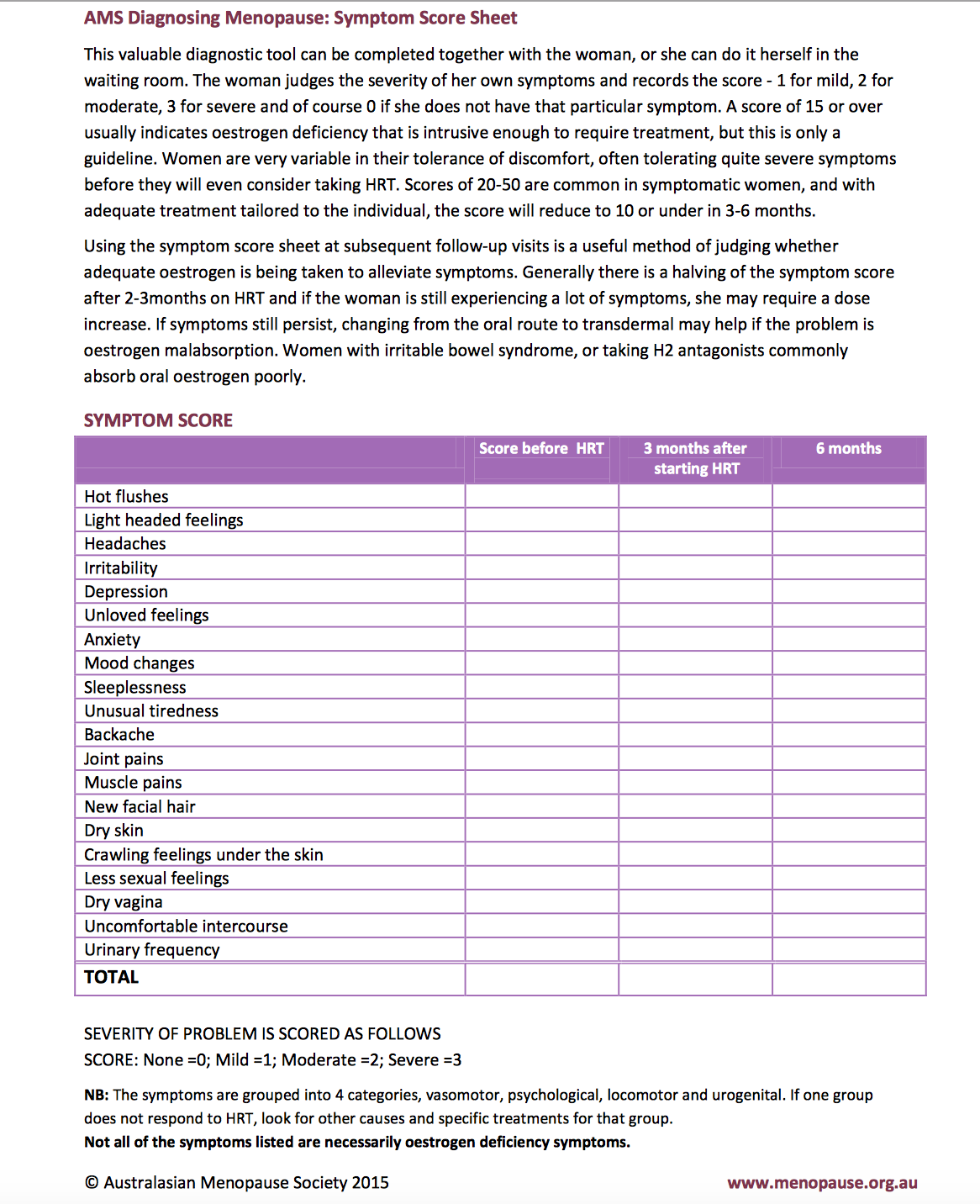
- Take a good history of menopausal symptoms, preferably using a standardised symptom measurement system
- Ask how the symptoms are affecting quality of life, particularly sleep disturbance
- Record personal medical history and risk factors for breast cancer, cardiovascular disease, thromboembolic disease and osteoporosis
- Ask about absolute or relative contraindications to MHT:
- uncontrolled hypertension,
- undiagnosed abnormal bleeding,
- previous breast or endometrial cancer and
- personal history or high inherited risk of thrombo-embolic disease
- Ensure that screening (breast, cervical) is up to date
Menopause - Contraception
While fertility declines with age, women are at risk of an unintended pregnancy until
- 12 months after the last menstrual period if over 50 years
- 24 months if below 50 years
Women should be provided with evidence-based information about all contraceptive options in order to support informed decision making
- Oestrogen containing methods (combined oral contraception and the vaginal ring) and the contraceptive injection are generally not recommended after 50 years as the cardiovascular risks outweigh the benefits
- The LNG-IUD provides effective management of heavy menstrual bleeding as well as contraception and it can be used as part of an HRT regimen
- Women in a new relationship should be advised about the use of condoms to prevent STIs
- Women should be informed about the availability of the Emergency Contraceptive Pill without a prescription at pharmacies and its effectiveness up to 96 hours after unprotected intercourse
Premature menopause
Premature menopause is considered to have occurred if a woman is younger than 40 when she becomes menopausal.
- About 1% of women experience a spontaneous premature menopause (POI or premature ovarian insufficiency) and around another 6% have premature menopause due to surgery, chemotherapy or radiation.
- There has been relatively little research on symptoms in these women, but it seems that their menopausal symptoms may be more severe than in older women, particularly when menopause occurs due to surgery or chemotherapy.
- There are also distinct personal, sexual, social and psychological issues for younger women, particularly those who have not yet started or completed their families. These women need extra counselling, and time to come to terms with their situation. This is the one time that measuring and finding a high FSH and a low oestradiol is helpful to differentiate between menopause and other causes of secondary amenorrhoea.
- The measurement of FSH and oestradiol should be repeated at least once.
Menopause symptoms
Symptoms
Vasomotor, for example:
- hot flushes (80%)
- night sweats (70%)
- palpitations (30%)
Psychogenic, for example:
- tearfulness/depression
- irritability
- anxiety/tension
Urogenital (60%), for example:
- atrophic vaginitis
- vaginal dryness (45%)
- dyspareunia
Musculoskeletal,
- e.g. non-specific muscular aches
Skin and other tissue changes,
- e.g. dry skin
Other, e.g.:
- unusual tiredness
- headache
Menopause Inx
Investigations
Apart from a Pap test, consider the following tests:
- urinalysis
- FBE, lipids inc. HDLC
- liver function tests
- mammography (all women, preferably after 3 mths on HRT)
- diagnostic hysteroscopy and endometrial biopsy if undiagnosed vaginal bleeding
- bone density study (if risk factors)
If diagnosis in doubt (e.g. perimenopause; younger patient <45 yrs; hysterectomy):
- serum oestradiol
- serum FSH
HRT
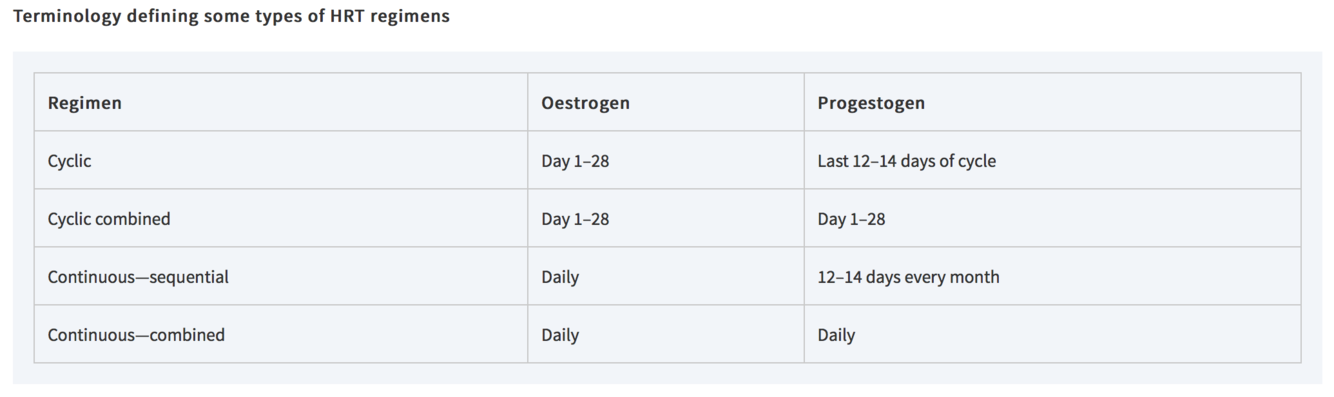
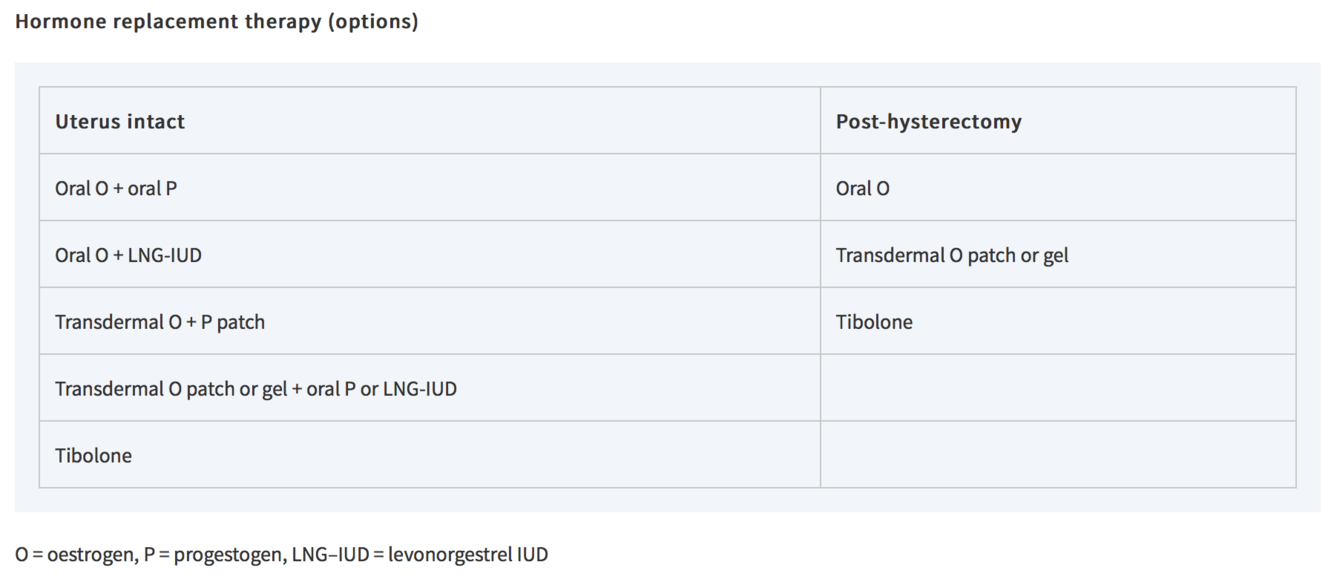
HRT has to be tailored to the individual patient and depends on several factors, inc. the presence of a uterus, individual preferences and tolerance. Aim for a max. of 3–5 yrs treatment then review. (Consider risks.)
Vaginal atrophy
VAGINAL DRYNESS
First-line therapy is non-hormonal e.g. Replens or K-Y gel. Second-line is a low dose vaginal oestrogen pessary.
HRT

-
Sleep 513/1527
-
Acne1
-
Murtagh Triads4
-
Acute Respiratory 486/1244
-
Dermatology 538/1733
-
Bones and Joints 519/157
-
Musculoskeletal0
-
Cardiology 534/1636
-
Ischaemic Heart Disease 480/121
-
ENT 525/1651
-
ENT 469/1166
-
Hernias7
-
Diabetes 521/1536
-
Addictions 201513
-
Perinatal Health 540/1724
-
Womens Health 530/167
-
Womens Health 509/140
-
Antenatal issues 483/120
-
Breast 474/110
-
Menstrual Disorders 471/110
-
Men's Health 532/161
-
Men's Health 500/1329
-
Urology 487/120
-
Normal Vital Signs2
-
ECG2
-
Menopause10
-
Contraception1



