microcirculation
•”business end” of the CV system •exchange of solutes and fluid between blood and tissue •slowest part of the circulation
terminal arterioles
•immediately upstream of the capillaries •discontinuous smooth muscle •capillary recruitment
larger arterioles
•completely enveloped with smooth muscle •”resistance” vessels •regulation of the distribution of cardiac output and MAP
capillaries
•small tubes consisting of a single layer of endothelial cells surrounded by a simple collagen support matrix (the basement membrane) •well designed to enhance diffusive exchange -short distance (small capillary diameter) -thin microvascular wall -large number of capillaries close to the cells -large capillary surface area for exchange, relative to blood volume in capillaries -blood slows down as it traverses capillaries
continous capillaries
- skeletal muscle, cardiac muscle, skin, lungs, adipose, CT and nervous system (BBB)
- endothelial cells overlap creating clefts with tight junctions that restrict solute exchange
- transport of lipid insoluble solutes (glucose) from blood to tissue ocurs through these clefts
- gases diffuse across the cell membrane
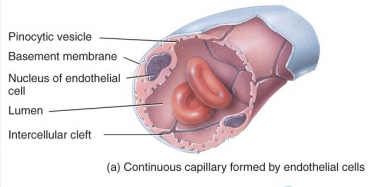
fenestrated capillaries
- glomerulus, exocrine glands, intestinal mucosa, ciliary body, choroid plexus, synovial lining of joints and endocrine glands
- endothelial lining perforated by small circular windows containing thin diaphragms
- solute and fluid exchange is roughly 10x greater than across continous capillaries
- larger molecules such as salts can move in and out
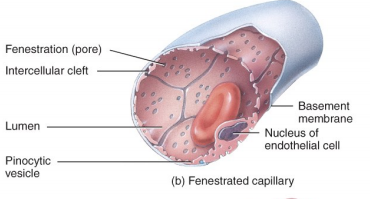
discontinous capillaries
- sometimes called sinusoids, liver, bone marrow and spleen
- discontinuities in the basement membrane as well
- large proteins and blood cells can move freely from blood to tissue (and vice versa) in these organs
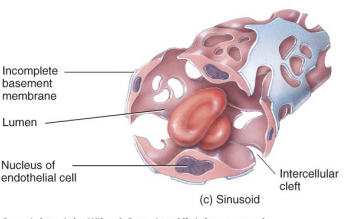
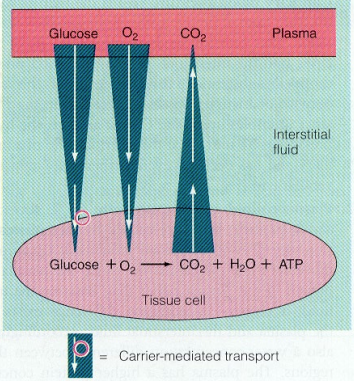
Fick’s Law of Diffusion
•governs the process of transcapillary solute exchange - solute molecules tend to move across the capillary wall from a region of higher concentration to a region of lower concentration
Js = PsS (Cc-Cl)
Js = solute flux
Ps= permeability coefficient
S = capillary surface area available for exchange
Cc = solute concentration within the capillary
Cl = solute concentration in the interstitial space
The Starling Equation
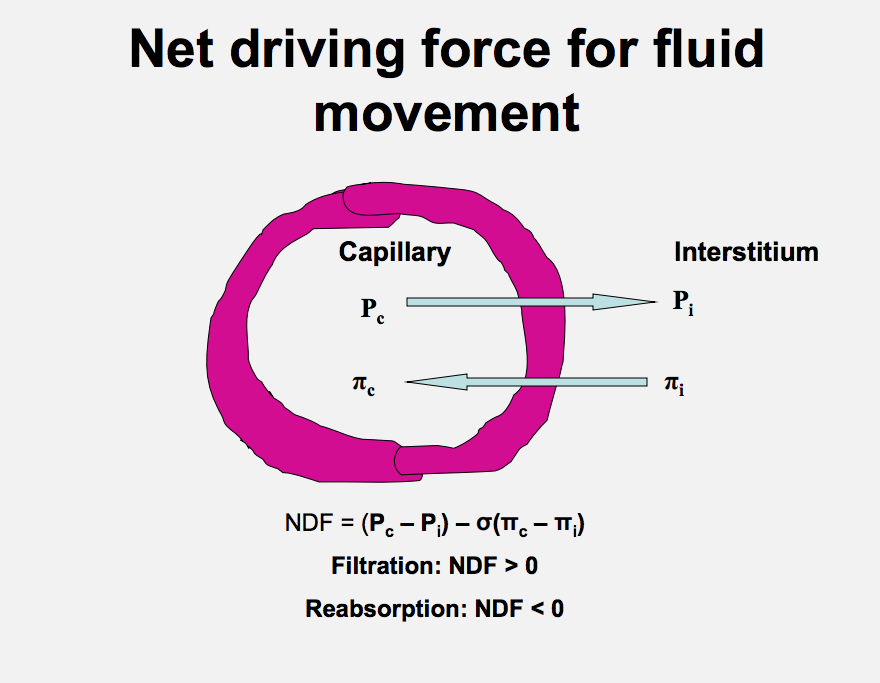
- governs the process of transcapillary fluid exchange
- each day about 3 L of fluid are flitered from blood to tissue
- there are hydrostatic pressure forces tending to push fluid out of the capillary into teh tissue; there is also an oncotic pressure, exterted by the plasma proteins, that tends to suck fluid into the capillaries
JF = LP S [(Pc – Pt) - σ (Πc - Πi)]
Pc – Pi = Hydrostatic pressure difference
Πc - Πi = Oncotic pressure difference
σ = Protein reflection coefficient
edema
• a term describing the accumulation of fluid in the interstitial space, occurs when the net fluid filtration from blood to tissue exceeds the lymphatic drainage
- arteriolar vasodilation
- long term sitting or standing
- liver failure
- malnutrition
- late term pregnancy
- impaired lymph drainage
- burns, inflammation
- snake bite
effect of venous blood pressure on edema formation
- blood pressure in the capillaries can be increased by either increasing the blood pressure in the upstream arterioles or in the downstream venules
- much more influenced by a change in venules
inflammatory swelling
- inflammation: rubor, calor, dolor, tumor and loss of function
- post exercise, joint sprains, arthritis, minor cuts and burns, immune
- adhesion of PMN to microvasculature at wound site or infection
- PMNs phagocytize injured cells or infectious agents - increase in microvascular permeability to proteins –> plasma exudes into tissue, carrying growth faactors that participate in the wound healing response
- causes swelling and discomfort
lymphatic architecture
- terminal lymph vessels permeate almost every tissue in the body
- endothelial cells in terminal lymphatic capillaries overlap and are not tight, “flaps” that serve as openings for interstitial fluid to freely enter
- not selective - everyone’s welcome!
- lymphatic capillaries –> lymph vessels –> lymph nodes –> venous vasculature
- lymph fluid is propelled by periodic compression of organs and by the smooth muscles in the lymph vessels that tend to contract when the vessel is distended - myogenic mechanism
lymph function
- return of excess filtered fluid
- defense against disease
- transport of absorbed fat
- return of filtered protein
lymphedema
- compromise of normal lymphatic function will lead to interstitial fluid accumulation (edema) and swelling
- depending which lymphatics are involved, the immune system may be involved
venous architecture
•venous blood volume greater than arterial volume
- lots of veins
- larger than arterial counterparts (usually paired)
- larger and more of them –> less vasculature resistance to blood flow, little decrease in blood pressure as the CO returns through the venous circulation
- veins contain most of the blood volume in the CV system - blood “reservoir” or “capacitance” vessels
- thinner walls, less smooth muscle than arteries
- less elastic (collagen/elastin ratio greater) recoil less in response to increasing volume (less myogenic tone)
- one way valves
venous return
•sympathetically induced venous contraction
- veins are not rich in vascular smooth muscle, but are richly innervated by sympathetic fibers –> more tone and constrict slightly
- mildly increases venous pressure but mobilizes venous blood –> increase venous return
•skeletal muscle activity
- muscle contraction
- Calf Muscle Pump
•respiratory activity
- during inspiration, pressure in teh chest cavity goes below atmospheric, distending venae cavae and increasing pressure gradient for venous return
- relfex increase in HR late in insporation as teh heart attempts to eject the increased venous return
•cardiac suction effect
- decrease in atrial pressure during atrial relaxation which increases the pressure gradient which also helps increase venous return
- during ventricular systole, the tendinous cords pull the AV valve cusps downward, slightly expanding the atrial space and creating a slight suction that draws blood from the venae cavae and pulmonary veins
venous disease
*DVTs
•CVI (chronic venous insufficiency)
-DVTs often occur around venous valves due to increased opportunitiy for stasis behind valve leaflets
central venous pressure
•blood pressure in the thoracic vena cava near the right atrium
peripheral venous pressure
•blood pressure in a vein located in the periphery, outside the thorax
venous return curve
- relationship between PVP and CVP
- CVP has to be less than PVP to maintain the pressure gradient that drives blood from veins to the heart
- venous blood volume
-if venous blood volume is increased, then PVP is increased and venous return increases
•venous tome
-when activation of teh sympathetic nervous system causes vasoconstriction, the venous blood pool is mobilized and PVP is modestly increased, increasing the venous return

-
Gross Anatomy38
-
Pathology25
-
Peripheral Circulation and Hemodynamics31
-
Determinants of MAP14
-
Regulation of Organ Blood Flow and Special Circulations26
-
Cardiac Cycle and Electrical Activity27
-
Myocardial Contractility7
-
Valvular Heart Disease49
-
Myocarditis, Cardiomyopathies and Hypertensive Heart Disease38
-
Coagulation46
-
Shock13
-
Microcirculation and Lymphatics21
-
Ischemic Heart Disease19
-
Heart Development25
-
Congenital Heart Disease60
-
Aortic Stenosis15
-
Cardiac Muscle7
-
Clinical Correlations I: Pressure Volume Loops10
-
ANS60
-
Clinical Correlations II and TL I: ANS18
-
Clinical Correlations III: Atherosclerosis54
-
Murmurs25
-
Anticoagulant, Antiplatelet and Thrombolytic Drugs40
-
Drugs for Ischemic Heart Disease10
-
Antihypertension Drugs15
-
Antiarrhythmic Drugs12
-
EKG37
-
Heart Failure33
-
Drugs for Heart Failure14
-
Analgesics, Antipyretic and Antinflammatory Drugs23
-
Imaging of Cardiac Pathology10
-
STEMI21
-
Long QT Syndrome17
-
Bradycardia and Tachycardia32
-
Antihyperlipidemic Drugs5



