List 6 properties of tendons
- Dense regular connective tissue
- Composed of <80% collagen (chiefly type 1) and 1-2% elastin
- Vary in size based on function
- Responsible for transmission of muscle force to bone
- Organised in bundles
- Strain resistant with up to 1260kg/cm2 tensile strength
List 4 properties of ligaments
- Similar to tendons in origin and internal structure
- Responsible for connecting bone to bone at joints
- Highly reliant on crimping regions to utilise their elasticity
- Crimping regions are also present in tendons but play a less prominent role
(Frank, 2004)
Describe the ascending organisation of tendons and ligaments
- Fibrils
- Fibres
- Primary bundles
- Secondary bundles
- Tertiary bundles
- Tendon / ligament
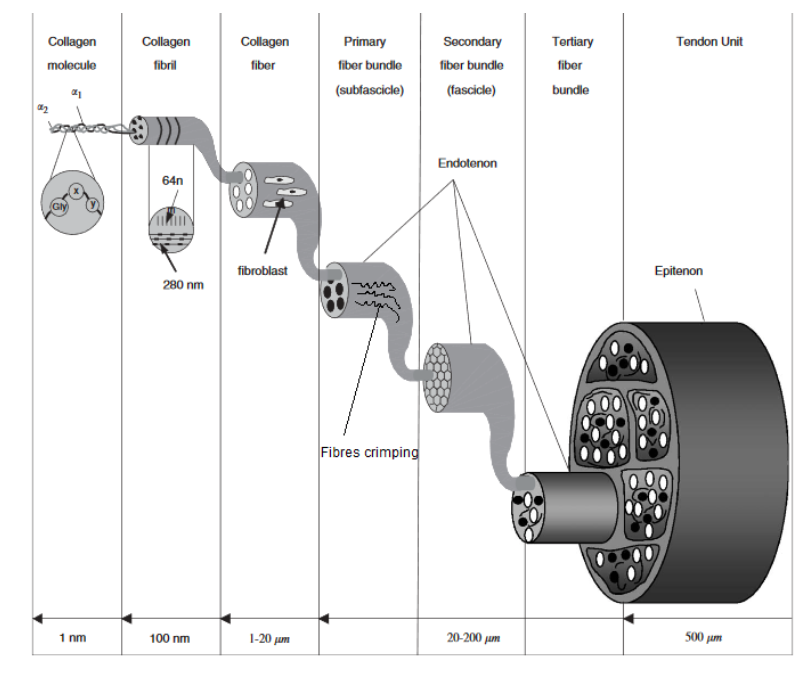
Describe fibrils
Composed of elongated fibroblast cells which run longitudinally, transversely and horizontally.
Bundles which run longitudinally do not always run parallel with each other; they often cross other bundles.
This structure acts as a buffer against forces acting on the tissues from all directions.
Describe the composition of a tendon exposed to higher strains
- Thicker
- Shorter
- Bigger, denser packed bundles
Describe the composition of a tendon exposed to lower strains
- Long
- Thin
- For more precise movements
What are groups of fascicles of a tendon bound by?
Epitenon (Kannus, 2000)
What is the supporting covering sheath of a ligament called?
Epiligament (Kannus, 2000)
Compare and contrast tendons and ligaments
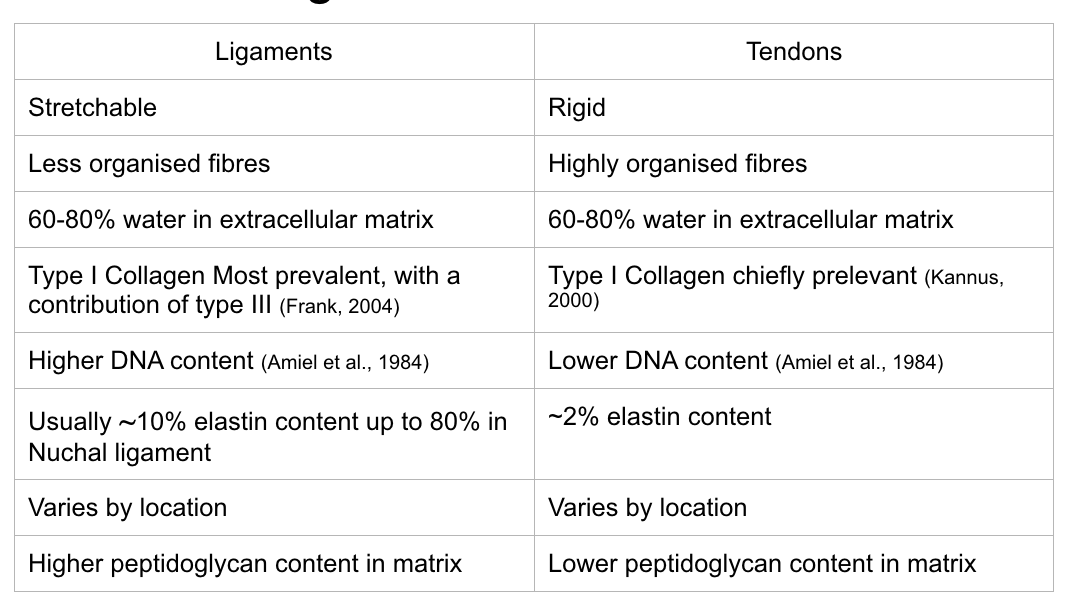
Tendons and ligaments are viscoelastic structures.
What does this mean?
When a force is applied, the tendon or ligament will stretch to allow movement, but will always return to its original structure.
Why are tendons strong?
Why are tendons flexible?
- Strong to withstand the forces applied during muscle contraction.
- Flexible to allow movement around bone and to move under retinacula (example - long flexor tendons of the hand).
Why are ligaments strong?
Why are ligaments flexible?
- Strong to offer resistance and hold the joint together during movement.
- Flexible to allow free and natural movement of the joint (example - medial and lateral collateral ligaments of the knee joint).
What is stress?
A measure of force per unit area
What is strain?
The response of a system when stress is applied
How do you calculate strain?
Ratio: change in length over initial length
Describe normal stress
- It is assumed that the intensity of distributed forces are uniform
- Changes dimensions but not the shape of the object under stress
- Compressive stresses or tensile stresses
- δ = F/A
F = force
A = area
Describe shear stress
- Equal and opposite forces applied to opposite faces of an object
- Changes the shape of the object under stress but does not change the dimensions
- τ= F/A
Describe normal strain
- Ratio of the amount of elongation to the original length
- ϵ= Δ1/1
- If the material increases in length then strain is tensile and positive
- If the material decreases in length then strain is compressive and negative
Describe shear strain
- Related to distortions from shear stress
- Shear strain is the ratio of horizontal displacement (d) to height (h)
- Ɣ= d/h
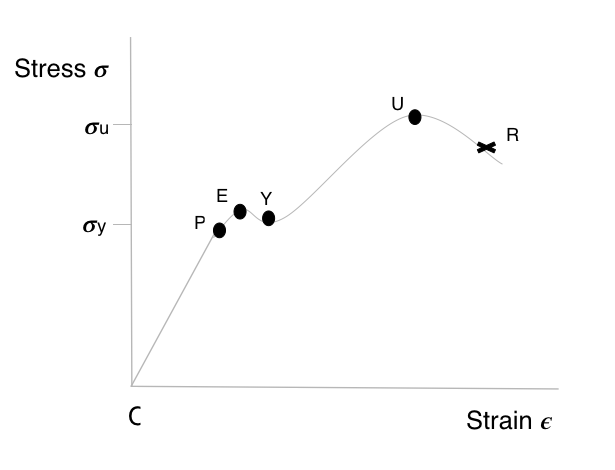
Draw the stress vs strain curve
- O - origin
- P - proportionality limit
- E - elastic limit
- Y - yield point
- U - highest stress point
- R - rupture point
- 𝛔y - yield strength of material
- 𝛔u - ultimate strength of material
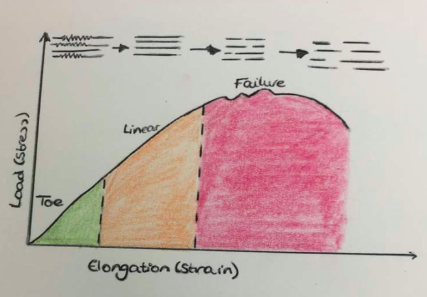
Describe the load and elongation curve
- Used to analyse biomechanical properties of tendons and ligaments
- Tissue has a tensile force applied to cause a constant rate of elongation
- This force is applied until the tissue ruptures
- There are 4 main points on the graph:
- Toe region (primary region)
- Linear region (secondary region)
- End of secondary region
- Maximum load
What limits range of motion of the vertebral column?
- Resistance of the ligaments
How does movement of the vertebral column occur?
As a whole - NOT between individual segments, except between C1 and C2.
Describe the structure and function of the nuchal ligament
Elasticity allows flexion and extension of the vertebral column without buckling of the ligament



-
Development of the vertebral column105
-
The neck90
-
Motion segments19
-
Microstructure and Ultrastructure54
-
Biomechanics of the Vertebral Body44
-
Cartilage47
-
Facet Joints50
-
Anatomical Variation in the Vertebral Column49
-
Factors in Initiation of Ossification25
-
Vasculature of the Vertebral Column69
-
Sacroiliac joints65
-
Gross Pathologies of the Vertebral Column38
-
Bone Marrow and Haematopoiesis61



