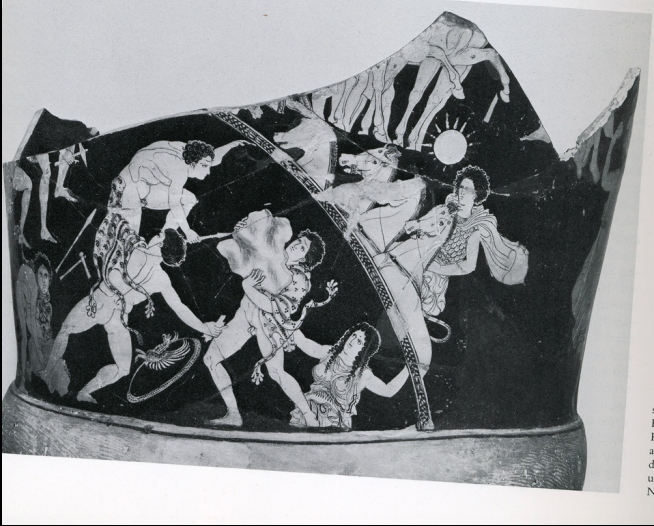
Giants attempt to climb Mt. Olympus (gigantomachy), Gaia is rising from below. As the sun rises (Helios in his quadriga), the gods are readying themselves for battle (legs of horses from chariot of one of the gods). Red figure krater in Naples, National Museum. C. 390 BC.
- ·Separation of realm of gods in heaven and realm of giants
- Trying to climb up to heavens, piling up stones, would hurl as well
- Can see Gaia
- One giant would remain powerful as long as he remained connected to Gaia, so we can see his foot touching her
- On gods’ side see Helios, sun painted towards his head
- See legs of horses of chariot of the gods – readying self for battle
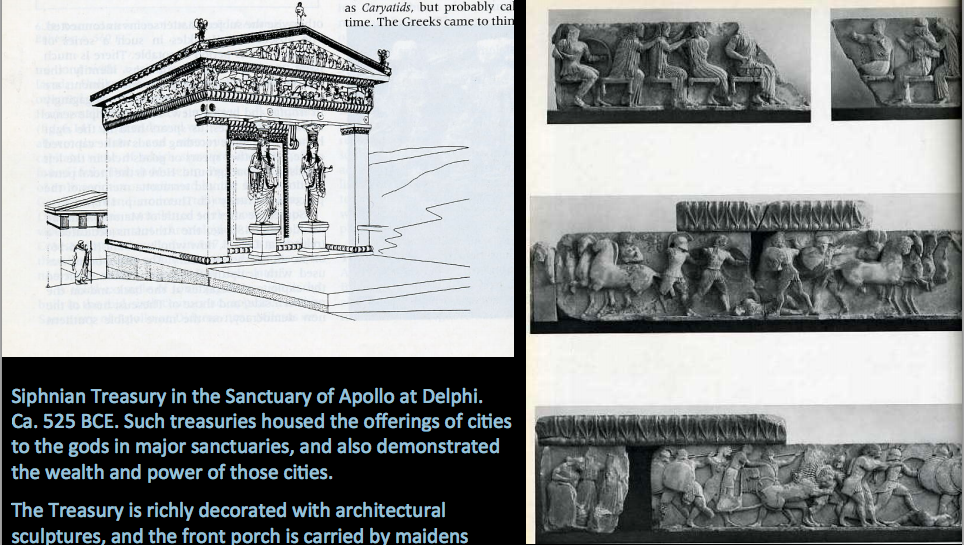
Siphnian Treasury in the Sanctuary of Apollo at Delphi. Ca. 525 BCE. Such treasuries housed the offerings of ciFes to the gods in major sanctuaries, and also demonstrated the wealth and power of those ciFes. The Treasury is richly decorated with architectural sculptures, and the front porch is carried by maidens instead of columns. The north frieze shows the fight between gods and giants (gigantomachy). The names of the gods and giants were inscribed below them: Hephaistos, Dionysos, Themis, Apollo, Artemis.
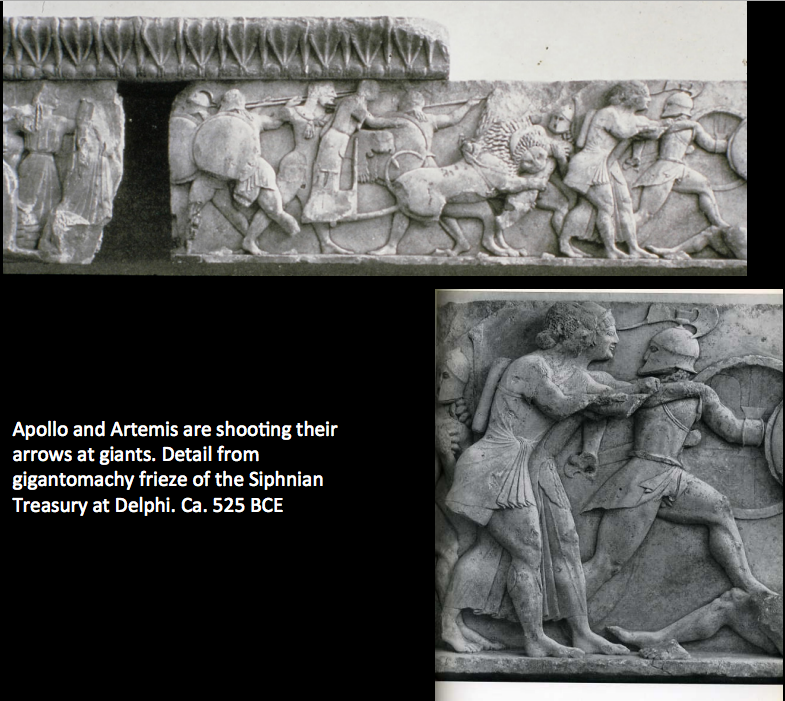
Apollo and Artemis are shooFng their arrows at giants. Detail from gigantomachy frieze of the Siphnian Treasury at Delphi. Ca. 525 BCE
Giants dressed like Hoplites (warriors at the time), helmets, anonymous
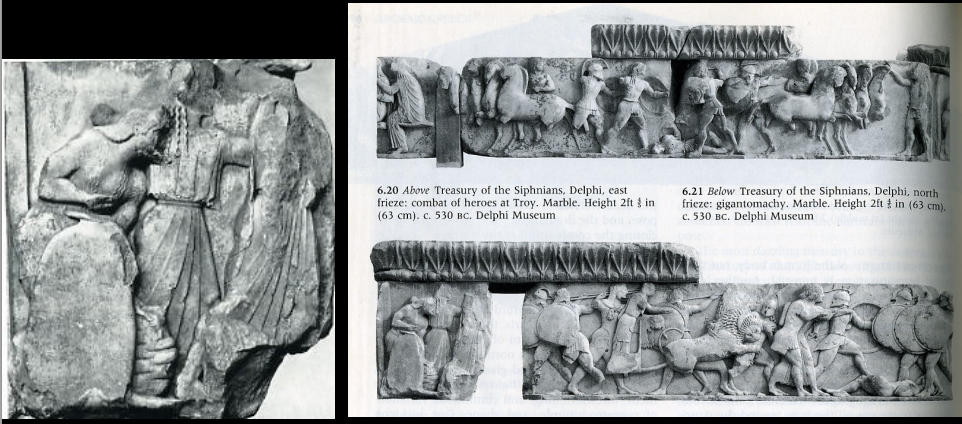
Hephaistos, the divine smith, is operaFng his bellows in the gigantomachy. Detail of frieze from Siphnian Treasury. Ca. 525 BCE.
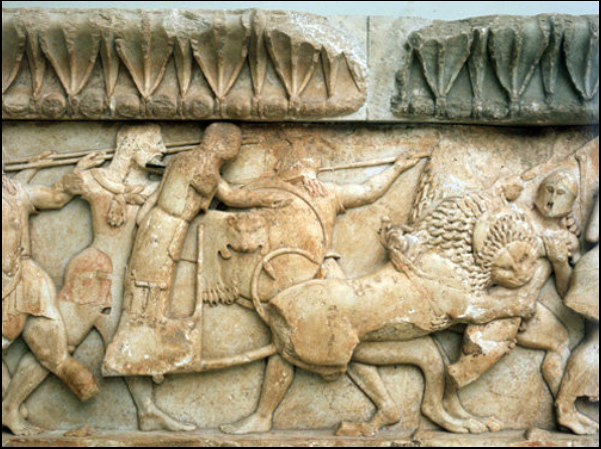
Siphnian treasury, north frieze. Themis in her chariot drawn by a lion. Behind her, Dionysos (with animal skin). The lion attacks the Giant/ hoplite whose face is depicted in frontal view. The negative light in which hoplite warfare is shown on the North frieze may have to do with the aristocratic outlook of the Siphnian patrons of the Treasury
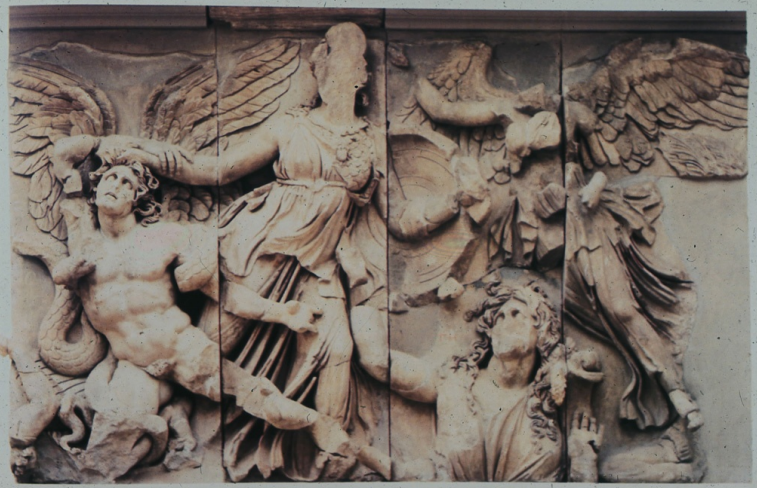
- Athena fighting giant (Alcyoneus?), crowned by a Nike (‘victory’). Gaia/ Ge rising from the earth. Great Altar, East frieze. Berlin, Pergamon-Museum C. 190-150 BC.
- Athena city goddess of Athens and Pergamon
- Moment in which Athena separates giant from the earth contact that gives him strength
- Gaia has cornucopia, symbol of abundance, rising from earth. Had inscription right next to head saying Gaia. Decisive moment. Separation loss of strength
- interest in decisive moment typical of Hellinistic art – reveral of fortune
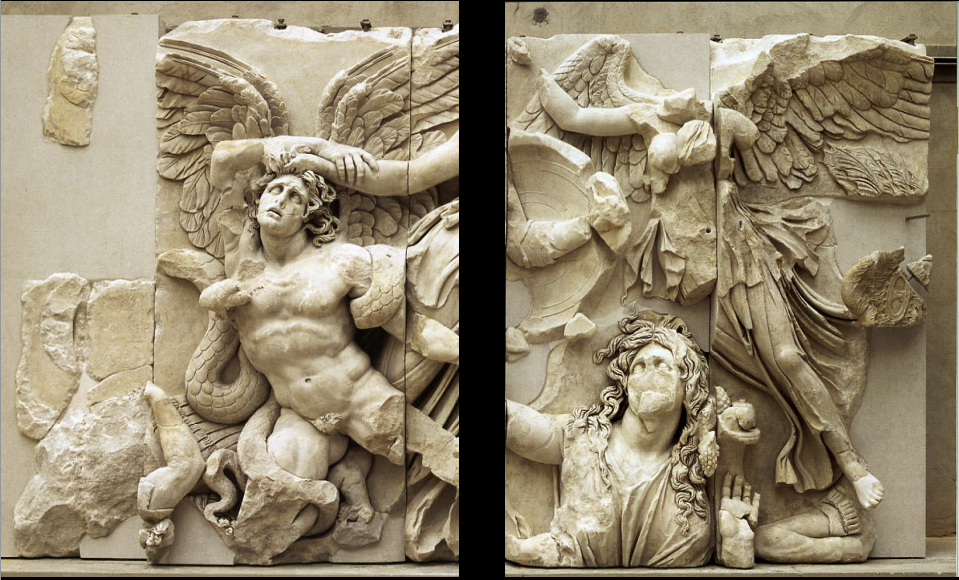
- Giant (Alcyoneus?), Athena, Gaia, Nike, from Pergamon altar, east frieze (details).
- A Nike with wings about to crown Athena. About to be crowned victorious while still fighting. City goddess, so big role, probably recipient of altar
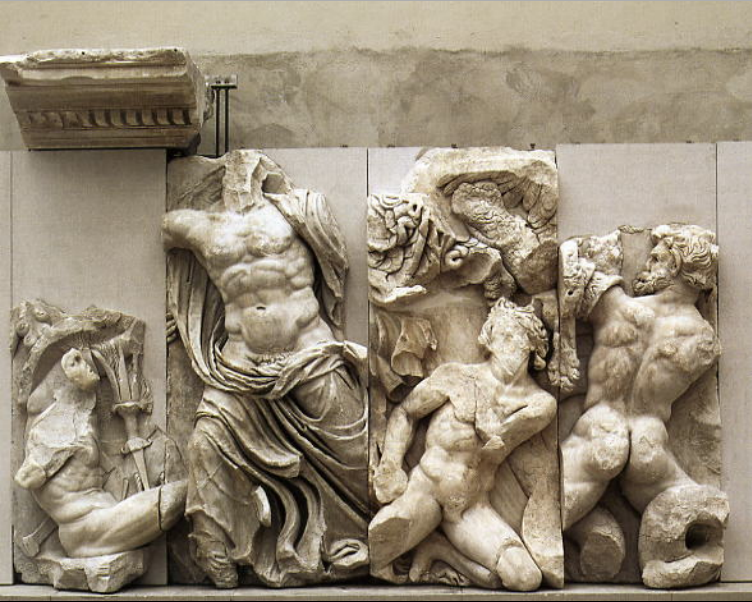
- Zeus (with aegis on left arm) battling giants. On the right Porphyrion, leader of the giants. Above his left arm the wing of Zeus’ eagle. Great Altar, East frieze. Berlin, Pergamon-Museum. C. 190-150 BC.
- Taking on leader and other giants at the same time. Legs turn to snakes. Other giant’s leg pierced with thunderbolt. Drastic realism of suffering. Enhanced by painting
- Zeus has golden fleece (the fleece is a symbol of authority and kingship), usually Athena, but also Zeus has one, like shield, giant has a shield
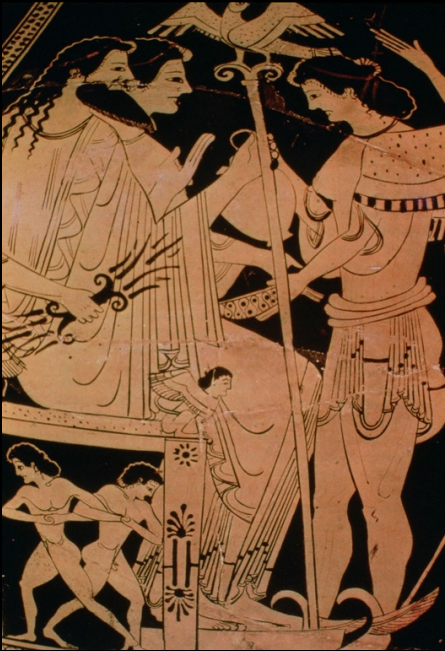
- Zeus (with eagle sceptre and thunderbolt) and Hera enthroned, served by Iris. Red figure vase. C. 500 BC.
- Being served by Iris
- Hera childbirth gesture, goddess of childbirth
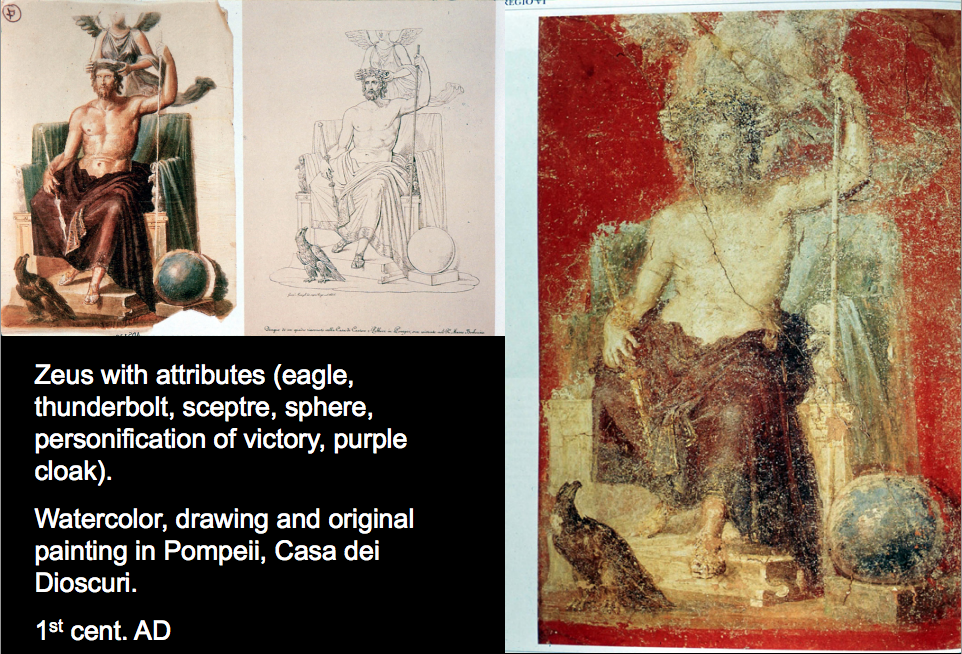
Zeus with attributes (eagle, thunderbolt, sceptre, sphere, personification of victory, purple cloak). Watercolor, drawing and original painting in Pompeii, Casa dei Dioscuri. 1st cent. AD
More unusual representation. Roman wall painting. Zeus upper body bare, sceptre. Sacred instruments in background
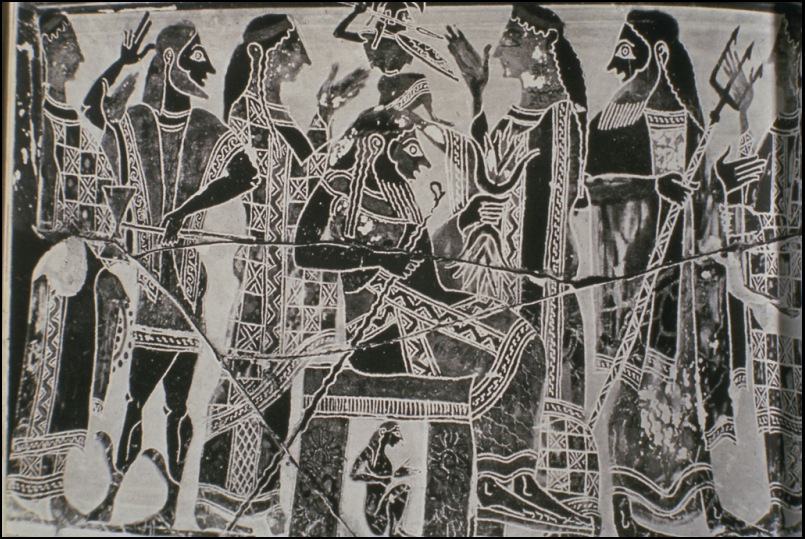
- Birth of Athena from head of Zeus, assisted by goddesses of birth (Eileithyiai). Hephaistos (axe) on the left, Poseidon (trident) on the right. Black figure pyxis from Thebes. C. 580-570 BC.
- Gesture of women is gesture of delivering a child. Birth of Athena from Head of Zeus. Hands ready to take child. Profile
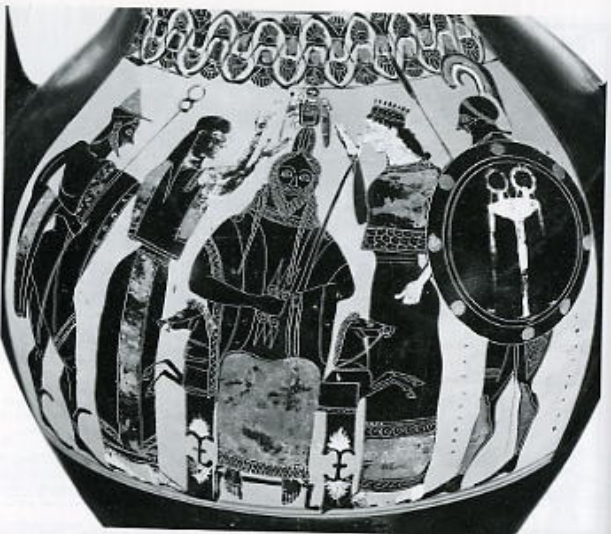
- Birth of Athena from head of Zeus, assisted by Eileithyiai. Hermes on the left, Ares on the right. Black figure amphora. Mid 6th cent. BC.
- Experimental frontal view, goddesses of child birth, Ares, Hermes
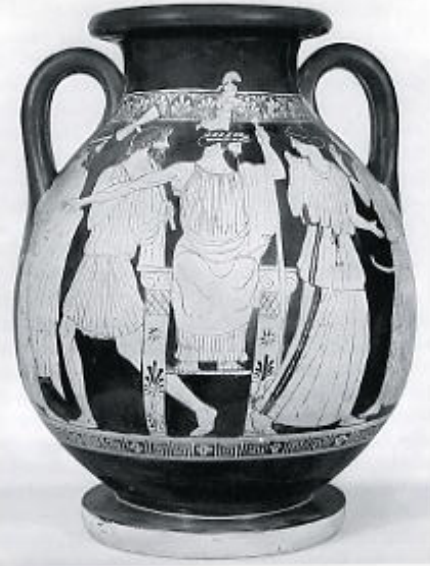
- Birth of Athena. Red figure Pelike in London, British Museum. C. 460 BC.
- Would need to make Zeus small to show Athena, so in Parthenon shows as if having jumped from head already and standing next to him
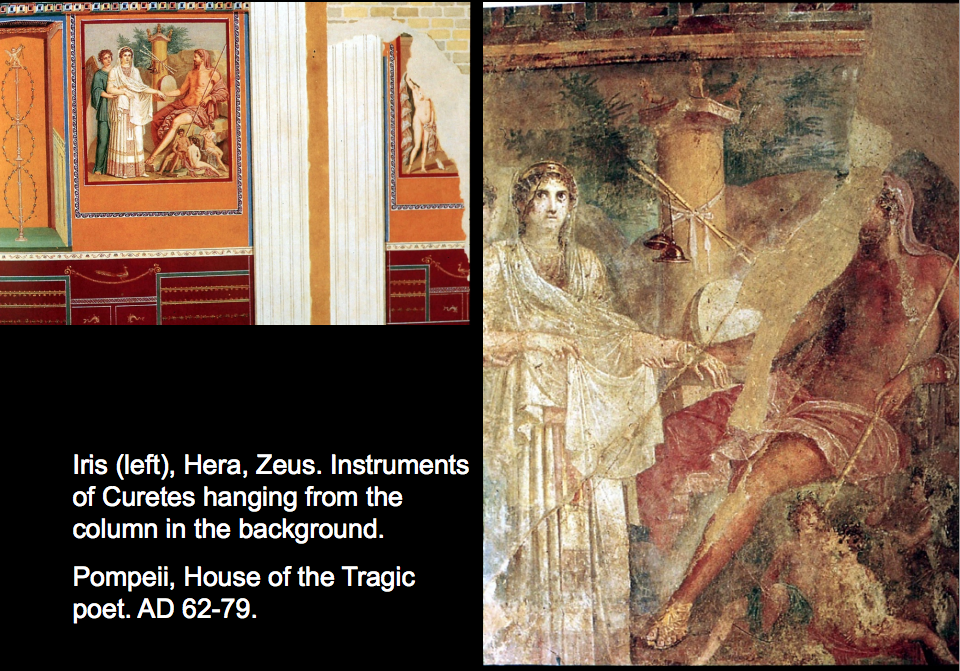
- Iris (left), Hera, Zeus. Instruments of Curetes hanging from the column in the background. Pompeii, House of the Tragic poet. AD 62-79.
- More unusual representation. Roman wall painting. Zeus upper body bare, sceptre. Sacred instruments in background. Hera white skin, contemporary hairstyle, like household women could have looked. Zeus holding by wrist, can be seen as taking someone as a wife in antiquity. Hera might be hiding magic girdle given to her by Aphrodite to make self irresistible to Zeus. Or could be during Trojan war where each were on opposing sides. Painting as model of owners of the house, reflected in mythological paintings. Other paintings in the room also show mythological couples
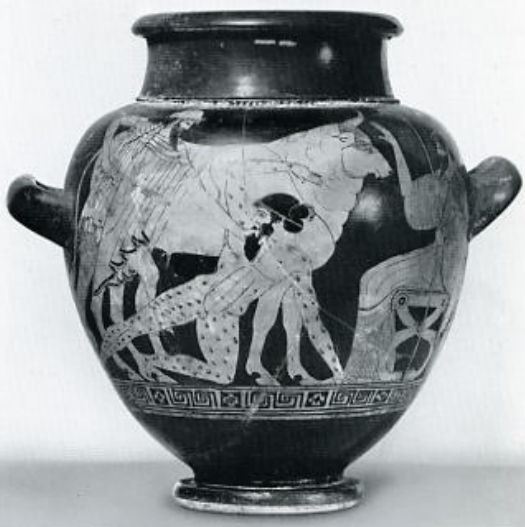
- Hermes, Argus, Zeus. Io in the background. Red figure stamnos by so-called Argos painter. Vienna, Kunsthistorisches Museum. C. 460 BC.
- Hermes with sword killing Argus, Zeus present in chair with scepter
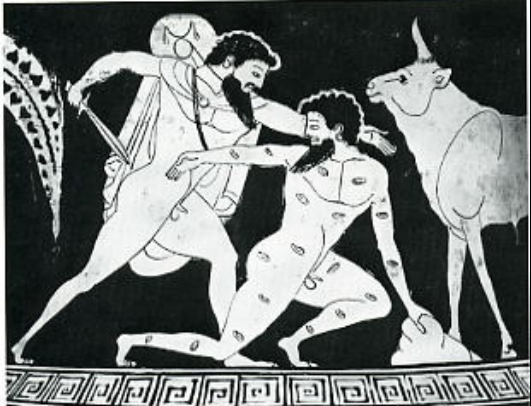
- Hermes killing Argus. Io on the right. Amphora by Eucharides painter in Hamburg (Germany), Museum fuer Kunst und Gewerbe. C. 490 BC.
- Only neck painted. Shows on two sides juxtaposition of scnes. Divine punishment. Acteon, punished by Artemis, killed by own hounds. And punishment f Argus by Zeus via Hermes
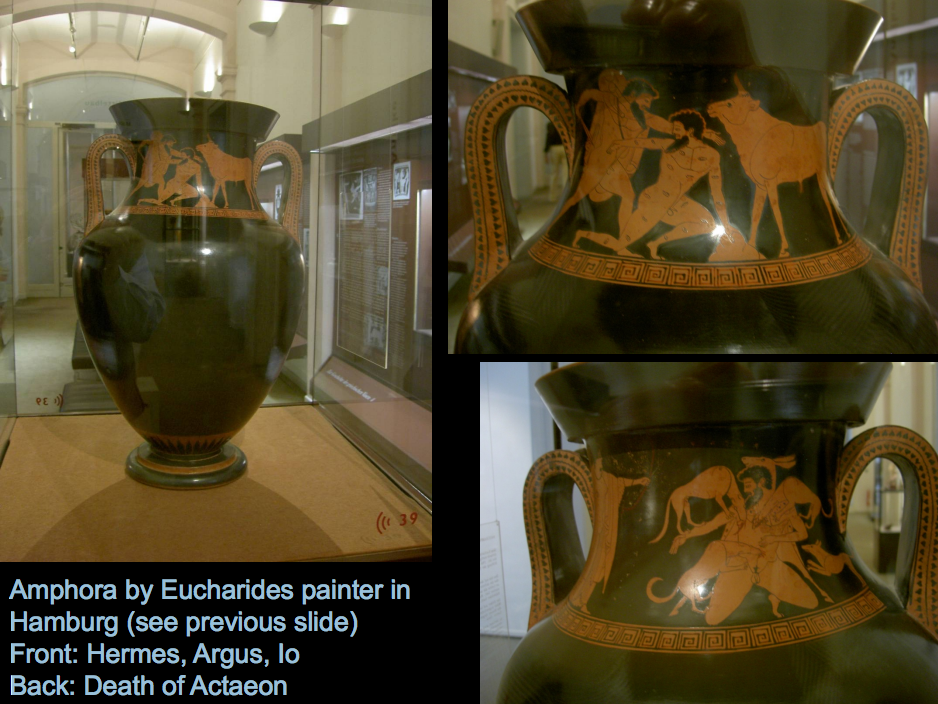
- Amphora by Eucharides painter in Hamburg (see previous slide) Front: Hermes, Argus, Io Back: Death of Actaeon
- Only neck painted. Shows on two sides juxtaposition of scenes. Divine punishment. Acteon, punished by Artemis, killed by own hounds. And punishment of Argus by Zeus via Hermes
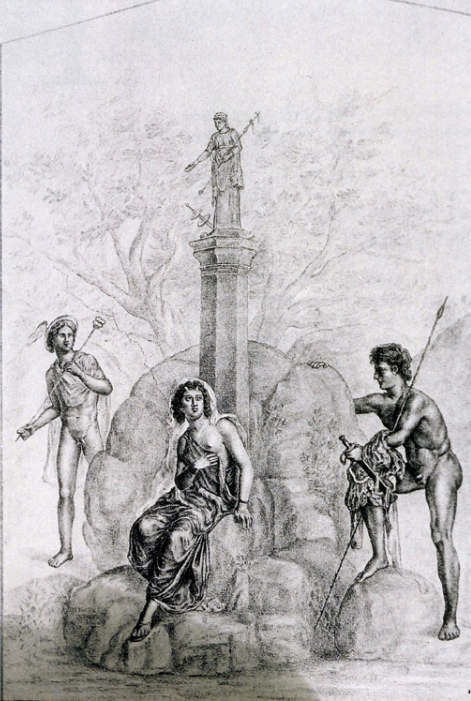
- Hermes, Io, Argus. On the column in the centre a statue of Artemis (or Hera?). Roman wall painting from Rome, Villa of Livia (wife of Augustus) on Palatine hill. C. 30 BC.
- Later representation shown in different manner
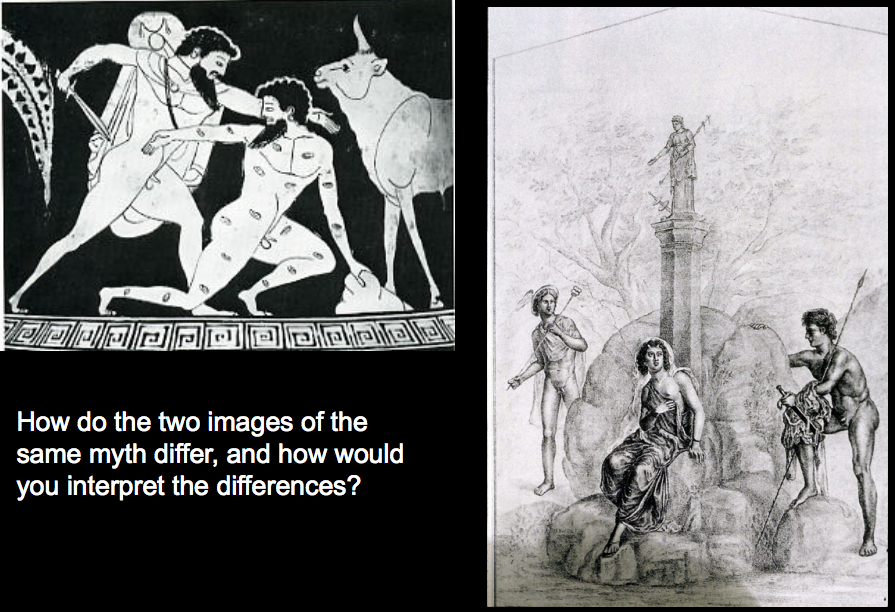
- Left: Hermes killing Argus. Io on the right. Amphora by Eucharides painter in Hamburg (Germany), Museum fuer Kunst und Gewerbe. C. 490 BC.
- Right: Hermes, Io, Argus. On the column in the centre a statue of Artemis (or Hera?). Roman wall painting from Rome, Villa of Livia (wife of Augustus) on Palatine hill. C. 30 BC.
- Right: Argus looks quite different. Hera present, importance of landscape. Argus not shown as monstrous. Beautiful, heroic, male. Famous pose that was also used for Alexander the great. Romanticized. Less violent than amphora where see dagger. Argus and Io in foreground, stronger. The men no beards. Male beauty. Hermes no beard, younger generation of gods.
- Left: No matter which myth looking at, shift of emphasis from heroic aspect (killing – warrior scheme) in ancient art (more about infliction of divine punishment/will). Io only there as reminder of mythological context. Undetermined setting
- Right: Emphasis on beauty, beauty of Io. One breast exposed. About act of looking, erotic gaze, as we are gazing. Argus looks at her as well, not guarding but gazing as she shows herself
- Hermes placeholder for ancient viewer who looked at scene, we stumble upon scene of beginning/developing erotic encounter, just as Herms stumbles upon it as well
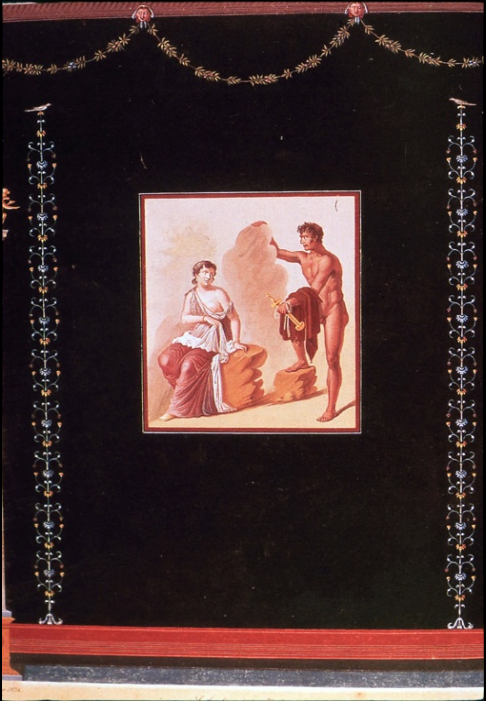
- Io and Argus. Roman wall painting from the fish and meat market (macellum) in Pompeii. 1st cent. AD.
- More romanticized. Scheme used for heroic males. Hermes left out. Scheme for gazing.
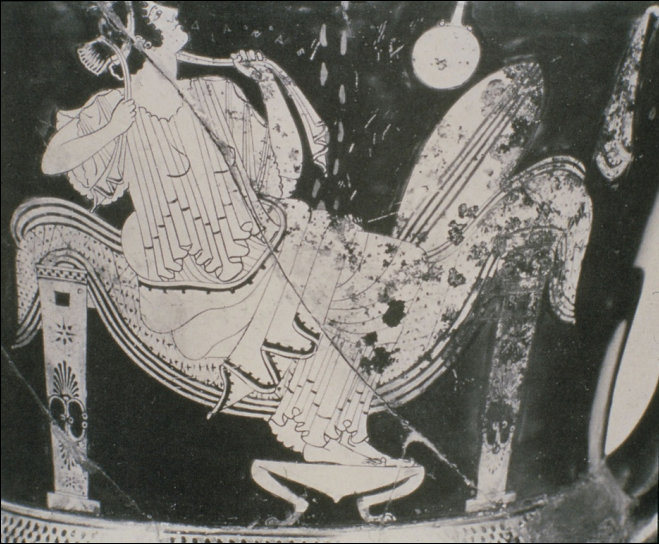
- Danae (daughter of Acrisius, king of Argos) receiving Zeus as a shower of gold. From red figure krater by Triptolemos painter. St. Petersburg (Russia), Ermitage. C. 470 BC.
- Princess. Not shown as much in art. Told daughter would give birth to son tha would kill him. Tries to prevemt, self fulfilling prophecy. Locks her away. Either underground chamber made of bronze or bronze tower. No way of keeping Zeus out.
- Couches used in for symposia, foot stool. Elegant princess in beauty routine. Drops of gold raining down into lap. Only see breats under garment, fully dressed.
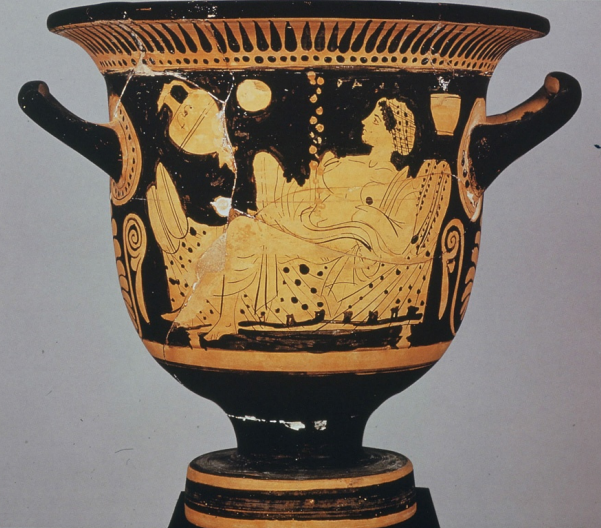
- Danae receiving Zeus as a shower of gold. Boeotian red figure krater. C. 410-400 BC.
- later artists go further - upper body undressed
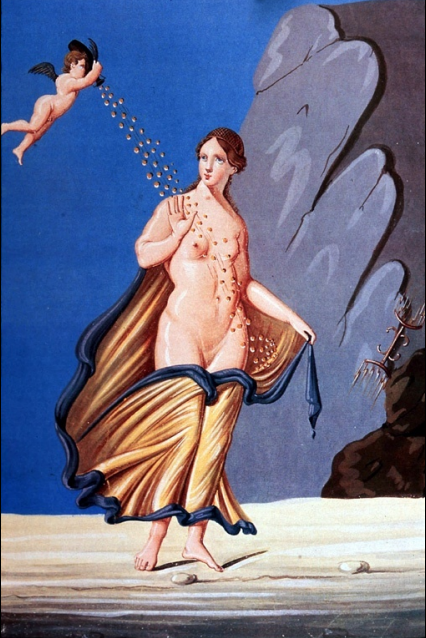
- Danae/shower of gold Watercolor after wall painting in Pompeii, Casa della Caccia Antica (VII 4, 48) 1st cent. AD.
- Erotic aspect brought out, pose like Aphrodite. Eros pouring shower of gold.
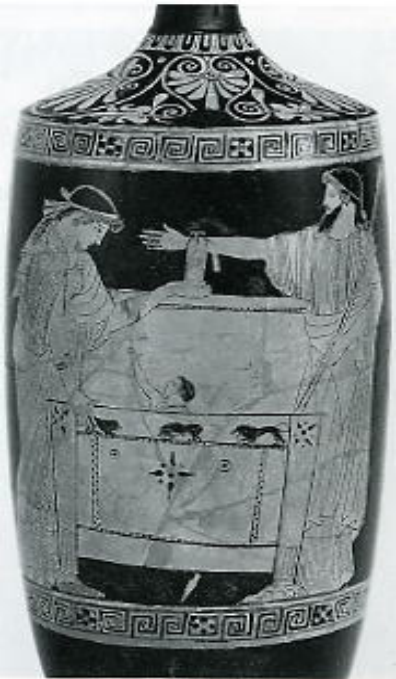
- Danae and Perseus (already in the chest), Acrisius with sceptre. (Textbook p. 550). Note the correspondence between the oil container (Alabastron) and the function of the Lekythos (also a container for oil) on which the scene is painted. There also is a parallel between the placing of an Alabastron in the chest (myth), and the placement of Lekythoi in tombs (as offerings). Red figure Lekythos. C. 450 BC.
- Perfume oils, not sure why emphasis placing bottle in chest. Understood as as comment on what vase does itself. Different type, but also container for perfume. Many used as funerary gifts.






