Database design
A database design is a set of database specifications that can actually be implemented in a specific DBMS product.
DB design = Logical design + some physical design
Three design stages
Conceptual design (conceptual schema)
Logical design (logical schema)
Physical design (physical schema)
Steps for Transforming a
Data Model into a Database Design I
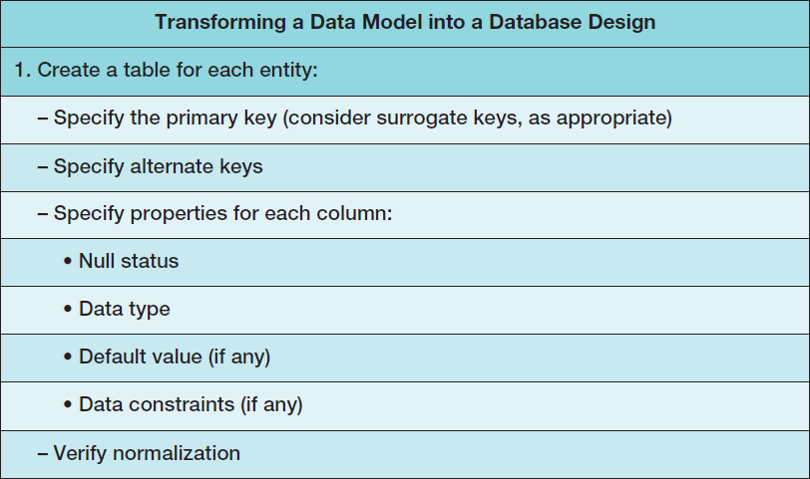
Steps for Transforming a
Data Model into a Database Design II
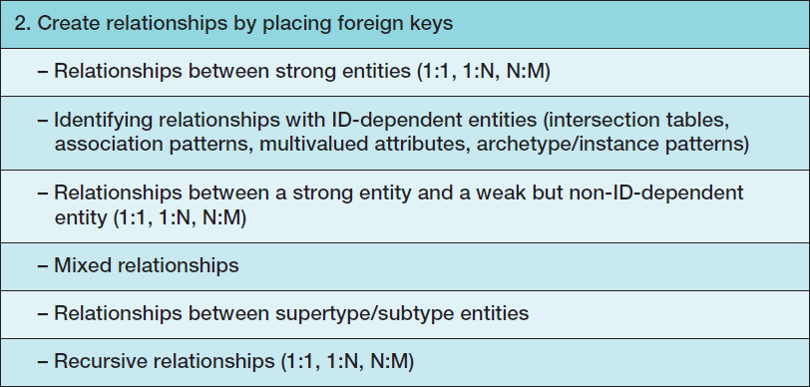
Steps for Transforming a
Data Model into a Database Design III
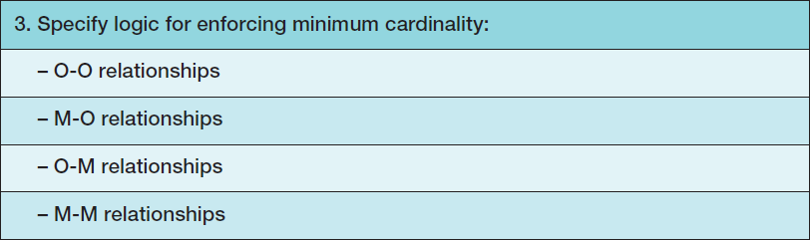
How to select the primary key
- The ideal primary key is short, numeric, and fixed.
- Surrogate keys meet the ideal, but have no meaning to users.
Some database designers take the position that, for consistency, if one table has a surrogate key, all of the tables in the database should have a surrogate key. Others think that such a policy is too rigid; after all, there are good data keys, such as ProductSKU (which would use SKU codes discussed in Chapter 2). If such a key exists, it should be used instead of a surrogate key. Your organization may have standards on this issue that you should follow.
Be aware that DBMS products vary in their support for surrogate keys.
Microsoft Access 2013, Microsoft SQL Server 2014, and MySQL 5.6 provide them.
Microsoft SQL Server 2014 allows the designer to pick the starting value and increment of the key, and MySQL 5.6 allows the designer to pick the starting value.
Oracle’s Oracle Database, however, does not provide direct support for surrogate keys, but you can obtain the essence of them in a rather backhanded way, as discussed in Chapter 10B.
In this book, we use surrogate keys unless there is some strong reason not to. In addition to the advantages described here, the fact that they are fixed simplifies the enforcement of minimum cardinality, as you will learn in the last section of this chapter.
Specify Candidate (Alternate) Keys
- The terms candidate key and alternate key are synonymous.
- Candidate keys are alternate identifiers of unique rows in a table.
- Will use AKn.m notation, where n is the number of the alternate key, and m is the column number in that alternate key.
What NULL means
Null status indicates whether or not the value of the column can be NULL.
Data types
- Generic data types:
- Char(n), Nchar(n)
- Varchar(n), Nvarchar(n)
- Date
- Time
- Integer
- Decimal(m,n)
- Numeric(m,n)
- Money(m,n)
Creata Table Statement
CREATE TABLE Persons
(
P_Id INT NOT NULL,
LastName varchar(255) NOT NULL,
FirstName varchar(255),
Address varchar(255),
City varchar(255) DEFAULT ‘Sandnes’ NULL
);
Data constraints
Data constraints are limitations on data values:
- Domain constraint—column values must be in a given set of specific values.
- Range constraint—column values must be within a given range of values.
- Intrarelation constraint—column values are limited by comparison to values in other columns in the same table.
- Interrelation constraint—column values are limited by comparison to values in other columns in other tables (referential integrity constraints on foreign keys).
DDL Constraints
Constraints can be defined within the CREATE TABLE statement, or they can be added to the table after it is created using the ALTER table statement.
- Five types of constraints:
- PRIMARY KEY may not have null values
- UNIQUE may have null values
- NULL/NOT NULL
- FOREIGN KEY
- CHECK
Create table example
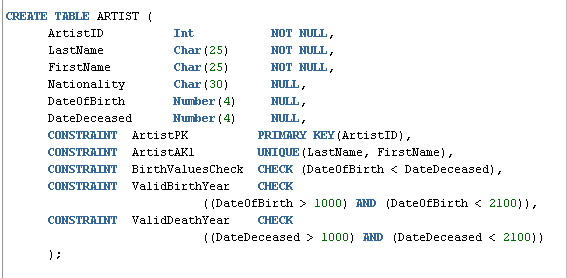

-
Module 01a - History12
-
Module 01b - Components of a Database System9
-
Module 02a - Introduction to SQL8
-
Module 02b - Basic SQL - Part I/II13
-
Module 02b - Basic SQL - Part II/II11
-
Test 1 - Module 115
-
Test 1 - Module 222
-
Module 03a - Dependencies17
-
Module 03b - Normalization12
-
Module 04 - Data Modeling13
-
Module 05a - Relationship and Cardinality21
-
Module 05b - Relationships and Patterns in ER Model11
-
Module 06a - Creating Tables13
-
Module 06b - Creating Relationships7
-
Module 06c - More Constraints14



