08.01 Properties of Water
♣
08.01
Properties of Water
♣
08.01 Properties of Water
What properties of water make it essential to life on earth?
Water has a high specific heat capacity allows maintain stable temperature
- Water and Ice: water takes longer most substances to freeze
- less dense than liquid water - floats
- Ince forms on lakes and rivier on top of water
- organisms in water below
- Perfect Temperatures: water have stable and warm temperatures
- large bodies of water have greater temperature changes between summer and winter months
- Climate Regulator: oceans redistribute heat from solar radiations
08.01 Properties of Water
How does polarity affect the cohesive porperty of water?
Water is polar molecule with strong attraction to other water molecules
- causes water to form hydrogen bonds (O-H): strong
- negative oxygen end and its positive hydrogen end, it acts like a magnet and attracts other molecules around it.
- results surface tension → property of liquids caused by attraction between molecules, less penetrable by solid objects
08.01 Properties of Water
How does the cohension of water and hydrogen bonding affect specific heat capacity?
Cohension: molecules sticking together and being mutually attracted to one another
- more energy break hydrogen bonds
- once broken: molecules collide and shift into another state of matter
- useful to life on earth: Capillary Action
08.01 Properties of Water
What is Capillary Action?
Ability of a liquid to flow in narrow spaces against external forces (like gravity)
08.01 Properties of Water
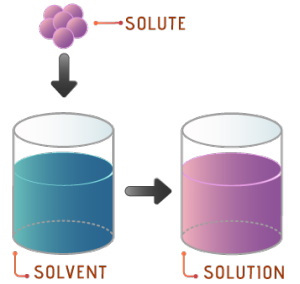
What are solvent and solutes?
Solvent: largest amount
Solute: other
08.01 Properties of Water
What is an aqueous solution?
solutions in which water is the solvent
Whether or not a material will dissolve in another is dependent on the materials’ attraction for each other. The stronger the attraction between solute and solvent particles, the greater the ability for them to mix and dissolve. If a solute can dissolve in a solvent like water, it does so because the attractive forces between the solute and solvent are as strong as, or stronger than, the intermolecular forces between the solute particles and solvent particles individually.
In the case of water, the attraction to another substance like sodium (NaCl) has to be stronger than the hydrogen bonds that form between water molecules.
08.01 Properties of Water
What is a saturated and unsaturated solution?
containing the maximum amount of solute able to be dissolved under the given conditions
Saturation point = dynamic equilibrium
- A solution that has not reached the point of saturation and equilibrium, meaning that more solute can still be added and dissolved, is called an unsaturated solution.
- not dissolved in solvent = insoluble
08.01 Properties of Water
What 4 factors afffect the solubility of a solute?
- Surface Area
- Stirring
- Temperature
- Pressure
08.01 Properties of Water
how does surface area affect solubility?
The greater the number of collisions between the solvent and solute particles, the faster the solute will separate and dissolve in the solvent.
Hence, greater surface area = more collisions
08.01 Properties of Water
how does stirring affect solubility?
Increases the rate at which it dissolves in liquid
- disperses dissolved solute particles - continue dissolve
- Rate dissolving increased
08.01 Properties of Water
How does temperature affect solubility?
Changing temperature is the only factor that changes both the rate of dissolving and the amount of solute able to be dissolved (solubility).
Dissolving a Solid:
- heat increases rate of dissolving and amount of solute can be dissolved
- increased kinetic energy cuases more movement and more collisions
Dissolving a Gas:
- opposite of solids
- Decreases when heat increases
- increaed temperature = more movement = gas encounters surface more frequentyly = escpaing
08.02 Molarity and Dilutions
♣
08.02
Molarity and Dilutions
♣
08.02 Molarity and Dilutions
What are the units of concentration?
Molarity and percent by mass
- Molarity:
the number of moles of solute in one liter of solution
- Percent by mass:
the number of grams of solute in 100 grams of solution
08.02 Molarity and Dilutions
What is molarity as a unit of concentration?
Molarity (M) = (moles of solute (mol)) ÷ (liters of solution (L))
concentration expressed in moles of solute per one liter of solution
08.02 Molarity and Dilutions
What is percent of mass?
Concentration of a solution used in everyday life
- mass of the solute, in grams, would be if we had 100 grams of a solution
- Percent by Mass = [mass of solute (g)] ÷ [mass of solute + mass of solvent (g)] *100
08.02 Molarity and Dilutions
How do you complete stoichiometric calculations using the concentration of a solution?
- What do you know
- What do you need
- Start Stoichiometry calculations
- Use mole ratio from the balanced equation
- Use molarity in the stoichiometry calculations
- Convert to desired units and solve.
08.02 Molarity and Dilutions
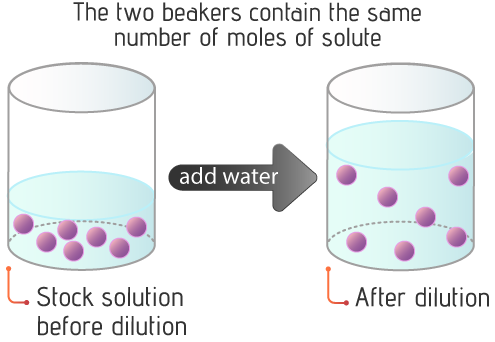
What is dilution?
decrease the concentration of a solution by adding additional solvent
- start with amount of solute →add solvent → until get concentration needed
08.02 Molarity and Dilutions
What is the dilution process?
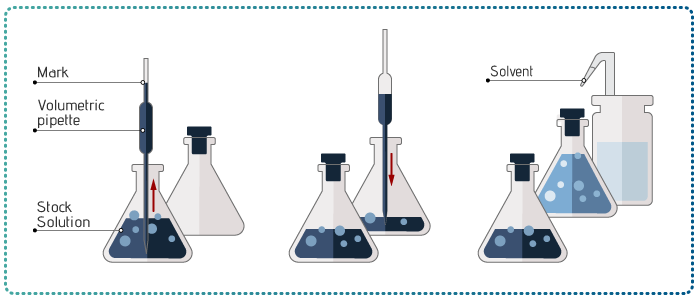
- A volume containing the desired moles of solute is measured from a stock solution of known concentration.
- The measured volume of stock solution is transferred to a second volumetric flask.
- The measured volume in the second flask is then diluted with solvent up to the volumetric mark.
08.02 Molarity and Dilutions
What is the dilused solution equation?
MsVs = MdVd
Ms = the molarity of stock solution
Vs = the volume of stock solution
Md = the molarity of the diluted solution
Vd = the volume of the diluted solution
08.02 Molarity and Dilutions
What is true of an aqueous solution that is 15.0 percent HNO3 by mass? (3 points)
- It contains 15.0 grams of HNO3 per 1.0 liter of water.
- It contains 15.0 grams of HNO3 per 100 grams of solution.
- It contains 15.0 moles of HNO3 per 100 moles of water.
- It contains 15.0 moles of HNO3 per 1.0 liter of solution.
2. It contains 15.0 grams of HNO3 per 100 grams of solution
08.02 Molarity and Dilutions
A 650.0 mL solution contains 125 grams of glucose (C6H12O6). If the molar mass of C6H12O6 is 180.16 g/mol, what is the molarity of this solution? (3 points)
- 0.0106 M C6H12O6
- 0.0195 M C6H12O6
- 1.07 M C6H12O6
- 1.92 M C6H12O6
3. 1.07 M C6H12O6
08.02 Molarity and Dilutions
What volume of 0.550 M KBr solution can you make from 100.0 mL of 2.50 M KBr? (3 points)
- 455 mL
- 576 mL
- 924 mL
- 1,230 mL
1. 455 mL



