- Which of the following amino acids, when deficient, will cause a deficit of catecholamines as part of the sympathetic nervous system response?
a. Tryptophan
b. Histidine
c. Tyrosine
d. Glutamate
c. Tyrosine
Catecholamines (norephinephrine, epinephrine) are derived from tyrosine. The protein amino acids phenylalanine and tyrosine serve as precursors of epinephrine, norepinephrine, and DOPA (dihydroxyphenylalanine). (p19 Harpers)
- Selenium deficiency in the diet, leading to Keshan disease, a condition characterized by heart failure, also impairs the body’s ability to clear free radicals. The amino acid that requires selenium is?
a. Synthesized in the nucleus
b. Produced during translation through modification of cysteine
c. Synthesized in the ribosomes
d. Produced during translation through modification of serine
d. Produced during translation through modification of serine.
Selenocysteine is structurally similar to cysteine; both derived from serine. It has selenium residue instead of sulfur. Impairments in human selenoproteins have been implicated in tumorigenesis and atherosclerosis, and are associated with selenium deficiency cardiomyopathy (Keshan disease). (p286 Harpers)
- Which of the following amino acids will most likely cause akink in a helical peptide?
a. Serine
b. Alanine
c. Proline
d. Cysteine
c. Proline
Proline, owing to its uncanny structure (imino acid), causes it to disrupt helices by introducing folds and kinks.
- Glutathione is a tripeptide composed of the following, EXCEPT?
a. Cysteine
b. Glutamate
c. Methionine
d. Glycine
c. Methionine
Glutathione is a tripeptide that is composed of (Glu-Cys-Gly) Glutamate, Cysteine, and Glycine that participates in the metabolism of xenobiotics and the reduction of disulfide bonds, is linked to cysteine by a non-α peptide bond. (Harper p23)
- In sickle cell anemia, the altered hemoglobin structure has which of the following changes to the amino acids involved?
a. Polar to non-polar
b. Basic to acidic
c. Acidic to basic
d. Non-polar to polar
a. Polar to non-polar
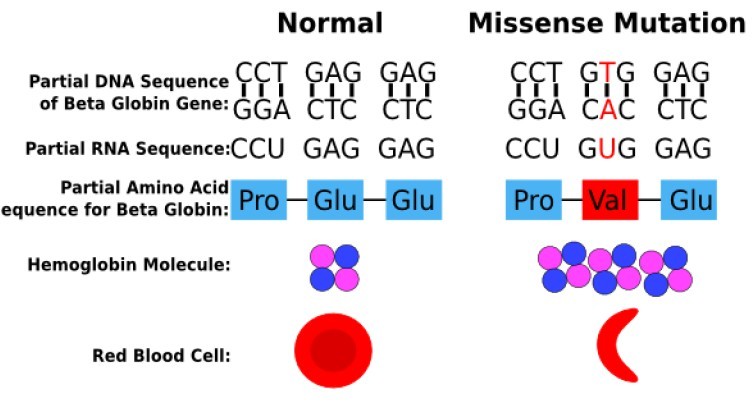
Sickle cell is a disease that results from a substitution of a polar amino acid known as glutamate with a nonpolar one valine at position six of the beta polypeptide unit of hemoglobin. The substitution happens as a result of a change in one of the bases in the beta-globin gene from adenine to thymine. (Harper p417)
- A patient is diagnosed with familial hypercholesterolemia where there is a mutation in the receptors needed for lipoprotein transport and docking into the liver. Which of the following is a most likely outcome?
a. Poor wound healing
b. Hemolytic anemia
c. Decreased plasma lipoproteins
d. Early onset cardiovascular disease
d. Early Onset Cardiovascular Disease
Inherited defects in lipoprotein metabolism lead to the primary condition of either hypo- or hyperlipoproteinemia. For example, familial hypercholesterolemia (FH), causes severe hypercholesterolemia and is also associated with premature atherosclerosis. (Harpers p275)
- Which of the following stabilizes the secondary structure of peptides?
a. Salt bridges
b. Hydrophobic interactions
c. Peptide bonds
d. Hydrogen bonds
d. Hydrogen Bonds
Secondary structures are usually the general conformation or how the peptide is folded. Alpha helices, which is one of the abundant secondary structures for globular proteins, are stabilized by hydrogen bonding between the amide nitrogens and carbonyl carbons of peptide bonds. While for the Beta Sheets, which can be found more prominent in fibrillar proteins, are also being stabilized by hydrogen bonds for folding and alignment.
- A patient with osteogenesis imperfecta has a mutation in the gene encoding for collagen leading to poor bone and soft tissue maturation and development. The resulting collagen protein most likely has an altered?
a. Primary protein structure
b. Secondary protein structure
c. Primary, Secondary, Tertiary, and Quarternary protein structures
d. Tertiary protein structure
c. Primary, Secondary, Tertiary, and Quarternary protein structures
Osteogenesis Imperfecta (brittle bones) is characterized by abnormal fragility of bones. -Exome sequencing has emerged as an alternative to whole genome sequencing as a means for diagnosing rare or cryptic genetic diseases like the osteogenesis imperfecta. -Since it affects the sequencing, it has already affected the protein structure starting from the primary.
- Which of the following amino acids is neutrally charged at physiologic pH?
a. Histidine [Considered correct after revisions]
b. Aspartate
c. Arginine
d. Leucine
a. Histidine (Considered Correct after Revisions) AND d. Leucine
Histidine plays unique roles in enzymatic catalysis. The pKa (6.0) of its imidazole proton permits histidine to function at neutral pH as either a base or an acid catalyst without the need for any environmentally induced shift.
Leucine is an amino acid with aliphatic side chains that is branched and it is a non-polar which makes it a neutrally charged at physiologic pH
- A mutation in the peptide portion of a glycoprotein will most likely impair?
a. Cell-to-cell communication
b. Stability of connective tissue
c. Activation of thyroid hormones
d. Intercellular transport of lipids
a. Cell-to-cell communication
Glycoproteins are covalently associated with carbohydrates and it is functionally active in cell to cell interactions.
- An ion transporter containing 5 sub-units uses which level/s of protein structure?
a. Quaternary only
b. Primary, Secondary, Tertiary, and Quarternary
c. Primary, Secondary and Tertiary only
d. Primary and Secondary only
b. Primary, Secondary, Tertiary, and Quarternary
Many proteins consist of more than one polypeptide chain in their functional states. Each polypeptide chain in such a protein is called a subunit. -All levels of protein structure are used in 5 sub-units ion transporter since polypeptide chain will not be produced when it does not start with the primary protein structure which is responsible for the sequence of the chain. In secondary structure, it is responsible for the folding of the chain. In tertiary structure, it is responsible for the 3-D folding pattern. Then, quaternary structure is the arrangement of subunits and the nature of their interactions.
- A procedure that obliterates disulfide bonds between proteins, as in rebonding of hair, alters which level of protein structure?
a. Primary
b. Secondary
c. Tertiary
d. Both primary and secondary
c. Tertiary
Tertiary protein structures are stabilized by noncovalent and covalent interactions; and some of these are hydrophobic interactions, hydrogen bonds, salt bridges, and disulfide bonds – where the sulfhydryl groups of cysteinyl residues in a tertiary protein are bonded. Any alterations affecting these interactions in particular, like the disulfide bond, will lead to the denaturation of a tertiary protein.
- Which of the following amino acids actively participates in N-linked glycosylation?
a. Asparagine
b. Tyrosine
c. Histidine
d. Serine
a. Asparagine
Glycoproteins are proteins that contain oligosaccharide chains (glycans) covalently bound to amino acids. This bond is formed from a process called glycosylation, which is the enzymatic attachment of sugars, and the linkage can either be O-linked or N-linked.
- Ganglioside GM1 serves as the receptor for the cholera toxin, which is responsible for causing voluminous diarrhea in cholera. To gain entry into intestinal cells, the cholera toxin specifically binds to the
a. Alcohol head group
b. Monosaccharide (glucose or galactose) moiety
c. Oligosaccharide moiety
d. Phosphate group
c. Oligosaccharide
Moiety Gangliosides are glycosphingolipids, which contain sphingosine and sugar residues as well as a fatty acid. GM1, a complex ganglioside, is known to be the receptor in the human intestine for cholera toxin. Merritt et al. (1994) states that cholera toxin (CT) links to the pentasaccharide moiety of ganglioside GM1.
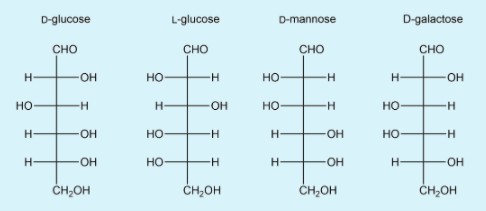
Please refer to the image. Technically, D-mannose and Dgalactose are _____ with respect to each other.
a. Diastereoisomers
b. Enantiomers
c. None of the choices
d. Constitutional Isomers
a. Diastereoisomers
Diastereoisomers are a type of stereoisomer that are not mirror images of each other. This is as opposed to enantiomers, which are non-superimposable mirror images, and constitutional isomers, which differ in the way the components of the molecule are attached and arranged. (Tymoczko, Berg & Stryer, 2015, pg. 168)
- When glycoproteins lose these saccharide residues from their oligosaccharide chains, they are endocytosed by the liver and thus cleared from circulation.
a. Galactose
b. Fucose
c. Sialic acid
d. Mannose e. N-acetylgalactosamine
c. Sialic Acid
“Loss of terminal sialic acid residues accelerates clearance of plasma glycoproteins from the circulation.”
- The following statements regarding glycosaminoglycans are correct, EXCEPT
A. They extend perpendicularly from core proteins of proteoglycans in a bottlebrush-like structure.
B. As a group, they are considered as the heteropolymeric type of polysaccharides.
C. Genetic inability of the body to break them down leads to development of mucopolysaccharidoses.
D. An example would be a repeating disaccharide unit containing neuraminic acid and galactosamine.
d. An example would be a repeating disaccharide unit containing neuraminic acid and galactosamine.
This choice is incorrect, as the structure of a glycosaminoglycan consists of a repeating disaccharide unit containing an amino sugar and uronic acid. Reference: Module 1A.5 Carbohydrates of Physiological Significance PDF, Page 11
- Medications such as Ibuprofen (Advil) and Mefenamic acid (Dolfenal) work by inhibiting or preventing the production of prostaglandins, eicosanoids responsible for mediating pain and inflammation. Which of the following enzymes is the most likely target of these drugs for inhibition?
a. Cyclooxygenase
b. Phosphodiesterase
c. Nucleotide cyclase
d. Lipoxygenase
a. Cyclooxygenase
Indomethacin and ibuprofen inhibit cyclooxygenases by competing with arachidonate. (Rodwell, Bender, Botham & Kennelly, 2018, pg. 226) Reference: Rodwell, V. W., Bender, D. A., Botham, K. M, Kennelly, P. J. & Weil, P. A. (2018). Harper’s illustrated biochemistry [31st ed.]. McGraw-Hill Education.
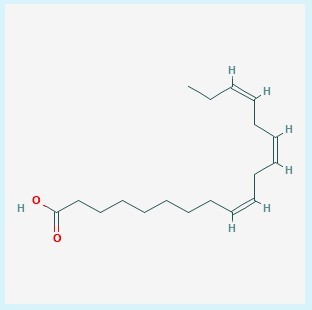
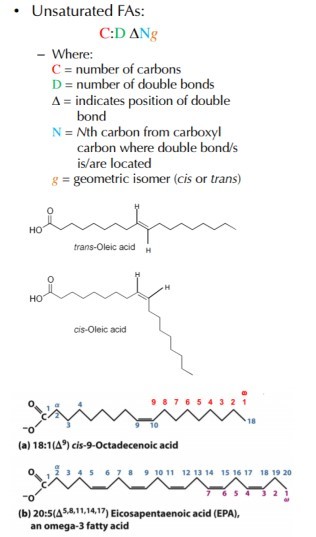
- Which of the following is the most appropriate nomenclature for alpha-linoleic acid? Examine the image carefully!
a. Omega-9 PUFA
b. 18:3 (Δ 9,12,15)all-cis
c. 18:3 (Δ 9,12,15)all-trans
d. Omega-3 MUFA
e. 20:4 (Δ 1,9,12,15)all-cis
b. 18:3 (Δ 9,12,15)all-cis
Carbon atoms are counted from the carboxyl carbon (C-1). Succeeding carbons C-2, C-3, and C-4 are also known as ⍺, 𝛽, and 𝛾 carbons. DΔN denotes the number of double bonds (D) and position (N) from the carboxyl carbon (C-1). Trans isomers have hydrogen on opposite side; cis isomers have hydrogen bonds on the same side. Structure shows an 18-carbon fatty acid with 3 double bonds located at the 9th, 12th, and 15th carbon from C-1 all in the cis formation (18:3Δ9,12,15)-all cis. Reference: Dr. Van Haute - Lecture on Carbohydrates and Lipids of Physiologic Significance (Part 3)
- The straight-chain form of a monosaccharide derivative will be unable to cyclize if
a. At least one of the parent monosaccharide’s hydroxyl groups is replaced by a hydrogen.
b. When a hydroxyl group of a parent monosaccharide has been replaced with an amino group.
c. The carbonyl group of the parent monosaccharide’s aldose or ketose is reduced to an alcohol.
d. When there is one carboxyl group on each end of the straight-chain monosaccharide.
c. The carbonyl group of the parent monosaccharide’s aldose or ketose is reduced to an alcohol.
Cyclic structures are formed by the reaction between the aldehyde or ketone group with an alcohol. Loss of aldehyde or ketone by reduction prevents cyclization. (Tymoczko, Berg, and Stryer, 2015, pg. 169-170) Reference: Tymoczko, J. L., Berg, J. M., & Stryer, L. (2015). Biochemistry: A short course (p. 169-170). New York: W.H. Freeman & Company.
- Which of the following occurs during the cyclization of a linear fructose molecule?
a. A ketal is formed following a nucleophilic attack on the hemiketal group by a hydroxyl group from another monosaccharide.
b. Two forms that are non-superimposable mirror images of each other emerge in solution at equilibrium.
c. A hemiacetal is formed following a nucleophilic attack on the ketone group by a hydroxyl group on the same molecule.
d. A hemiketal is formed following a nucleophilic attack on the aldehyde group by a hydroxyl group on the same molecule.
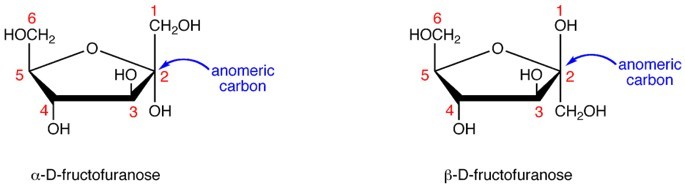
e. A new asymmetric carbon is designated, with two anomeric forms of the molecule emerging at equilibrium.
e. A new asymmetric carbon is designated, with two anomeric forms of the molecule emerging at equilibrium.
Anomers are isomers that differ at a new asymmetric carbon atom formed on ring closure. Furanose-ring of fructose has anomeric forms ⍺ and 𝛽 at the anomeric carbon C2 (see image below). These two structures are present at equilibrium. (Tymoczko, Berg, and Stryer, 2015, pg. 170) Reference: Tymoczko, J. L., Berg, J. M., & Stryer, L. (2015). Biochemistry: A short course (p. 170). New York: W.H. Freeman & Company.
- Which of the following carbohydrates would not be able to lose its electrons to oxidize another chemical species?
- Sucrose
- Lactose
- Fructose
- Galactose
- Glucose
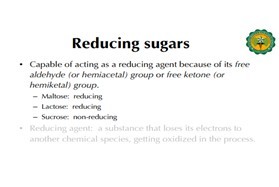
a. Sucrose
Reducing agents are capable of reducing its electrons to oxidize another chemical species. Since sucrose is a non-reducing sugar, it may not perform such function. Reference: Handout 1 Carbohydrate and Lipid Chemistry, Module 1A, Dr. Van Haute’s Lecture
- Compared with palmitic acid (16:0), oleic acid (18:1 Δ 9 cis) has a lower melting point because oleic acid has
- a kink produced by the double bond.
- a longer hydrocarbon chain.
- a trans-double bond at carbon 9.
- a more saturated chain.
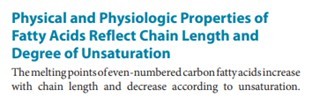
a. a kink produced by the double bond.
Oleic acid contains a double bond, hence making it an unsaturated fatty acid. Melting point of fatty acids decreases/lowers because of this double bond, which produces a kink in the chain. Reference: Rodwell, V., Bender, D., Botham, K., Kennelly, P., & Weil, A. P. (2015b). Harper’s Illustrated Biochemistry (30th ed., p. 213). McGraw-Hill Education / Medical.
- A medication called Montelukast (brand name, Singulair) antagonizes or blocks the leukotrienes responsible for bronchoconstriction (narrowing of the airways) during asthmatic attacks. Leukotrienes are eicosanoids derived specifically from which of the following? Choose the best answer.
- Eicosapolyenoic acid
- Arachidonic acid
- Ceramide
- Phosphatidylinositol
b. Arachidonic Acid
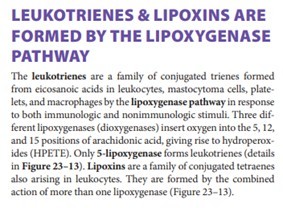
Leukotrienes are derived from arachidonic acid through the lipoxygenase pathway. Reference: Rodwell, V., Bender, D., Botham, K., Kennelly, P., & Weil, A. P. (2015b). Harper’s Illustrated Biochemistry (30th ed., p. 240). McGraw-Hill Education / Medical.