Marketing Program
- Strategic combination of four marketing mix elements (product, price, distribution or place, and promotion)
- Aimed at maximizing tangible, intangible, and perceptual attributes of a complete offering
- Commoditization
- Core product is incapable of differentiating the offering from that of the competition - Given the state of commoditization in many markets, the core product (the element that satisfies the basic customer need) typically becomes incapable of differentiating the offering from those of the competition.
- Most organizations try to enhance the service and symbolic elements of their offerings by changing price, distribution, or promotion
The best marketing strategy is likely to be one that combines the product, price, distribution, and promotion elements in a way that maximizes the tangible, intangible, and perceptual attributes of the complete offering. Therefore, the best marketing strategy considers all four elements of the marketing program and the offering rather than emphasizes a single element.
Product Strategy
- Most critical strategic decision in a marketing plan
- Involves design, development, branding, and positioning decisions
- Real value of offerings
- Ability to deliver benefits that enhance customer’s situation or solves a customer’s problems - For example, customers do not purchase pest control; they puchase a bugfree environment. BMW customers do not purchase a car; they purchase luxury, status, comfort, and social appeal.
- Products fall into two general categories
- Consumer products - For personal use and enjoyment
- Business products - For resale, use in making other products, or use in firm’s operations - For example, companies do not need computers; they need to store, retrieve, distribute, network, and analyze data and information for their operations.
Types of Consumer Products
- Convenience products - Soft drinks, candy and gum, gasoline, dry cleaning - Inexpensive, routinely purchased products that consumers spend little time and effort in acquiring.
- Shopping products – Appliances, furniture, clothing, vacations - Products that onsumers will spend time and effort to obtain. Consumers shop different options to compare prices, features, and service.
- Speciality products – Antiques, sports memorabilia, plastic surgery, luxury items - Unique, one-of-a-kind products that consumers will spend considerable time, effort, and money to acquire.
- Unsought products - Emergency medicine, repair services, insurance - Products that consumers are unaware of or a finished product that consumers do not consider purchasing until a need arises.
Types of Business Products
- Business products
- Raw materials - Iron ore, chemicals, agricultural products, wood pulp
- Component parts - Spark plugs, computer chips, pane glass, hard drives
- Process materials - Food additives, wood sealants, paint colorings
- Maintenance, repair, and operating products – Furniture, building security, janitorial services
- Installations - Enterprise software, buildings, heat and air systems
- Business services - Legal services, accounting services, consulting, research services
Business products
Raw materials: basic natural materials that become part of a finished product. They are purchased in very large quantities based on specifications or grades.
Component parts: finished items that become part of a larger finished product. They are purchased based on specifications or industry standards.
Process materials: finished products that become unidentifiable upon their inclusion in the finished product.
Maintenance, repair, and operating products: products that are used in business processes or operations but do not become part of the finished product.
Installations: major purchases, typically of a physical nature, that are based on customized solutions including installation/construction, training, financing, maintenance, and repair.
Business services: intangible products that support business operations. These purchases often occur as a part of outsourcing decisions.
Product line
Group of closely related product items
Product mix or portfolio
Total group of products offered by the firm
Critical strategic decisions
- Width or variety of product mix, which refers to the number of product lines offered
- Assortment or depth of each product line
Critical strategic decisions:
(1) by offering a wide variety of product lines, the firm can diversify its risk across a portfolio of product offerings. Also, a wide product mix can be used to capitalize on the strength and reputation of the firm;
(2) Firms can attract a wide range of customers and market segments by offering a deep assortment of products in a specific line. Each brand or product in the assortment can be used to fulfill different customer needs (e.g., Hilton, Inc.: Hilton, Hilton Garden Inn, Hampton Inn, Conrad, and Embassy Suits).
The Product Portfolio
- Product line
- Group of closely related product items
- Product mix or portfolio
- Total group of products offered by the firm
- Critical strategic decisions
- Width or variety of product mix, which refers to the number of product lines offered
- Assortment or depth of each product line
Most firms sell a variety of products to fulfill a variety of different needs. The products sold by a firm can be described with respect to product lines and product mix or portfolio. A product line consists of a group of closely related product items. For example, Proctor & Gamble sells a number of famous brands in its Fabric and Home Care line, including Tide, Dawn, and Cascade.
A firm’s product mix or portfolio is the total group of products offered by the company. For example, Proctor & Gamble’s entire product mix consists of Beauty, Hair, and Personal Care product; Baby, Feminine, and Family Care products; and Health and Grooming products in addition to the products in its Fabric and Home Care line.
Critical strategic decisions:
(1) by offering a wide variety of product lines, the firm can diversify its risk across a portfolio of product offerings. Also, a wide product mix can be used to capitalize on the strength and reputation of the firm;
(2) Firms can attract a wide range of customers and market segments by offering a deep assortment of products in a specific line. Each brand or product in the assortment can be used to fulfill different customer needs (e.g., Hilton, Inc.: Hilton, Hilton Garden Inn, Hampton Inn, Conrad, and Embassy Suits).
Potential Benefits of Offering a Large Product Portfolio
- Economies of scale
- Offering many different product lines can create economies of scale in production, bulk buying, and promotion.
- Package uniformity
- All packages in a product line have the same look and feel.
- Standardization
- Product lines can use the same component parts.
- Sales and distribution efficiency
- Sales personnel can offer a full range of choices and options to customers.
- Equivalent quality beliefs
- Customers expect and believe that all products in a line are equal in terms of quality and performance.
Although offering a large portfolio of products can make the coordination of marketing activities more challenging and expensive, it also creates the above important benefits.
Unique Characteristics of Services and Resulting Marketing Challenges
- Intangibility
- Simultaneous production and consumption
- Perishability
- Heterogeneity
- Client-based relationships
It is important to remember that products can be intangible services and ideas as well as tangible goods. Service firms (e.g., hotels, hospitals, hair stylists, nonprofit organizations, governmental agencies) develop and implement marketing strategies designed to match their portfolio of intangible products to the needs of target markets. Here are five unique characteristics of services and resulting marketing challenges:
- Intangibility: (1) it is difficult for customers to evaluate quality, especially before purchase and consumption; (2) it is difficult to convey service characteristics and benefits in promotion. As a result, the firm is forced to sell a promise; (3) many services have few standardized units of measurement. Therefore, service prices are difficult to set and justify.
- Simultaneous production and consumption: (1) customers or their possessions must be present during service delivery; (2) other customers can affect service outcomes including service quality and customer satisfaction; (3) service employees are critical because they must interact with customers to deliver service; (4) converting high-contact services to low-contact services will lower costs but may reduce service quality.
- Perishability: (1) services cannot be inventoried for later use. Therefore, unused service capacity is lost forever (unsold hotel room and flight seat); (2) service demand is very time-and-place sensitive. As a result, it is difficult to balance supply and demand, especially during periods of peak demand; (3) service facilities and equipment sit idle during periods of off-peak demand.
- Heterogeneity: (1) service quality varies across people, time, and place, making it very difficult to delivery good service consistently; (2) there are limited opportunities to standardize service delivery; (3) many services are customized by nature. However, customization can dramatically increase the costs of providing the service.
- Client-based relationships: (1) most services live or die by maintaining a satisfied clientele over the long term; (2) generating repeat business is crucial for the service firm’s success.
Developing New Products
- Crucial to a firm’s effort to sustain growth and profits
- Factors affecting sales potential of new product
- Firm’s ability to create differential advantage
- Market characteristics
- Defined market opportunity
- Customer perception
The development and commercialization of new products is a vital part of a firm’s efforts to sustain growth and profits over time. The success of new products depends on the product’s fit with the firm’s strengths and a defined market opportunity. Market characteristics and the competitive situation will also affect the sales potential of new products.
For example, GPS manufacturers are consistently developing new GPS devices. However, the future of standalone GPS devices is unclear given that GPS functionality is now an option on most new cars and is fully integrated into every smartphone. As these GPS-enabled devices add more features, consumers are going to be much less likely to purchase standalone GPS units. This is why many GPS units can now sync with telephones or serve as music players. Garmin has expanded beyond GPS devices into areas such as wearables, action cameras, and smartphone apps.
Strategic Options Related to Newness of a Product
- New-to-the-world products (discontinuous innovations)
- Involve a pioneering effort by a firm that eventually leads to the creation of an entirely new market.
- New product lines
- Represent new offerings by the firm, but the firm introduces them into established markets.
- Product line extensions
- Supplement an existing product line with new styles, models, features, or flavors.
- Improvements or revisions of existing products
- Offer customers improved performance or greater perceived value.
- Repositioning
- Involves targeting existing products at new markets or segments.
- Cost reductions
- Involves modifying products to offer performance similar to competing products at a lower price.
Many firms base their new product introductions on key themes such as product or technological superiority. Also, in other firms and industries, new product introductions may stem from only minor tweaking of current products. This approach is common in packaged goods and household items. Truthfully, what is considered to be a new product depends on the point of view of both the firm and its customers. Although some product introductions are actually new, others may only be perceived as being new. The above six strategic options related to the newness of products.
New Product Development Process
- Idea generation: new product ideas can be obtained from a number of sources, including customers, employees, basic research, competitors, and supply chain partners.
- Screening and evaluation: new product ideas are screened for their match with the firm’s capabilities and the degree to which they meet customers’ needs and wants.
- Development: at this stage, product specifications are set, the product design is finalized, and initial production begins.
- Test marketing: as a final test before launch, the new product is test marketed in either real or simulated situations to determine its performance relative to customer needs and competing products.
- Commercialization: in this final stage, the product is launched with a complete marketing program designed to stimulate customer awareness and acceptance of the new product.
Although the new product development process varies across firms, most firms will go through the above stages (from idea generation to commercialization through screening and evaluation, development, and test marketing).
Importance of a Pricing Strategy
- Relation to revenue equation (revenue = price × quantity sold)
- Easily changeable marketing variable
- Important consideration in competitive intelligence
- Only real means of differentiation in highly commoditized markets
There is no other component of the marketing program that firms become more infatuated with than pricing. There are at least four reasons for this attention:
- There are only two ways for a firm to grow revenue: increase prices or increase the volume of product sold.
- Pricing is the easiest of all marketing variables to change.
- Firms take considerable pains to discover and anticipate the pricing strategies and tactics of other firms.
- Price is considered to be one of the few ways to differentiate a product in commoditized and mature markets.
Issues in Pricing Strategy: Using the Firm’s Cost Structure
•Breakeven in units
Total Fixed Costs
Unit Price – Unit Variable Costs
•Selling price
Average Unit Cost
1 – Markup Percent (decimal)
A firm that fails to cover both its direct costs (e.g., finished goods/components, materials, supplies, sales commission, transportation) and its indirect costs (e.g., administrative expenses, utilities, rent) will not make a profit. A popular way to associate costs and prices is through breakeven pricing as indicated above.
Cost-plus pricing is another strategy that is commonly used in retailing. As indicated above, the firm sets prices based on average unit costs and its planned markup percentage.
However, a firm’s cost structure should not be the driving force behind pricing strategy because different firms have different cost structures.
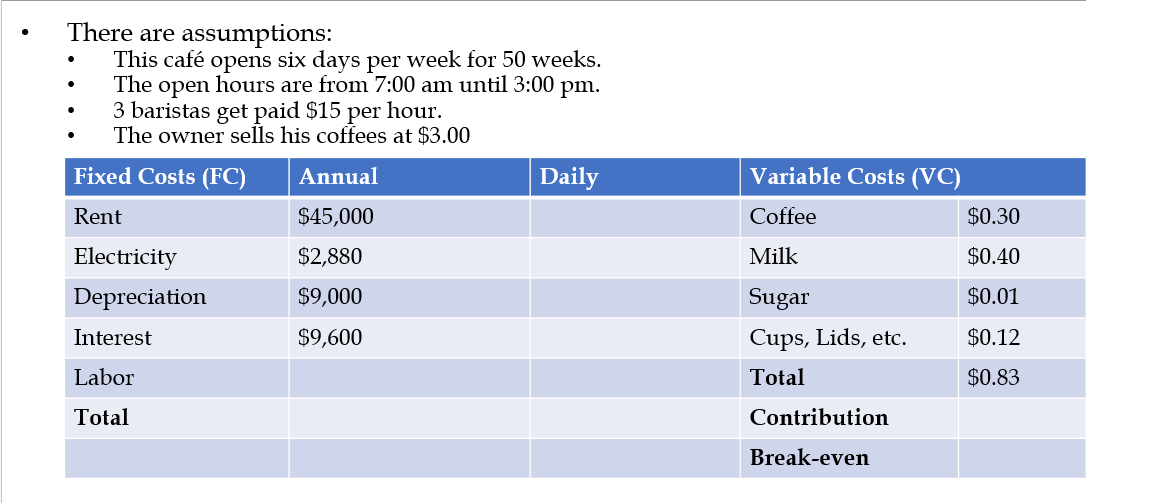
A Simple Example of a Break-Even Analysis
(See slide 14 and 15)
- There are assumptions:
- This café opens six days per week for 50 weeks.
- The open hours are from 7:00 am until 3:00 pm.
- 3 baristas get paid $15 per hour.
- The owner sells his coffees at $3.00
Issues in Pricing Strategy: Perceived Value
- Value
- Customer’s subjective evaluation of benefits relative to costs
- Helps determine worth of a firm’s product-offering relative to other product offerings
- Intricately tied to all marketing program elements
- Key factor in customer satisfaction and retention
- Customer benefits
- Everything customers obtain from an offering
- Customer costs
- Everything the customer must give up
Value can be defined as a customer’s subjective evaluation of benefits relative to costs to determine the worth of a firm’s product offering relative to other product offerings. A simple formula: Perceived Value = Customer Benefits / Customer Costs
Value is a key component in setting a viable pricing strategy. In fact, value is intricately tied to every element in the marketing program and is a key factor in customer satisfaction and retention.
Issues in Pricing Strategy: Price/Revenue Relationship
- Myth #1 - When business is good, a price cut will capture greater market share
- Myth #2 - When business is bad, a price cut will stimulate sales
- Price cutting should be offset by increase in sales volume to maintain revenue level
- To stimulate sales and revenue, build value into the product offering at the same, or even a higher price
Virtually all firms face intense price competition from their rivals, which tends to hold prices down. Although it is natural for firms to see price-cutting as a viable means of increasing sales, all price cuts affect the firm’s bottom line. There are two general pricing myths:
- Myth #1: When business is good, a price cut will capture greater market share.
- Myth #2: When business is bad, a price cut will stimulate sales.
However, the reality is that any price cut must be offset by an increase in sales volume just to maintain the same level of revenue. It is often better for a firm to find ways to build value into the product and justify the current price, or even a higher price, rather than cut the price.
Description of Common Pricing Objectives
- Profit-oriented: designed to maximize price relative to competitors’ prices, the product’s perceived value, the firm’s cost structure, and production efficiency. Profit objectives are typically based on a target return, rather than simple profit maximization.
- Volume-oriented: sets prices to maximize dollar or unit sales volume. This objective sacrifices profit margin in favor of high product turnover.
- Market demand: sets prices in accordance with customer expectations and specific buying situations. This objective is often known as “charging what the market will bear.”
- Market share: designed to increase or maintain market share regardless of fluctuations in industry sales. Market share objectives are often used in the maturity stage of the product life cycle.
- Cash flow: designed to maximize the recovery of cash as quickly as possible. This objective is useful when a firm has a cash emergency or when the product life cycle is expected to be quite short.
- Competitive matching: designed to match or beat competitors’ prices. The goal is to maintain the perception of good value relative to the competition.
- Prestige: sets high prices that are consistent with a prestige of high-status product. Prices are set with little regard for the firm’s cost structure or the competition.
- Status quo: maintains current prices in an effort to sustain a position relative to the competition.
Pricing objectives must be realistic, measurable, and attainable. Firms make money on profit margin, volume, or some combination of the two. A firm’s pricing objectives will always reflect this market reality. A firm’s pricing objectives will always reflect this market reality.
Profit-oriented pricing objective
designed to maximize price relative to competitors’ prices, the product’s perceived value, the firm’s cost structure, and production efficiency. Profit objectives are typically based on a target return, rather than simple profit maximization.
Volume oriented pricing objective
sets prices to maximize dollar or unit sales volume. This objective sacrifices profit margin in favor of high product turnover.
Market demand pricing objective
sets prices in accordance with customer expectations and specific buying situations. This objective is often known as “charging what the market will bear.”
Market share pricing objective
designed to increase or maintain market share regardless of fluctuations in industry sales. Market share objectives are often used in the maturity stage of the product life cycle.
Cash flow pricing objective
designed to maximize the recovery of cash as quickly as possible. This objective is useful when a firm has a cash emergency or when the product life cycle is expected to be quite short.




