3 Different Stages of Motor Learning
- Cognitive Stage
- Associative Stage
- Autonomous Stage
Cognitive Stage
Cognitive=Thinking about it the most
- What do I do?
- “Trial and Error” stage with several
mistakes and the lack of coordination.
- Patient NEEDS visual cues.
- Demonstrating the task is most effective
- Cognitive demands are high
- High frustration potential
*Questions like: “Pt is being instructed…” means they are in the cognitive stage. They need DEMONSTRATION
Associative Stage
- How do I do it?
- Known as the “practice or
adjustment phase”
- Patient needs to FEEL IT
- kinesthetic learning
(proprioception), intrinsic and
extrinsic feedback
Autonomous Stage
- How Do I Master It
- Known as the “fine-tuning phase”
- Patient able to self-correct and
movements are habitual with little
cognitive efforts
What is Retention?
• Ability of the learner to
demonstrate skill over time
after a period of NO practice
What is Acquisition?
• Ability of the learner to
demonstrate the skill
What are the two different types of feedback?
Internal (Inherent) and External (Augmented)
What subcategories are a part of the two feedbacks?
- Internal (Inherent)-
- Proprioception
- Visual
- Vestibular
- Cutaneous (stretching)
- External feedback-
(Augmented)
- Visual
- Auditory
- Tactile (touching)
What is Knowledge of Results?
Feedback given about the end result
related to a goal that was set.
Wheelchair to edge of bed (EOB)
transfer within 5 seconds using
stand-pivot transfer (GOAL)
• “Mr. Larry that took us 6.5 seconds
to complete that transfer”
(FEEDBACK)
*Like a time in a swim meet
Knowledge of Results-Bandwidth
Feedback given only when performance
deviates outside of pre-determined error
ranges
Example
• While ambulating, patient rotates trunk
to wrong side when taking a step.
• Not an acceptable error as it
creates a bad movement pattern
and increased risk for falls.
*“Stay within your bandwidth”
What is Knowledge of Performance?
• Feedback given about the quality of the
movements produced DURING the
performance.
Example
• The task is to perform 10 sit to stand
transfers (GOAL)
• Mr. Larry you are doing the sit to stand
transfers correctly, but I noticed that you
attempting to stand straight up without
any momentum. We can improve your
sit to stand speed by making sure that
you use momentum by bringing your
“nose over your toes”
How do we prescribe practice?
- Practice time
- Variability of
practice
- Practice Order
- Practice
Environment
• Part to whole
practice
Practice Time-What is massed practice?
- Rest time < Practice time
- Fatigue
- Decreased performance
- Risk of injury
Practice Time-What is distributed practice?
- Rest time >/= Practice time
- Slower acquisition but significant retention
*Better for people with PD or neurological pathologies that fatigue easily
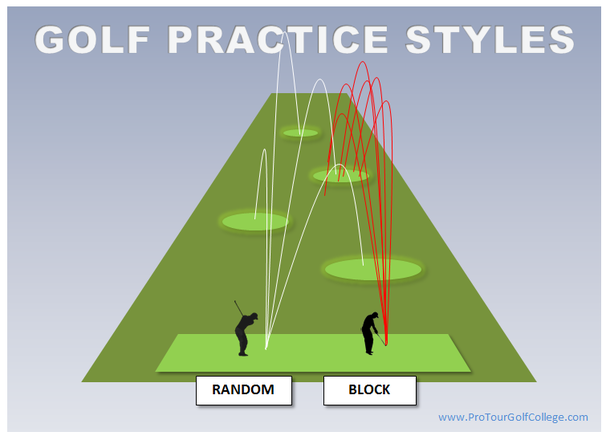
Practice Variability-Blocked Practice
- Performing only the one task
- Example, WC to EOB only, over and over
- Benefits
- Superior skill acquisition / better initial
performance
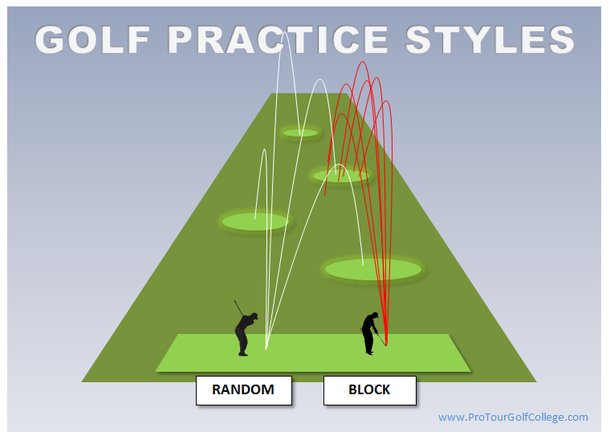
Practice Variability-Randomized Practice
- Performing different tasks in random order
- Example, WC to EOB, WC to bathtub, EOB to Floor
- Benefits
- Superior long term effects on retention
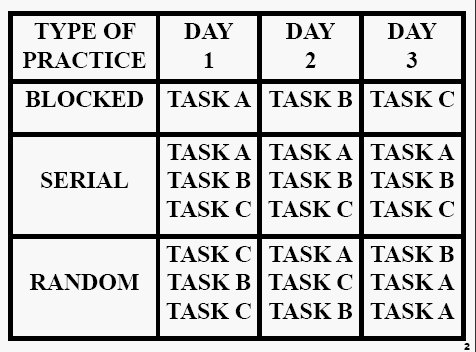
Practice Order-Blocked
- Repeated practice of a task or group of tasks in order
- WC to EOB x3, EOB to floor x 3, Floor to WC x 3
- Same session
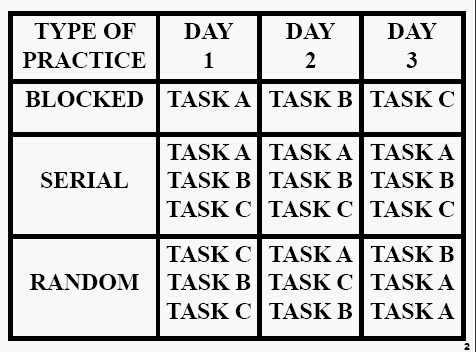
Practice Order-Serial Order
- Serial Order (improved retention / generalizability)
- Predictable and repeated order of multiple tasks
- WC to EOB x1, EOB to floor x1, Floor to WC x1 then repeat
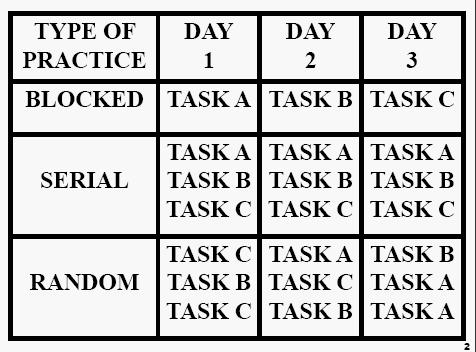
Practice Order-Random Order
- Random Order (improved retention / generalizability)
- Non-repeating, non-predictable order
- 132312321
What are the 2 types of environments?
Closed Environment-
• Enclosed environment with minimal
distractions including noise, colors,
lighting, people, objects etc.
- Improved skill acquisition
- Delayed Retention
Open Environment-
• An environment with multiple
distractors such as people, objects,
changing ambient lighting, and noise.
- Delayed skill acquisition
- Improved long term retention and
generalizability
What is Part Training?
- Part Training
- Breaking up a complex motor task into
independent parts to be practiced
individually.
• WC to Bed transfer
What is Whole Training?
- Whole Training
- Practicing the entire task at one time
and is typically used for continuous
tasks with highly integrated parts.
• Walking
When in the cognitive stage…
- Patient relies on: Vision and Demonstration
- Patient needs: Guidance, Direction to pay
attention to critical details of task
• Feedback that should be given: KR and KRbandwidth
mostly with KP intermittently and
provided after every trial early f/b faded
• Remember to: Point out similarities to
learned tasks (lead up tasks)
• What environment types: Closed
environments
- What practice time: Distributed practice
- What type of practice: Blocked practice
- What practice order, : Blocked f/b serial and
random
• Part or Whole training: Part training followed
by whole if possible
When in the associative stage…
Patient relies on: Proprioception and
Introspection “feeling the movement”
• Patient needs: less augmented feedback and
more practice
• Feedback that should be given: Use both KR and
KP, but limit use only providing necessary
feedback to improve performance/avoid faulty
movement patterns
• Remember to: Intervene only when necessary
during the task and rarely facilitate and guide
movements because it may be counterproductive
• What environment types: Closed environments
with progression to open
• What practice time: Distributed practice as
needed
- What type of practice: Random practice
- What practice order, : Variable practice order,
serial and random
• Part or Whole training: Part training as needed,
focus on whole if possible



