Structure of the K+ channel
a) Dimer
b) Trimer
c) Tetramer
d) Pentamer
c)Tetramer
How can we explain the saturation of ion-channel throughput rates at high ion concentrations?
A. By an active transport mechanism
B. At high ion concentrations the throughput rate becomes diffusion limited
C. By passive diffusion through a cylindrical hole
D. The pore contains binding sites for the permeant ion; at high ion concentrations the off-rate of the ion from its binding site becomes rate limiting
E. None of the above provides an explanation
B. At high ion concentrations the throughput rate becomes diffusion limited
Which of the following statements are true for ion-channel gating?
- Gating is a stochastic process
- Gating is a deterministic process
- Rate constants describe the probabilities of transition between stable open and closed conformations
- Gating schemes describe well the kinetics of ionic currents of the whole cell membrane
- Gating schemes are only useful for describing kinetics of single ion channels
A: 2,4
B. 1,3,5
C. 1,3,4
D. 3,4
E. 5
C: 1,3,4
Which statements are true?
- At normal [Na+]e.c. and [K+]i.c. the activity of the Na,K ATPase is less than 15% of its maximal activity
- When action potential is formed, the activity of the Na,K ATPase increases 25 fold
- Corticosteroids decrease the expression of Na,K ATPase in the kidney
- Dopamine activates the Na,K ATPase in the kidney
- Epinephrine activates the Na,K ATPase in the skeletal muscle
A. 1,2,3 B. 1,2,4
C. 2,4,5 D. 3,4,5
E. 1,2,5
E. 1,2,5
Which hormones/neurotransmitters stimulate the activity of the Na,K-ATPase in a tissue-specific manner?
- Dopamine
- Norepinephrine
- Insulin
- Aldosterone
- Epinephrine
A: 1,2,3,4 B: 2,3,4,5
C: 1,3,4 D: 1,2,4,5
E: All
B: 2,3,4,5
(Dopamine, as far as I know, does not ever stimulate but only inhibits Na,K-ATPase. This is another hard one to answer confidently)
Which statements are valid for the Na+-H+ exchanger?
- Due to its action the pH in the cells is higher than the extracellular pH
- It pumps Na+ and H+ against their electrochemical gradient
- Its inhibiton diminishes the resting membrane potential
- It takes part in the maintenance of pH gradient between the vesicles and the cytoplasm
- Its action results in decreased sodium reabsorption in the kidney
A: 1,2,4 B: 1,4,5
C: 2,3,4 D: 2,4,5
E: none
E: none
Which of the statements are valid?
- Choline is formed from acetylcholine by choline acetyltransferase
- The choline uptake is mediated by the so-called “low-affinity choline transporter”
- Na+-cotransporters inactive acetylcholine in cholinergic synapses
- The uptake of acetylcholine into the synaptic vesicles is an ATP-dependent process
- Acetylcholine esterase can be inhibited by atropine
A: 1,2,4 B: 2,3,5
C: 2,4 D: 1,3,4
E: 2,5
C: 2,4
(1, 3, and 5 are definitely false, and 4 is definitely true, so process of elimination leads to this answer. On choline uptake affinity transporters, the slides say the low affinity ones are in all tissues, but the high affinity ones are only in cholinergic neurons)
Which of the following factors has no role in the cellular effects of muscarinic receptor activation?
A. Increase of intracellular Ca2+ concentration
B. Activation of phospholipase C
C. Na+ uptake
D. Activation of K+ channel
E. Activation of G protein
C. Na+ uptake
Which of the listed interrelations are valid for the following 2 statements:
- Dopamine beta hydroxylase is localized in the vesicles of noradrenergic axon terminals
- Dopamine is formed in the synaptic vesicles
A. Statements 1 and 2 are both valid, and 2 is the consequence of 1
B. Statements 1 and 2 are both valid, but there is no causative relation between them
C. Statement 1 is valid, but statement 2 is not
D. Statement 2 is valid, but statement 1 is not
E. Neither statement is valid
C. Statement 1 is valid, but statement 2 is not
(NE is formed in the vesicles, not dopamine)
Which of the following listed interrelations are valid for the following two statements:
- Monoamine oxidase is localized in the outer mitochondrial membrane
- Deprenyl inhibits monoamine oxidase
A. Statements 1 and 2 are both valid, and 2 is the consequence of 1
B. Statements 1 and 2 are both valid, but there is no causative relation between them
C. Statement 1 is valid, but statement 2 is not
D. Statement 2 is valid, but statement 1 is not
E. Neither statement is valid
B. Statements 1 and 2 are both valid, but there is no causative relation between them
(presumably this is the answer, unless there’s something more complicated about the mechanism of deprenyl that they didn’t explain where it only works bc MAO is in the outer mitochondrial membrane. it’s a shitty question)
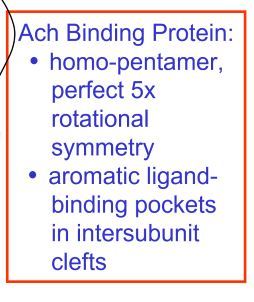
Which statements are true concerning the nicotinic acetylcholine receptor channel?
- The channel is a homopentamer, its dysfunction can lead to myasthenia
- The channel is a heteropentamer, its dysfunction can lead to myasthenia
- The channel is a tetramer, its dysfunction can lead to myotonia
- The ligand-binding domain is a 4-fold symmetrical gating ring
- The ligand-binding domain is a 5-fold symmetrical ring
A. 1,5 B: 2,5
C: 3,4 D: 1
E: 2
B: 2,5
(PROBABLY this answer anyway, this is according to questions asked to a professor about it. Apparently the binding unit is a homopentamer but the whole channel is a heteropentamer… This is so fucking stupid)
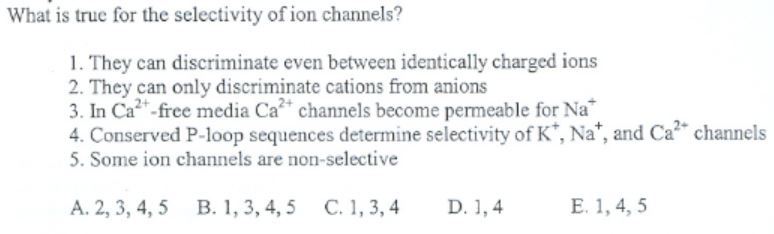
B: 1,3,4,5
(They never talked about it, but non-selective ion channels do exist.. unless our biochem department doesn’t believe in them. 1,3,4 are definitely true and were covered though.)
Which plasma membrane calcium ATPase is predominantly neuronal?
A. PMCA1
B. PMCA2
C. PMCA3
D. PMCA4
E. PMCA5
B. PMCA2
(During the lecture, I’m pretty she said we don’t need to know the specifics of this, yet it’s on past papers)

-
W1L1 Ion Channels, General (Dustin)28
-
MT2: Hemostasis19
-
W1L2 Molecular Diversity of Ion Channels (Dustin)48
-
MT1 PP Open Questions26
-
W2&3 Membrane Transports + Na/K ATP-ase (Dustin)41
-
W3 Cholinergic Neurotransmission (Dustin)30
-
W4 Noradrenergic Neurotransmission (Ben)58
-
WK5 Dopaminergic Transmission (Ben)25
-
WK5 Serotonergic Transmission (Ben)26
-
MT1 PP MCQ13
-
MT1: Mats Short Answers29
-
WK06L1 - Hemostasis (Ben)45
-
WK06L2 - Hemostasis II (Ben)41
-
WK07L1 - Hemostasis III (Ben)22
-
WK08L1 - Fibrinolysis (Ben)23
-
WK08L1 - Platelets + Endothelium (Ben)41
-
WK08L2 - Atherosclerosis (Ben)25
-
WK09L1 - Biotransformation I (Ben)38
-
WK09L2 - Biotransformation II (Ben)41
-
MT2 Hemostatic Abnormalities (Dustin)15
-
Shirley's Notes Molecular Biochem I (Ben)50
-
Shirley's Notes Molecular Biochem II (Ben)21
-
Final: Diseases + Their Causes (Ben)35
-
Final: AA Metabolism (Ben)42
-
Final: Co-factors, Mnemonics, etc. (Ben)28
-
Final: Rate-Limiting/Regulatory/Important Steps (Ben)14
-
Final: Purine Metabolism (Ben)20
-
Final: Pyrimidines + Deoxynucleotides (Ben)22
-
Final: Heme + Iron Metabolism (Ben)15
-
Final: All structures (Ben/Lukas)99
-
Final: Sem. 1 Essentials, Oncogenes + Signal Trans (Incomplete, Ben)11
-
Open Answers (Final)30
-
Midterm 2 Open Answers32
-
Some Test1.pdf Final Past Papers39
-
MT1 - Structures19



