What is Human Resource Management
A distinctive approach to employment mgmt. which seeks to achieve
COMPETITIVE ADVANTAGE
Through the strategic deployment of a
HIGHLY COMMITTED and CAPABLE WORKFORCE
Using an array of cultural, structural and personnel techniques
Name some of the activities involved in HRM
What is involved in HRM?
- Recruitment and selection
- Performance mgmt.
- Career planning
- Training and development
- Job evaluations, descriptions, policies, codes & ethics
- Compensation and benefits packaging
- Dismissals & terminations, legal and compliance
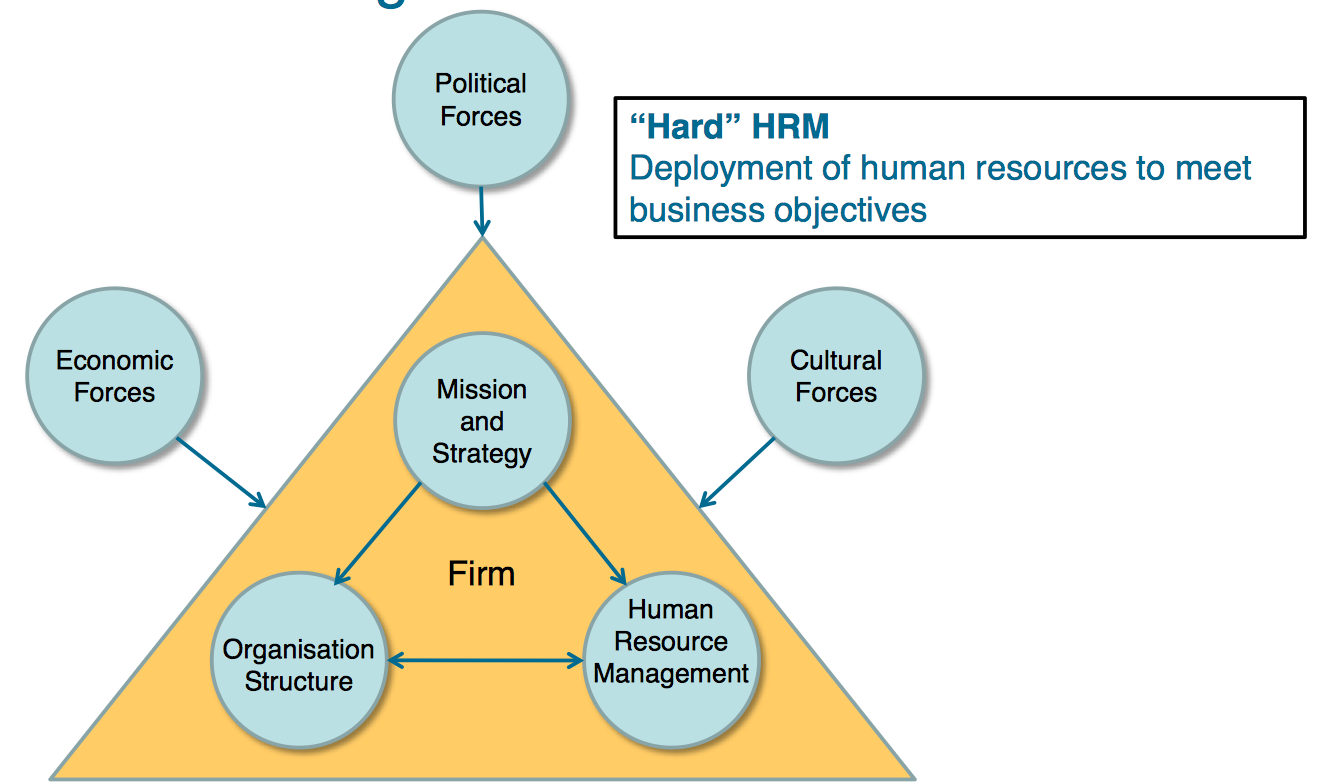
Explain the Matching Model of hard HRM
The Matching Model – Hard HRM
Hard HRM: Deployment of human resources to meet business objectives
- Selection of most suitable people to meet business need
- Appraisal, monitoring performance and providing feedback to organisation & employees
- Performance in the pursuit of business objectives
- Rewards for appropriate performance
- Performance in the pursuit of business objectives
- Development of skills and knowledge required to meet business objectives
Two assumptions underpin this model:
- The most effective means of managing people varies between organisations
- Conflict or at least differing views cannot exist in the workplace
Explain the Harvard Model of soft HRM
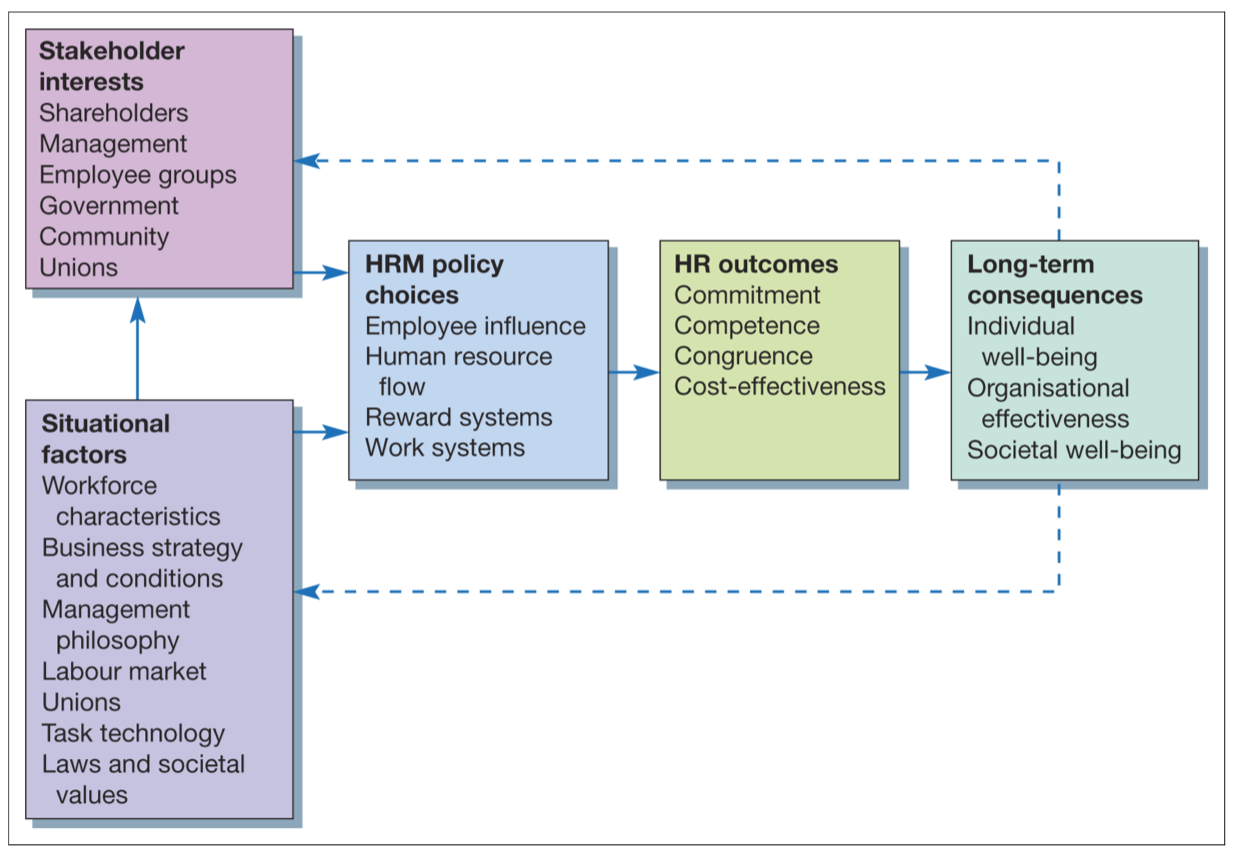
The Harvard Model of HRM – “Soft HRM”
Aimed at enhancing the commitment, quality and flexibility of employees
Stakeholder interests and situational factors impact HRM policy choices
Strategic Integration
- Ability to integrate HRM issues into strategic plans
High Commitment
- Behavioural commitment to pursue agreed goals
- Attitudinal commitment reflected in a strong identification with the enterprise
- Goals: (human wellbeing and societal commitment goals)
High Quality
- Of all aspects of managerial behaviour including investment in employees, which in turn affects the quality of products and services
Flexibility
- Adaptable organisational structure to manage and foster innovation
This assumes that it is possible to balance the strategic integration associated with ‘hard’ HRM with the ‘softer’ elements of high commitment practices.
What is an example of soft HRM
An example of soft HRM is the Starbucks College Achievement Plan
They pay for their employees’ (known as “partners”) tuition fees
Adds value to their employees, so that they can be promoted e.g. to head offices
Name the different strategic HRM perspectives
Best-fit
- Lifecycle
- Competitive Strategy
Resource-based view
- VRIO
- Core competency
Best-practice
- High-commitment “bundles”
NB in practice it is extremely rare to use just one of these first two perspectives, and instead all need to be considered when developing an HR strategy:
Where in the lifecycle are you?
What is your competitive strategy?
What is your core competency?
What rare qualities do you have in your people? etc. etc.
What is corporate strategy? Give examples
Corporate strategy:
- Identifies the portfolio of businesses that comprise the company
- Identifies the ways in which these businesses are related to each other
Examples of corporate strategies include:
Concentration
- The company offers one product or product line, usually in one market
Diversification
- The firm expands by adding new product lines
Vertical integration
- The firm expands up or down the supply chain
- E.g. producing its own raw materials, or selling its products directly to consumers
Consolidation
- The company merges two divisions into one
What is competitive strategy? Give examples
Competitive strategy
Determines the advantages that enable a company to differentiate its product or service from those of competitors
Examples of competitive strategies include:
Cost leadership
- The business seeks to become the low-cost leader in an industry
Differentiation
- Seeking to be unique in its industry along dimensions that are widely valued by buyers
- E.g. quality and service
Focus on niche markets
- Seeking to be innovative and creative
What is functional strategy?
Functional strategy
Identifies the basic course of action that each department will pursue in order to help the business achieve its competitive goals
Draw and explain the lifecycle model of strategic HRM
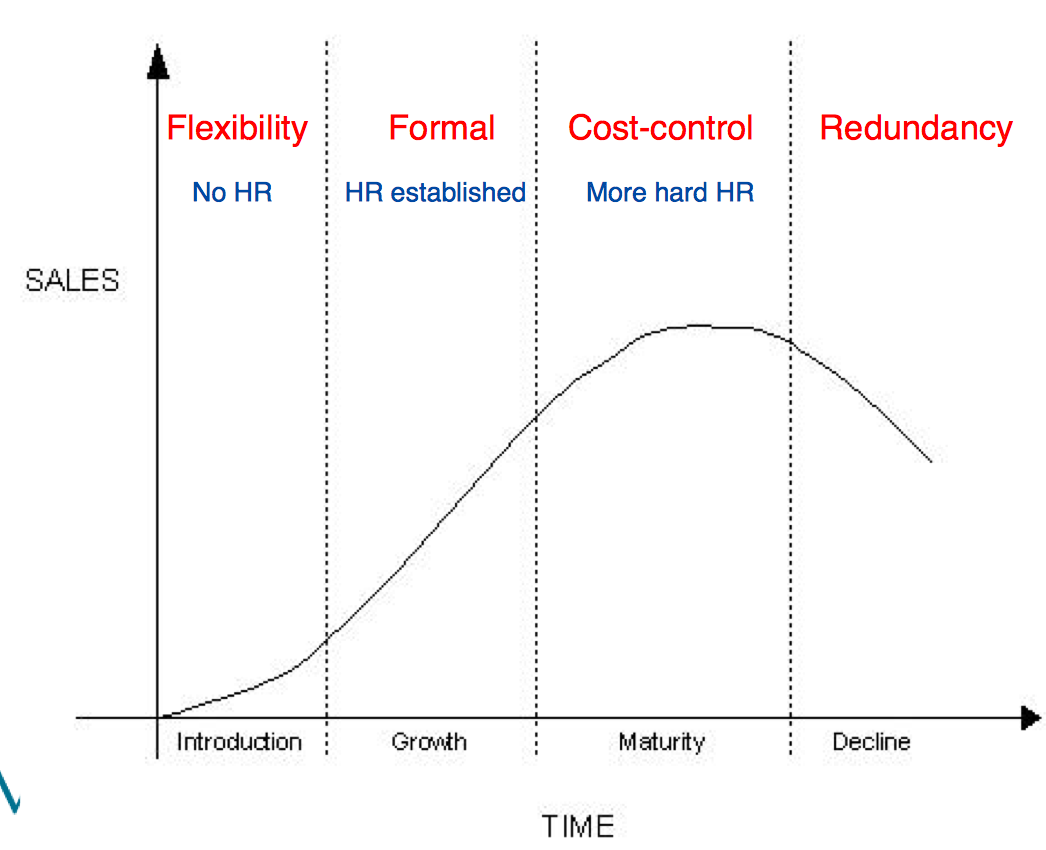
Lifecycle model:
Business and product lifecycle models can be linked to the selection and management of appropriate HR policies:
Start-up phase
- There is an emphasis on ‘flexibility’ in HR
- Enables the business to grow and foster entrepreneurialism
Growth stage
- Once a business grows beyond a certain size, emphasis moves to the development of more formal HR policies and procedures
Maturity stage
- As markets mature, margins decrease and performance plateaus, the focus of the HR strategy may move to cost control
Decline stage
- The emphasis shifts to rationalisation
- This has downsizing and redundancy implications for the HR function
What is strategic HRM?
Best fit models of SHRM focus on alignment between HRM, business strategy and the external context of the firm.
- They assess the extent to which there is fit between business strategy and HRM policies
- This is done by linking business goals to individual objective setting, and measuring and rewarding attainment of that business goal
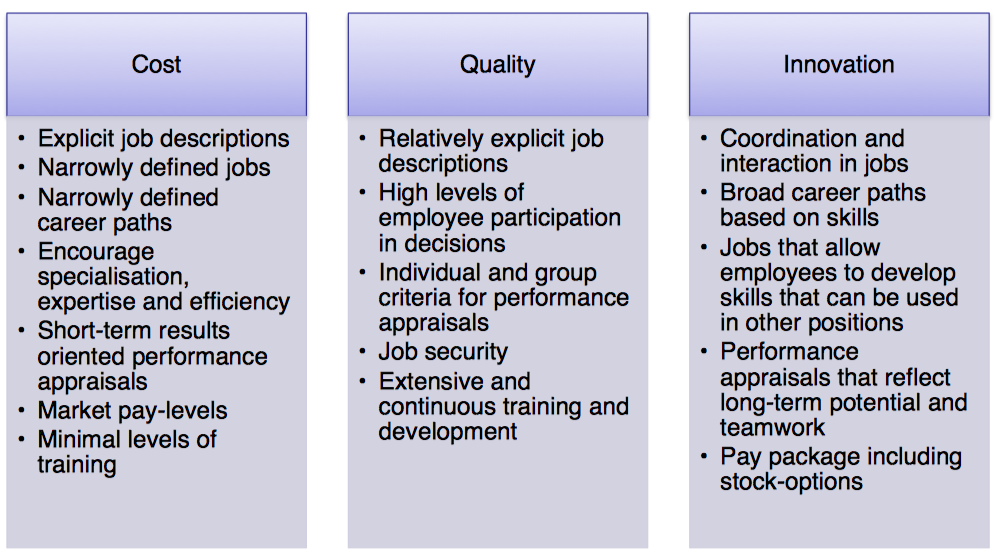
Draw and explain the competitive strategy of HRM
They defined HR policies and practices to ‘fit’ the generic strategies of cost reduction, quality enhancement and innovation
They argued that business performance will improve when HR practices mutually reinforce the organisation’s choice of competitive strategy.
- The ‘cost-reduction’-led HR strategy is likely to focus on the delivery of efficiency through mainly ‘hard’ HR techniques
- Contrastingly, ‘quality-enhancement’ and ‘innovation’ focus on the delivery of added value through ‘softer’ HR techniques and policies
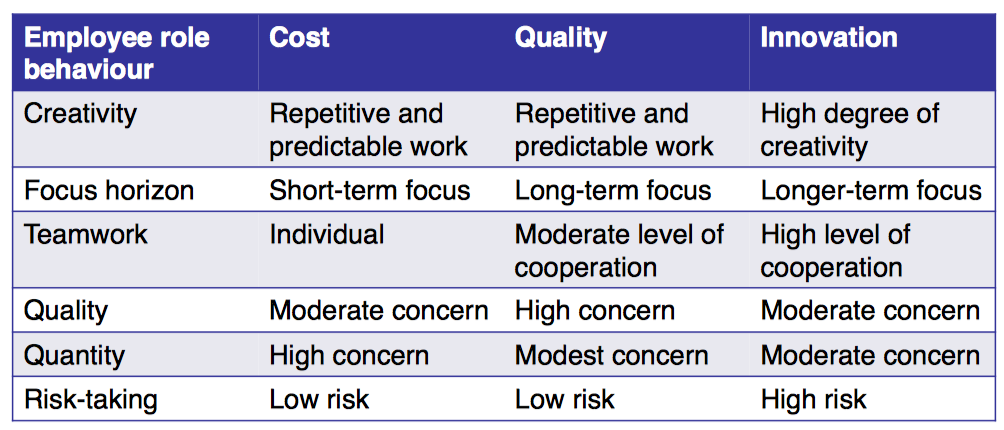
Explain how the following roles are affected in the different competitive strategies of SHRM.
Creativity, focus horizon, teamwork, quantity, quality and risk taking
Explain the resource based view of SHRM. What is the VRIO framework?
The resource-based view of SHRM explores the ways in which an organisation’s human resources can provide sustainable competitive advantage
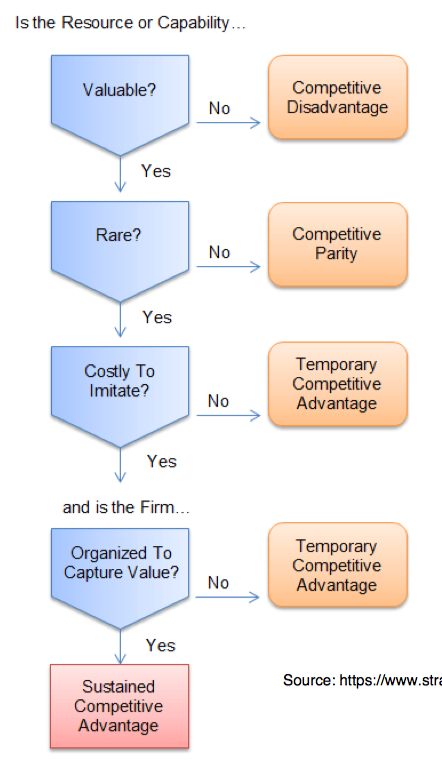
This is best explained by the VRIO framework, used to assess how much of a competitive advantage a firm has
- Value
- Rarity
- Imitability
- Organisation
Explain each of the different parts of the VRIO framework
Value
- How can the human resources function of a firm create value?
- Cost reduction (head count) vs. revenue enhancement (enhanced customer service)
Rarity
- What rare qualities do the human resources offer?
- How can the organisation capitalise on these qualities?
EXAMPLE: NORDSTROM
- Focus on individual salespeople as source of competitive ad. Pay twice industry average
Inimitability: if firms can imitate then these advantages are lost over time
- How can an organisation develop characteristics that are difficult to imitate
EXAMPLE: Southwest airlines
- Fun and trust culture that can’t be imitated, tough recruitment process
Organisational compatibility
- How can the business organise to build and exploit resources?
- Allows them to capitalise on the above
Why are resources hard to imitate?
- Historical conditions. Resources that were developed due to historical events or over a long period usually are costly to imitate
- Causal ambiguity. Companies can’t identify the particular resource that are the cause of competitive advantage
- Social complexity. The resources and capabilities that are based on company’s culture or interpersonal relationships
What are the different competitive advantage classifications associated with the VRIO framework?
Explain the core competency model of SHRM, give an example
Core Competency
A bundle of skills and technologies that enable a company to provide particular benefits to customers
- Not product specific
- Represents the sum of learning across individual skill sets and individual organisational units
- Must be competitively unique
- Is not an “asset” in the accounting sense of the word
- Represents a “broad opportunity arena” or “gateway” to the future
EXAMPLE: Dynamatics Technologies
started in gear pumps, high precision
core competency allowed them to move into aerospace components
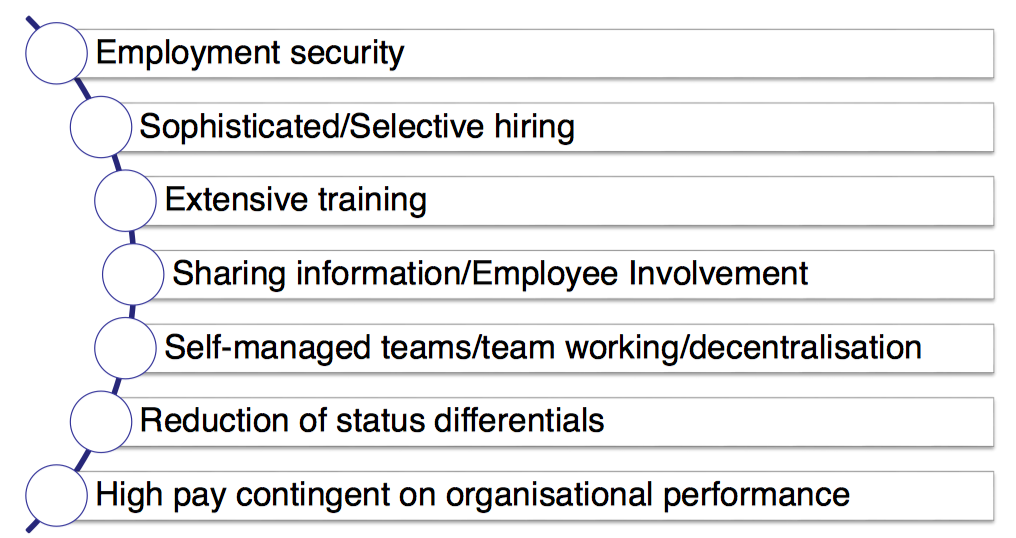
Explain the different aspects of best practice HRM
Best practice HRM: functional activities and strategic plans that result in enhanced organisational performance
Employment security
Sophisticated/selective hiring
Extensive training
Sharing information/employee involvement
Self-managed teams/team working/ decentralisation
Reduction of status differentials
High pay contingent on organisational performance
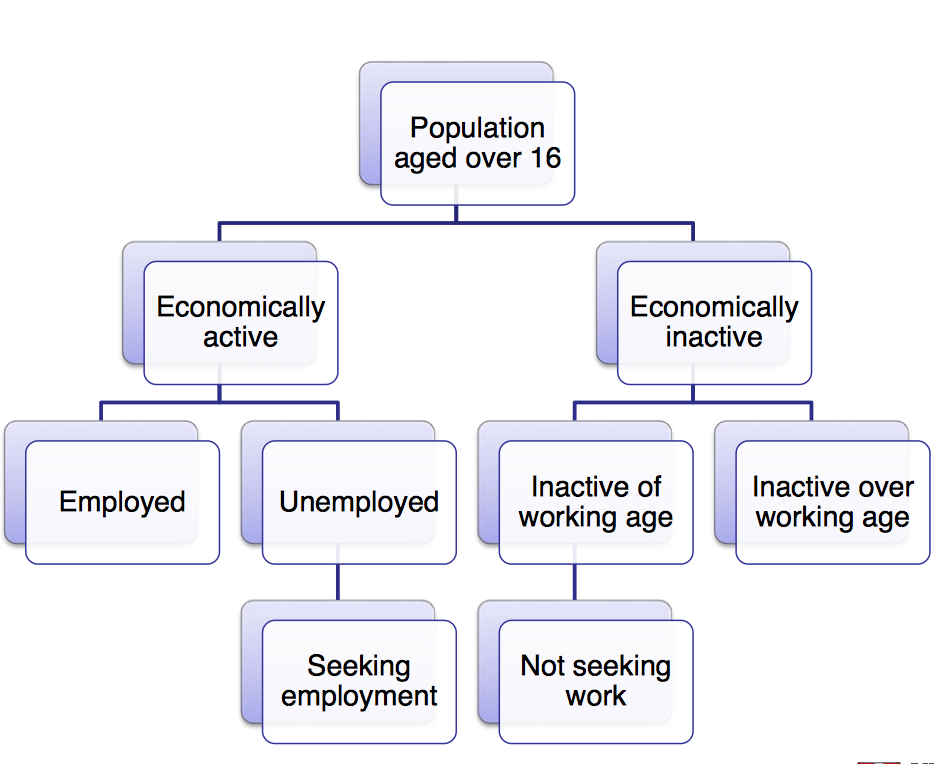
What is the workforce? What is it made up of?
The workforce is drawn from the segment of the population of working age
This ranges from 16 up to state retirement age
What is the talent paradox
The current talent paradox is that,
- Despite high unemployment,
- Many companies are facing shortages in the critical areas
- Where they most need to attract and keep highly skilled talent
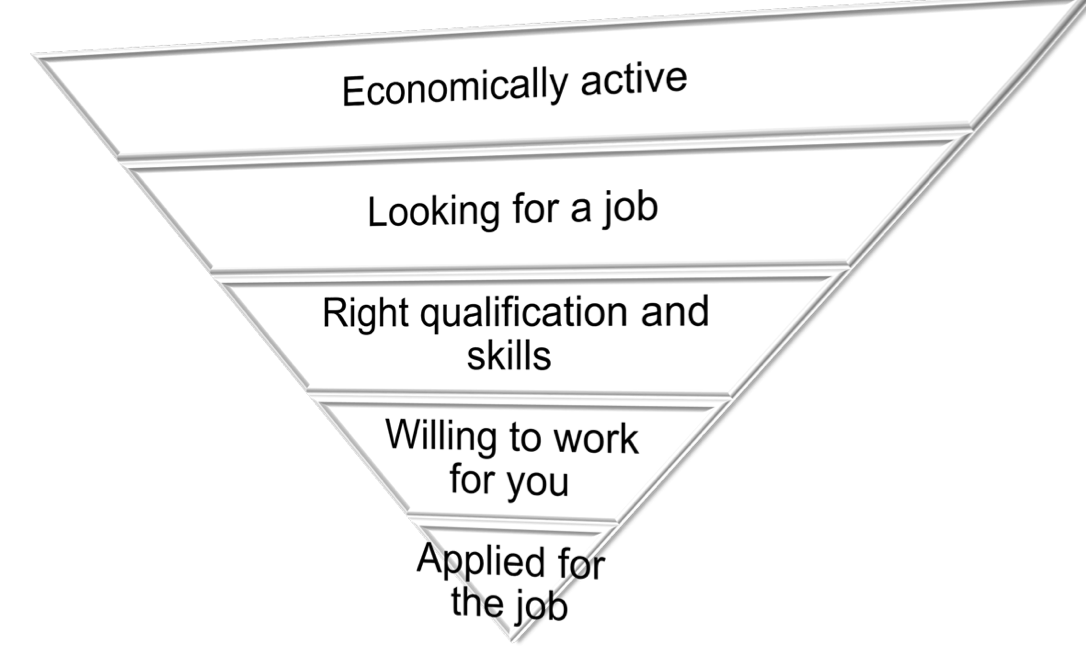
In other words, a surplus of jobseekers doesn’t mean that talent is available where and when it is needed
What are the different ways of assessing job quality?
The quality of jobs on offer in the labour market varies
Traditionally, economists have used PAY as the measure of job quality
- However, this may no longer be an appropriate measure
Social scientists have stressed the level of skill as a key measure
- Skilled work not only provides workers with better pay but also more variety, personal autonomy and involvement
Ultimately, it gives them more control over their effort
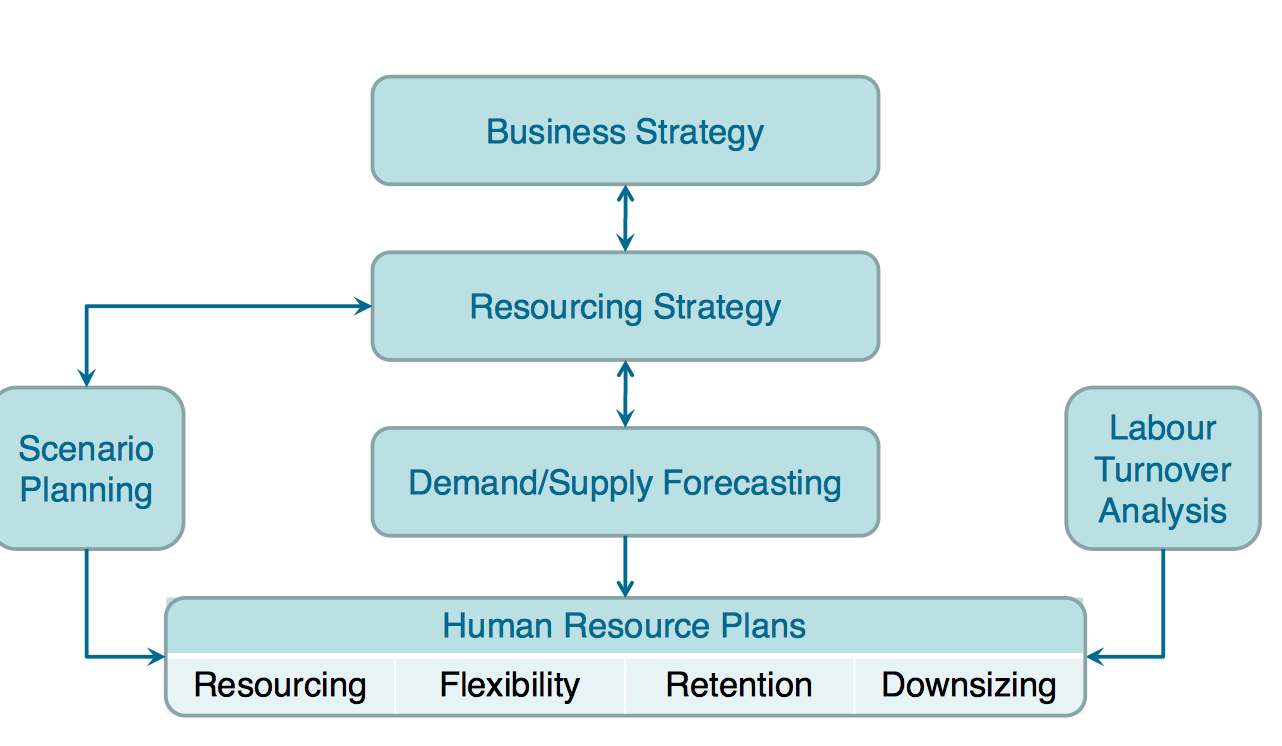
Show graphically how HR planning relates to strategy
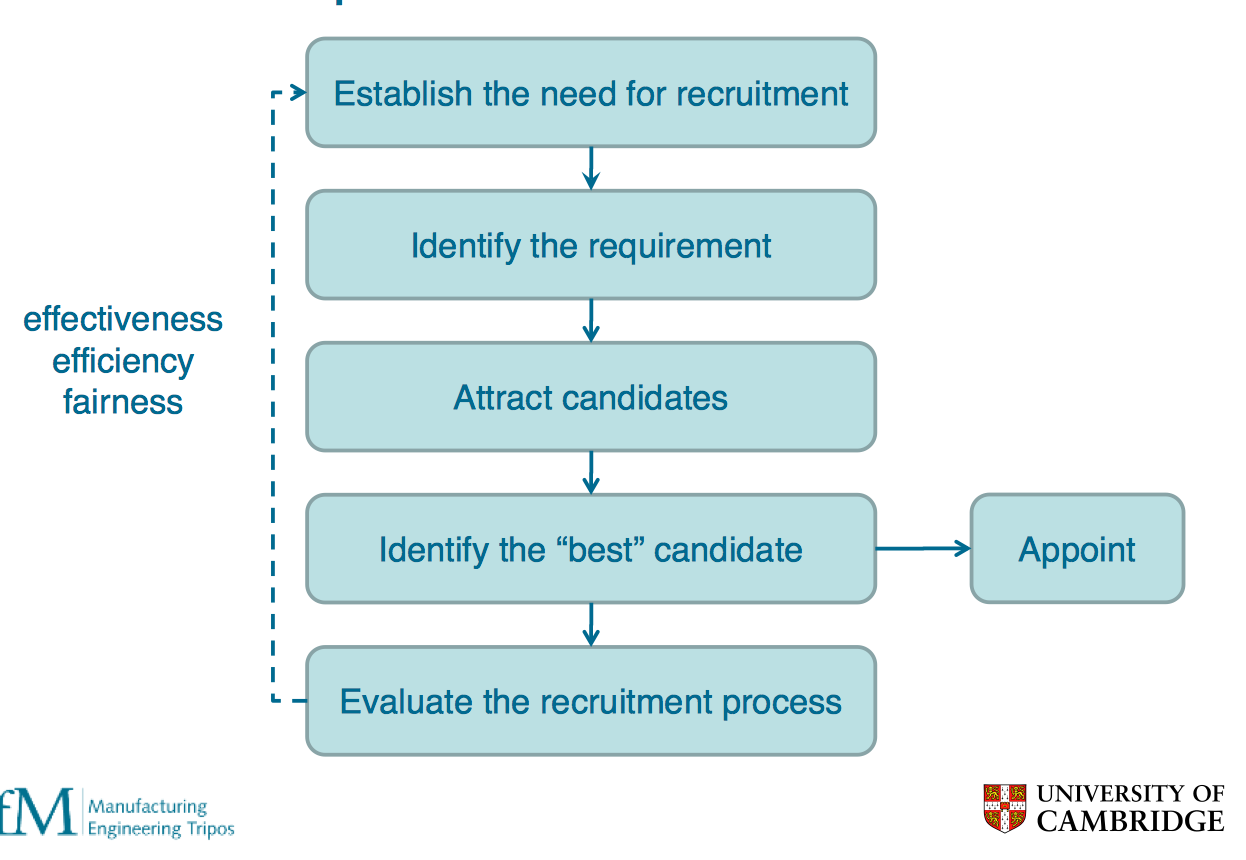
What are the different stages in the recruitment process
ESTABLISH THE NEED
IDENTIFY THE REQUIREMENT
ATTRACT CANDIDATES
IDENTIFY THE “BEST” CANDIDATE
EVALUATE THE RECRUITMENT PROCESS