What type of worms are Nematodes?
Tell me some general facts about them
Nematodes- round worms
- Intestinal round worm infections constitute the larges group of helminthic disease
- Tissue living filarial worms cause devastating disease e.g., River blindness
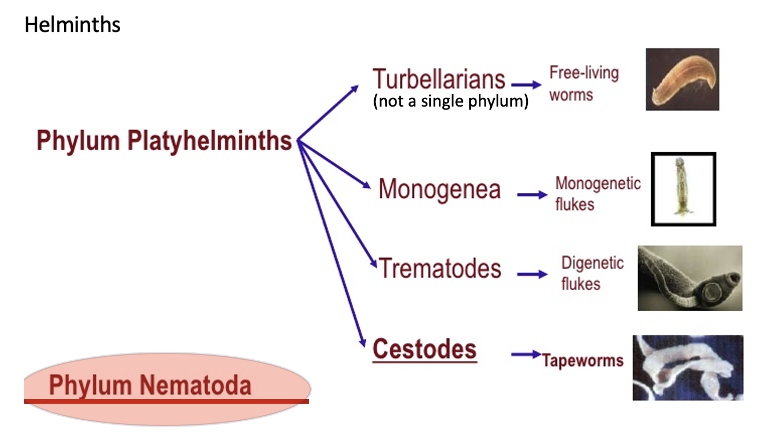
Tell me about the structure of nematodes
- Size-Adults vary from ~1mm to >Placentonema gigantissima (means basically giant worm of the placenta) (~10m)
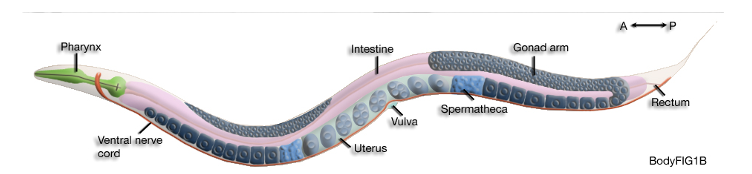
- Typically- dioecious (XX and XO) with sexual dimorphism cf C elegans (these are a great model to study for nematodes and anti-nematode)
(Males spicules to hold vulva open bursa in some males hold to female)
Tell me about the shedding of the nematodes and when this occurs?
Tell me how growth occurs
All show growth with shedding of a complex cuticle
– shedding occurs 4 times, sometimes 5 (as the egg could be viewed as one of the shedding stages)
- L1 to L4 to adult (L5)- only adult have formed gonads which are matured (microfilaria- differ, have a microfilarial stage…?)
- L5 is the sexually mature stage
- In adults any growth is by cellular hypertrophy (increase and growth of muscle cells) rather than hyperplasia (increase in the number of cells in an organ or tissue)
Tell me more about the nematodes structure
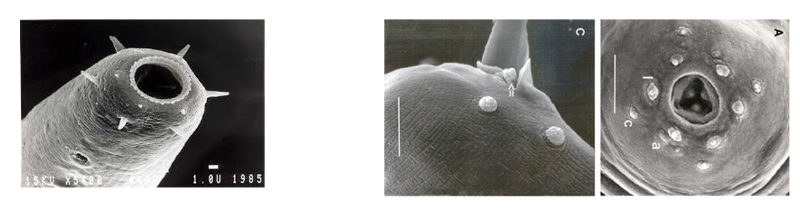
- Have usually a uniform cylindrical shape, with lips (0 to 6) opening onto a buccal cavity
- C elegans hermaphrodite (XX) and XO male, other species use XX female and XY male
- hardened structure in the wall that guides the protrusion of the spicule at copulation.[spicules open and dilate the vagina of the female and the gubernaculum is a plate which controls the spicules motion- useful for telling males and females and species apart;
- Pre L1 (prelarval- or embryo form)- in blood vessel dwellers known as a microfilaria – but this can be debated as some texts also call L1 microfilaria
- Nitrogenous breakdown products – lost as ammonia through cuticle, while more significant for excretory pore – ion balance
Nematodes usually lack holdfasts (cf cestodes and trematodes)
But instead, what do they have?
How does this work?
Nematodes- usually lack holdfasts (cf Cestodes and Trematodes)
But some have “teeth”- sit around pharynx so also suck through this
The GI tract is full and patent at both end- strong pumping oesophagus which changes between species and over life span of organism
Tell me about the muscular oesophagus in the nematodes
Muscular oesophagus – changes in shape between groups and in developmental stages -all have associated glands
Beyond the oesophagus valve the gut is a simple epithelial tube until the cloaca
Shape of oesophagus used to identify species and stage
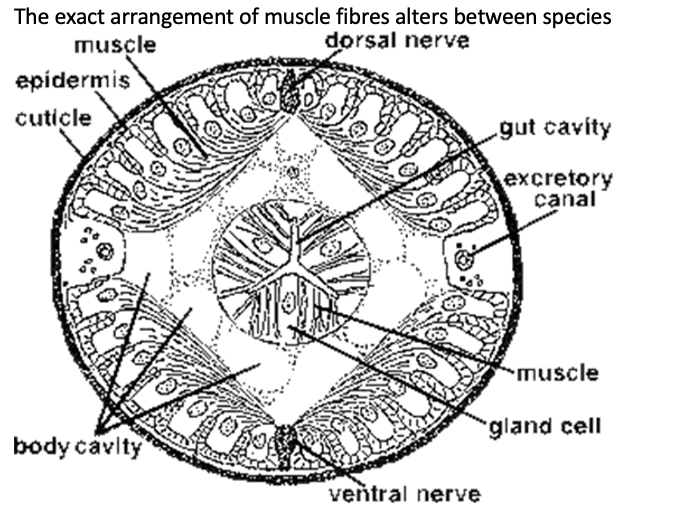
Hermaphroditic here – and sincytial hypodermis
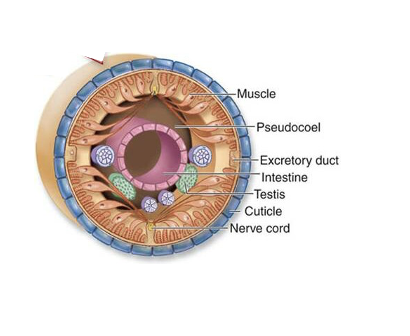
Full of fluid and acts as a skeleton of organism as helps to keep its structure
Excretory duct and channel which is important for ionic balance as opposed to nitrogenous balance
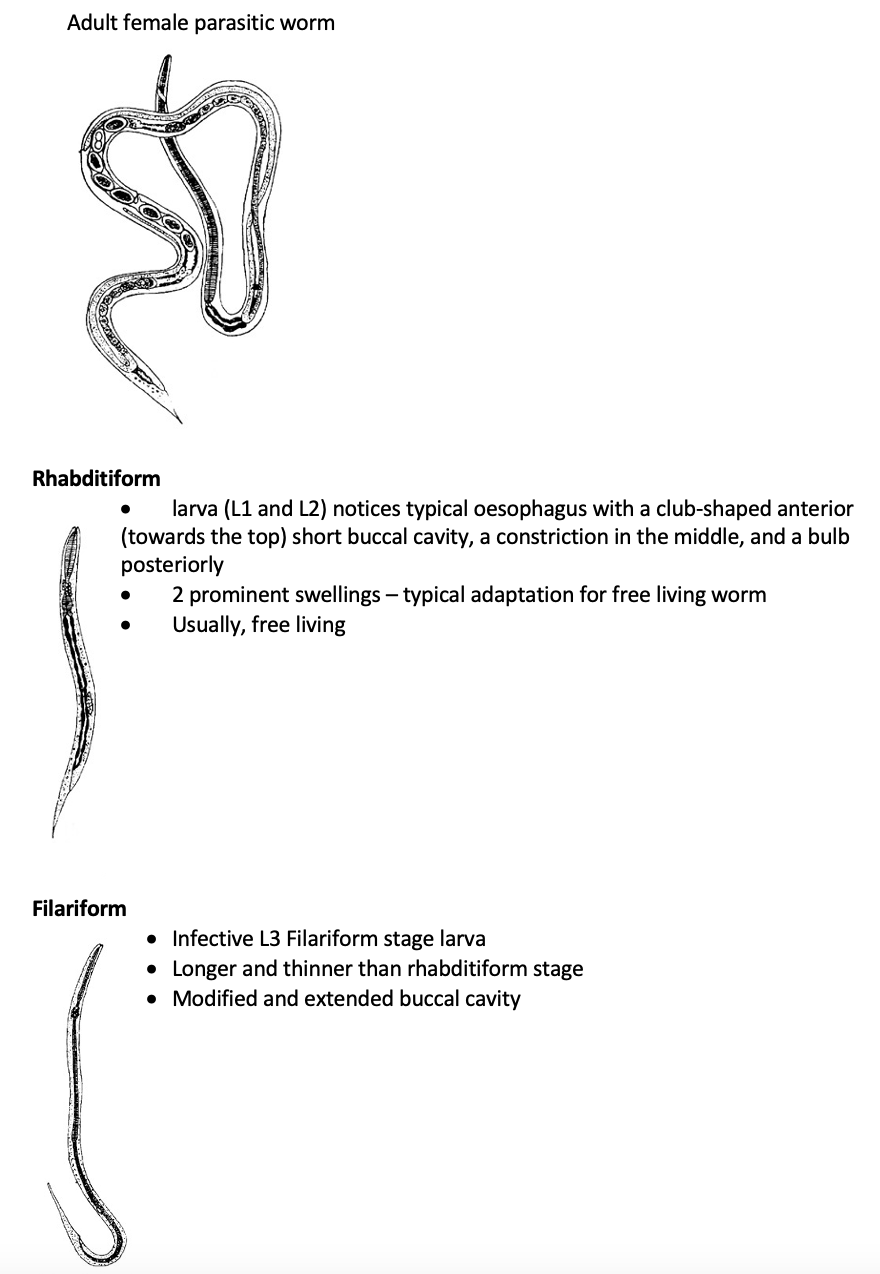
What are the different forms of the nematodes, describe their appearance and when this form is taken?
The exact arrangement of muscle fibres alters between species
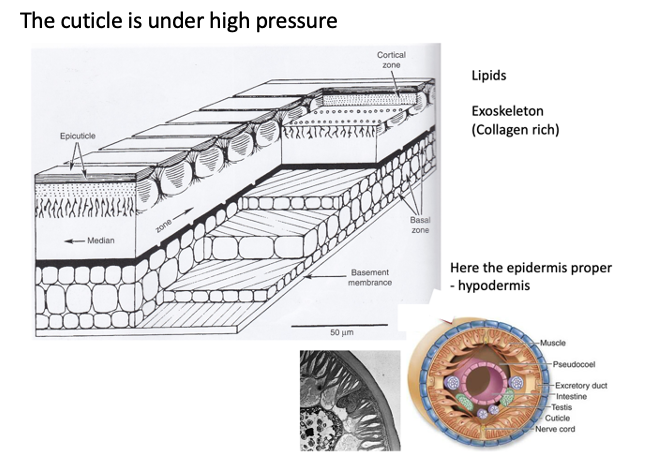
The cuticle is under high pressure
Over 100 collagen forms- in cuticle- far more than mammals
Cells below basement membrane which produce that membrane (this is a mirror in humans as they have the other way round)
30 collagen tubes?
Tell me about the Pseudocoelom
Between the somatic muscles and the GI tract
Non compressible fluid – i.e., a hydrostatic skeleton
No circulatory system – but haemolymph acts to transport solutes
Some forms have a defined excretory system but most loss of nitrogenous waste is via diffusion over cuticle
Is under pressure and if damaged will burst
Tell me about the nervous system of the nematode
Formed predominantly from a nerve ring about the oesophagus / pharynx
C elegans 20 neurons innervate the pharynx and organise a ring shape structure, 282 somatic neurons
Dorsal/ Ventral and smaller lateral nerves innervating glands, rectum/ cloaca/ muscles (former) receive input from touch and chemoreceptive cilia, papillae, and bristles
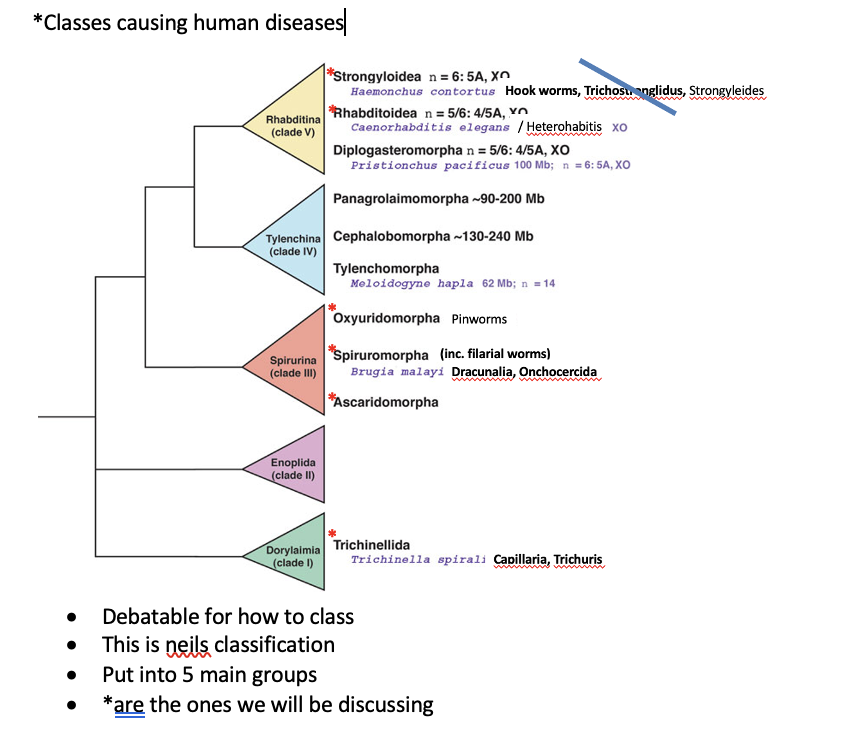
Classes causing human disease
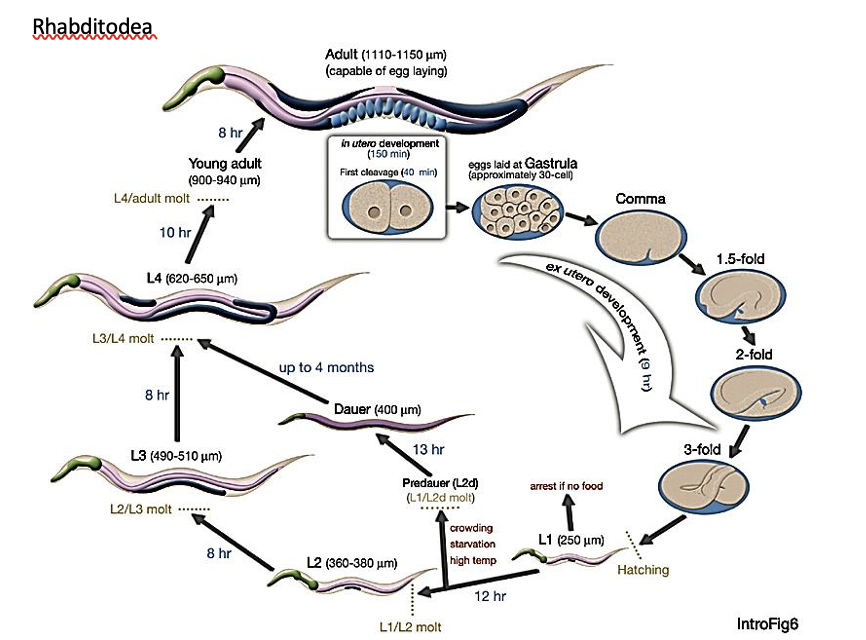
What is the life cycle of the Rhabditodea?
What is the timing of the cycle based on?
What are some signals?
Timing based upon C elegans - Egg dauer stage- diapause
Signals such as temperature, food supply, and levels of a dauer-inducing pheromone, a population density cue,
- Egg (L1) and L3 hardiness
- Inutero development –> hatching occurs in around 10-11 hours
- Then can stay in resting state where it can survive for several weeks
- Usual cycle is L2–> L3
- L4–> L5 in host
- Then mature as L5 sexually then reproduce
What does the Rhabditodea (Rhabditina) Class contain?
Rhabditoidea (C elegans and others- free living or parasitic)
Strongyloides (mostly parasitic worms)
This class contains the widest selection of nematodes- many are free living non parasites
some are obligate parasites and some facultative parasites
C elegans is a member of the group
Heterorhabditis … obligate parasites of insects, used as biological control agent
What does the nematode carry and what does this cause?
The nematode carries a toxic bacterium Photorhabdus luminensces which kills the grub
- Causes a colour change
- Causes fluorescence- prevents eating by predators
- Causes chemical releases
What is Strongyloidea?
Superfamily of worms mainly GI worms of herbivores (generally 2 sexes and oviparous)
Give an example of a Strongyloidea
Eg Haemochonchus contortus (sheep- v high losses, if infected it will kill sheep)
However, Human Hookworms* are part of this family
- Ancylostoma duodenale*
- Necator americanus*
*Don’t need to know these two names but it would be good if we did
Whats the life cycle of the Strongyloidea?
Blood sucking GI worms
Tell me about the stages of the Rhabditodea and what this means
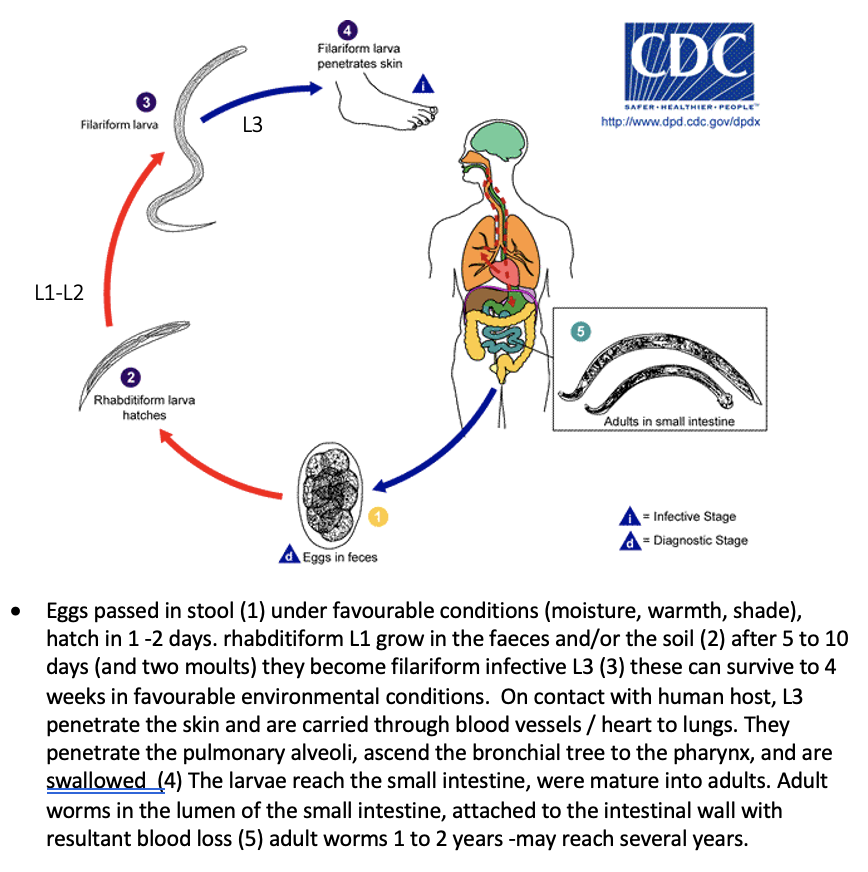
L1 and. L2, the feeding non-infective rhabditoform stage, feed on soil microbes L3 the filariform stage is the non-feeding infective form of the larvae.
The filariformL3 larvae highly motile non feeding, and migrates up through soil.
Tell me about how the Rhabditodea infects their host?
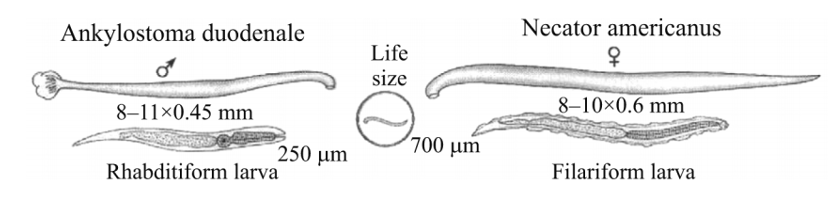
Infect host through skin penetration (rare ingested) usually from soil with faecal contamination.
Larvae enters the vascular system (Blood Vessels and lymphatics)
carried to the lungs (see later)
and coughed or passed in cilia up the trachea
are swallowed and attach to the small intestine
where the larvae L3- mature to adult worms L5 (~ 1cm long- but can have infections of 1000s and each removed ~0.3ml blood per day)
- Necator infection, >5 years
- Ancylostoma ~ 6 months.
Long term infection. Don’t need to know exact times just that its long term
(However, L3 may encyst during body migration- give longer infection)
They mate inside the host, females laying up to 30,000 eggs per day, in warm conditions eggs develop in ~10 days to L3
Infection is usually asymptomatic with hookworm disease but what can it cause?
- Allergic reaction at the sire of parasitic penetration
- Migratory phase cough/ pneumonia
- Diarrhoea and GI colic
What can a high infection with hookworm disease lead to?
However high infection levels may cause chronic disease iron deficiency, anaemia, and protein malnutrition in children causes growth retardation and cognitive impairment.
Tell me about Translactation and Transplacental infection with hookworm disease
Skin-invasive larvae may migrate around the body via the circulation, to become dormant inside muscle fibres.
They may reactivate and re-enter the circulation (very common during pregnancy presumably by sudden hormonal changes), pass into the mammary glands and through its mother’s milk (cf canine infection). Explains heavy, hookworm infections very young children. (May also show transplacental infection – also observed in other species
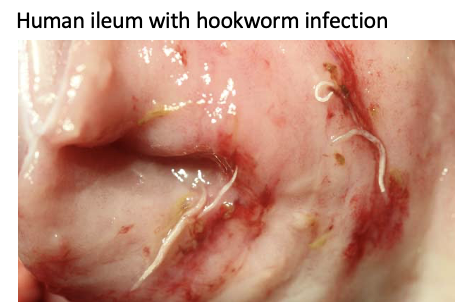
Human ileum with hookworm infection


-
Introduction and classification and cost of parasites68
-
Parasite diversity and Biodiversity31
-
Parasite- Host interactions35
-
Trematodes and Cestodes71
-
Introduction to Platyhelminths and Schistosomes58
-
Nematodes92
-
Using model organisms to facilitate advances in medical parasitology18
-
Protozoal parasites91
-
Toxoplasmosis27
-
Malaria Biology43
-
Malarial treatment and control68
-
Arthropods/ Ectoparasites73
-
Lice, Ticks and Lyme disease27
-
Origins and drivers of parasitism37
-
Insect control53
-
Future challenges and opportunities in a changing world45
-
Platyhelminths20
-
Nematodes19
-
Protists19
-
Arthropods6
-
Insect control3
-
Life cycles to learn24
-
Leishmania4



