List the disorders associated with Nephritic Disorder
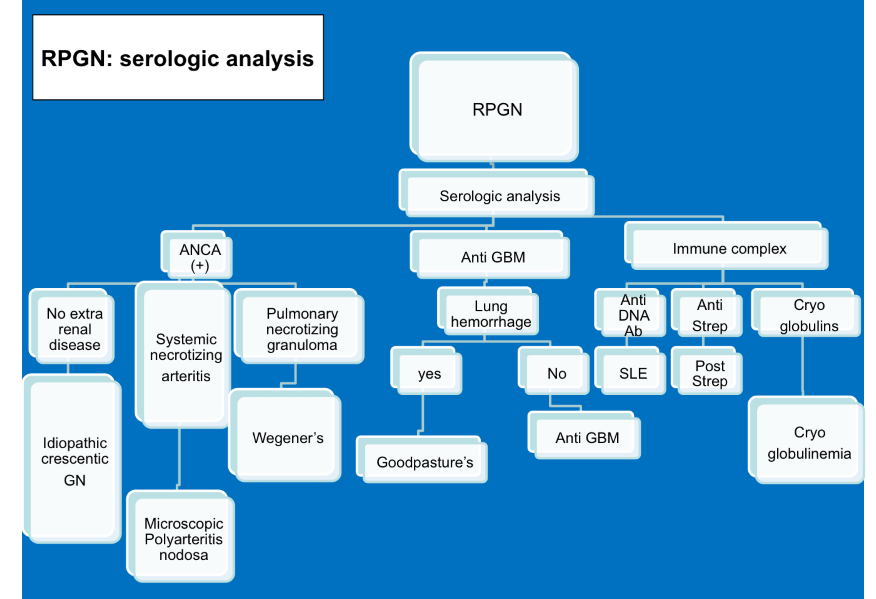
Normal complement levels
- IgA Nephropathy/Henoch-Schonlein Purpura
- SLE (Class I, II, V)
Low complement levels
- Post infectious (Post Streptococcal) Glomerulonephritis
- Membranoproliferative Glomerulonephritis
- SLE (Class III, IV)
Varable complement
- Rapidly Progressive Glomerulonephritis
IgA Nephropathy/Henoch-Schonlein Purpura (Clinical Presentation)
- This is the most common type of Glomerulonephritis and may present at any age (peak in 20/30 yyer-olds).
- Greatest incidence in Asians & Caucasians and rare in blacks
- Presents with episodes of gross hematuria (associated with viral respiratory illness or GI illness) with persistent microscopic hematuria between these episodes
- Usually non-nephrotic range proteinuria (<3.5gm/day) and normal C3/C4
- Generally a prolonged benign course, BUT ~20% patients will progress to ESRD
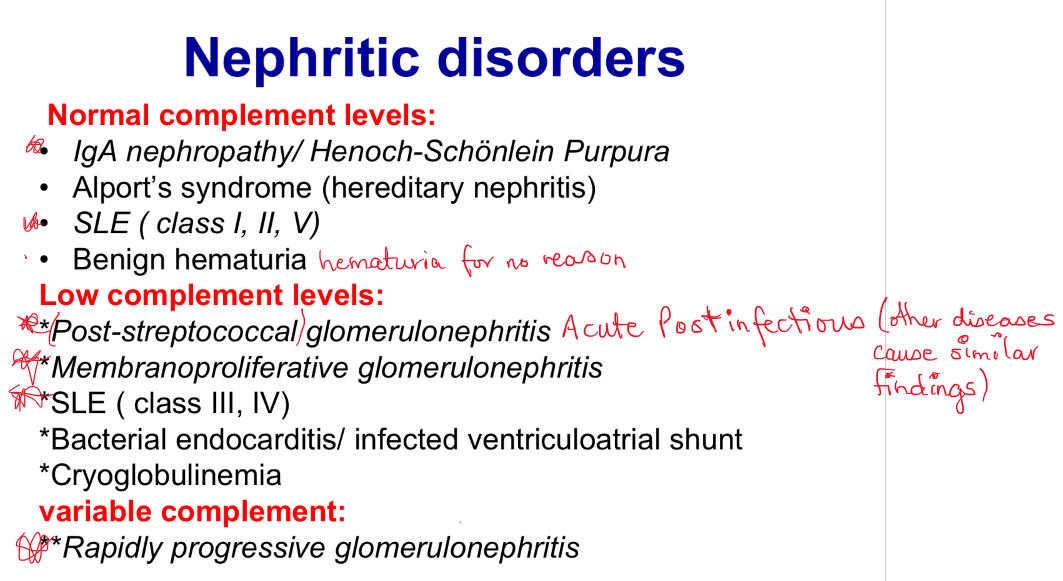
- Most cases of IgA nephropathy are clinically restricted to kidney or associated with arthritis, vasculitis, nonthrombocytopenic purpura (Henoch-Schönlein- Purpura) {HSP}
IgA Nephropathy/Henoch-Schonlein Purpura (Pathogenesis)
Production of IgA IC ( predominately polymeric IgA1 subclass, which is mainly derived from the mucosal immune system)
Supported by clinical observation that hematuria worsens during URI or GI infections
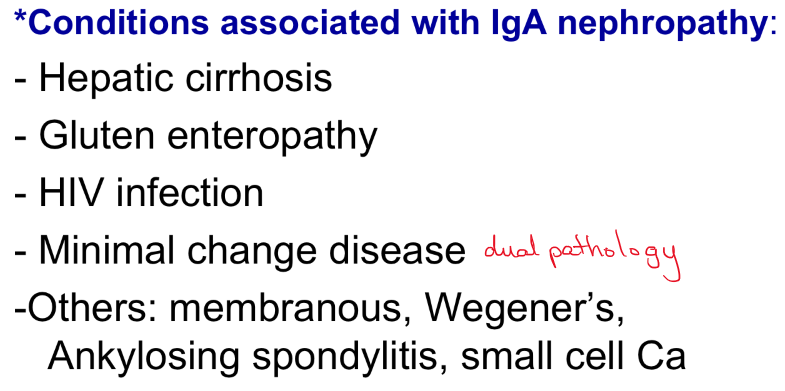
Most likely due to deposition of circulating IgA ICs with subsequent activation of complement { supported by finding of granular deposits of IgA and complement (C3) in the glomerular mesangium on IF
IgA Nephropathy/Henoch-Schonlein Purpura (Pathology)
LM: Segmental areas of increased mesangial matrix & hypercellularity
IF: Mesangial and subendothelial deposits of IgA & C3 (+/- IgG, IgM)
EM: Mesangial and Subendothelial deposits
Post infectious (Post Streptococcal) Glomerulonephritis (Clinical Presentation)
Post infectious (Post Streptococcal) Glomerulonephritis (Pathogenesis)
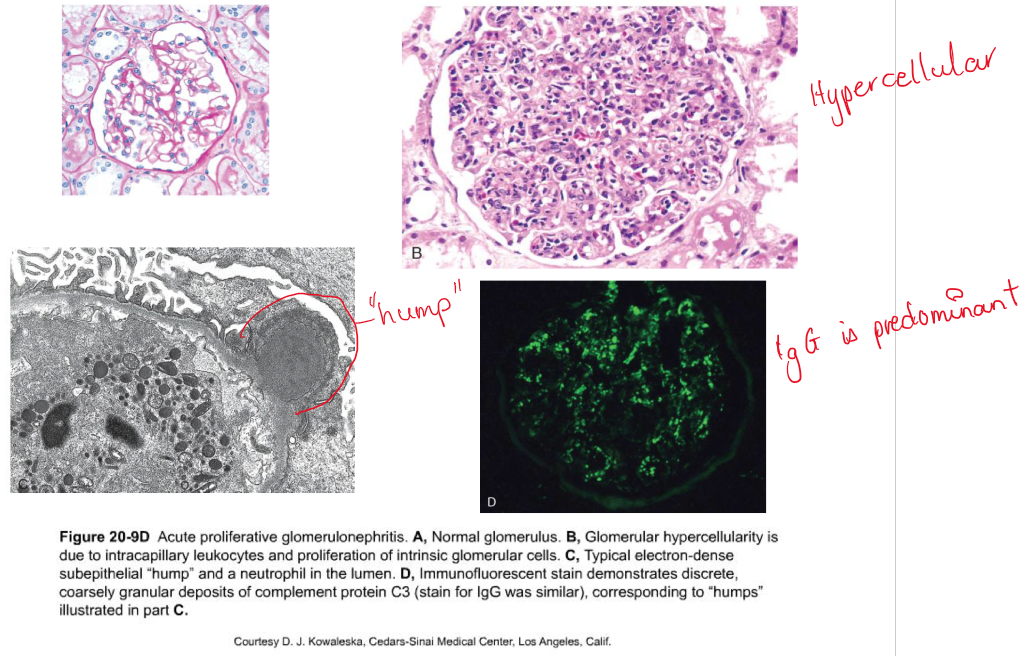
Post infectious (Post Streptococcal) Glomerulonephritis (Pathology)
LM
- Hypercellular glomeruli (neutrophils + monocytes)
- Proliferation of mesangial, endothelial, epithelial cells.
- Process is diffuse (entire lobules of all glomeruli)
Closure of capillary loops due to: proliferation & swelling of endothelial cells & leukocytes infiltration
IF: granular deposits of IgG & C3 in the mesangium & along capillary walls
EM: electron dense deposits in subepithelial space “ humps”.
Membranoproliferative Glomerulonephritis (Clinical Presentation)
Glomerular disease characterized by: thickening of basement membrane, mesangial proliferation, infiltration of inflammatory cells
Can be primary (idiopathic) or secondary (underlying systemic disorder)
- Type I: most common type
- Idiopathic rare
- Secondary forms are more common
Evaluate patient for underlying diseases (for sec causes):
- Lupus
- Hepatitis C
- Cryoglobulinemia
- Endocarditis
- Parasitic infection
Usually presents before age 30 in one of 4 ways:
1-Hematuria or proteinuria discovered on urinalysis
2-Acute nephritic syndrome with hematuria HTN and edema
3-Recurrent episodes of gross hematuria
4-Insidious onset of edema and nephrotic syndrome -
Most progress to ESRD within 10-15 years
Membranoproliferative Glomerulonephritis (Pathogenesis)
- Complement activation via the classical pathway in Type I disease
- Via alternate pathway in Type II disease,
- C4 levels may be normal but C3 remains depressed for prolonged periods due to C3 nephritic factor (IgG molecule that binds to and stabilizes C3bBb convertase allowing for continuous degradation of C3)
Membranoproliferative Glomerulonephritis (Pathology)
- 3 major types: have the same pattern of injury seen on LM findings BUT are differentiated on the basis of EM & IF findings:
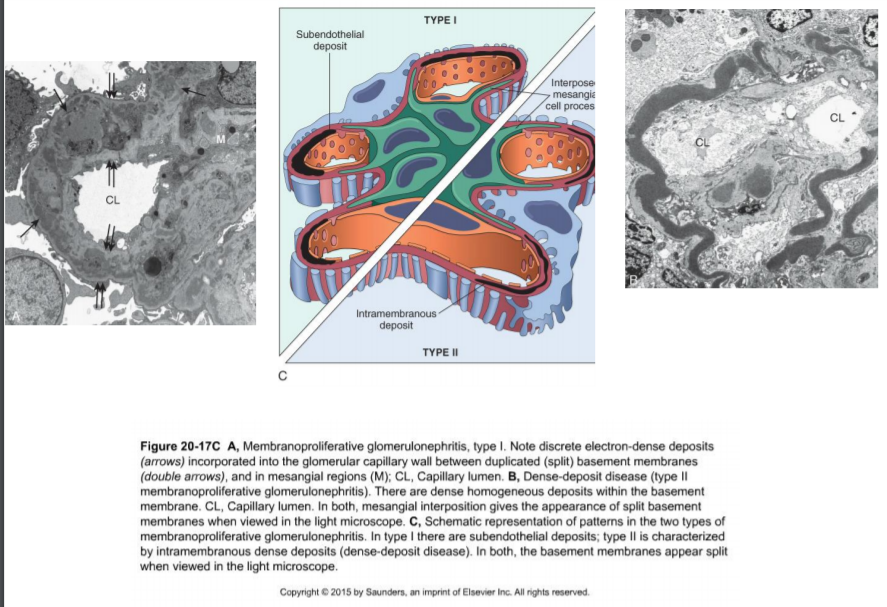
LM: mesangial expansion & hypercellularity “Thickening of the peripheral capillary loops due to double contour formation “ tram track” = duplication of GBM”
EM:
Type I: subendothelial deposits (C3 +/- IgG, C1q, C4)
Type II: deposition of dense material along GBM (unknown composition)-(C3 + BM - (not in deposits) & IgG , C1q, C4 absent)
Type III: subendothelial, mesangial, subepithelial deposits (C3 +/- IgG)
Rapidly Progressive Glomerulonephritis (Clinical Presentation)
“A group of disorders associated with rapid decline in renal function with associated severe oliguria & if untreated death from renal failure within weeks to months”
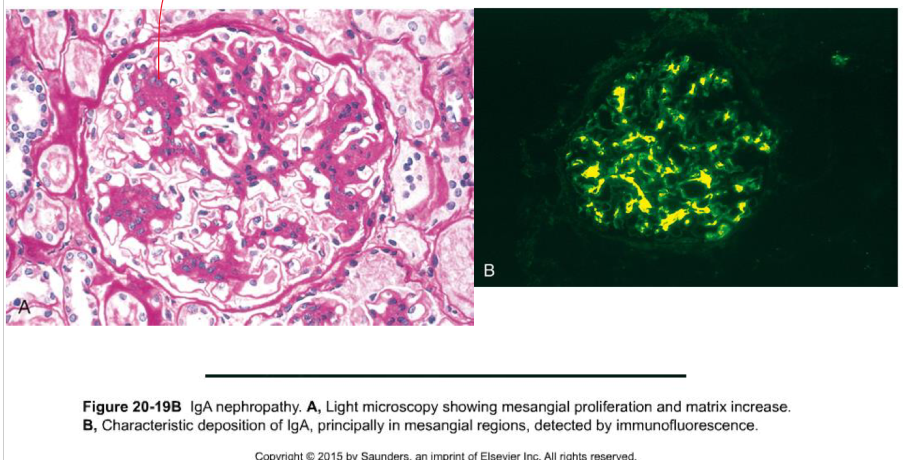
** Renal biopsy & serologic analysis are indicated for diagnosis: ** sub classified in to 3 types ( I, II, III)
*Clinical presentation is somewhat variable Common denominator in all types of RPGN is severe glomerular injury:
- Proteinuria (non-nephrotic), hematuria, red blood cell casts, hypertension, edema, variable degree of oliguria
- Overall 75% die or are placed on dialysis within 2 years of diagnosis
- Best prognosis is seen in those with a treatable underlying disorder (such as SLE) or one that spontaneously remits (such as post-strep)
Rapidly Progressive Glomerulonephritis (Pathogenesis)
Rapidly Progressive Glomerulonephritis (Pathology)
Histologically (LM): characterized by a proliferative GN with prominent “crescent” formation in 30-70% of glomeruli and +/- segmental necrosis “The histological picture is the same regardless of the cause”
The crescents evolve from cellular to fibrocellular to fibrous crescents